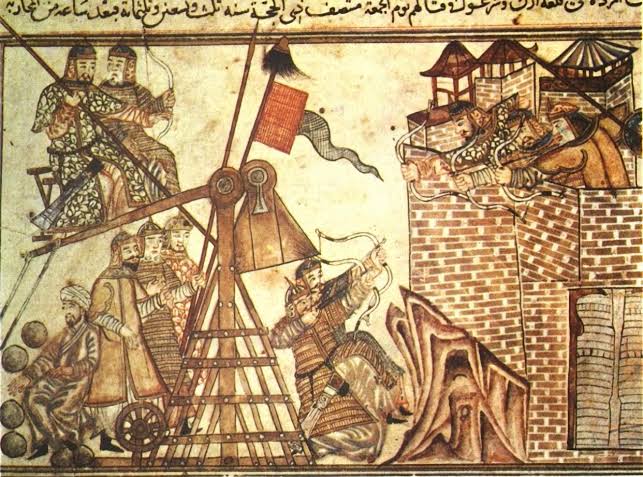
In 1346, outside the walls of the Genoese port of Caffa on the Crimean coast, an army of the Golden Horde was itself besieged by disease. According to one famous medieval account, the attackers loaded plague-stricken corpses into siege engines and hurled them over the walls. The defenders removed the bodies, ships later sailed west, and the Black Death entered Mediterranean history. It is one of the most chilling stories ever told about warfare and epidemic disease.
It is also less certain than confident retellings suggest. The corpse bombardment is described by a writer who was probably not present. Plague biology makes some routes of infection more likely than others. Most importantly, even scholars who accept that the attack occurred do not generally treat it as the single cause of Europe’s pandemic. The Siege of Caffa matters because it sits where commerce, Mongol power, medieval warfare, and the movement of disease met.
Where Caffa stood in the medieval world
Caffa, now Feodosia in Crimea, occupied a sheltered position on the Black Sea. Genoa established its settlement there in 1266 through an agreement with the Golden Horde, the western part of the Mongol imperial world. It was not an isolated European outpost. It belonged to a region in which Mongol rulers, Italian merchants, Greeks, Armenians, Jews, Turkic peoples, and others traded and competed.
Its value came from connections. Ships linked Caffa to Constantinople and the Mediterranean, while coastal traffic led toward Tana at the mouth of the Don. River and overland routes extended toward the Golden Horde’s centers and farther into Eurasia. Grain, fish, wax, furs, silk, spices, enslaved people, and other goods passed through Black Sea markets. Caffa was a transfer point between maritime and land-based systems rather than the end of a single “Silk Road.”
By the 1340s Caffa was again a fortified commercial center. Its walls offered protection, and sea access made complete blockade difficult. Those advantages explain both why displaced merchants sought refuge there and why Khan Jani Beg could not easily force its surrender.
How a street fight became an international siege
The immediate conflict began at Tana in 1343. Accounts describe a quarrel between Italian merchants and local Muslims that escalated into violence and a killing. Jani Beg, khan of the Golden Horde, intervened against the Italians. Merchants fled from Tana to Caffa, carrying a local dispute into a wider confrontation over jurisdiction and commercial privilege.
The Golden Horde’s forces besieged Caffa in 1343–1344. The defenders could receive supplies by sea, while Italian ships attacked or disrupted the besiegers. Later narratives offer impressive figures for Mongol losses, but such numbers are not supported by modern muster records and should not be repeated as exact facts. The first phase failed to break Genoese control. Jani Beg lifted the siege, then renewed pressure in 1345.
Trade continued to shape the war. Italian naval power could restrict ports, and the colony retained a route to outside aid. Jani Beg’s forces dominated the land approaches but struggled to seal the sea. The siege became an extended contest of endurance—until an enemy neither army understood transformed it.
Plague reaches Jani Beg’s army
During the renewed siege, a lethal epidemic struck the Golden Horde’s forces. The reported symptoms, especially swellings in the groin or armpit followed by fever and rapid death, are consistent with bubonic plague. Genetic research has confirmed that the fourteenth-century pandemic was caused by Yersinia pestis, a bacterium maintained in animal reservoirs and commonly transmitted to humans through infected fleas.
How the epidemic reached the army cannot be reconstructed in detail. Plague was moving through Eurasian ecological and commercial networks before it appeared at Caffa. Soldiers, merchants, pack animals, food, textiles, rodents, and fleas created repeated opportunities for transmission. A large encampment dependent on stored supplies could be vulnerable once infected rodents and their parasites were present.
The epidemic was severe enough to help end the siege. The harder question is what the besiegers did next. Here the story depends above all on one writer, Gabriele de’ Mussi, whose vivid narrative shaped nearly every modern retelling.
Gabriele de’ Mussi and the only detailed account
Gabriele de’ Mussi was a notary from Piacenza in northern Italy. His account of the plague was probably composed in 1348 or early 1349, close to the catastrophe it describes. The original is lost; the text survives in a later fourteenth-century manuscript copy. De’ Mussi begins in the East and eventually describes suffering he knew in Piacenza.
Older historians sometimes assumed that he had been present at Caffa. Documentary and textual evidence makes that unlikely. Notarial records place him in Piacenza during much of the relevant period, and his wording separates eastern events from things he says he personally witnessed in the West. He may have heard merchants or sailors returning through Italian networks, but we cannot identify his informants.
According to de’ Mussi, plague devastated the besieging army. The attackers then put corpses in throwing machines and projected them into Caffa, hoping the stench would kill those inside. Defenders allegedly cast bodies into the sea, yet disease spread, and infected sailors later carried the pestilence west. The account combines recognizable symptoms with medieval ideas about corrupted air, contagion, providence, and punishment.
This is valuable evidence, not courtroom proof. It is near the event and technically possible, but secondhand and uncorroborated by another detailed account of the bombardment. Responsible history therefore uses conditional language: the corpse attack may well have happened; it cannot be presented as independently confirmed.
Could bodies really be thrown over the walls?
Large counterweight trebuchets could throw heavy objects over substantial distances. Siege armies used them to damage walls, terrify defenders, and project unpleasant material. Dead animals, human remains, and refuse appear in accounts from other conflicts, although individual stories vary in reliability. Placing a corpse or parts of one in a throwing sling was not beyond fourteenth-century engineering.
Medieval people knew nothing of bacteria or fleas, but ignorance of microbes did not mean ignorance of contagion. Communities observed that illness clustered around sick people, clothing, households, ships, and decay. They also believed that corrupt air caused disease. Hurling infected bodies made sense within that mixture of observation and miasmatic theory.
The alleged act can be called biological warfare in a broad sense because disease material was deliberately used against an enemy. It should not be imagined as a scientifically designed weapon. The attackers could not culture bacteria, control dose, predict incubation, or protect themselves. If it occurred, it was a desperate, indiscriminate expedient during an epidemic already beyond anyone’s control.
How plague actually spreads
Bubonic plague usually reaches humans through a flea carrying Yersinia pestis, often after infected small mammals die and their fleas seek new hosts. Direct contact with infected tissues or fluids can also transmit disease, especially through broken skin. Pneumonic plague affects the lungs and can spread through respiratory droplets during close contact, although it is not an invisible cloud travelling indefinitely.
These distinctions complicate the Caffa story. Rotting odor does not cause plague. Merely smelling a corpse would not produce bubonic infection. Yet defenders dragging mangled bodies or throwing remains into the sea might have touched infectious fluids through cuts and abrasions. Fleas could travel in clothing, goods, or with rodents, although their survival on corpses projected through the air cannot be assumed.
Historian of biological warfare Mark Wheelis argued that transmission from bodies was plausible, especially through direct handling. Other scholars emphasize that plague could have crossed siege lines without deliberate bombardment or emerged within Caffa through ordinary movements of people, goods, rodents, and parasites. The sources cannot reveal which chain of transmission first operated inside the walls.
The safest conclusion is narrow. A corpse attack was technically possible and could have exposed defenders if it happened. Its infections cannot be calculated, and the episode is not required to explain why a major connected port experienced plague during a regional epidemic.
Did the Siege of Caffa start the Black Death in Europe?
The best-known version says survivors fled Caffa, sailed to Sicily or Italy, and thereby caused the Black Death in Europe. This gives the pandemic one dramatic launch point and a human villain. The chronology and geography do not support such certainty.
Plague moved west through several Black Sea ports and south along overland routes. Constantinople suffered by 1347, and outbreaks appeared across the Mediterranean through interconnected voyages rather than one identifiable ship. Genoese vessels from the Black Sea were part of this process, and some may have departed Caffa. But other ports continued trading, while caravans linked the steppe to the Caucasus and Middle East.
Wheelis, even while judging the corpse attack plausible, concluded that it was probably unimportant to the pandemic’s wider spread. If infected ships left several ports over many months, Europe did not depend on a single group escaping one siege. Removing Caffa from the map would not necessarily have stopped plague’s westward movement.
The siege should be described as an episode at a crucial commercial junction, not “the moment the Black Death began.” Europe’s pandemic emerged from repeated contacts across Eurasian networks. Caffa’s story survives because it is vivid; vividness is not the same as causal importance.
What ancient DNA changed—and what it did not
For generations, historians debated whether the Black Death was truly plague and where its lineage originated. Ancient DNA from medieval burials has identified Yersinia pestis in Black Death victims. A major 2022 study also analyzed individuals buried in 1338–1339 near Lake Issyk-Kul, in present-day Kyrgyzstan, whose gravestones referred to pestilence.
The bacterial genomes from those burials sit close to the great diversification from which later Black Death strains descended. Combined with historical, archaeological, and ecological evidence, the research strongly locates the pandemic’s early emergence in central Eurasia. It replaces vague claims about an eternal “Asian origin” with a more precise biological history.
Ancient DNA does not draw a continuous itinerary from Issyk-Kul to Caffa. Several years and thousands of kilometers separate the cemetery evidence from the siege. The bacterium could move through wildlife reservoirs, pastoral landscapes, armies, caravans, and cities in combinations not preserved by written sources. Genetics cannot prove whether anyone projected bodies over Caffa’s walls.
The science confirms that Caffa was downstream of an expanding plague lineage rather than the disease’s birthplace. It also encourages historians to combine genomes with climate, animal ecology, trade, and human mobility instead of searching for one guilty ship.
Ships, fleas, cargo, and the maritime road west
Medieval ships carried more than sailors and merchandise. Grain, textiles, packing material, food stores, and animals created habitats for rodents and parasites. A vessel could arrive with human cases, infected fleas, or a hidden chain of transmission below deck. Unloading cargo then connected shipboard ecology to warehouses, docks, homes, and local animals.
The older textbook model placed black rats and rat fleas at the center of every European outbreak. Research has complicated that picture. Human fleas and body lice may have contributed in some settings, and epidemic patterns differed by place. Scholars still debate the balance of animal reservoirs, ectoparasites, pneumonic transmission, and social conditions. No one mechanism needs to explain the entire continent.
What matters for Caffa is redundancy. Many ships sailed, many ports traded, and multiple potential vectors travelled with them. The same connected economy that made Black Sea commerce profitable allowed infection to bypass a closed road or failed siege. Networks are resilient for merchants and dangerous during epidemics for the same reason: there is rarely only one path.
Caffa’s maritime world can be compared with the northern trading system described in the history of the Hanseatic League. The institutions differed, but both show how medieval ports linked distant regions through ships, privileges, warehouses, and merchant communities. Disease needed no strategy to exploit those links.
The human cost behind the famous anecdote
Debate over siege engines can make the people inside and outside Caffa disappear. The Golden Horde’s camp suffered a deadly epidemic before the alleged attack. Soldiers, servants, craftspeople, traders, captives, families, and nearby residents faced illness with no effective treatment. An army remembered as an aggressor was also a population in crisis.
Inside the city, uncertainty intensified fear. Defenders did not know which objects, bodies, people, or winds were dangerous. Removing corpses, maintaining watches, rationing supplies, and caring for the ill could expose residents while exhausting everyone. Cosmopolitan Caffa contained communities with unequal rights and resources; protected merchants did not represent every inhabitant.
Flight was not a conscious decision to spread disease. Sailors and passengers sought survival. Some may have been infected without symptoms when ships departed because plague has an incubation period. Receiving ports lacked modern diagnosis, antibiotics, or an understanding of vectors. Quarantine practices developed more systematically only as Mediterranean governments repeatedly confronted epidemic arrivals.
Why Caffa became a biological-warfare landmark
Modern writers often list Caffa among the earliest recorded biological attacks. It appears in military histories and public-health literature because it offers a clear narrative: a diseased army intentionally turns its dead into weapons. That framing gained force in the twentieth century, when states built scientific biological-warfare programs and analysts sought historical precedents.
The comparison illuminates intent but can distort. Modern programs isolate pathogens, standardize production, test delivery, and calculate effects. The alleged action at Caffa had none of those capabilities. Its planners, if de’ Mussi is correct, expected putrefaction and poisoned air to harm the enemy; their theory differed fundamentally from bacteriology.
A better description is that Caffa is one of the best-known early reports of deliberate disease material used during a siege. “Report” acknowledges the source problem, while “one of” avoids a false race for priority.
What we can say with confidence
Several elements are well established. Caffa was a Genoese-ruled commercial center operating under the broader power of the Golden Horde. Conflict beginning at Tana led to sieges under Jani Beg. Plague struck the besieging forces during the renewed campaign and helped end their effort. The wider pandemic then reached the Mediterranean through Black Sea and Eurasian connections.
One near-contemporary narrative states that attackers threw plague corpses into the city. Such an action was mechanically possible and compatible with medieval beliefs. Contact with infected remains could, under some conditions, transmit plague. The report cannot be dismissed merely because it sounds grotesque.
Other propositions remain uncertain. We do not know how many bodies were thrown, whether the action produced cases, or whether plague had already entered Caffa. De’ Mussi was probably not an eyewitness, and no equally detailed independent testimony confirms his scene. We cannot trace infections on particular ships back to corpses inside the walls.
One popular claim is misleading: the bombardment did not single-handedly bring the Black Death to Europe. Plague was already moving across a connected region and had multiple routes toward the Mediterranean. Caffa participated in that movement, but participation is not sole causation.
What the historical record leaves us with
The Siege of Caffa endures because it compresses the Black Death into a horrifying image: bodies arcing over a wall while doomed ships wait in the harbor. The image may preserve a real act. It may also enlarge rumor, memory, and medieval explanation into a scene more orderly than the epidemic itself.
Good history does not require choosing between total belief and dismissal. De’ Mussi wrote close enough to events to deserve attention, yet he was probably reporting news rather than eyewitness experience. Siege technology makes the bombardment feasible, and plague biology makes infection through handling remains possible. Neither fact proves that the attack occurred exactly as described or determined the pandemic’s course.
Caffa’s deeper significance lies in its connections. Genoese merchants, Golden Horde rulers, caravan routes, shipping, animal hosts, parasites, and human fear intersected there. The same networks that moved wealth could move disease, offering so many paths that no single wall, ship, or military decision controlled the outcome.
The confirmed history is disturbing enough. An epidemic shattered an army, warfare may have turned victims into projectiles, and plague travelled onward through a world bound together by trade. The legend begins only when that episode becomes the unique cause of Europe’s catastrophe. Caffa was a doorway in the Black Death’s history—but never the only door.
Research and further reading
For readers who want to verify details or continue researching this subject, these external reference collections provide useful starting points: