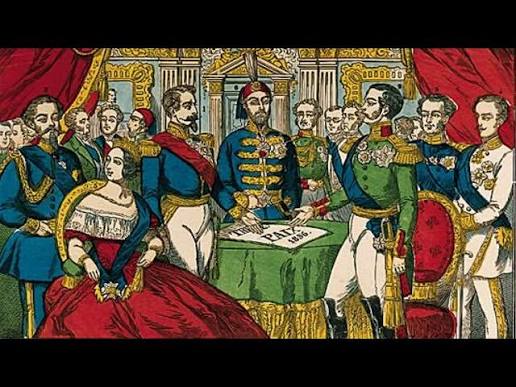
On November 3, 1839, officials, religious leaders, dignitaries, and foreign diplomats gathered in the rose garden beside Istanbul’s Topkapı Palace. There, a decree issued in the name of the young Sultan Abdülmecid I promised security of life, honor, and property, regular taxation, orderly military recruitment, and public legal procedures. Its language suggested that better laws could restore a shaken empire.
The proclamation opened the era known as the Tanzimat, usually dated from 1839 to 1876. The Ottoman term means “reorganizations,” and the plural is revealing. Tanzimat was not one reform plan implemented from a master blueprint. It was a succession of laws, councils, schools, ministries, courts, provincial experiments, and political bargains carried out across nearly four decades.
Some changes strengthened the state; others created new conflicts. Equality before the law was proclaimed more clearly than it was practiced. Central officials tried to curb arbitrary provincial power, yet often extended Istanbul’s reach into daily life. European models mattered, but Ottoman statesmen were not simply copying Europe. They were trying to preserve a multiethnic empire in an age of military competition, nationalist revolts, and foreign intervention.
The Gülhane Edict made reform a public promise
The Imperial Edict of Gülhane, also called the Hatt-ı Şerif of Gülhane, presented reform as a return to lawful government. Its opening argued that the empire had prospered when it observed religious law and imperial regulations, then weakened when those principles were neglected. New institutions were therefore described as restoration and renewal rather than a rejection of Ottoman legitimacy.
The decree promised protections to the sultan’s subjects without initially offering a constitution or representative government. It addressed three urgent problems: arbitrary punishment and confiscation, irregular taxation, and military conscription that disrupted communities without predictable limits. It also insisted that accused people should face proper hearings rather than secret punishment.
Mustafa Reşid Pasha, an experienced diplomat and leading reformer, helped shape the proclamation. His service in European capitals informed his views, but the crisis was unmistakably Ottoman. Sultan Mahmud II had died in 1839 while the empire faced a dangerous confrontation with the powerful governor of Egypt, Mehmed Ali. Reform was meant to recover authority as well as reassure European governments.
The public reading mattered. The sultan bound his reputation to principles that subjects, officials, and foreign observers could cite later. Yet the edict did not create an independent body capable of forcing the ruler to obey it. Its guarantees depended on further legislation, administration, and political will. Tanzimat began with a solemn promise, not an instantly enforceable bill of rights.
Reform had begun before 1839
The Tanzimat did not emerge from nowhere. Ottoman rulers had spent decades responding to military defeats, fiscal pressure, and provincial challenges. Sultan Selim III attempted to build a “New Order” army in the late eighteenth century, but resistance from entrenched interests helped bring down his program and his reign.
Mahmud II pursued centralization more aggressively. In 1826 he destroyed the Janissary corps after a violent confrontation known officially as the Auspicious Incident. The elimination of this once-elite military institution removed a formidable political obstacle, though it came through lethal state force. Mahmud created new ministries, expanded salaried bureaucracy, changed official dress, conducted censuses, and sought tighter provincial control.
These measures altered the meaning of reform. Earlier programs were often justified as restoring a properly ordered past. The new bureaucracy increasingly treated government as responsible for regulating populations, collecting information, providing education, and redesigning institutions. The state’s ambitions widened even where its practical capacity remained limited.
Continuity matters because it prevents the period from becoming a story in which Europe suddenly awakened a stagnant empire. Ottoman officials had their own debates about order, justice, military organization, and fiscal survival. They borrowed selectively from French and other European practices while working within Islamic law, dynastic rule, communal institutions, and existing administrative habits.
Historians therefore disagree over whether “modernization,” “Westernization,” or “centralization” best describes the Tanzimat. Each word captures something real, but none is sufficient. Reformers wanted an army and bureaucracy capable of competing internationally, while also building a more direct relationship between the imperial center and its subjects.
New laws did not simply erase Islamic law
Legal reform was among the Tanzimat’s most visible achievements. New penal, commercial, and procedural codes appeared, and secular-style Nizamiye courts developed alongside Islamic courts and communal tribunals. This produced a plural legal system rather than a clean replacement of religious law by a single secular code.
The 1840 and 1858 penal codes limited some forms of arbitrary punishment and drew partly on French examples. Commercial courts addressed disputes arising from expanding domestic and international trade, including cases involving Muslims, non-Muslims, and foreigners. Written procedure, trained officials, and appeals were intended to make judgments more predictable.
The Mecelle, compiled in stages from 1869 into the 1870s under the direction of Ahmed Cevdet Pasha, demonstrates the hybrid character of reform. It codified principles of Hanafi Islamic jurisprudence in numbered articles suitable for use in new civil courts. It was neither a wholesale importation of the French civil code nor a simple preservation of older judicial practice.
Codification changed power. Rules that had been interpreted through scholars, judges, customs, and local relationships became texts administered increasingly by state institutions. That could protect litigants from arbitrary decisions, but it also enabled the central government to define which version of law officials would enforce.
The gap between legislation and practice remained wide. Courts lacked equally trained personnel everywhere; jurisdiction overlapped; and access depended on wealth, location, language, and social position. A new code could announce consistency without producing identical justice in Istanbul, Damascus, Sarajevo, Baghdad, and a rural district. Tanzimat legal history is therefore a record of institutional construction, not one decisive moment of secularization.
Equality challenged the empire’s religious hierarchy
The Ottoman Empire governed Muslims, Christians, Jews, and other communities through a combination of imperial law, Islamic principles, local privilege, and communal authority. Before the Tanzimat, Muslims and non-Muslims did not hold identical legal and political status, even though actual arrangements varied greatly across time and place.
The Reform Edict of 1856, issued after the Crimean War, stated the principle of equality more explicitly than the 1839 proclamation. It addressed access to state employment and schools, communal administration, worship, legal testimony, taxation, and military obligations. European powers pressed for protections of Christians, but Ottoman officials also sought a shared imperial loyalty that would reduce separatism and foreign interference.
This developing ideology is often called Ottomanism: the attempt to treat people of different religions as members of one political community under the sultan. It did not abolish religious identities or communal institutions. Instead, reformers tried to combine them with a broader status of Ottoman subjecthood.
The project generated resistance from several directions. Some Muslims saw equal citizenship as a loss of established privilege. Some Christian leaders feared that direct state authority would weaken communal autonomy. National movements did not disappear when equality was proclaimed, and European governments continued to use the treatment of particular communities as a reason to intervene.
Implementation was inconsistent, and violence between communities persisted. It would be inaccurate to describe 1856 as the instant emancipation of every non-Muslim subject. It is equally misleading to dismiss the edict as meaningless. Its language changed what subjects could demand from the state and helped move the political debate from tolerated difference toward contested equality.
Taxation and conscription exposed the limits of reform
To build regular institutions, the government needed predictable revenue. Tax farming had long allowed individuals to collect taxes in return for payments or obligations to the state. Reformers attacked abuses associated with the system and sought direct assessment and collection, but abolishing entrenched arrangements was much harder than announcing their end.
Officials needed surveys, population registers, property information, and reliable provincial agents. Local notables possessed knowledge and influence that Istanbul could not simply replace. In some districts, the state negotiated with these figures; elsewhere it tried to bypass them. Centralization often produced a new partnership between bureaucrats and local elites rather than total control from the capital.
Conscription created similar tensions. Reformers wanted a disciplined standing army with defined terms of service. Muslim families could lose labor for years, while rules affecting non-Muslims changed repeatedly. The substitution of a military exemption tax for direct service did not settle the larger issue of whether equal citizenship required equal military obligation.
People responded pragmatically. They petitioned, concealed eligible men or property, migrated, negotiated classifications, or sought protection through influential intermediaries. Such behavior was not merely hostility to progress. Households were defending labor, income, and local expectations against a state demanding more accurate information and more regular service.
The Tanzimat expanded administrative reach, but its reach was negotiated. A law written in Istanbul became real only through provincial councils, tax collectors, military officers, village leaders, and residents. The results differed widely, which is why studies of individual provinces often complicate the smooth national story told by official legislation.
Schools, telegraphs, and ministries changed government
Reformers needed officials who could keep accounts, draft laws, translate foreign correspondence, and administer new courts. They established and expanded schools for military science, medicine, civil administration, and other specialized fields. A new educated bureaucracy gradually acquired an identity and political influence distinct from the palace household.
Education did not become uniform or universally accessible. Religious schools continued, missionary and communal schools expanded, and the government struggled to finance a coherent system. The 1869 education regulation outlined a hierarchy of schools, but plans on paper exceeded buildings, teachers, and enrollment in many areas.
Communications altered the pace of rule. Postal services and telegraph lines allowed orders and reports to move faster between Istanbul and provincial centers. Steamships and railways improved selected routes. These technologies supported trade and travel, but they also served surveillance, military mobilization, tax collection, and central command.
New ministries and councils produced an expanding documentary state. Officials classified people, property, disputes, budgets, and provinces in standardized forms. This paperwork could make administration more legible and accountable. It could also reduce complicated local identities to categories designed for officials.
Reform changed appearance as well as procedure. Government buildings, uniforms, ceremonies, newspapers, and public notices made the state more visible. The growth of an Ottoman-language press created spaces where educated readers debated policy. By the later nineteenth century, criticism increasingly came from people trained by reformed institutions themselves.
Provincial reform mixed representation with control
The empire’s provinces were not passive recipients of orders. The 1864 Vilayet Law reorganized administration through a hierarchy of provinces, districts, and subdistricts, with governors and councils assigned defined responsibilities. Provincial councils included appointed officials and selected local representatives, including non-Muslims.
These bodies offered limited participation, not parliamentary democracy. They advised on taxation, public works, commerce, and administration while operating under imperial authority. Selection procedures often favored wealthy or influential men. Even so, councils created political experience and new channels through which provincial interests entered government.
The 1858 Land Code sought to clarify registration and strengthen state knowledge of landholding. Its consequences varied. Registration could secure rights, but peasants sometimes avoided putting land in their own names because they feared taxes or conscription. In some regions, local power holders accumulated registered title. Later claims that the code created one identical pattern of dispossession everywhere oversimplify a complex process.
Municipal reforms addressed streets, sanitation, markets, policing, and construction in growing cities. Istanbul was a laboratory, but provincial cities adapted reforms to their own institutions. The result was not a straightforward march from “traditional” to “modern” city government. Older communal and guild practices coexisted with new councils and regulations.
Research comparing Edirne and Ankara shows why the provincial scale matters. Central laws encountered different economies, populations, and alliances. Tanzimat was made through local bargaining as much as imperial decree, and its successes often depended on officials cooperating with the very notables centralization was supposed to restrain.
European pressure both enabled and constrained the reforms
Ottoman leaders pursued reform in an international system dominated increasingly by European powers. Britain, France, Russia, Austria, and later other states supported different Ottoman communities, demanded commercial privileges, and intervened diplomatically or militarily. Reformers used alliances to protect the empire, but those alliances came with pressure.
The 1856 Reform Edict followed the Crimean War, in which Britain and France fought alongside the Ottoman Empire against Russia. European governments presented religious equality as an international concern. Ottoman statesmen resented foreign intrusion even when they endorsed parts of the equality program for their own reasons.
Economic integration also had unequal effects. Commercial agreements reduced some Ottoman monopolies and opened markets more widely to European goods. Infrastructure required capital, and borrowing accelerated. Foreign loans helped finance the state and major projects, yet debt service became increasingly dangerous. In 1875 the government effectively defaulted on parts of its obligations, exposing the limits of reform funded without stable revenue.
It is therefore too simple to label Tanzimat a European imposition. Ottoman ministers authored, modified, and defended reforms to solve imperial problems. It is also wrong to ignore coercive diplomacy and economic imbalance. The program developed through interaction between Ottoman agency and an international order in which the empire did not possess equal power.
The 1876 constitution was both culmination and rupture
By the 1860s, critics known as the Young Ottomans argued that bureaucratic reform without political accountability was insufficient. They combined constitutional ideas with Ottoman and Islamic concepts of consultation and justice. Their writings challenged both arbitrary palace rule and the dominance of elite ministers.
Crisis accelerated change. Revolts in the Balkans, fiscal default, diplomatic pressure, and palace upheaval destabilized the government. In December 1876, Sultan Abdülhamid II promulgated the empire’s first constitution. It established a parliament and formally defined Ottoman citizenship while preserving extensive powers for the sultan.
The constitution is often treated as the endpoint of the Tanzimat because it transformed administrative promises into a new political framework. Yet the First Constitutional Era was brief. Abdülhamid suspended parliament in 1878 during war with Russia and ruled for decades without reconvening it.
The ideas and institutions did not vanish. Schools, ministries, legal codes, provincial administration, communications, and a professional bureaucracy continued. Constitutional opposition also survived, contributing to the movement that restored the constitution in 1908. The site’s account of the Young Turk Revolution follows that later struggle.
There is no simple verdict on whether Tanzimat “succeeded.” It did not prevent territorial loss or guarantee equal treatment. It increased state power while opening a language of rights that subjects could use against the state. It created institutions that served both authoritarian control and constitutional politics.
What the Tanzimat changed—and what it could not
The Tanzimat reforms reshaped the Ottoman Empire because they altered expectations. Government increasingly claimed responsibility for regular law, education, infrastructure, taxation, and equal subjecthood. People could compare these promises with practice, petition against abuses, and argue over the meaning of Ottoman citizenship.
The reforms were uneven by design as well as circumstance. Ministers compromised with religious authorities, foreign governments, provincial notables, merchants, and communities. Codes overlapped with older jurisdictions. Equality collided with hierarchy. Centralization depended on local cooperation. These were not side effects of a finished plan; they were the substance of imperial reform.
The period also resists the familiar “decline” narrative. Ottoman officials were not watching passively as their state decayed. They built institutions, experimented, borrowed, codified, and debated. Some measures produced new inequalities or debts, while others survived into successor states. Failure and creativity existed together.
Tanzimat did not turn the empire into a European nation-state, nor was that its straightforward goal. It was an effort to make a diverse dynastic empire governable and competitive under nineteenth-century pressure. Its deepest legacy lies in the unresolved questions it raised: who belonged equally, what restrained sovereign power, and whether a stronger state would protect its people or supervise them more closely.
Sources and primary documents
Roy Rosenzweig Center for History and New Media, “The Gülhane Proclamation (1839)”
Cambridge University Press, “The Era of Modern Reform: The Tanzimat, 1839–1876”
Yonca Köksal, “Imperial Center and Local Groups”