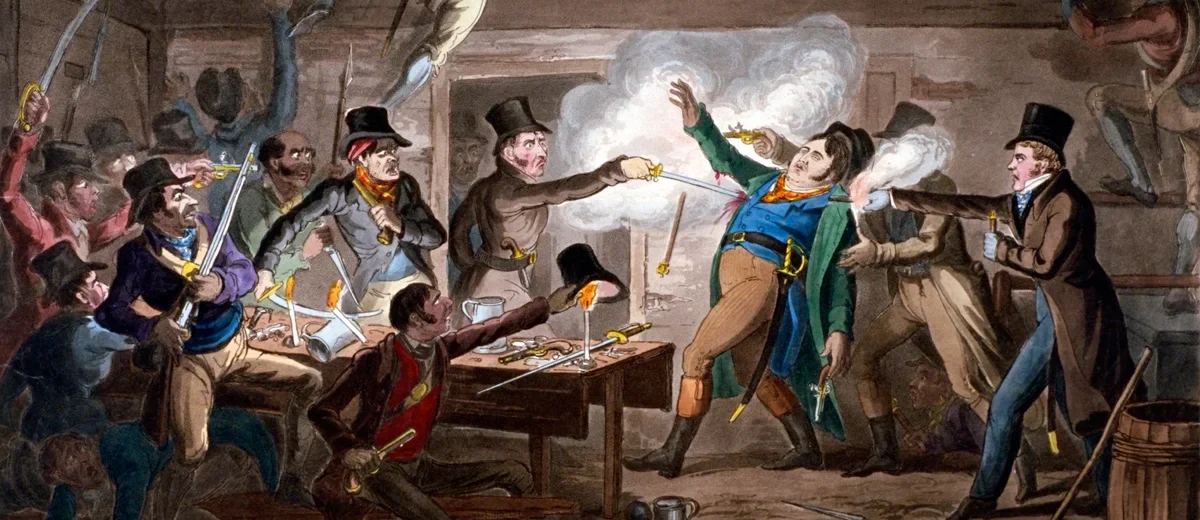
On the evening of 23 February 1820, armed men climbed into a hayloft above a stable near London’s Edgware Road. They carried pistols, swords, pikes, ammunition, and homemade incendiary devices. Within an hour, they intended to enter a cabinet dinner in Grosvenor Square, kill Britain’s leading ministers, and turn the shock into a revolution. The dinner did not exist. The authorities already knew the plan, and police were closing in.
The Cato Street Conspiracy lasted only a few chaotic minutes as an attempted insurrection, yet it exposes a much larger struggle over political representation, economic distress, state surveillance, and the limits of protest after the Napoleonic Wars. Five conspirators were eventually hanged and beheaded. Five others were transported. A police officer was killed during the raid. The government’s use of the informer George Edwards then raised a question that historians still confront: had officials uncovered a dangerous plot, or had their agent helped manufacture it?
Britain After the Napoleonic Wars
Britain emerged from the wars against revolutionary and Napoleonic France in 1815 as a victorious great power, but victory did not produce comfort for much of the population. Demobilized soldiers and sailors entered a weak labor market. Industrial change disrupted established trades. Poor harvests and high food prices sharpened hardship, while the Corn Law of 1815 protected domestic grain producers by restricting cheaper imports.
The political system offered few peaceful routes for working people to influence policy. Only a small minority of adult men could vote, electoral qualifications varied widely, and rapidly growing industrial towns had little or no direct representation. Meanwhile, tiny “rotten boroughs” could return members of Parliament under the influence of wealthy patrons. Reformers ranged from moderates seeking broader representation to republicans who believed aristocratic government could not be repaired.
Ministers had also spent decades fearing the example of the French Revolution. Wartime rebellion in Ireland, radical societies in Britain, and attempted risings reinforced the belief that agitation might become insurrection. The state used prosecutions, restrictions on meetings, newspaper taxes, and informers to watch political organizations. To officials, surveillance defended public order. To radicals, it proved that an unreformed ruling class would suppress lawful dissent.
From Spa Fields to Peterloo
Arthur Thistlewood, the central figure in the Cato Street Conspiracy, already had a history in militant radical politics. Born in Lincolnshire and briefly connected with military service, he moved through a radical world of taverns, debating groups, public meetings, and personal networks. He became involved in the Spa Fields agitation of 1816, when a reform meeting in London was followed by a failed attempt by some participants to seize arms and encourage an uprising.
Thistlewood was acquitted of treason after Spa Fields, but confrontation with the authorities continued. In 1818, he challenged Home Secretary Lord Sidmouth to a duel, was convicted of sending the challenge, and served a prison sentence. His experiences strengthened a conviction that constitutional reform was blocked and that the government could be displaced only by force.
The Peterloo Massacre of 16 August 1819 radicalized political opinion far beyond Thistlewood’s circle. Cavalry charged a huge, largely peaceful reform gathering at St Peter’s Field in Manchester. Eighteen deaths are commonly associated with the event, while hundreds were injured. The precise casualty figures vary between sources, but the political effect is not in doubt: critics saw Peterloo as evidence that ministers answered demands for representation with sabres.
Parliament’s response was the Six Acts of late 1819, a package designed to restrict large meetings, speed certain prosecutions, curb radical publications, and strengthen the search for weapons. Supporters presented the laws as a defense against revolution. Opponents saw collective punishment of reformers. Within this atmosphere, Thistlewood and other “ultra-radicals” moved from indignation toward a plan of assassination and insurrection.
Who Were the Cato Street Conspirators?
The plotters were not a cross-section of the British reform movement. They belonged to a small militant milieu, sometimes described as Spencean after the radical thinker Thomas Spence. Spence had advocated common ownership of land through parish-based administration, but the men at Cato Street did not simply translate a single philosopher’s program into action. Their ideas combined republicanism, economic grievance, memories of the French Revolution, and anger at repression.
Many were skilled or semi-skilled tradesmen under severe economic pressure. John Brunt worked in the shoe trade, Richard Tidd was a shoemaker, and James Ings was a butcher. Such occupations matter because they challenge caricatures of the conspirators as either mindless criminals or representatives of an undifferentiated “mob.” They inhabited communities where literacy, trade organization, radical newspapers, and political discussion overlapped.
William Davidson’s life was especially distinctive. Born in Jamaica to a Black mother and a Scottish father, he was educated in Scotland and worked as a cabinetmaker. The London Museum notes that he had been at Peterloo and that the experience pushed him toward radical politics. Davidson’s presence demonstrates that Black people participated in British political life not only as subjects of abolitionist debate but as political actors with their own judgments and commitments.
The Plan to Kill the Cabinet
The opportunity appeared after the death of George III on 29 January 1820, when normal parliamentary and political routines were disrupted. The conspirators discussed actions that would remove ministers and encourage coordinated unrest. Their most developed plan targeted a supposed cabinet dinner at the home of Lord Harrowby in Grosvenor Square on 23 February.
According to prosecution evidence and contemporary accounts, a small party would enter the house, kill Prime Minister Lord Liverpool and his colleagues, and take symbolic trophies from senior ministers. Other participants would seize weapons, attack strategic sites, and proclaim a provisional authority or “Committee of Public Safety.” They expected Londoners to join once the government appeared decapitated.
The plan was fantastically ambitious. A few dozen militants had no reliable force capable of controlling London, no secure national command, and no guarantee that soldiers or civilians would defect. Rumors of unrest in northern England and Scotland encouraged hopes of a wider rising, but expectation was not coordination. The conspirators confused intense discontent with readiness for revolution.
George Edwards: Informer or Agent Provocateur?
The authorities knew the group’s discussions through George Edwards, a government informer who had entered radical circles. Informers were central to the postwar security system because Britain lacked a modern national police or intelligence service. Magistrates, the Home Office, Bow Street officers, local agents, and paid sources formed an uneven network of surveillance.
The historical dispute concerns what Edwards did beyond reporting. Critics alleged that he proposed violent schemes, obtained weapons, spent unexplained money, and pushed vulnerable men toward crimes they might not otherwise have attempted. Ministers did not call him as a prosecution witness. After the executions, members of Parliament demanded an inquiry and debated accusations that he had become an instigator rather than an observer.
Hansard preserves this controversy in unusually direct form. On 2 May 1820, Alderman Matthew Wood asserted that witnesses could connect Edwards to plans and weapons. Henry Brougham defended the necessity of watching violent conspirators but drew a sharp distinction between employing spies and employing people who incited crimes. Ministers rejected the claim that Edwards alone created the Cato Street Conspiracy.
The False Dinner and the Hayloft Trap
A newspaper notice announced that the cabinet would dine at Lord Harrowby’s house. The conspirators treated it as confirmation of their opportunity. In reality, no such dinner was taking place. The London Museum describes the notice as part of the trap, while the National Archives emphasizes that officials watched the plotters through informers.
On 23 February, the men assembled in a rented loft above a stable in Cato Street, a narrow location near Edgware Road. Their weapons and equipment were poorly standardized: firearms, swords, pikes, knives, powder, and devices intended for fire or explosion. The setting was less a military headquarters than a cramped staging point chosen for secrecy.
Magistrate Richard Birnie organized the arrest. A party of Bow Street officers entered the loft before soldiers of the Coldstream Guards reached the scene. The raid immediately became confused. In darkness and close quarters, officers confronted armed men who had expected to leave for an attack. Some surrendered, some fought, and others escaped through windows or across roofs.
The Death of Richard Smithers
Bow Street officer Richard Smithers was killed during the raid. Contemporary evidence identified Thistlewood as the man who stabbed him with a sword. The death transformed an already serious treason case into a public narrative of murderous resistance and gave the authorities a fallen officer around whom to organize accounts of duty and sacrifice.
Thistlewood escaped from the loft but was arrested the next morning. James Ings also fled and reportedly fired at an officer before being captured. Other suspects were taken at the scene or detained afterward. The National Archives preserves arrest warrants, testimony from the police patrol, lists of charges, drawings of the building, and descriptions of weapons.
Smithers’s death should not be lost inside arguments about provocation. Whatever encouragement an informer supplied, the clash killed a real person. At the same time, acknowledging that fact does not settle whether officials responsibly managed the operation or whether Edwards crossed the line from intelligence gathering into incitement.
Trial for High Treason
The special commission proceedings opened at the Old Bailey in April 1820. Thistlewood was tried first. Prosecutors argued that the defendants had conspired to levy war against the king and overthrow the established government. The intended cabinet killings were presented not as isolated murders but as the opening act of insurrection.
The Crown relied on participants who turned evidence, especially Robert Adams and John Monument, as well as officers, physical exhibits, and evidence of meetings and preparations. Edwards’s absence from the witness box was conspicuous. For the defense, it allowed an argument that the government had hidden the person best placed to reveal how the plot developed.
Treason trials carried immense procedural and political weight. The prosecution had to connect words and intentions to overt acts, while defense lawyers attacked accomplice testimony and the reliability of informers. A sensational public atmosphere surrounded the proceedings, and publishers quickly sold narratives, portraits, courtroom reports, and illustrations of the loft.
Five men—Arthur Thistlewood, John Brunt, Richard Tidd, James Ings, and William Davidson—were convicted and executed. Five others accepted guilty pleas under arrangements that spared their lives and were transported for life. Not every arrested person received the same charge or outcome, another reason to avoid treating everyone found in radical company as equally culpable.
Execution at Newgate
The formal sentence for high treason was hanging, drawing, and quartering, a punishment inherited from earlier centuries. For the five principal defendants, the sentence was commuted in practice to hanging followed by decapitation. They were executed outside Newgate Prison on 1 May 1820 before a large crowd.
Authorities feared that the event might become a radical demonstration. Troops and artillery were positioned nearby, though the crowd did not launch the anticipated uprising. Newspaper reports described hostility toward the executioner and sympathy for the condemned among some spectators. Public execution was intended to display state power, but crowds could interpret the performance on their own terms.
After hanging, the bodies were lowered and beheaded. An axe had been specially made, but the decapitations were carried out with a knife by a masked man. The Cato Street five are commonly described as the last people judicially beheaded in Britain. That statement is more precise than saying they were the final people sentenced to the full traditional punishment, since legal formulas and practical commutations did not always coincide.
The Widows, Families, and Transportation
Capital punishment ended five lives, but the penalties extended into households. Widows lost partners and income, children lost fathers, and association with treason brought stigma as well as hardship. A petition preserved by the National Archives records appeals from widows of the executed men, reminding readers that political trials created consequences beyond the courtroom.
Transportation removed five convicted conspirators to Australia for life. Transportation was neither an acquittal nor a mild alternative. It separated people permanently from family and community, subjected them to coerced labor and penal discipline, and inserted British political prisoners into a colonial system built on dispossession.
The difference between execution and transportation often reflected legal strategy as much as a precise moral ranking. Defendants who pleaded guilty or cooperated could receive commutation; leading figures chosen for exemplary punishment were put to death. The state used differentiated penalties to secure convictions, obtain testimony, and communicate that organized revolutionary violence would fail.
Was Britain Close to Revolution?
In 1820, the prospect of rebellion did not look absurd. The French Revolution remained living memory. Britain had recently experienced mass reform meetings, Luddite violence, the Spa Fields unrest, Peterloo, and the Pentrich rising of 1817. In April 1820, the Radical War in Scotland would produce strikes and armed encounters. European revolutions also broke out that year.
Yet evidence of unrest is not evidence that Thistlewood could command it. Most British reformers rejected cabinet assassination. Local movements had different priorities, leadership, and capacities. The Cato Street group possessed no secure mechanism for converting news of murdered ministers into control of London, much less the country.
Government officials nevertheless had reasons to magnify the threat. A terrifying conspiracy justified surveillance and validated claims that restrictive legislation protected society. Radicals, conversely, could depict the plot as the product of spies in order to defend the broader reform cause. Both sides used Cato Street politically.
Cato Street and the Limits of State Security
The affair presents a classic problem of political policing. A government confronted with credible violent threats must gather intelligence before lives are endangered. But secret agents can distort the movements they enter. They may exaggerate danger to remain valuable, encourage crimes that generate evidence, or blur the boundary between discovery and creation.
Ministers argued that watching Thistlewood’s circle was necessary. Their critics did not all deny that danger. Brougham’s parliamentary intervention instead focused on responsibility: the state that employs an informer must ensure that he reports crime rather than produces it. That principle gives the controversy lasting significance.
Cato Street can be compared with other moments when governments tested the line between public order and political legitimacy. The earlier American Whiskey Rebellion, for example, also forced authorities to decide how strongly to answer organized resistance, though its scale, political system, and outcome were very different.
Myths and Oversimplifications
One myth says the Cato Street Conspiracy was wholly invented by the government. The evidence does not support that claim. The men discussed assassination, assembled weapons, and gathered for departure. Edwards may have encouraged them, but he did not create Thistlewood’s prior militancy or physically compel the group to arm itself.
The opposite myth portrays a large, disciplined revolutionary organization narrowly prevented from taking Britain. The loft contained around twenty men, while the wider network was uncertain. The plan depended on instant popular support and military defections for which the conspirators had little reliable evidence.
A third simplification treats the executions as a clean triumph of law over terrorism. The proceedings occurred inside a political system that excluded most adults, restricted radical organization, and shielded a controversial informer. Legal conviction establishes responsibility under the law of the time; it does not answer every ethical question about surveillance, provocation, or punishment.
Finally, the plot should not be used to smear the entire parliamentary reform movement. Peaceful and constitutional campaigns continued, eventually contributing to the Reform Act of 1832 and later expansions of political participation. Cato Street was one violent branch within a much broader struggle over who could speak for Britain.
Conclusion: A Real Plot Inside a Manufactured Opportunity
The Cato Street Conspiracy was both more serious and less powerful than legend suggests. Its participants genuinely intended to kill the cabinet and trigger insurrection. They were not close to governing Britain, but their weapons, preparations, and resistance during arrest made the danger real.
The government did not passively stumble upon them. Officials monitored the group through George Edwards, allowed preparations to mature, and used a nonexistent dinner to bring the plan to a point where arrests and treason convictions became possible. Whether Edwards merely reported or actively accelerated the conspiracy remains disputed because ministers protected him from full public examination.
The event therefore resists moral simplicity. Economic distress and political exclusion explain radicalization without excusing murder. Government responsibility for security explains surveillance without settling the charge of provocation. The executions punished a violent conspiracy while displaying the formidable power of an unreformed state.