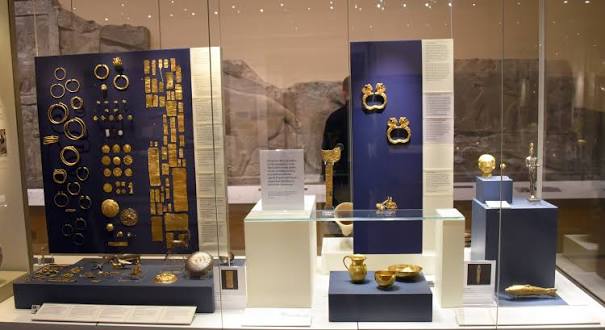
A gold chariot small enough to rest on a hand carries four horses and two carefully modeled riders. Nearby, winged griffins curve around the ends of an armlet, while thin gold plaques show worshippers in Persian and Central Asian dress. These objects look like a coherent royal treasury. Their modern history is anything but coherent.
The Oxus Treasure is a collection of roughly 180 surviving gold and silver objects, usually dated mainly to the fifth and fourth centuries BCE and associated with the Achaemenid Persian world. It was reportedly found near the Oxus River—the modern Amu Darya—in Central Asia during the late 1870s. Yet no archaeologist recorded the discovery. Dealers, merchants, soldiers, and collectors separated the pieces before they reached museums, leaving basic questions about the findspot, composition, and purpose unresolved.
That uncertainty does not make the treasure worthless as evidence. Its plaques, jewelry, vessels, statuettes, seals, and model chariots reveal remarkable metalworking and the cultural range of an empire extending from the Aegean to Central Asia. But responsible history must distinguish what the objects demonstrate from the dramatic stories later attached to them.
What Is the Oxus Treasure?
The name refers to a group of precious-metal objects believed to have been discovered on or near the north bank of the Oxus in the region of present-day Tajikistan. Most are now in the British Museum, although one famous griffin-headed armlet belongs to the Victoria and Albert Museum and is displayed on long-term loan. Other pieces passed through private hands or separate collections.
The surviving group includes bracelets and armlets, rings, vessels, miniature figures, animal forms, gold plaques, a sheath or scabbard, seals, and two model chariots, one substantially complete. “Treasure” suggests a single buried deposit, but that assumption cannot be proved. Objects attributed to the find entered the market at different times, and early accounts do not agree on exactly what was discovered together.
About 200 coins have often been connected with the Oxus Treasure, while early reports mentioned far more. Their association is less secure than that of the metalwork. Some coin types came from different regions and periods, raising the possibility that dealers combined separate discoveries or added material to make the group more attractive.
The most defensible definition is therefore practical: the Oxus Treasure is the body of objects assembled under that name through late nineteenth-century collecting, most of which scholars consider genuine ancient metalwork with strong Achaemenid connections. It is not a perfectly documented archaeological hoard.
The Achaemenid World Behind the Gold
The Achaemenid Empire was founded by Cyrus the Great in the sixth century BCE and lasted until Alexander the Great’s conquest in the late fourth century BCE. At its height, it ruled territories stretching across western and Central Asia and into Egypt. Royal inscriptions presented this diversity as an ordered collection of lands owing loyalty to the Great King.
Central Asia was not a remote edge without importance. Bactria, Sogdia, and neighboring regions supplied troops, horses, tribute, minerals, and routes linking Iran with the steppe and lands farther east. Administrators and local elites participated in imperial systems while preserving regional traditions.
The treasure’s strongest pieces fit this world of shared symbols and varied workshops. Clothing, weapons, animal motifs, and techniques combine Persian, Median, steppe, Mesopotamian, and Greek-looking elements. That mixture need not mean the objects are later imitations. Achaemenid art deliberately drew on many traditions and circulated through courts, temples, military networks, and elite gift exchange.
Royal art from Persepolis offers useful comparisons. Tribute bearers carved on the Apadana reliefs carry vessels and animal-headed bracelets resembling forms found in the Oxus group. The resemblance does not prove that the treasure came from a royal workshop, but it places its luxury objects within a recognizable imperial visual language.
The Griffins on the Famous Armlets
The best-known objects are a pair of gold armlets with terminals shaped as winged, horned griffins. Their bodies turn outward from a thick curved hoop, combining feline strength, wings, and elaborate horns. Empty settings on the creatures suggest that colored inlays once created a brighter surface.
Animal-headed bracelets appear in Achaemenid court imagery and were likely powerful markers of rank, wealth, or political connection. The Persepolis reliefs show delegations presenting comparable ornaments. It is tempting to label the Oxus examples “royal,” but no inscription identifies an owner, and luxury forms could circulate beyond the king’s immediate household.
The armlets also demonstrate how portable prestige worked. Gold could be worn, offered, stored, melted, or transferred across enormous distances. A bracelet was both artistic object and concentrated wealth. Its imagery communicated participation in an elite culture understood across different parts of the empire.
One armlet’s separate ownership illustrates the collection’s fractured modern path. Captain Francis Charles Burton acquired it after recovering objects stolen from merchants, and it later entered the Victoria and Albert Museum. Its companion became part of the British Museum group assembled through other collectors.
Gold Plaques and the Question of Worship
Dozens of thin rectangular plaques form one of the treasure’s most unusual categories. Many were made by hammering and chasing gold sheets. They depict standing men in profile, sometimes holding barsom-like bundles associated with Iranian ritual, flowers, or other objects. Dress varies, including long robes and garments commonly described as Median.
Because the plaques are thin and small, scholars have often interpreted them as votive offerings deposited at a sanctuary. Worshippers may have dedicated images of themselves or idealized devotees in return for divine favor. Similar practices are known in many cultures, though the exact ritual behind these plaques is not recorded.
The figures should not be treated as precise portraits or an illustrated census of ethnic groups. Ancient costume conventions signaled status and identity, but artists also repeated formulas. Labels such as “Persian,” “Median,” or “Saka” are scholarly interpretations based on comparison, not captions written on the objects.
The plaque group supports a religious explanation for at least part of the treasure, yet it does not establish that every object belonged to one temple. Jewelry, tableware, seals, and chariots may have entered a sanctuary as offerings, but they might also come from separate caches combined during sale.
The Gold Chariot and Achaemenid Craft
The model four-horse chariot is among the most technically complex pieces. A high-ranking figure sits in the vehicle beside a driver, while four horses stand in paired formation. The tiny wheels, harness elements, human bodies, and chariot box were made from multiple components joined into a single miniature.
British Museum technical research found evidence of sophisticated goldworking, including hammering, cutting, soldering, and mechanical joins. Some components were formed separately and then assembled. The model was not a crude lump of bullion shaped to suggest a vehicle; it was a carefully engineered object whose maker understood both metal and chariot design.
The passengers’ clothing and the chariot’s decoration connect the model to Achaemenid elite culture. Scholars have proposed that the seated man could represent a satrap or another senior official. That identification remains an inference because the figure lacks a name or unique royal attribute.
Its purpose is also uncertain. The model may have been a votive gift, a prestige object, or a symbolic representation of authority and movement. Calling it a child’s toy would ignore its costly material and ritual context. Calling it definitely royal goes beyond the evidence.
Where Was the Treasure Found?
Early reports placed the discovery near Takht-i Kuwad, close to the junction of rivers that form the Amu Darya. Other accounts claimed objects were recovered from sand exposed in the riverbed. Dates range from about 1877 to 1880, possibly because finds appeared over more than one season or because dealers gradually released material.
The absence of an excavation record is decisive. No plan shows the objects in the ground. There is no documented container, layer, building, or associated pottery. Even if the general region is correct, the treasure could have been buried at a settlement, lost in transport, concealed during danger, or removed from a sanctuary before discovery.
This problem affects every interpretation. A votive deposit inside a temple would mean something different from a merchant’s cache, a palace treasury, or mixed objects collected from several sites. Provenance is not bureaucratic paperwork added after archaeology; it is part of the historical meaning.
Takht-i Sangin and the Temple of the Oxus
Takht-i Sangin lies near the reported discovery zone and became famous through excavations of a sanctuary commonly called the Temple of the Oxus. Archaeologists found thousands of offerings there, including weapons, figurines, jewelry, vessels, and coins deposited over centuries. A dedication naming the river god Oxus helped identify the cult.
The sanctuary makes a temple origin for the Oxus Treasure attractive. Gold plaques interpreted as worshippers and precious objects suitable for dedication could fit a sacred treasury. The region was also a major river crossing where political, commercial, and religious activity converged.
However, Encyclopaedia Iranica warns that the connection remains hypothetical. The excavated temple’s main chronology begins around the Hellenistic period, while many treasure objects are earlier and Achaemenid. Older offerings could have been preserved in a later sanctuary, but that possibility is not proof.
Takht-i Kuwad, a different site downstream, has also been proposed as the source. The similarity of names in older publications and the movement of objects through trade have encouraged confusion. The safest conclusion is that the treasure probably came from the broader Oxus region; its relationship to any known temple is unresolved.
Merchants, Bandits, and Captain Burton
The collection’s best-known modern story begins with merchants from Bukhara who bought ancient gold and carried it south toward markets in British India. Near Kabul, they were attacked by bandits who seized their goods and held them. A servant escaped and reached Captain Francis Charles Burton, a British political officer.
Burton reportedly confronted the robbers with only a small escort and recovered much of the treasure. Further pressure produced additional objects. The merchants continued toward Rawalpindi, where pieces entered the antiquities market. Burton acquired at least some items, including material later catalogued in museum collections.
The adventure appears in early museum histories and is supported by accounts connected with the merchants and officials, but details vary. It should not be retold as a perfectly documented rescue scene. By the time anyone recorded the story, the original find had already passed through multiple hands and some objects were missing.
Cunningham, Franks, and the British Museum
Major-General Alexander Cunningham, the first director-general of the Archaeological Survey of India, purchased many pieces through dealers. He published objects he believed came from the discovery, helping establish the treasure’s scholarly identity. His collecting also reflected a nineteenth-century system in which officials could privately acquire antiquities from regions affected by imperial power.
Augustus Wollaston Franks, an influential British Museum curator and collector, acquired other pieces and later bought Cunningham’s group. When Franks died in 1897, his bequest brought most of the assembled Oxus Treasure into the British Museum. Separate acquisitions continued to be associated with it.
This history matters because a museum catalogue can make a dispersed market assemblage look like an intact archaeological discovery. Shared display cases and a single collection name encourage viewers to assume that every item lay together. In reality, attribution depended on dealer statements, stylistic comparison, collector judgment, and early publications.
The story also belongs to the history of empire and museums. British officials, Indian markets, Central Asian finders, Afghan routes, and London institutions all shaped what survives and how it is interpreted. The treasure is ancient Persian and Central Asian art, but its modern identity was constructed through colonial collecting networks.
Authenticity and the Problem of a Market Assemblage
Doubts about authenticity appeared early because the pieces emerged through dealers rather than excavation. Styles and workmanship vary, while the market through which they passed could supply additions, substitutions, or modern imitations. Some scholars have questioned individual objects or the unity of the group.
Variation alone is not proof of forgery. A collection formed from offerings accumulated over time could contain products of different workshops, dates, and regions. Scientific examination of major pieces has identified ancient techniques and materials consistent with sophisticated Achaemenid-period goldwork.
Most specialists accept the core metalwork as genuine, but caution remains essential. The secure claim is not that every catalogued object certainly came from one deposit. It is that the group contains a substantial body of authentic ancient precious metalwork, while the membership and history of particular pieces may differ.
The coins are an especially important warning. Early accounts linked large numbers of coins to the find, yet chronological and geographic inconsistencies weakened the association. Historians should not use a questionable combined coin list to assign a precise burial date to all the metalwork.
What the Treasure Reveals About Achaemenid Power
The Oxus objects demonstrate that Achaemenid political culture cannot be reduced to monuments in southwestern Iran. Imperial styles reached deep into Central Asia, where local elites and craftspeople selected, adapted, and reproduced forms connected with royal authority.
Hybrid imagery was not necessarily evidence of cultural confusion. The empire governed many peoples without requiring identical art everywhere. A griffin could draw on long traditions shared across Iran and the steppe; a garment could mark a regional identity; a vessel shape could circulate through tribute, diplomacy, or trade.
The objects complement written proclamations such as the Behistun Inscription of Darius I. Behistun presents the king’s ordered vision of lands and rebellions, while the Oxus Treasure shows how imperial imagery and luxury materials operated far from the royal rock monument. One is an official political text; the other is a contested material archive.
Ownership, Replicas, and Modern Meaning
Most of the treasure remains in London, far from the region where it was reportedly found. That separation invites questions about legal ownership, colonial acquisition, and cultural belonging. The collection entered Britain through nineteenth-century trade rather than a modern scientific excavation conducted under today’s heritage laws.
Tajikistan treats the Oxus heritage as important to its ancient past. In 2013, the British Museum presented high-quality replicas of selected objects for display in the National Museum of Tajikistan. Replicas increase local access but do not settle broader debates about where originals should reside.
Historical analysis should avoid inventing a formal restitution dispute where the legal and diplomatic record is more complex. It is accurate to say that the treasure’s location and acquisition raise ethical questions. Any claim about an official demand, refusal, or legal title should be tied to specific documentation.
Common Myths About the Oxus Treasure
The first myth is that archaeologists discovered a sealed royal treasury. They did not. Local finders and merchants brought the objects to market, and the exact context was never recorded. “Royal” may describe style or quality, not a proven owner.
The second myth is that the treasure certainly came from the Temple of the Oxus at Takht-i Sangin. The temple offers a persuasive comparison, especially for the votive plaques, but chronological and geographic problems remain. It is a hypothesis, not an excavation fact.
The third myth is that every coin and object displayed under the name belonged to one ancient deposit. The group was assembled through several purchases, and some associations are stronger than others. A shared catalogue history cannot replace stratigraphy.
The opposite claim—that doubtful provenance makes the entire treasure fake—is also misleading. Technical research, stylistic comparison, and the early record support the antiquity of the core collection. Uncertainty should refine conclusions, not erase evidence.
Conclusion: A Treasure Defined by What Was Lost
The Oxus Treasure preserves some of the finest surviving Achaemenid-period metalwork: griffin-headed armlets, ritual plaques, miniature figures, vessels, seals, and an extraordinary gold chariot. Together they illuminate wealth, devotion, craftsmanship, and imperial connections in ancient Central Asia.
Yet the collection’s greatest limitation is inseparable from its fame. Because the objects were removed without archaeological recording and dispersed through markets, historians cannot confidently reconstruct the original deposit. The findspot is approximate, the temple connection debated, and the coin group insecure.
That does not reduce the Oxus Treasure to a mystery with no answers. It changes the questions. The objects can reveal techniques, imagery, and networks even when they cannot identify one owner or burial event. Their modern journey can also reveal how colonial collecting transformed scattered antiquities into a named museum treasure.
The most honest interpretation allows brilliance and uncertainty to coexist. Gold survives when documents, textiles, wood, and ordinary lives disappear. But even gold cannot restore the context lost when discovery becomes commerce before it becomes archaeology.