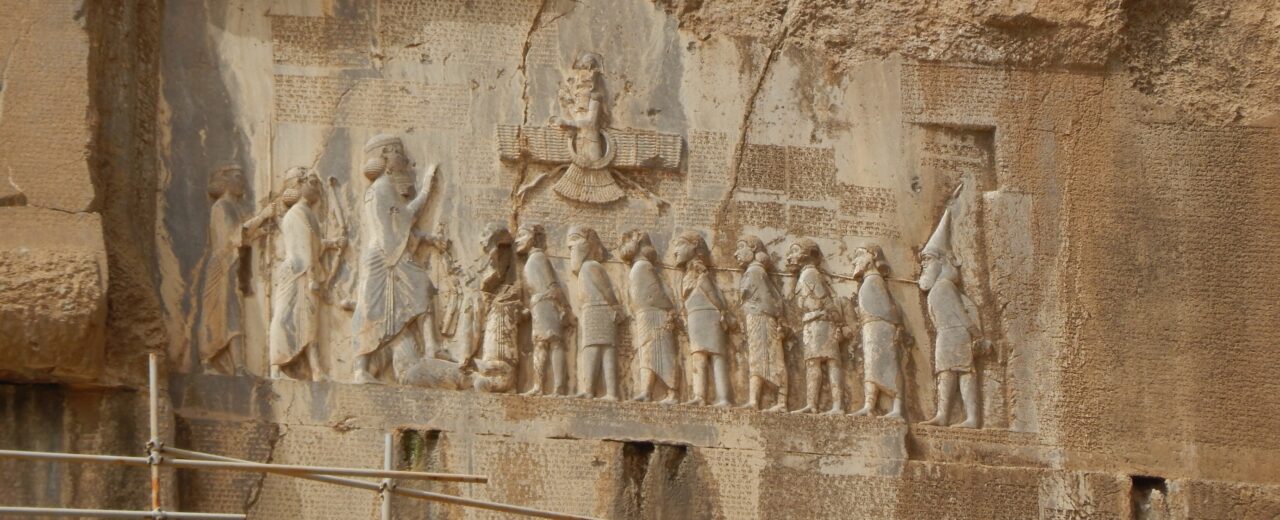
About sixty metres above the plain at Bisotun in western Iran, Darius I turned a disputed accession into stone. The king is shown with a bow, one foot on a defeated figure and a line of bound opponents before him. Around the relief, inscriptions in Old Persian, Elamite and Babylonian explain why Darius claimed to be the legitimate ruler and why the rebellions against him were acts of “the Lie.”
The Behistun Inscription matters for two different reasons. For ancient history, it is the most extensive surviving statement of how Darius wanted the crisis of 522–520 BCE remembered. For the history of scholarship, its parallel cuneiform texts became crucial to nineteenth-century decipherment. UNESCO’s Bisotun record describes the monument as the only known Achaemenid monumental text documenting a specific historical event and compares its importance for Assyriology with that of the Rosetta Stone for Egyptology.
But Behistun is not a neutral chronicle. Darius had every reason to portray rivals as impostors and his own victories as the restoration of truth and divine order. That makes the inscription more, not less, valuable. It lets historians examine both the events of an imperial crisis and the political language used to turn victory into legitimacy. The central task is to separate what the monument securely documents from what remains Darius’s claim.
A royal message carved into an imperial route
Behistun rises near modern Kermanshah on the route that historically connected Mesopotamia with the Iranian plateau. In Achaemenid times, travelers moving between Babylon and Ecbatana passed below the mountain. The location therefore had political meaning. Darius placed his monument beside a major artery of imperial movement, within a landscape whose springs, cliffs, and strategic position had attracted communities long before his reign.
The relief and texts were cut far above ground level. Their height protected them from easy damage and made the cliff itself part of the message. Travelers could recognize the monumental scene but usually could not approach the writing closely, so the composition communicated through scale, position, and imagery as well as words. UNESCO added Bisotun to the World Heritage List in 2006, recognizing both the Achaemenid work and the wider archaeological landscape, which preserves remains from several periods.
The Crisis After Cambyses II
Darius’s account begins with instability. Cyrus the Great had created a vast empire, and his son Cambyses II extended Persian rule into Egypt. In 522 BCE, while Cambyses was absent from the imperial heartlands, a man whom Darius calls Gaumata took the throne. According to Behistun, Gaumata was a Magian who pretended to be Bardiya, Cyrus’s son and Cambyses’s brother. Greek writers later called the royal brother Smerdis.
Darius claims that Cambyses had secretly killed Bardiya before leaving for Egypt. Because the murder was unknown, Gaumata could impersonate the missing prince. Cambyses died, and the new ruler held power until Darius and several companions killed him at a fortress in Media. Darius says that he restored the kingship to its proper family. This is a clear contemporary claim, but not independent proof: another possibility is that Darius killed the genuine Bardiya and invented an impostor to justify a coup.
Darius’s Official Version of the Coup
The inscription makes legitimacy a contest between truth and falsehood. Darius repeatedly says that opponents “lied” by assuming royal or regional identities that were not theirs. Gaumata falsely claimed to be Bardiya; other rebels supposedly pretended to descend from earlier kings. Darius, by contrast, claims truthful Achaemenid ancestry and the support of Ahura Mazda. The language turns civil war into a moral struggle: rebellion becomes disorder founded on deception, while suppression becomes restoration.
Historians must not mistake a coherent story for a verified one. Behistun reveals exactly how Darius wanted his accession remembered, but it cannot establish every assertion about his enemies. Herodotus, writing generations later, tells a broadly similar story about a false Smerdis and a conspiracy of Persian nobles. Yet his names, speeches, motives, and dramatic details differ. The overlap may preserve related traditions, but the Greek account is not simple confirmation of the king’s version.
How image and text made legitimacy visible
The relief translates Darius’s argument into imagery understandable without literacy. The king is larger than the captives, a convention for expressing rank. He holds a bow, signifying royal and military power. Gaumata lies beneath his foot, while surviving rebel leaders stand with their hands bound. Armed attendants reinforce the scene’s hierarchy. Above them is a winged figure or symbol generally linked with Ahura Mazda, visually echoing the text’s repeated claim that Darius prevailed by divine favor.
The composition also records change. A captive representing Skunkha, identified as a leader of the pointed-cap Scythians, was added after the first arrangement, requiring adjustments to the written layout. The monument was not designed once and left untouched; it developed while Darius’s campaigns continued. That makes the cliff a material record of how royal propaganda was edited. New victories were incorporated into an expanding tableau in which every opponent occupied a place beneath the king.
Three Languages for a Multilingual Empire
The main narrative appears in Old Persian, Elamite, and Babylonian, the last a form of Akkadian. All were written with wedge-shaped signs, but “cuneiform” does not mean a single universal script. The systems differed in signs, sound values, vocabulary, grammar, and scribal history. Old Persian used a relatively restricted, partly alphabetic system. Elamite had deep roots in southwestern Iran, while Babylonian belonged to an influential Mesopotamian learned tradition.
The language choices mapped the political world of the empire. Old Persian represented the ruling house; Elamite was central to administration in the Persian heartland; Babylonian could reach readers trained in the prestigious scribal culture of Mesopotamia. The versions are parallel, not mechanically identical. Differences reflect translation, space, and revisions. An early Elamite version occupied an area affected by the expanding relief, and another Elamite text was placed elsewhere, showing scribes adapting the monument as its program grew.
An Empire Reconstructed Through Rebellion
After Gaumata’s death, Behistun describes revolts in Elam, Babylonia, Media, Persia, and more distant territories. Several challengers adopted famous identities. Rebels in Babylon claimed the royal name Nebuchadnezzar; a Median leader presented himself as belonging to the line of Cyaxares. These were not random inventions. They drew upon remembered dynasties that could mobilize regional loyalty against a new and vulnerable king.
Darius supplies battles, commanders, dates, captures, and punishments in rapid succession. These details help reconstruct the alarming scale of the crisis, yet their arrangement is ideological. Separate local wars become one moral drama in which rebellion repeatedly collapses before a divinely favored ruler. Popular summaries sometimes repeat impressive totals for battles and captured kings without explaining differences among the monument’s versions and stages. The secure conclusion is that resistance was widespread and that Darius depended on coordinated armies acting across enormous distances.
Violence, Restoration, and Divine Order
Behistun does not conceal the brutality of Darius’s victory. Captured leaders are executed, mutilated, or publicly displayed. The relief fixes that violence into a permanent hierarchy: the king upright, enemies bound or crushed. At the same time, Darius describes himself as a restorer. He claims to return property, sanctuaries, or institutions disrupted by Gaumata and to place peoples back in their correct relationship to royal power. Whether each claim is accurate is difficult to test, but the intended contrast is unmistakable.
The monument’s logic makes punishment and restoration complementary. Violence removes “the Lie”; order can then return. Ahura Mazda grants Darius the kingdom and enables his victories, while future rulers are warned to resist falsehood and protect the inscription. This is important evidence for Achaemenid royal religion, but it is not a complete religious creed. Scholars still debate how closely Achaemenid practice should be identified with later Zoroastrian tradition. The text expresses the theology of kingship in a specific political emergency.
What the inscription proves—and what it does not
Behistun securely confirms that Darius publicly promoted a detailed account of his accession early in his reign. It provides names of rebels and regions, campaign sequences, three official languages, and repeated invocations of Ahura Mazda. Its chronological claims can be compared with Babylonian tablets and other contemporary evidence. The monument also confirms the extraordinary resources invested in broadcasting legitimacy: quarrying, sculpture, scribal work, translation, and dangerous labor on a high rock face.
It does not independently prove that Gaumata was an impostor, that every rival lacked genuine support, or that victories were as inevitable as the rhetoric suggests. Ordinary soldiers, villagers, and families affected by the wars have almost no voice. The responsible choice is neither to dismiss the monument as “mere propaganda” nor to read it literally. Propaganda is evidence. It reveals what Darius feared, what he needed to explain, and which moral language he thought could turn victory into legitimate rule.
How the inscription became unreadable—and readable again
Knowledge of cuneiform eventually disappeared, and the inscription’s words became inaccessible. The visible relief survived, but later observers supplied other explanations. Some associated it with biblical figures; a Persian tradition connected the mountain with Farhad, the tragic stonecutter whose impossible labor was performed for love. Those stories belong to the monument’s later reception, not its Achaemenid origin. Darius commissioned the relief; Farhad did not carve it, and its original subject was not a biblical episode.
Later legends should not be treated simply as foolish mistakes. Communities confronted an enormous image whose official language no living reader could understand. Storytelling kept the cliff meaningful when the king’s words had fallen silent. European travelers likewise proposed varying identifications before decipherment. Their descriptions and drawings were uneven because the text was remote and difficult to inspect, but they carried news of the site into antiquarian scholarship and prepared the way for systematic copying.
The Foundations of Old Persian Decipherment
The recovery of cuneiform began before Henry Rawlinson worked at Behistun. Travelers had copied shorter inscriptions from Persepolis, allowing scholars to notice recurring sign groups. Georg Friedrich Grotefend made a critical advance by matching patterns with expected sequences of Achaemenid kings and titles. His readings were incomplete and sometimes wrong, but he demonstrated that the marks encoded language and that royal names could anchor decipherment.
Other scholars corrected and expanded those proposals. Old Persian offered the easiest entrance because its sign inventory was comparatively small and its repetitive royal formulas contained recognizable names. Even so, identifying a few kings did not yield a language overnight. Researchers needed better copies, grammatical comparison, and tests across multiple texts. This cumulative prehistory matters: the popular tale in which one heroic scholar suddenly “cracked cuneiform” erases decades of work that made Behistun readable.
Rawlinson’s Dangerous Work on the Cliff
Henry Creswicke Rawlinson, a British officer and diplomat in Persia, began copying Behistun’s Old Persian text in the 1830s. The fieldwork was genuinely hazardous. Some areas could be reached along narrow ledges or by ladders, while others stood beyond gaps in the rock. Rawlinson returned in the 1840s for more complete copies, including difficult Babylonian passages, and relied on local climbers and workers whose contributions were rarely recorded as carefully as his own.
Rawlinson published the Old Persian inscription and translation through the Royal Asiatic Society. Behistun’s long, connected narrative offered repeated phrases, proper names, and grammatical patterns that short labels from Persepolis could not provide. The text became a powerful dataset for checking proposed values. Rawlinson deserves a central place in this history, but not solitary credit: he built upon Grotefend and others, collaborated with contemporaries, and depended on practical assistance at the site.
How Babylonian Cuneiform Yielded Its Meaning
Once much of Old Persian could be read, Behistun’s parallel Elamite and Babylonian versions offered clues to more complicated systems. This was not a matter of swapping one alphabetic letter for another. Babylonian cuneiform signs could express syllables, entire words, or multiple sound values; conventions had accumulated over centuries. Elamite posed different linguistic problems and was less supported by later-known literature.
Edward Hincks, Jules Oppert, Rawlinson, and other researchers made major contributions to Akkadian decipherment. In 1857, the Royal Asiatic Society asked several experts to translate an unpublished Assyrian inscription independently. Their broadly compatible results convinced many skeptics that the method worked, though refinements continued. The statement that “Rawlinson deciphered cuneiform” is therefore too simple. His role was indispensable, but the achievement was international, cumulative, and divided among languages, copies, hypotheses, and repeated tests.
Why the Rosetta Stone comparison only goes so far
Behistun resembles the Rosetta Stone because both carry versions of a royal text in multiple languages and became crucial to recovering lost scripts. The analogy quickly communicates why parallel wording mattered. Yet the puzzles were not identical. The Rosetta Stone included Greek, which scholars already read fluently. At Behistun, Old Persian itself first had to be reconstructed through names and formulas found in other royal inscriptions.
The three Behistun texts were also written in distinct cuneiform systems and do not correspond word for word. Nor did one monument unlock every archive. Decipherment depended on Persepolis inscriptions, additional discoveries, comparative linguistics, and years of correction. Behistun was the decisive long text that accelerated and confirmed progress, not a magical master key. Calling it the “Rosetta Stone of cuneiform” is reasonable shorthand only when the metaphor does not replace the collaborative and technically difficult history.
What cuneiform decipherment changed
Reading cuneiform opened archives that transformed the history of Mesopotamia, Iran, and neighboring regions. Rulers and wars known through Greek or biblical traditions could be investigated using records produced inside ancient Near Eastern societies. Administrative tablets revealed taxation, labor, trade, law, farming, and family life on a scale monumental histories seldom preserved. Classical writers remained valuable, but they no longer stood alone as narrators of western Asia.
The impact reached far beyond Darius. Assyrian royal inscriptions, Babylonian chronicles, letters, scholarly texts, and literature became accessible. Tablets associated with the Library of Ashurbanipal exposed modern readers to major works of Mesopotamian learning and storytelling. Behistun helped provide a route into that world. It also demonstrated a permanent challenge: an indigenous contemporary source may stand closer to events than a later Greek author while still speaking in the interested voice of a victorious king.
Why Behistun remains indispensable
The Behistun Inscription changed history twice. In the sixth century BCE, it allowed Darius I to present a disputed accession as the triumph of rightful order over deception. In the nineteenth century CE, its parallel texts enabled scholars to recover languages unread for centuries. Few monuments connect the practice of ancient empire so directly with the making of modern historical knowledge.
Its value does not require belief in every royal claim. Darius may have defeated an impostor named Gaumata, or he may have constructed that story after removing Cyrus’s son. The evidence permits argument, not certainty. What is unmistakable is his method: image, language, theology, geography, and violence combined to make one ruler’s version monumental. Behistun likewise shows that lost scripts yield not to a flash of solitary genius but through copying, comparison, risk, correction, and cooperation. The cliff was a key, but generations of people learned how to turn it.
Sources and further reading
This article was reviewed against institutional, academic, or primary-source material. These links are provided so readers can check the evidence and explore the subject in greater depth.
- UNESCO World Heritage Centre – Bisotun
- UNESCO – 2006 World Heritage decision on Bisotun
- British Museum – cast of an Old Persian section of the Behistun inscription
- UNESCO World Heritage Centre – Bisotun nomination and documentation
Related reading on Top History Facts: Library of Ashurbanipal and Dura-Europos