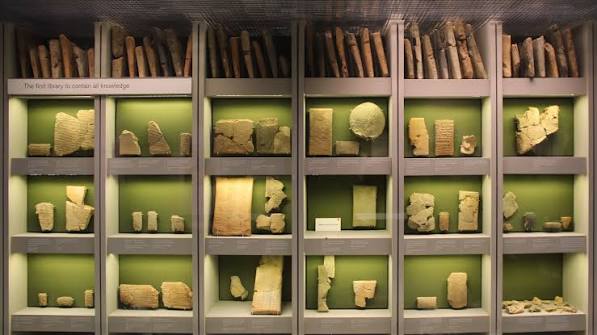
In 1872, a self-taught scholar named George Smith was reading fragments of clay tablets in the British Museum when he recognized a story that seemed impossible. Long before the biblical book of Genesis had been written, a Mesopotamian poem described a divine flood, a great boat, the survival of people and animals, and birds released to test whether the waters had fallen. The fragment belonged to the Epic of Gilgamesh, and it had come from the ruined palaces of Nineveh.
The discovery made the Library of Ashurbanipal famous, but the familiar name can be deceptive. This was not a public library with readers borrowing books from organized shelves. It was a royal collection of clay tablets and writing boards assembled for the last great king of Assyria, spread across palace rooms and scholarly contexts. Its broken remains preserve literature, medicine, magic, religion, mathematics, law, administration, and omens—an intellectual world much larger than one celebrated flood story.
A king who claimed to read the most difficult texts
Ashurbanipal ruled the Neo-Assyrian Empire in the seventh century BCE, conventionally dated from 668 to about 627 BCE. His empire extended from Mesopotamia across much of the Near East and, for a time, into Egypt. Assyrian kings presented themselves as warriors chosen by the gods, and Ashurbanipal followed that tradition through campaigns, royal hunts, monumental reliefs, and uncompromising punishment of enemies.
He also presented himself as an exceptional scholar. In royal inscriptions, Ashurbanipal claimed mastery of scribal learning, including the ability to read complex Sumerian and Akkadian texts and solve difficult calculations. Some rulers before him had scribal education, but few advertised literary expertise so strongly. His training may have been unusually extensive because he was not originally expected to become the principal heir.
Royal claims always require caution. Assyrian inscriptions were instruments of kingship, designed to display qualities that justified rule. Ashurbanipal may not have personally read every tablet associated with his collection, and the work of gathering, copying, correcting, storing, and interpreting texts depended on many professional scribes and scholars. Still, the repeated emphasis on learning is meaningful. Whatever the precise limits of his ability, the king made scholarship part of his public identity and directed imperial resources toward preserving it.
Why Nineveh became the center of an empire
Nineveh stood on the eastern bank of the Tigris, opposite the modern Iraqi city of Mosul. It was an ancient settlement long before the Neo-Assyrian period, but King Sennacherib transformed it into an imperial capital around 700 BCE. He expanded its walls, created canals and gardens, and built what his inscriptions called a “Palace Without Rival.” His successors inherited a city designed to display the reach of Assyrian power.
Ashurbanipal constructed or renovated his own North Palace while continuing to use the broader royal complex. Palaces were not only residences. They contained reception halls, administrative offices, workshops, storerooms, archives, and spaces used by scholars serving the crown. Texts discovered at Nineveh came from more than one building and room, including areas associated with both Ashurbanipal and Sennacherib.
This distribution matters because “the Library of Ashurbanipal” sounds like a single institution created at one moment. Archaeological evidence instead reveals collections accumulated through several reigns, then rearranged, mixed, and finally disturbed by destruction and excavation. Ashurbanipal was the decisive patron whose name appears on many tablets, but Nineveh’s written heritage also included older palace records, inherited texts, and scholarly materials assembled over generations.
How Ashurbanipal gathered knowledge from across Mesopotamia
The king’s agents sought learned works from temple cities and scholarly households, especially in Babylonia. Letters and directives show officials requesting tablets, locating rare compositions, and arranging for copies to be produced. Subjects included rituals, incantations, omen series, lexical lists, prayers, medical recipes, and ancient literary compositions. Some originals may have been transferred to Nineveh; other works were copied locally or by scribes in southern centers.
This was not neutral collecting. Assyria ruled Babylonia through conquest, negotiation, and repeated violence. Royal commands carried the force of empire, and scholars could not necessarily refuse requests from Nineveh. Ashurbanipal’s cultural achievement therefore depended on the same political system that extracted tribute, labor, objects, and obedience from conquered territories.
The tablets themselves reveal efforts at quality control. Scribes collated copies, noted damaged exemplars, and sometimes identified the source from which a text had been copied. Colophons—statements written at the end of tablets—could name the owner, scribe, series, or storage context. Many invoke Ashurbanipal and his palace, warn against removing tablets, or ask future readers to return them. These notes helped manage knowledge, but they did not create a modern catalog with a stable call number for every item.
What the Library of Ashurbanipal contained
The surviving collection comprises more than 30,000 tablets and fragments, not 30,000 complete books. One work could occupy many tablets, and a single tablet might shatter into numerous pieces later registered separately. Modern counts therefore depend on whether scholars are counting fragments, joined objects, compositions, or individual manuscripts. The impressive number is real, but it should not be mistaken for a shelf of 30,000 intact titles.
Literary works form the best-known group. They include versions of the Epic of Gilgamesh, the Babylonian creation poem Enūma Eliš, the descent of Ishtar to the underworld, myths about gods and heroes, hymns, prayers, laments, and wisdom literature. Many were already ancient when copied for Ashurbanipal. Sumerian compositions were preserved in a scholarly culture whose everyday language had long become Akkadian.
The collection’s practical and scholarly texts are even more extensive. There are medical diagnoses and treatments, rituals against illness or misfortune, astronomical observations, mathematical materials, bilingual word lists, grammatical exercises, and long omen series interpreting celestial events, animal organs, unusual births, and daily occurrences. Administrative and legal documents were also found at Nineveh. To modern readers, science, religion, medicine, and magic may appear separate; Assyrian scholarship connected them within systems for recognizing and responding to divine signs.
Cuneiform was a writing system, not a language
The tablets were written in cuneiform, a script made by pressing a reed stylus into soft clay to create wedge-shaped marks. Cuneiform had developed in Mesopotamia during the late fourth millennium BCE and was adapted to several languages over its long history. Describing a tablet as “written in cuneiform” is therefore like describing a document as written in the Latin alphabet: it identifies the script, not necessarily the language.
Most scholarly texts at Nineveh were in Akkadian, a Semitic language whose Assyrian and Babylonian varieties were used across Mesopotamia. Sumerian, a linguistically unrelated language, survived in learned, religious, and lexical traditions long after it ceased to be spoken in ordinary life. Scribal education required mastery of signs that could represent words, syllables, or several different readings.
Lists pairing Sumerian and Akkadian terms were not simple phrasebooks. They organized animals, plants, stones, professions, places, and technical vocabulary while training scribes to navigate inherited traditions. The same intellectual continuity can be seen in earlier monuments such as the Code of Hammurabi, whose famous legal text was already about a thousand years old in Ashurbanipal’s time. Nineveh’s scholars preserved the past because antiquity itself carried authority.
The Epic of Gilgamesh and the Flood Tablet
The most famous literary work from the collection is the Standard Babylonian version of the Epic of Gilgamesh. Its hero, king of Uruk, begins as an oppressive ruler, befriends the wild man Enkidu, confronts monsters, experiences grief, and searches unsuccessfully for escape from death. The poem’s power lies not in providing a straightforward historical biography but in exploring friendship, kingship, loss, fame, and human mortality.
The flood episode appears when Gilgamesh meets Utnapishtim, a survivor granted immortality after a divinely ordered deluge. Utnapishtim describes building a vessel, taking living creatures aboard, surviving the waters, releasing birds, and offering sacrifice. Parallels with Genesis were immediately striking to nineteenth-century readers, but neither text is simply a copy of the other. Mesopotamia possessed several flood traditions, including the older Atrahasis story, and biblical authors worked within their own literary and theological setting.
The library did not preserve a perfectly complete edition. The epic was distributed across a sequence conventionally described as twelve tablets, with gaps and damaged passages. Additional manuscripts from other sites have helped scholars reconstruct the poem. The name of the learned figure Sîn-lēqi-unninni is traditionally associated with the Standard Babylonian form, but his date and precise role remain debated. “Authored by” is less secure than saying later Mesopotamian tradition linked him to the epic.
Nineveh falls—and clay survives the destruction
After Ashurbanipal’s death, Assyria entered a rapid political and military crisis. Babylonian forces under Nabopolassar allied with the Medes and others against the empire. In 612 BCE, the coalition captured and devastated Nineveh. The city’s palaces burned and collapsed, bringing an imperial capital that had once terrified its neighbors to a violent end.
Fire destroyed perishable materials such as wooden writing boards, leather, and textiles. Clay tablets behaved differently. Many had been deliberately fired or dried before storage; others were hardened further by the heat of burning buildings. This accident of material helps explain their survival, but the popular claim that the fire neatly “baked the entire library” is too tidy. Heat could preserve clay while falling masonry crushed tablets and scattered fragments across floors.
The ruins buried the collection for roughly two and a half millennia. Its survival was selective. Durable clay favors certain kinds of evidence, while waxed boards and other organic media have mostly vanished. What historians call Mesopotamian literature is therefore shaped by preservation as well as ancient taste. The broken archive is extraordinarily rich, but it is not a complete mirror of everything Assyrians wrote, read, or valued.
The nineteenth-century rediscovery of Nineveh
European and local excavators began uncovering Assyrian palaces near Mosul in the nineteenth century. Austen Henry Layard’s work at the mound of Kuyunjik in the late 1840s revealed sculpted reliefs, architecture, and rooms filled with tablet fragments. Hormuzd Rassam, an Ottoman Assyrian archaeologist born in Mosul, continued excavations and made discoveries fundamental to identifying Ashurbanipal’s palace and written collection.
Older histories frequently cast Layard as the heroic discoverer while reducing Rassam to an assistant. That framing reflects the unequal institutions of nineteenth-century archaeology. Rassam directed important excavations, navigated local and imperial politics, and recovered major objects. At the same time, artifacts were shipped to London under arrangements shaped by British influence and the developing practices of imperial museums.
Excavation methods were designed to find impressive objects quickly, not to preserve every spatial relationship by modern archaeological standards. Tablets from different rooms, campaigns, and findspots could be mixed during removal, transport, registration, and museum storage. Early labels and excavation records remain vital but incomplete. Scholars now reconstruct joins and original contexts from handwriting, clay, content, museum numbers, and surviving documentation—an enormous puzzle created partly by ancient destruction and partly by modern recovery.
George Smith makes ancient literature headline news
George Smith came from a working-class London family and trained as a banknote engraver. Fascinated by Assyriology, he studied tablets at the British Museum and developed unusual skill in joining fragments and reading cuneiform. In 1872 he identified a version of the flood story on a tablet from Nineveh. The discovery was announced publicly that December and attracted intense attention because it appeared to predate the biblical narrative.
Newspapers turned cuneiform scholarship into popular drama. The Daily Telegraph financed Smith’s expedition to Nineveh in 1873 to search for missing pieces. He found a fragment that added to the flood account, though reconstruction of the epic continued long after him. Smith’s achievement was remarkable, but the familiar image of one instant discovery hides years of decipherment by several scholars and continued work by generations of Assyriologists.
Smith reportedly became so excited by his breakthrough that he removed some of his clothing in the museum workroom. The anecdote is repeated widely and may derive from a later recollection by a colleague. It captures the emotional force of the moment, but it is less securely documented than the scholarly announcement itself. The lasting fact is that fragments once created for an Assyrian king suddenly transformed Victorian debates about scripture, chronology, and the history of literature.
Was it really the world’s first library?
The Library of Ashurbanipal is regularly called the world’s first library. It was not. Mesopotamian temples, palaces, schools, and households had stored tablets for many centuries. Important earlier collections have been found at Ebla, Mari, Hattusa, Nippur, Sippar, and other sites. The archaeology of the Sumerian city of Girsu likewise demonstrates how writing and institutional recordkeeping long predated the Neo-Assyrian Empire.
Nor was Ashurbanipal’s collection a public library in the modern sense. Access belonged principally to the king’s scholars, scribes, priests, administrators, and palace personnel. Texts supported ritual, government, divination, medicine, and royal legitimacy. Ordinary residents of Nineveh did not enter to browse epics or borrow a medical tablet.
Its genuine distinction is different. It was one of the ancient world’s most ambitious royal programs to gather, copy, and systematize Mesopotamian learning on a vast scale. Ashurbanipal deliberately sought authoritative texts from across his empire, and the resulting concentration survived in unusual abundance. Calling it “the first library” makes a catchy superlative; describing it as an imperial scholarly collection better explains why it existed and how it worked.
Knowledge, empire, and the violence behind the collection
Ashurbanipal’s cultivated image can tempt modern readers to separate the scholar from the conqueror. Assyrian palace reliefs and inscriptions refuse that separation. They celebrate campaigns, tribute, executions, deportations, and the humiliation of defeated rulers. The sack of Susa in Elam was remembered through language and imagery of systematic destruction. Royal knowledge and royal violence belonged to the same political order.
Texts helped govern that order. Omens advised kings about war and danger. Rituals protected the palace. Lexical expertise trained elite scribes. Historical and religious traditions linked current rule to an ancient Mesopotamian past. Collecting was an act of preservation, but also an assertion that the Assyrian court could gather the world’s expertise at its center.
This tension should not be flattened into a verdict that the library was either noble culture or stolen propaganda. It was both a scholarly achievement and a product of unequal power. Individual scribes preserved works of immense human depth within an empire capable of extreme coercion. Recognizing that context makes the tablets more historical: they were not timeless masterpieces waiting for a museum, but working documents in institutions shaped by patronage, fear, devotion, curiosity, and ambition.
How scholars are rebuilding a shattered library
The collection remains unfinished research rather than a closed discovery. Thousands of fragments must be identified and joined. A broken edge, handwriting style, repeated phrase, clay composition, or sequence marker can reveal that two pieces belonged to the same tablet. Some joins have been made physically; others can be proposed through photographs and digital models without repeatedly handling fragile objects.
Modern editions compare Nineveh manuscripts with tablets from Babylon, Uruk, Sippar, and other sites. A damaged line in one copy may survive in another. Digital cuneiform databases now allow researchers worldwide to search transliterations, translations, photographs, and catalog records. These tools do not eliminate interpretation, but they transform the scale on which scattered evidence can be reunited.
Reconstruction also requires confronting excavation history. Museum registration numbers do not automatically reveal an ancient shelf location, and tablets labeled as belonging to Ashurbanipal’s library may come from different rooms or collections. Scholars increasingly distinguish archival groups rather than treating every Kuyunjik tablet as one royal library. The more precise the research becomes, the less the old picture of a single orderly room can be sustained.
What survives beyond the popular version
The Library of Ashurbanipal matters because a seventh-century BCE court attempted to concentrate centuries of Mesopotamian learning—and because the empire’s destruction accidentally protected part of that effort. Its clay fragments preserve epics, prayers, diagnoses, omens, dictionaries, rituals, and observations that would otherwise be known only dimly or not at all.
Its story also demands precision. Ashurbanipal was a learned patron, but thousands of scribes and earlier authors made the collection possible. Nineveh held an extraordinary library, but not the first library or a public one. The fall of the city preserved some clay while destroying other media, and nineteenth-century excavators recovered knowledge while also separating objects from context and homeland.
The broken tablets have outlived the empire that gathered them. Gilgamesh’s failed search for immortality survived because vulnerable clay, buried under a conquered palace, proved more durable than Assyrian power. That irony is the collection’s deepest legacy: a king assembled texts to magnify his reign, but the library became most valuable for preserving the voices, questions, and accumulated knowledge of civilizations far older and broader than the king himself.
Research and further reading
For readers who want to verify details or continue researching this subject, these external reference collections provide useful starting points: