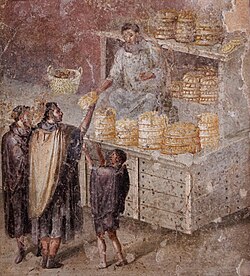
Stand on the quays of imperial Portus and the Roman grain dole stops looking like a simple handout. Ships arriving from North Africa and Egypt had to be unloaded, cargo had to be stored without spoiling, barges had to move it up the Tiber, and officials had to keep track of both public stocks and eligible recipients. The system worked only because agriculture, taxation, private shipping, ports, warehouses and state administration were connected across the Mediterranean.
That is the useful way to approach the cura annonae. It was not identical to the free grain distributions received by part of Rome’s citizen population. It was the broader problem of keeping an enormous city supplied with food. Augustus himself distinguished between emergency responsibility for the grain supply and the distributions he made to the Roman people in his Res Gestae. Archaeology at Portus shows the physical scale of the infrastructure behind that political promise.
This matters because the familiar phrase “bread and circuses” can flatten a complicated institution into a story about emperors buying obedience. The evidence points to something more interesting: a mixed economy in which public authority managed risk, encouraged shipping and distributed grain to a defined group, while private merchants and markets continued to feed much of the city. The question is not simply how Rome gave away wheat. It is how a preindustrial capital made the daily arrival of food into a function of imperial power.
The system behind the monthly ration
The Latin word annona could refer to the annual harvest, the available food supply, its price, or the institutions concerned with provisioning. It did not always mean a free ration. Inscriptions across the empire use the word for local supplies and prices that had nothing to do with the distributions in Rome.
Historians therefore distinguish the broad supply system from the frumentationes, the distributions of grain to registered recipients. The cura annonae sought to keep grain flowing into the capital and markets functioning. The dole was one important part of that responsibility, not the whole of it.
This distinction resolves a common puzzle. Ancient sources and modern estimates suggest that the capital consumed vastly more grain than the state distributed to perhaps 150,000 or 200,000 beneficiaries. The difference was purchased through commercial channels, consumed by people outside the eligibility list, used by institutions, or handled through other arrangements.
Why a City of Rome’s Size Needed Imports
At its imperial height, Rome probably contained close to a million inhabitants, although estimates remain debated. No preindustrial city of that scale could depend only on nearby fields. The population required grain, oil, wine, meat, vegetables, and fuel in quantities that transformed the wider Mediterranean into its supply zone.
Grain was especially important because it stored relatively well and delivered dense calories. Wheat could become porridge, flatbread, or leavened loaves. A disruption in supply therefore threatened more than diet: it could raise prices rapidly, exhaust household reserves, and turn anger toward magistrates or emperors.
Italy produced grain, but elite land use, urban growth, military demands, regional specialization, and the limits of local harvests made imports essential. Sicily, Sardinia, North Africa, and later Egypt became major sources at different periods. Their contribution changed over time rather than following one permanent formula.
From emergency measure to permanent institution
Roman authorities had long intervened when scarcity threatened the city. Magistrates sought overseas supplies, arranged purchases, or sold grain below prevailing prices in emergencies. These measures were episodic and politically charged because food prices affected both poor citizens and the reputation of officeholders.
A major institutional step came with Gaius Gracchus in 123 BCE. His grain law offered eligible citizens a regular quantity at a fixed, subsidized price. It was not initially free, and it did not feed every inhabitant. The measure created a predictable entitlement instead of relying solely on emergency generosity.
Opponents condemned such laws as fiscal irresponsibility or popular bribery. Supporters could argue that predictable prices reduced exploitation and stabilized a capital filled with citizens whose labor and political participation mattered to the republic. Grain policy became inseparable from struggles between popular reformers and senatorial elites.
Later legislation repeatedly altered the terms. Sulla restricted distributions; subsequent leaders restored or expanded them. In 58 BCE, the tribune Publius Clodius Pulcher made the ration free. By the late republic, enrollment had grown dramatically, and control of the list became a central administrative problem.
Who Received the Grain—and Who Did Not
The classic grain dole was tied to civic status, not a modern means-tested definition of poverty. Recipients were generally free adult male Roman citizens registered in the capital. Women, enslaved people, many migrants, children, and noncitizens did not receive independent shares merely because they were hungry.
The monthly quantity commonly associated with the imperial distribution was five modii. Converting that measure into modern weight varies with grain type and calculation, but it represented roughly thirty or more kilograms of wheat. It was a major contribution to a household diet, not necessarily a complete diet by itself.
Augustus Turns a Republican Program into Imperial Duty
Civil war left Rome’s institutions strained and its population dependent on stable provisioning. Augustus inherited an inflated distribution roll and a political culture in which successful rulers were expected to prevent famine. He reduced and reorganized the list, ultimately fixing the number of recipients at about 200,000 according to his own public record.
Augustus sometimes distributed grain at personal expense and sometimes relied on state resources, carefully presenting food security as evidence of restored order. During a severe shortage he assumed extraordinary responsibility, expelled some nonessential residents, and managed supplies directly.
Administrative arrangements evolved. Augustus appointed officials to oversee distributions and eventually established a permanent prefect of the grain supply, the praefectus annonae. Usually drawn from the equestrian order, this prefect became one of the capital’s most consequential administrators.
How grain crossed the Mediterranean and reached Rome
Sicily and Sardinia were important suppliers during the republic, while the fertile regions of North Africa became crucial to imperial Rome. After Octavian annexed Egypt in 30 BCE, the Nile valley added an exceptionally productive and administratively controlled source.
Ancient authors sometimes offer neat fractions, such as Africa supplying two-thirds and Egypt one-third. Such statements are useful evidence but should not be treated as timeless shipping statistics. Harvests varied, provincial boundaries changed, and the mix of tax grain, rent, state purchase, and private commerce shifted.
Much public grain originated as taxation in kind or obligations connected with imperial estates. The state could also purchase supplies. Meanwhile, private grain entered Rome because a huge urban population offered profit. Public and commercial cargo could travel on the same routes and depend on the same ports.
Crossing the Mediterranean
Moving grain by sea was far cheaper than hauling it long distances overland, but it remained risky. Storms, piracy, shipwreck, delay, and seasonal winds threatened cargoes. Sailors preferred the warmer sailing season; winter navigation was possible but dangerous and less predictable.
The Roman state relied heavily on private shipowners, often called navicularii, rather than operating a single enormous government fleet. Contracts and privileges encouraged them to carry public grain. Emperors could offer legal benefits, exemptions, or protection against specified losses.
Claudius is credited with measures designed to make winter or high-risk supply voyages more attractive, including state assumption of certain losses. Details in legal and literary sources are difficult to generalize, but the policy logic is clear: the government shifted risk so merchants would serve the capital.
This partnership complicates the idea of a command economy. The emperor possessed coercive and fiscal power, yet he still needed private capital, expertise, crews, and hulls. Like the much later Hanseatic League, Rome’s supply network depended on negotiated relationships between political authority and commercial specialists.
Ostia, Portus, and the Last Miles to Rome
Ships approaching Rome faced a geographic problem. The mouth of the Tiber at Ostia was exposed, silting, and poorly suited to the largest vessels. Cargo might be transferred offshore into smaller craft, adding cost and vulnerability at precisely the point where grain was closest to the city.
Emperor Claudius began a major artificial harbor north of Ostia, with moles, a basin, and a lighthouse. Trajan later added a sheltered hexagonal basin linked to canals. The complex known as Portus increased capacity and offered safer storage and transfer.
Warehouses at Ostia and Portus held goods moving through the system, although identifying the contents of every ancient building is difficult. Grain leaves less distinctive archaeological debris than olive oil amphorae, so impressive structures should not automatically be labeled public grain depots.
From the coast, grain traveled up the Tiber in smaller vessels, often hauled against the current, and entered warehouses in Rome. The final journey required laborers, boat crews, towpaths, quays, schedules, and security. A successful sea crossing could still be wasted by congestion or spoilage on land.
Storage, Milling, and Distribution Inside the Capital
Once grain reached Rome, it had to remain dry, ventilated, measured, and protected from pests, theft, and fire. Large warehouses, or horrea, formed essential nodes. Some were publicly owned, others private, and many stored multiple commodities rather than serving one exclusive purpose.
Officials tracked quantities and recipients, while workers moved sacks through a chain of handling points. Measurement invited fraud: damp grain weighed more, poor-quality grain could be substituted, and officials or contractors might manipulate accounts. Regulation and inspection were therefore part of provisioning.
For much of the early empire, recipients collected unmilled grain and arranged grinding and baking themselves or through commercial specialists. Over time, milling and baking became more closely integrated with public distribution. In late antiquity, bread increasingly replaced raw grain in the ration.
That change transferred labor and risk. Grain no longer had to be milled by each household, but the state became more dependent on organized bakeries, mills, water power, fuel, and controlled delivery. A more convenient benefit required a more elaborate administration.
Food security as administration and political power
The grain prefect coordinated information and intervention rather than personally directing every sack. His office dealt with supplies, contracts, warehouses, shippers, market conditions, and legal disputes. Subordinates and local officials managed particular stages across Rome’s vast network.
The prefect answered to the emperor, whose public image became tied to abundance. Coins and monuments personified Annona as a woman with grain, a cornucopia, ship’s prow, or lighthouse. These images turned logistics into political theology: prosperity arrived because imperial rule mastered land and sea.
Shortages, Riots, and the Politics of Hunger
Food scarcity could trigger protest quickly. Crowds confronted magistrates, attacked suspected hoarders, or demanded action from emperors. Even rumors of shortage encouraged panic buying and price increases. The political danger came not only from starvation but from the belief that authorities had lost control.
Ancient narratives describe emperors facing abuse in public during crises. Claudius was reportedly pelted with bread during a shortage and responded with measures to encourage shipping. Whether every dramatic detail is reliable, the story reflects a real expectation: the ruler must keep the capital supplied.
Officials could release stocks, import emergency grain, regulate traders, or investigate hoarding. Price controls and coercion might provide short-term relief while discouraging future supply if applied badly. Roman policy therefore oscillated between market support and forceful intervention.
Provisioning was a form of security. The capital contained senators, soldiers, laborers, and a politically expressive plebs. Later Constantinople faced similar pressures, as the Nika Riots would demonstrate in a different context: urban crowds were not passive recipients but actors capable of threatening imperial authority.
The Myth of “Bread and Circuses”
The satirist Juvenal complained that the Roman people, once politically powerful, desired only “bread and circuses.” His phrase remains memorable because it captures elite contempt for mass politics. It is not a neutral statistical description of how ordinary Romans lived.
Recipients still worked. Rome’s lower classes included builders, dockworkers, shopkeepers, artisans, porters, vendors, household servants, and casual laborers. A grain ration reduced food insecurity but did not normally eliminate the need for income, rent, clothing, fuel, oil, vegetables, and other necessities.
The dole was also not simply an emperor’s personal gift to anyone who applauded. It rested on registration, law, taxation, and administrative continuity. Emperors publicized generosity, but citizens could regard regular supply as an obligation of rule rather than optional charity.
Juvenal’s line is best read as political rhetoric. It tells us how one elite writer represented the urban populace. Using it as a complete explanation turns complex citizens into a bribed mob and hides the labor and logistics that made Rome function.
How Much of Rome Did the State Really Feed?
Modern calculations vary because the evidence is fragmentary. Scholars debate Rome’s population, per-person consumption, the capacity of ships and warehouses, the scale of private imports, and how figures in ancient texts should be interpreted.
A list of roughly 200,000 beneficiaries under Augustus was enormous, but it probably represented about a fifth or somewhat more of the total population, depending on the estimate used. Their rations could support dependents, yet many residents remained outside the formal distribution.
Some older reconstructions multiply a standard ration by recipient totals and compare the result with statements about Egyptian or African supply. The exercise is useful, but ancient numbers may be rounded, rhetorical, or drawn from different years. False precision creates confidence the sources cannot sustain.
The safest conclusion is that public distributions consumed a major but minority share of the capital’s grain. The state’s larger importance lay in securing flows, reducing risk, and sustaining infrastructure on which both public and private supply depended.
How the system changed in late antiquity
The annona changed with the empire. In the third and fourth centuries, distributions increasingly included prepared bread rather than only grain. Other commodities such as oil, pork, and wine became associated with state-supported urban rations at various times.
These additions were not one unchanging “Roman welfare package.” Eligibility, quantity, funding, and administrative form evolved. Reforms attributed to emperors such as Aurelian must be interpreted carefully because later sources can compress gradual change into one ruler’s dramatic act.
Constantinople developed its own public grain and bread supply after becoming an imperial capital in the fourth century. Egyptian grain that had once flowed chiefly toward Rome increasingly served the eastern capital, while Rome relied more heavily on North Africa.
Political fragmentation exposed the vulnerability of that dependence. Vandal control of North African territories in the fifth century disrupted western imperial access to a core supply region. Rome’s declining population reduced demand, but diminished state capacity and lost provinces also weakened the old system.
What the evidence can actually prove
Ports, canals, warehouses, bakeries, mills, inscriptions, coins, shipwrecks, and transport containers reveal the physical world of Roman provisioning. Portus in particular demonstrates investment on a scale compatible with a capital drawing supplies from across the sea.
Yet grain is archaeologically elusive. It was carried in sacks or bulk, consumed, burned, or rotted. Olive oil amphorae created lasting debris such as Monte Testaccio; wheat rarely created an equivalent monument. Researchers must combine architecture and environmental evidence with texts that have their own biases.
Legal sources describe privileges and obligations but may record ideals rather than everyday practice. Literary authors favored crises, emperors, and moral judgment. Inscriptions often illuminate individual officials or associations without revealing the system’s entire scale.
The best history therefore works across imperfect evidence. No surviving Roman operations manual explains the annona from field to ration line. Its reconstruction remains an argument built from many local fragments, and disagreements over numbers are part of serious scholarship rather than proof that nothing is known.
Why the annona matters
The Roman grain dole was real, large, and politically important, but it was never a universal income in wheat. It served a defined body of citizens within a city whose wider population still depended heavily on markets, wages, family networks, charity, and private trade.
The cura annonae was broader. It linked provincial taxation and production to private shipping, imperial harbors, Tiber transport, warehouses, mills, bakeries, and distribution records. It succeeded not because the state controlled every transaction, but because public authority organized and supported a mixed system.
Food gave that system its political force. Emperors could claim credit for abundance, while crowds could punish failure through protest. The monthly ration made citizenship tangible, and the harbor at Portus made imperial geography visible in stone and water.
Rome’s achievement should neither be romanticized nor dismissed as bribery. It rested on provincial extraction, unequal status, dangerous labor, and imperial power. Yet it also sustained a city larger than Europe would see again for centuries. The annona shows that empires are held together not only by armies and laws, but by the daily movement of ordinary grain.
Sources and further reading
This article was reviewed against institutional, academic, or primary-source material. These links are provided so readers can check the evidence and explore the subject in greater depth.
- Augustus, Res Gestae – grain distributions and the grain-supply crisis
- University of Southampton – The Portus Project
- University of Southampton – archaeological research on Portus and grain imports
Related reading on Top History Facts: Nika Riots and Hanseatic League