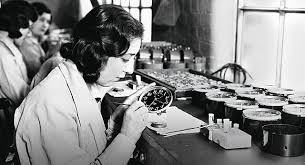
In the 1910s and 1920s, luminous watch and instrument dials were painted by hand. The job required a point fine enough to trace tiny numerals, and in several American factories painters were taught to shape their brushes with their lips. Each touch could transfer a minute quantity of radium-bearing paint into the mouth. Repeated day after day, that practice created one of the defining occupational-health cases of the twentieth century.
The women later remembered as the Radium Girls were not one single group and their legal cases did not unfold in one courtroom. The story stretches across New Jersey, Illinois and other dial-painting centers, and it involves factory managers, physicians, laboratory scientists, lawyers, regulators and workers whose illnesses helped establish how dangerous internally deposited radium could be. A modern review published through the U.S. National Library of Medicine describes thousands of dial workers in the historical research cohort, while a National Park Service account traces their influence on later radiation-safety practice.
That wider history is more revealing than the simplified claim that “the Radium Girls created OSHA.” OSHA would not exist until decades later. Their cases mattered because they helped change the evidentiary and legal landscape: workers forced employers, courts and scientists to confront chronic occupational exposure, and the medical data gathered from dial painters influenced radiation-protection standards long after the factories themselves had changed their methods.
Why luminous paint became an industrial hazard
Marie and Pierre Curie announced the discovery of radium in 1898. In the following decades, the element acquired an extraordinary cultural reputation. Physicians experimented with it in cancer treatment, while advertisers attached “radium” to tonics, cosmetics, water devices, and other products, some containing genuine radioactive material and others little more than a fashionable name.
Luminous paint exploited a specific physical effect. Radium itself did not simply function as green pigment. Radiation from radium excited zinc sulfide in the mixture, causing the material to emit light without first being charged by sunlight. Instruments could therefore remain readable in darkness for years, an obvious advantage in military conditions.
The First World War expanded demand for luminous watches, aircraft instruments, gunsights, and other equipment. After the war, glowing clocks and watches entered civilian markets. Behind that modern convenience stood painstaking handwork: tiny numerals and marks had to be painted accurately, quickly, and in immense quantities.
Why Young Women Painted the Dials
Dial painting was treated as delicate work suited to young women. Employers valued speed, steady hands, and the ability to reproduce fine marks. Many painters were teenagers or in their early twenties, often recruited through relatives and friends. In working-class communities, a clean factory job with comparatively good pay could seem highly desirable.
Piece rates rewarded output. A painter earned according to the number of dials completed, so anything that slowed the brush could reduce wages. The finest work was performed with small camel-hair brushes. Their tips quickly spread after dipping into the watery paint, making it difficult to form narrow lines.
Supervisors taught a technique commonly summarized as “lip, dip, paint.” A worker placed the brush between her lips or touched it with her tongue to restore a point, dipped it into the luminous mixture, and painted the dial. The action was efficient and became routine. Each repetition transferred a little material into the mouth.
Some women also dusted their clothes, hair, nails, or teeth with luminous paint for amusement. That behavior is frequently used to make the story sensational, but it should not shift responsibility onto the workers. They had been assured the material was safe, saw radium promoted as beneficial, and worked in a culture that rewarded close contact with it. The occupational exposure was systematic even for women who never played with the paint.
Three Centers of the American Dial Industry
The best-known New Jersey painters worked for the United States Radium Corporation in Orange. Production began during the wartime boom, and the plant combined dial painting with other radium-related operations. The company sold luminous paint under the name Undark and supplied military and commercial customers.
A separate industry developed around Ottawa, Illinois, where the Radium Dial Company painted faces used by major clock manufacturers. Women there employed similar brush-pointing methods. Later disputes in Illinois followed their own legal route, unfolding years after the first New Jersey illnesses had attracted attention.
“Radium Girls” is therefore a collective label, not the name of a formal organization. It can honor shared experience, but it can also blur distinctions among hundreds or thousands of workers. Not every painter became visibly ill, not every illness had the same latency, and not every affected woman participated in litigation.
How radium exposure became measurable disease
Radium behaves chemically in ways similar to calcium. When swallowed, a portion can enter the bloodstream and become incorporated into bone. Radium-226 has a half-life of about 1,600 years, so biological elimination—not radioactive decay alone—determines how much remains in a living body over time.
Alpha particles emitted during radioactive decay travel only a short distance and cannot penetrate intact skin deeply. That fact sometimes created false reassurance about external handling. Inside bone, however, the short range concentrates damage in nearby cells. Radium also decays through products that include radon gas, which investigators could detect in an exposed person’s breath.
Early symptoms often appeared dental rather than obviously “nuclear.” Teeth loosened, extraction wounds failed to heal, infections developed, and jaw tissue died. Severe anemia, weakened bones, fractures, and systemic decline followed in some cases. Later survivors faced increased risks of bone sarcomas and cancers of tissues near the sinuses and skull.
The pattern was not instantaneous poisoning. Some women became gravely ill within a few years; others developed tumors after long latency; many exposed workers never experienced the same outcome. Dose differed with the quantity swallowed, the duration of employment, work practices, and individual biology. That variability complicated both medical recognition and legal proof.
The First Illnesses and a Search for Causes
In the early 1920s, women from the Orange plant began reporting painful dental and skeletal problems. Amelia Maggia, who had painted dials for several years, died in 1922 at only twenty-four or twenty-five, depending on how age is counted in contemporary records. Other former coworkers suffered similar symptoms, but doctors initially lacked a settled diagnostic category for internal radium poisoning.
The stigma attached to certain diagnoses also became a weapon. Company-aligned claims that some women suffered from syphilis or poor personal health undermined their credibility and reputation. Such explanations were scientifically inadequate, but socially powerful: they converted an emerging workplace pattern into alleged individual moral failure.
The Drinker Investigation and a Suppressed Warning
In 1924, the United States Radium Corporation asked Harvard public-health specialists Cecil Drinker and Katherine Rotan Drinker to investigate the Orange plant. Their work found serious contamination and supported a connection between workplace conditions and the painters’ illnesses. They recommended protective measures.
The company disputed or obstructed conclusions unfavorable to it. A version sent to New Jersey labor authorities misrepresented the investigation, and publication of the full findings was delayed amid legal pressure. Alice Hamilton, a leading occupational-health reformer, helped bring attention to the discrepancy.
This episode is sometimes described as proof that everyone in management had always understood every biological consequence of lip-pointing. The evidence supports a more precise accusation. By the mid-1920s, company leaders received strong professional warnings and had ample reason to stop ingestion, reduce contamination, and inform workers. Resistance continued even as illness accumulated.
Harrison Martland Builds the Medical Case
Harrison Martland, chief medical examiner of Essex County, became central to establishing internal radium poisoning as a recognizable occupational disease. Working with other specialists, he examined sick and deceased painters and developed ways to demonstrate radioactivity in breath, tissues, and bone.
His 1925 publications connected the painters’ conditions to radium deposited within their bodies. Exhumed remains provided especially stark evidence: bone samples retained measurable radioactivity years after exposure. The finding explained why symptoms could progress after a woman had stopped painting dials.
Martland’s work helped overturn the argument that external measurements alone showed a safe workplace. A worker might no longer carry dust on her clothing, yet still contain a long-lived internal source irradiating bone and marrow. The distinction between external and internal exposure became fundamental to radiation protection.
From medical evidence to legal action
Grace Fryer spent roughly two years trying to find counsel. In 1927 she joined Katherine Schaub, Edna Hussman, and sisters Quinta Maggia McDonald and Albina Maggia Larice in proceedings against the United States Radium Corporation. Newspapers called them the “Radium Girls,” turning five individuals into national symbols.
The legal obstacles were severe. Occupational disease could appear after the period allowed for filing a claim, making statutes of limitation especially unjust for slow injuries. By 1928, several plaintiffs were bedridden or dependent on braces. Postponement was not neutral when witnesses were dying.
The case ended in a settlement rather than a full trial verdict. Each woman received $10,000, an annual payment of $600 for life, and coverage of specified legal and medical expenses. The corporation did not formally admit liability. For desperately ill plaintiffs, immediate support mattered more than an abstract victory years later.
Calling the settlement a complete triumph overlooks its limits. Money could not remove radium from bone, restore lost health, or provide a sweeping national rule. Yet the case generated publicity, validated the women’s claims, and demonstrated that scientific evidence could overcome attempts to isolate each illness as a private misfortune.
The Illinois Fight and Catherine Donohue
Workers in Ottawa, Illinois, confronted a different company and different compensation procedures. Even after the New Jersey controversy, lip-pointing and hazardous practices persisted. Some Illinois women began seeking help as their teeth, bones, and general health failed.
Catherine Wolfe Donohue became the most visible claimant. Too ill to travel normally, she gave testimony from her home as proceedings before the Illinois Industrial Commission attracted national attention. Other affected women pursued claims alongside her with the help of attorney Leonard Grossman.
In 1938, the commission ruled for the workers. Appeals continued, and the United States Supreme Court later declined to hear the company’s challenge, leaving the lower outcome standing. Donohue did not live to enjoy a long victory; she died in 1938 as the legal struggle continued.
What changed in factories and radiation protection
Preventing ingestion did not require a breakthrough comparable to discovering radium. Factories could prohibit lip-pointing, provide alternative tools, improve ventilation and housekeeping, isolate radioactive material, supply protective clothing, monitor contamination, and train workers honestly.
Evidence from later dial operations showed that better practice sharply reduced severe poisonings. Radium continued to be used in luminous instruments for decades, especially where long-lasting self-illumination was valuable, but workers no longer had to place contaminated brushes in their mouths.
The pattern resembles other public-health crises in which the hazard is initially invisible and its effects delayed. As the history of the Great Smog of London also demonstrates, suffering becomes politically consequential only when measurements, testimony, and public pressure overcome a convenient explanation that nothing decisive can yet be proved.
What their cases changed—and what they did not
A popular claim says the Radium Girls’ lawsuits directly created the Occupational Safety and Health Administration. The chronology does not support that simple statement. Congress enacted the Occupational Safety and Health Act in 1970, more than four decades after the New Jersey settlement, amid a much broader history of labor organizing, industrial disasters, public-health research, and political negotiation.
Workers’ compensation laws also predated the dial-painter cases in many states. The problem was that early systems often handled accidents more easily than diseases with delayed onset. Radium poisoning exposed the inadequacy of rules that demanded claims before science or symptoms made the injury recognizable.
The women’s actual legal legacy is still substantial. Their cases strengthened public acceptance that employers could be responsible for occupational disease, highlighted the need to accommodate latency, and showed how corporate control of research could distort regulation. The publicity supported safer practices and recognition of radium poisoning as compensable harm.
Bodies Turned into Long-Term Scientific Evidence
Surviving dial workers were followed for decades by researchers studying internally deposited radionuclides. Scientists measured radium body burdens, reconstructed employment histories, recorded cancers, and examined how risk changed with dose and time. These data contributed to recommended limits for occupational exposure and to models of radiation effects on bone.
The research had genuine protective value for later workers and patients. It also raises ethical questions. Many women had entered the factories without informed consent to danger; afterward, their bodies became unusually valuable scientific records. The line between medical care and data collection was not always clear by modern standards.
The strongest conclusions do not require claiming that every exposed painter died from radiation. High internal doses produced characteristic bone injuries and cancers, risk increased with exposure, and improved controls prevented recurrence on the same scale. Uncertain totals should not be replaced by dramatic but unsupported numbers.
Why the workers struggled to be believed
The dial painters’ age and gender shaped both their employment and the response to their illnesses. Employers described the work as feminine precision labor and benefited from a workforce with limited industrial power. When women challenged medical and corporate authority, they faced assumptions that they misunderstood science or exaggerated symptoms.
Class also mattered. A well-paid factory job could support a family, while litigation threatened income and future employability. Companies possessed lawyers, scientific contacts, and control over workplace records. Sick former workers had medical bills and shrinking time.
Recognizing these inequalities does not mean the women lacked agency. They shared information, sought doctors, found reform allies, persisted through postponements, and made private illness public. Their achievement was not passive martyrdom; it was the organized production of evidence under conditions designed to discredit them.
Myths, Memory, and Radioactive Graves
Stories about the Radium Girls often say their bodies “glow in their graves.” Human remains do not necessarily emit visible green light. The glow of dial paint came mainly from zinc sulfide excited by radiation, and that phosphor degraded. The historically important fact is that radium-226 can remain detectable in bones for an extraordinarily long time.
Another myth presents the industry as harmless until no one could have known better. Early knowledge was incomplete, but radiation injuries and laboratory precautions existed before the lawsuits. By the time companies received workplace studies and multiple illnesses appeared, continued denial cannot be explained simply as innocent ignorance.
A legacy that reached beyond the courtroom
Former factory locations left environmental problems as well as personal ones. Radium contamination in buildings and soil required investigation and cleanup long after the dial industry declined. Old luminous instruments can still present hazards if damaged, dismantled, or handled without knowledge of their materials.
The scientific lesson remains relevant: the route of exposure can matter as much as the radiation source. A material that appears manageable outside the body may be profoundly dangerous when inhaled or swallowed. Protection must consider chemistry, biological retention, and cumulative dose rather than a single reading at the edge of a workspace.
The institutional lesson is broader. Research funded or controlled by an interested company needs independent scrutiny. Workers must receive understandable information, and rules for compensation must account for diseases that emerge years after exposure. Delayed harm should not become a legal escape route.
Most importantly, safety history is not a smooth march from ignorance to regulation. Evidence can exist without action; simple controls can remain unused; and legal recognition can arrive after victims die. The Radium Girls changed that history because they forced hidden exposure into medicine, law, and public debate.
What the Radium Girls changed
The luminous dials produced in Orange, Ottawa, and Waterbury represented modern technology, military usefulness, and consumer convenience. Their glow depended on an industry that placed radioactive paint in the hands—and repeatedly in the mouths—of young workers told they were safe.
When disease appeared, the women faced more than a difficult diagnosis. They confronted suppressed evidence, damaging rumors, short filing deadlines, fragmented state law, and companies capable of delaying responsibility. Medical investigators established how radium lodged in bone; workers and lawyers made that knowledge matter publicly.
Their cases did not single-handedly create OSHA, immediately end radium use, or compensate every harmed painter. They did help transform occupational disease from an individual misfortune into a question of corporate duty and public policy. Their bodies also yielded radiation data that protected later generations, often at a cost they had never agreed to bear.
The enduring meaning of the Radium Girls lies in that combination of science and testimony. Instruments could measure radiation, but measurements alone did not produce justice. The women gave the danger names, faces, and legal force. What their work illuminated most clearly was not a watch dial, but the human price of treating uncertainty as permission to do nothing.
Sources and further reading
This article was reviewed against institutional, academic, or primary-source material. These links are provided so readers can check the evidence and explore the subject in greater depth.
- U.S. National Park Service – Radium Girls and later radiation-safety practice
- National Library of Medicine / NIST – The National Bureau of Standards and the Radium Dial Painters
- NCBI Bookshelf / ATSDR – health effects of radium exposure in dial painters
- National Library of Medicine – review of the U.S. radium dial-worker cohort
Related reading on Top History Facts: Kyshtym Disaster and Great Smog of London