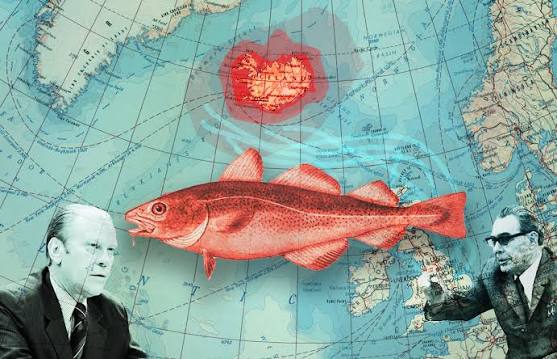
In the winter darkness of the North Atlantic, a small Icelandic patrol ship approached a British trawler and dropped a strange steel device into the water. The tool caught the trawler’s towing wires, sliced them, and sent an expensive net sinking away from its catch. British frigates, ocean-going tugs, and trawler captains responded by blocking, pursuing, and sometimes ramming the Icelandic vessels. No government declared war, yet ships collided, warning shots were fired, diplomatic relations were broken, and NATO feared a quarrel between allies could weaken its defenses against the Soviet Union.
These confrontations became known as the Cod Wars. Between 1958 and 1976, Iceland repeatedly expanded the fishing zone around its coast, while Britain tried to preserve access for its distant-water fleet. Iceland possessed no conventional navy and faced a state with one of the world’s most powerful maritime traditions. Nevertheless, it secured recognition of a 200-nautical-mile fishery zone. The outcome was not a fairy tale in which a few gunboats simply humiliated the Royal Navy. Iceland prevailed because fish were essential to its survival, international law was moving in its direction, and its strategic position gave a small country unusual leverage during the Cold War.
Why Cod Mattered More Than the Nickname Suggests
The term “Cod Wars” sounds comic, and contemporary newspapers often treated the confrontations as maritime theater. For Iceland, however, the dispute concerned the economic foundation of an independent society. Fish and fish products generated a large share of export earnings, provided employment, and supplied the foreign currency needed to buy fuel, machinery, and other imports. A serious collapse in catches threatened far more than one industry.
Cod was especially valuable, but the conflict concerned control over fisheries generally. Icelandic policymakers argued that foreign fleets equipped with increasingly efficient trawlers could exhaust stocks close to the island. Conservation and sovereignty became inseparable. If Iceland could not decide who harvested nearby waters, many Icelanders believed that political independence would remain incomplete.
Britain’s interests were also concrete. Distant-water trawlers from ports such as Hull, Grimsby, and Fleetwood had worked the grounds around Iceland for generations. Their voyages supported crews, dock workers, merchants, processing plants, repair yards, and entire neighborhoods. British officials did not merely defend a taste for fish and chips; they faced organized communities whose livelihoods depended on access. This unequal dependence shaped the contest. Iceland risked a national economic crisis, while Britain faced severe but geographically concentrated losses.
The Dispute Began Before the First Cod War
For much of the nineteenth and early twentieth centuries, many coastal states claimed only a narrow belt of territorial sea, commonly three nautical miles. The rule was never as universal or timeless as later summaries imply, but it suited maritime powers that wanted broad access to fishing grounds and shipping lanes. Technological change made that arrangement harder to sustain. Steam trawlers could travel farther, tow heavier gear, and remove fish on a scale earlier fleets could not match.
Iceland had moved gradually toward greater control. In 1952 it extended its fishery limit from three to four nautical miles, using new baselines drawn around the coast. Britain protested and responded with restrictions on Icelandic fish landings in British ports. That episode is sometimes called a preliminary or early Cod War, although the standard three-war chronology begins in 1958.
The First Cod War: The Twelve-Mile Limit
On 1 September 1958, Iceland’s new 12-nautical-mile fishery limit took effect. Britain refused to recognize the unilateral extension and sent Royal Navy vessels to protect British trawlers operating within the disputed zone. Iceland’s Coast Guard attempted to order the trawlers away, board vessels, or threaten arrest. Frigates maneuvered between patrol ships and fishing boats, turning enforcement into a contest of nerves.
There were collisions, dangerous close passes, and limited exchanges of fire, but both governments tried to prevent deaths and uncontrolled escalation. The description “war” was never legally accurate. Britain and Iceland remained NATO allies, diplomatic relations continued, and neither treated the dispute as conventional armed conflict. Historians more precisely describe the Cod Wars as militarized interstate disputes.
A settlement emerged in 1961. Britain accepted the 12-mile limit, while Iceland agreed that certain future disputes over extensions could be referred to the International Court of Justice. The compromise did not settle the underlying issue. Iceland had demonstrated that sustained resistance could make British protection operations politically expensive, while changing attitudes toward coastal-state rights suggested that wider zones would eventually gain acceptance.
The Law of the Sea Was Moving Toward Iceland
The Cod Wars unfolded during a global transformation in maritime law. Newly independent and coastal states challenged rules that disproportionately benefited countries with large long-distance fleets. Governments claimed wider rights over fisheries, oil, minerals, and other resources. The debate was not simply Iceland against Britain; it concerned who would govern enormous spaces previously treated as open sea.
By the 1970s, the trend toward 200-nautical-mile exclusive economic zones was unmistakable. The concept would later be codified in the 1982 United Nations Convention on the Law of the Sea. Iceland acted ahead of final codification, but it was not swimming against history. This matters because popular retellings sometimes imply that Reykjavík won solely through bluff. Its threats were effective partly because other states were already preparing to claim broader maritime jurisdiction.
The Second Cod War and the Fifty-Mile Zone
Iceland extended its fishery jurisdiction to 50 nautical miles in September 1972. Britain again rejected the claim, and West German vessels were also affected. At first London tried to avoid sending warships, relying on civilian support vessels and negotiations. The confrontation nevertheless became more disruptive than the first because the Icelandic Coast Guard introduced an effective new instrument: the trawl-wire cutter.
The cutter was towed across the path of a trawler’s gear. When used successfully, it severed the wires connecting the ship to its net. The loss cost time, equipment, and catch without requiring the Coast Guard to seize a much larger vessel. British trawler crews improvised defenses, while tugs and later Royal Navy frigates attempted to shield fishing groups. Ramming became a recurring tactic and an equally recurring subject of competing accusations. Each side often claimed the other ship had turned deliberately.
The danger was real despite restraint. In 1973, Icelandic engineer Halldór Hallfreðsson died from electrocution while working with welding equipment after seawater entered a damaged compartment. He is generally identified as the only confirmed fatality directly associated with the Cod Wars. His death undercuts the idea that the disputes were harmless comedy, even though the confrontations never produced battle casualties on the scale implied by the word “war.”
Net Cutters Changed the Balance at Sea
Britain enjoyed overwhelming conventional naval superiority, but destroying the Icelandic Coast Guard was never a politically acceptable objective. Royal Navy captains had to protect trawlers while avoiding the appearance of a major power attacking a far smaller ally. Icelandic commanders, by contrast, did not need to defeat British frigates. They needed to make fishing inside the disputed zone costly, uncertain, and diplomatically embarrassing.
The trawl cutter was well suited to that limited strategy. A patrol vessel could threaten the economic purpose of the British presence without trying to sink ships. Even an unsuccessful attempt forced escorts and trawlers to maneuver defensively. Collisions damaged hulls and equipment, drew news coverage, and raised the possibility that a miscalculation in rough seas would kill sailors.
The 1973 Compromise Solved Little
By autumn 1973, NATO officials were deeply involved in mediation. Icelandic politicians faced strong domestic pressure not to retreat, while Britain wanted to protect both the fishing fleet and the Western alliance. A temporary agreement allowed a limited number of British vessels to operate in specified areas within the 50-mile zone and placed a ceiling on their catch. Royal Navy ships withdrew.
Most important, the world was already moving beyond 50 miles. Negotiations at the Third United Nations Conference on the Law of the Sea strengthened expectations that coastal states would acquire resource rights out to 200 nautical miles. When the temporary Anglo-Icelandic agreement approached expiration in 1975, both governments knew the next confrontation would occur under very different legal and diplomatic conditions.
The Third Cod War: The Two-Hundred-Mile Claim
Iceland declared a 200-nautical-mile fishery limit in 1975. Britain accepted the growing international case for wide economic zones in principle but resisted being immediately excluded from grounds on which its distant-water fleet depended. Negotiations failed to bridge the disagreement over allowable catch, access, and transition. Coast Guard vessels resumed cutting trawls, and Britain deployed frigates and powerful civilian tugs.
The sea confrontations became frequent and aggressive. Ships struck one another in maneuvers that each side described as defensive. Hulls, rails, antennas, and other equipment were damaged. Warning shots were fired in some incidents, and sailors were injured. Claims that the Cod Wars were completely bloodless are therefore misleading, even though deliberate lethal force remained tightly constrained.
NATO Turned Geography Into Icelandic Leverage
Iceland had no standing army, but its location was extraordinarily important. The island sat near the Greenland-Iceland-United Kingdom gap, a North Atlantic passage watched closely by NATO planners tracking Soviet submarines and protecting reinforcement routes between North America and Europe. The American-operated air base at Keflavík strengthened surveillance and defense across the region.
Icelandic governments repeatedly linked the fishing dispute to security cooperation. Threats to reconsider NATO membership or the American defense presence were sometimes inconsistent and shaped by domestic coalition politics, but they could not be dismissed. Even a small chance of losing facilities in Iceland alarmed allied governments. The United States and NATO therefore had reasons to press Britain toward compromise.
Breaking Diplomatic Relations Raised the Stakes
In February 1976, Iceland broke diplomatic relations with Britain. This was an extraordinary step between NATO members and a clear signal that ordinary bargaining had failed. Consular and practical contacts continued through other channels, but the rupture made the alliance’s embarrassment visible to the world.
British officials also faced growing recognition that a 200-mile regime was likely to become normal. Parliamentary debates in 1976 discussed extending Britain’s own fishing limits to 200 miles or to median lines between neighboring states. London’s objection was increasingly about timing, historic access, and protection of affected communities rather than permanent defense of narrow zones everywhere.
On 1 June 1976, the governments reached an agreement. Britain recognized Iceland’s 200-mile limit, while a restricted number of British trawlers received temporary access under defined conditions for a short transition. The settlement effectively ended centuries of British distant-water fishing near Iceland. Diplomatic relations were restored, but the economic consequences would continue.
Why Iceland Won Without Defeating the Royal Navy
The simplest explanation—Iceland threatened NATO and Britain surrendered—misses the interaction of several advantages. First, Iceland valued the outcome more. Fisheries were central to the national economy, whereas the British costs, though devastating in particular ports, were distributed across a much larger state. Reykjavík could sustain greater political unity around exclusion than London could build around indefinite naval protection.
Second, Iceland chose tactics that exploited legal and political limits on British power. Coast Guard vessels could cut gear, challenge trawlers, and create incidents without giving Britain a plausible reason to use overwhelming force. The Royal Navy could win a battle that neither government wanted, but it could not convert superiority into an acceptable political settlement.
Third, time favored Iceland. Wider coastal jurisdiction was gaining international support, fish stocks required management, and Britain itself was moving toward a 200-mile zone. NATO geography added leverage at decisive moments. Iceland did not prove that small states always defeat larger ones. It showed that power depends on the issue, alternatives, alliances, legitimacy, and willingness to absorb costs—not only on the number of ships available.
British Fishing Ports Paid the Heaviest Price
National-level accounts often end with Iceland’s diplomatic victory, but communities in northern England experienced the settlement as economic loss. Hull, Grimsby, and Fleetwood had developed around distant-water trawling. When access to Icelandic grounds closed, vessels were withdrawn, crews lost work, and associated trades contracted. The change combined with depleted stocks, rising operating costs, technological shifts, and evolving European fisheries policy.
The contrast explains why the same events occupy different national memories. In Iceland they are celebrated as a successful defense of resources and sovereignty. In Britain they can appear as a story of governmental retreat and neglected fishing towns. Both memories contain truth, but neither replaces analysis of conservation, law, and economic change.
Conservation Was Real, but Not Politically Neutral
Iceland consistently presented wider jurisdiction as necessary to protect cod stocks. The argument was not invented: both Icelandic and British experts recognized pressure on the fishery and the need to control catches and juvenile harvests. Open access made conservation difficult because each fleet feared that restraint would merely leave more fish for competitors.
Yet conservation did not automatically dictate that Iceland should receive virtually the entire allowable catch. British negotiators argued that historic users should share the burden of reductions and retain transitional access. Icelandic leaders treated coastal dependence and national ownership as giving their fleet priority. Scientific concern and distributive conflict were intertwined.
The later 200-mile exclusive economic zone system created clearer responsibility, but national control alone does not guarantee sustainability. Governments can still set excessive quotas or distribute fishing rights unequally. The Cod Wars helped establish who could regulate the waters around Iceland; they did not permanently solve every ecological or social question within them.
Common Myths About the Cod Wars
The first myth is that Iceland defeated Britain in a conventional naval war. It did not. No war was declared, and neither side attempted to destroy the other’s armed forces. The Royal Navy’s mission was limited protection, while the Coast Guard pursued enforcement and disruption. The outcome was negotiated under political constraints.
The second myth is that nobody was hurt. Numerous sailors were endangered and some were injured; one Icelandic engineer died in an accident following damage during the 1973 confrontation. The restraint that prevented greater loss should not turn hazardous collisions into slapstick.
A third myth is that a single NATO threat decided everything. Security leverage mattered, but so did Iceland’s economic dependence, domestic unity, trawl-cutting campaign, conservation case, and the emerging international consensus behind 200-mile zones. Finally, the disputes were not simply a greedy contest over abundant fish. They arose because modern industrial fishing had made the sea’s resources visibly finite.
How the Cod Wars Reshaped Maritime Sovereignty
Britain soon adopted legislation enabling a 200-mile fishery limit of its own, bounded by median lines where neighboring states were closer. Other governments made similar moves, and the exclusive economic zone became a core feature of modern maritime law. The zone does not convert all waters into territorial sea: foreign ships retain navigation rights, while the coastal state receives defined authority over natural resources and related economic activities.
Iceland was not solely responsible for this global change, but its confrontations dramatized why the old system was breaking down. A resource-dependent coastal state demanded regulatory control against a powerful long-distance fleet and succeeded before the new rules were fully codified. The dispute demonstrated how legal change often occurs through unilateral claims, resistance, negotiation, and eventual general acceptance.
The victory became part of Iceland’s modern national identity, alongside other episodes showing how the island’s history was shaped by its environment—from fisheries to the Laki eruption. Control of the surrounding sea remains politically sensitive because it represents both economic security and the authority to make national choices.
What the evidence can support
The Cod Wars were dramatic enough to earn their name, but understanding them requires looking beyond ramming ships and severed nets. Iceland never conquered British forces. It defined a narrow objective, made continued foreign fishing increasingly costly, and linked the dispute to a legal transformation already underway. Britain could deploy more ships, yet it could not use their full power without damaging an alliance, international standing, and interests larger than the catch itself.
Iceland’s success also carried no universally happy ending. The 200-mile zone strengthened national control and conservation capacity, while British fishing communities absorbed painful losses. Later quota systems created their own debates over ownership and inequality. Sovereignty determined who would make the decisions, not whether every decision would be wise.
The enduring lesson is that small states are not powerful in the same way as great powers, but they are not powerless. When dependence creates resolve, geography creates leverage, tactics fit political constraints, and international norms move in the same direction, a patrol service with a net cutter can achieve what a fleet of battleships might not. That is how Iceland won the Cod Wars without ever fighting a formal war.
Research and further reading
For readers who want to verify details or continue researching this subject, these external reference collections provide useful starting points: