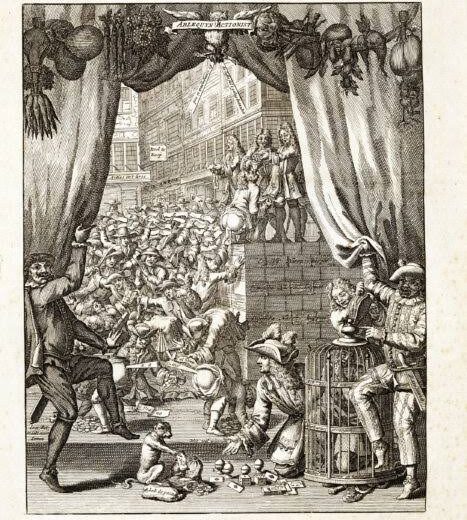
Paris in 1719 and 1720 experienced something new: public finance, paper money, colonial speculation and share trading became parts of the same experiment. Investors crowded around the market for shares in John Law’s company while banknotes expanded the supply of money and the French state tried to convert an enormous inherited debt into equity. The resulting boom is remembered as the Mississippi Bubble.
Calling it a bubble is useful, but it can also hide what John Law was attempting. The scheme was not merely a fraudulent company selling imaginary riches. Law combined a bank, a chartered commercial company, tax revenues and government debt into a system intended to make French credit more liquid and cheaper to service. A contemporary account preserved by the Library of Congress shows how closely the Mississippi Company was associated with Law’s monetary experiment, while economic historians still debate how irrational the boom really was.
The collapse came because confidence in several promises had become interdependent. Company shares depended on expectations of future revenue; banknotes depended on confidence in convertibility and policy; and the state depended on both institutions to restructure its finances. Once officials tried to control share prices and the quantity of paper money simultaneously, the system’s contradictions became impossible to hide. The useful historical question is therefore not “how could people be so foolish?” but how an ambitious financial reform turned market confidence into a single point of failure.
The fiscal crisis that made radical reform attractive
When Louis XIV died in 1715, France possessed great military prestige and a badly damaged balance sheet. Decades of war, especially the War of the Spanish Succession, had left the monarchy with a heavy debt burden, irregular revenues, and expensive short-term obligations. Creditors distrusted royal promises because the crown had repeatedly manipulated coinage, delayed payments, and imposed partial defaults.
Government finance was fragmented. Tax collection depended heavily on private financiers and tax farmers, while many offices and revenue rights had been sold in advance. Philippe II, Duke of Orléans, governed as regent for the child Louis XV and inherited the problem. Conventional remedies—spending cuts, inquiries into financiers, debt reductions, and coin alterations—could not easily restore growth and credibility. This was the opening for John Law, who promised that better money and more abundant credit could revive commerce while making the debt manageable.
John Law Before the Mississippi System
Law was born in Edinburgh in 1671 into a family connected with goldsmith banking. He studied probability, commerce, and monetary questions, but his early life was hardly that of a respectable civil servant. In London he killed Edward Wilson in a duel in 1694, was convicted of murder, escaped custody, and spent years moving through European financial centers. Gambling gave him both notoriety and practical experience with risk, odds, and liquidity.
In Money and Trade Considered, published in 1705, Law argued that a shortage of circulating money could restrict employment and exchange. He distinguished money’s economic function from the intrinsic metal contained in coins and proposed institutions capable of expanding credit. Not all of his early plans matched the system later attempted in France, and it is misleading to treat the book as a blueprint for fraud. Law was a serious monetary thinker whose ambition and confidence eventually exceeded the safeguards surrounding his experiment.
The Banque Générale and the Appeal of Paper Notes
With the regent’s backing, Law established the privately owned Banque Générale in 1716. It accepted deposits, discounted commercial bills, and issued notes redeemable in coin. The notes gained credibility partly because taxes could be paid with them and because they promised a stable unit of account despite changes in the metallic currency. For merchants, reliable notes could be more convenient than moving bags of uneven and frequently revalued coins.
The bank’s early success was real. Notes circulated beyond Paris and improved some transactions. In late 1718 the institution became the crown-owned Banque Royale, with its notes guaranteed by the king. That change increased its authority but also tied monetary credibility directly to royal policy. Calling it France’s first modern central bank is tempting but imprecise: it issued widely used notes and served the state, yet it lacked the independence, regulatory structure, and lender-of-last-resort responsibilities associated with later central banks.
How the Mississippi Company became part of the state
In 1717 Law reorganized a company holding rights to French Louisiana as the Company of the West, commonly called the Mississippi Company. Louisiana then covered an immense claimed territory in North America, but French settlement and revenue remained limited. The company received monopolies and administrative privileges intended to turn colonial trade into a profitable enterprise.
Law steadily absorbed other companies and concessions. The enlarged organization gained rights connected with tobacco, trade with Africa and Asia, the royal mint, and eventually major tax-collection functions. By 1719 it was generally known as the Company of the Indies. This was more than a speculative shell. It became a sprawling public-private corporation expected to manage colonial commerce, collect state income, service debt, and reward shareholders. The breadth of those functions made the scheme impressive—and dangerously difficult to value or govern.
The Colonial Dream and the Reality of Louisiana
Promoters presented Louisiana as a landscape of abundant mines, fertile land, and commercial opportunity. Printed reports and imagery encouraged investors to imagine rapid colonial profits. Some claims were exaggerated, and the territory could not generate cash at the pace implied by soaring share prices. Settlement faced disease, supply failures, conflict, and enormous transportation costs.
Yet describing Louisiana as completely worthless is also wrong. New Orleans was founded during the Law period, colonial migration increased, and the company’s privileges had potential long-term value. That expansion carried a human cost often omitted from financial narratives. Coerced settlers were transported, Indigenous peoples faced growing French intrusion, and the company participated in the Atlantic slave trade, bringing enslaved Africans to Louisiana. The speculative vision depended on imperial extraction and forced labor, not merely clever trading on a Paris street.
The Debt-for-Equity Conversion
Law’s decisive proposal was to refinance the monarchy’s liabilities through company shares. Investors could use forms of government debt to subscribe for new issues, converting creditors of the crown into shareholders in a corporation that would receive state revenues and privileges. If the company earned enough and the state paid its obligations reliably, lower interest costs and expanding commerce might support the arrangement.
The mechanism resembled other early eighteenth-century debt conversions, including Britain’s later South Sea scheme. France’s version was far more comprehensive. The company took over a huge share of government debt while the bank expanded notes that helped investors purchase shares. The rising share price made further issues appear attractive, and further issues financed the conversion. The system therefore contained a feedback loop: public credit, company valuation, and paper money increasingly depended upon one another.
From financial reform to speculative boom
Mississippi shares originally had a nominal price of 500 livres. Through successive issues, installment plans, and intense demand, quoted prices rose many times above that level, reaching around 10,000 livres at the height of the boom in late 1719 or early 1720. Exact peaks vary among sources because trades occurred in a disorderly market and different contracts did not always represent identical claims.
The Rue Quincampoix became famous for crowds and sudden social mobility. Contemporary anecdotes describe servants becoming wealthy, aristocrats bargaining with brokers, and strangers renting tiny rooms merely to conduct trades. Some stories were embellished by later writers, but the participation of new investors and the extraordinary rise in prices are well documented. Easy credit and part-paid subscriptions magnified demand. Buyers could control valuable shares without paying the full price immediately, increasing both potential gains and exposure to reversal.
Banknotes, Liquidity, and Inflation
The Banque Royale issued growing quantities of notes as the company absorbed debt and supported the share market. More liquidity made transactions easier and helped push asset prices higher. Law believed an expanding economy could use a larger money supply without destructive inflation. But the growth of notes outpaced the system’s ability to maintain confidence and produce corresponding goods, tax revenues, or colonial profits.
Prices rose, and holders of paper wealth increasingly tried to convert gains into land, luxury goods, foreign exchange, or metallic coin. The bank could not redeem every note at its stated value if a mass of holders demanded specie simultaneously. Authorities responded with restrictions on gold and silver holdings, changes to coin values, and efforts to channel wealth back into notes and shares. Measures designed to protect the system advertised its vulnerability instead.
Why the System Was More Than a Simple Ponzi Scheme
Modern retellings sometimes call Law’s project a Ponzi scheme. The label is rhetorically powerful but historically loose. The company owned monopolies, collected taxes, operated colonial ventures, and received payments from the state. Investors were not promised returns from a fictitious business with no assets. France also received a genuine restructuring of public liabilities.
The deeper problem was that the system used monetary expansion and policy power to sustain a valuation disconnected from plausible near-term earnings. Law occupied overlapping roles as banker, company director, and, briefly in 1720, controller general of finances. Rules could be altered to defend the share price, while the bank financed demand for the company whose shares supported the debt conversion. It was an innovative but conflict-ridden attempt at national financial engineering, not merely a private confidence trick.
The Merger That Concentrated Every Risk
In early 1720 the bank and company were formally brought together more closely. Law now stood near the center of French monetary policy, colonial commerce, tax revenue, and debt management. Supporters saw integration: profits and public income would secure shares and notes. Critics saw circular accounting, because the same state promises supported institutions that were supposed to secure the state.
Confidence became the essential reserve. As long as investors preferred shares and notes, the system could continue refinancing itself. When they preferred coin, land, or foreign assets, every component came under pressure at once. A modern diversified financial system separates functions partly so one failure does not automatically destroy all others. Law’s system concentrated them, leaving no independent institution able to restore trust when the company price and banknote value began falling together.
Why confidence broke in 1720
Law attempted to manage the decline rather than permit a sudden crash. A decree of 21 May 1720 announced a staged reduction in the official value of company shares and banknotes. In theory, coordinated deflation could align paper claims with economic reality. In practice, the government had just told holders that their officially supported wealth would be cut. Public outrage was immediate, and the decree was revoked within days.
The reversal made policy appear unstable. Investors rushed to escape paper assets, while additional decrees alternately restricted payments, reorganized trading, and adjusted monetary values. Shares continued falling. Crowds gathered at payment offices, and a deadly crush occurred in Paris in July; contemporary reports establish fatalities, although later accounts disagree on the number. The crisis was therefore not a single-day “pop” but a prolonged breakdown in which improvised rescues repeatedly damaged credibility.
Law’s Fall and the Liquidation
By the end of 1720, Law had lost political protection and public trust. He left France in December with limited portable wealth, eventually settling in Venice, where he died in 1729. The popular image of a mastermind escaping with France’s treasure is inaccurate. His personal fortune was entangled with the system, and he spent his final years seeking a return to influence rather than enjoying the secure proceeds of a calculated swindle.
French authorities then conducted a vast liquidation known as the visa. Claims were examined, paper holdings converted or reduced, and the public debt reorganized. Outcomes varied: some early sellers preserved fortunes, late buyers suffered, and politically connected participants could defend themselves better than ordinary holders. The company itself did not simply vanish. Its viable overseas operations survived reorganization and continued as the French Indies Company, separated from the grand monetary experiment.
What historians still debate about the bubble
Historians and economists disagree over how to interpret the extraordinary prices. The traditional account emphasizes irrational speculation, misleading promotion, and uncontrolled note issuance. Revisionist work asks whether investors rationally valued the company’s tax privileges, debt-service income, monopoly rights, and government support. Some price increases could reflect new information about a radical reorganization rather than pure delusion.
That debate does not require choosing between “fundamentals” and “mania” as absolute opposites. The company held real assets and exceptional powers, but policy deliberately encouraged a price high enough to facilitate debt conversion. Leverage, scarce information, international capital flows, and expectations of official support drove prices beyond what colonial earnings alone could justify. A bubble can form around an enterprise with genuine value; the relevant question is whether market prices rest on sustainable cash flows and credible institutions.
A European Crisis, Not an Isolated French Folly
The year 1720 also brought the South Sea Bubble in Britain and speculative surges in Dutch markets. Investors and funds moved across borders. The apparent success of Law’s system influenced British proposals, while changing opportunities redirected capital from Paris toward London and Amsterdam. Research on securities beyond the two famous companies shows a broad international boom rather than two sealed national episodes.
The comparison is revealing. Britain and France both tried to convert public debt through privileged companies, but their institutions and post-crash settlements differed. Britain’s parliamentary system and Bank of England survived the South Sea crisis, while France’s experiment had fused the note-issuing bank more tightly with the company and royal state. The Darien Scheme offers another reminder that early modern investment disasters were shaped by state power, imperial ambition, and limited information as much as by personal greed.
Did the Bubble Cause the French Revolution?
A popular long-range story claims that Law’s collapse bankrupted France and led directly to the Revolution of 1789. The dates alone warn against this shortcut: almost seven decades separated the events. France continued borrowing, waging wars, reforming taxes, and expanding its economy after 1720. The fiscal crisis of the 1780s had more immediate causes, especially later war debts and the monarchy’s inability to restructure taxation.
The Mississippi collapse nevertheless left institutional and cultural consequences. It damaged trust in note-issuing banks, joint-stock finance, and ambitious state credit schemes. Banque de France histories note that a durable central bank was not established until 1800, though Law’s failure was not the only reason for the delay. Memories of confiscation, unstable decrees, and depreciating paper influenced later political attitudes. The bubble belongs in the Revolution’s financial background, not as its singular cause.
John Law after the crash
Law was neither a prophet defeated only by timid officials nor a cynical adventurer who understood nothing about money. He recognized that credit could mobilize idle resources, that paper claims could reduce dependence on coin, and that public debt could be reorganized through market institutions. Modern economies routinely use bank money, central-bank balance sheets, and securities backed by future public revenues.
His failure shows that those tools depend on limits, transparency, and credible governance. The quantity of claims cannot expand indefinitely without regard to prices, redemption promises, or productive capacity. A policymaker who simultaneously controls the currency, the market-support operation, the tax contractor, and the principal speculative asset faces fatal conflicts. Law’s ideas were modern in important ways; the concentration of power used to implement them was equally modern as a warning.
Why the Mississippi Bubble still matters
The Mississippi Bubble was not merely a craze for imaginary American riches. It was an audacious attempt to solve France’s debt crisis by binding together a bank, paper currency, colonial monopolies, tax revenue, and a giant debt-for-equity exchange. For a short period, the design lowered apparent financing costs, increased liquidity, and persuaded Europe that France had discovered a new financial future.
The system failed because every promise reinforced every other promise until confidence moved in reverse. Falling shares threatened the bank; distrust of notes intensified demand for coin; restrictive decrees revealed official fear; and policy reversals destroyed the credibility needed to hold the structure together. The confirmed history is dramatic enough without depicting Law as a simple conman or tracing a straight line to 1789. His experiment demonstrated both the creative power of finance and the danger of making a nation’s money, debt, and speculative market depend on the same fragile belief.
Sources and further reading
This article was reviewed against institutional, academic, or primary-source material. These links are provided so readers can check the evidence and explore the subject in greater depth.
- Library of Congress – contemporary account of the Mississippi Company and John Law
- Economic History Association (EH.Net) – discussion of the early financial bubbles and John Law
- Mississippi Department of Archives and History – John Law and the Mississippi Bubble
Related reading on Top History Facts: Darien Scheme and Roman Grain Dole