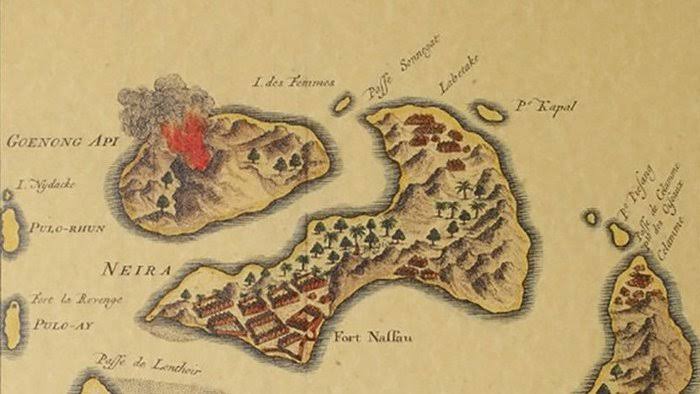
A spice small enough to rest in the palm of a hand once tied together Indonesian growers, Asian merchants, European consumers, armed corporations, and enslaved laborers. Nutmeg did not become globally valuable because Europeans “discovered” it. Long before Dutch ships reached eastern Indonesia, the people of the Banda Islands cultivated nutmeg and moved it through commercial networks stretching across the Indian Ocean. What changed in the seventeenth century was not the existence of the trade, but an attempt to make it exclusive.
In 1621, forces of the Dutch East India Company under Governor-General Jan Pieterszoon Coen conquered the Banda Islands. Villages were destroyed, leaders executed, and most of the indigenous population killed, enslaved, deported, or driven into flight. The company then reorganized the islands as a plantation zone designed to protect a nutmeg monopoly. The Banda Islands massacre was therefore more than an exceptionally brutal campaign. It was the violent construction of a new economic system whose profits depended on controlling plants, land, movement, and labor.
Why Nutmeg Grew at the Center of a Global Trade
The Banda Islands form a small volcanic archipelago in what is now Indonesia’s Maluku province. Before nutmeg was successfully transplanted elsewhere, the fragrant seed of Myristica fragrans and its red outer aril, processed as mace, came from these islands. That geographic concentration gave Bandanese producers an unusual position. They did not live on an isolated edge of commerce. They occupied the source of commodities already passing through layered Asian trading systems.
Nutmeg and mace traveled west through ports in Java, the Malay world, India, and the Middle East before reaching Mediterranean consumers. At every stage, transport, credit, political tolls, and merchant margins raised the price. Europeans knew the spice long before they knew its precise place of origin. It appeared in cooking, perfumery, and medical preparations. Claims that nutmeg could prevent plague increased demand during epidemics, although no such protection existed.
The familiar statement that spices were mainly used to disguise spoiled meat is another oversimplification. Meat was too costly to season lavishly merely to make rotten food tolerable, and preservation relied on salting, drying, and smoking. Spices signaled taste, status, medicinal expectation, and access to distant exchange. Nutmeg’s value came from scarcity and a long distribution chain, not from magical qualities intrinsic to the seed.
Banda Before European Conquest
Sixteenth-century Banda was not ruled by a single king whom foreign merchants could compel to sign for the whole archipelago. Political authority was dispersed among settlements and leading figures often described in European records as orang kaya, literally “rich people.” These elders and merchants negotiated, competed, and built alliances, but no one leader possessed unlimited authority. That structure supported commercial flexibility and later frustrated European companies seeking one binding monopoly agreement.
Bandanese communities cultivated nutmeg while importing much of their food, especially rice and sago. They exchanged spices with Javanese, Malay, Chinese, Arab, and other merchants and traveled within regional networks themselves. The islands’ prosperity depended on keeping several outlets open. Selling to competing buyers was not evidence of treachery; it was rational commercial practice in an economy that preceded European corporate demands.
Because surviving written evidence is heavily weighted toward Portuguese, Dutch, and English observers, indigenous society is easier to see at moments of foreign contact than on its own terms. Company records name local leaders when they negotiated or resisted, but rarely preserve ordinary Bandanese voices. Historians must read these archives critically: the people labeled unreliable or rebellious were defending control of their own production and trading relationships.
From Portuguese Contact to Dutch Corporate Power
Portuguese expeditions reached the region in the early sixteenth century after the conquest of Melaka opened a maritime path farther east. Portuguese merchants bought spices in Banda but did not create the durable territorial monopoly later sought by the Dutch. Asian trade continued, and European buyers entered an already functioning market rather than building commerce from nothing.
Dutch voyages arrived near the end of the sixteenth century. In 1602, the Dutch government chartered the United East India Company, usually known by its Dutch initials, VOC. The company could wage war, build forts, negotiate treaties, administer territory, and deploy soldiers while pursuing returns for investors. It was a commercial corporation equipped with powers normally associated with states.
The VOC’s directors wanted more than access to nutmeg. They wanted to eliminate competing buyers and dictate the quantity and price of supply. Company officials pressed Bandanese communities into contracts requiring exclusive trade. Such agreements were disputed in meaning and authority. Local signatories did not necessarily understand them as permanent surrender of the right to sell elsewhere, while Dutch officials treated subsequent trade with Asians or English merchants as a breach requiring punishment.
Fort Nassau, Failed Negotiations, and Escalating War
Violence intensified in 1609. A Dutch expedition under Admiral Pieter Willemsz Verhoeff sought to build a fort on Banda Neira. Bandanese leaders opposed the project, recognizing that a permanent fort would transform commercial leverage into military control. During negotiations, Verhoeff and other Dutch officers were killed. Dutch accounts described an ambush and made the deaths a lasting justification for retaliation.
The company completed Fort Nassau and forced new agreements, but its monopoly remained incomplete. Bandanese traders continued dealing with others, including the English East India Company, which maintained positions on the outlying islands of Ai and Run. Dutch forces captured Ai in 1616 after fierce resistance. Survivors were killed, enslaved, or expelled, foreshadowing the larger assault to come.
Neither side entered the conflict with equal resources. Bandanese fighters knew the terrain and could disperse among islands, but the VOC could bring ships, artillery, troops, supplies, and reinforcements from a growing Asian network. After founding Batavia on Java in 1619, Coen possessed a stronger regional base. He regarded unrestricted Bandanese trade not as legitimate economic autonomy but as an obstacle to be broken.
The 1621 Invasion
In early 1621, Coen led a major expedition to the archipelago. A frequently cited reconstruction lists thirteen ships, about 1,655 European and Asian troops, and roughly 250 Japanese mercenaries. Exact totals vary among accounts, but the scale is clear: this was not a policing mission against a few contract violators. It was a planned conquest intended to establish direct control over the main nutmeg-producing islands.
The company concentrated its attack on Lontor, now generally called Banda Besar. After Dutch troops secured key positions, resistance and renewed accusations of conspiracy brought severe reprisals. Villages and food supplies were destroyed. Residents were pursued into the hills, where hunger, exposure, and military pressure compounded direct killing. Others tried to escape by sea to nearby islands.
In May, forty-four orang kaya and associates were executed near Fort Nassau, reportedly by Japanese mercenaries acting under Dutch authority. The killings decapitated much of the visible leadership. Coen presented the campaign as necessary enforcement against disobedient subjects. That framing assumed the very point the Bandanese rejected: that disputed monopoly treaties had already made them permanently subordinate to the company.
How Many People Died?
Many modern accounts begin with a pre-conquest Bandanese population of roughly 15,000. After the campaign, perhaps only about one thousand remained on the principal islands under Dutch control. Those numbers convey the catastrophe but should not be converted into a precise battlefield death toll. Surviving records do not allow historians to divide the missing population exactly among those killed, starved, enslaved, deported, or able to flee.
Some refugees reached the Kei Islands and other parts of Maluku, where Bandanese communities and identities continued. Captives were transported, and selected survivors were retained because the Dutch needed their horticultural knowledge. The society was shattered and dispersed, not literally erased from existence. Describing every absent person as massacred obscures enslavement and forced migration; minimizing the operation as ordinary warfare obscures its deliberate demographic purpose.
Recent scholarship commonly describes the conquest as genocide. The term did not exist in 1621, but historians use it analytically because Coen’s campaign targeted an indigenous society for destruction and removal so that its land and production could be reorganized. Debate continues over definitions and totals, yet the central facts are not seriously in doubt: mass killing, expulsion, enslavement, and replacement followed a program of corporate conquest.
The Plantation System Built After the Massacre
The VOC divided productive land into estates called perken. European leaseholders, the perkeniers, supervised nutmeg cultivation while the company controlled purchase and export. The new arrangement is sometimes described as if efficient Dutch planters replaced an undeveloped local economy. In reality, the system depended on ecological knowledge and practices developed by Bandanese cultivators.
Nutmeg trees were not factory machines. They grew within a complex island environment, required years to mature, and benefited from shade trees and skilled maintenance. Recent research argues that the company intensified existing methods rather than inventing a wholly new agricultural system. Surviving Bandanese knowledge remained valuable even while the people who had developed it were dispossessed.
Labor came increasingly from enslaved people imported from across the Indonesian archipelago and farther parts of Asia. Their origins, legal conditions, and household roles varied, but coercion underpinned the plantation order. The VOC also tried to restrict trees to controlled islands and destroy unauthorized cultivation. Forts and patrols protected not only territory but a biological monopoly: the company sought to govern where a species could reproduce.
Monopoly Prices and the Meaning of Profit
The commercial logic was stark. By buying nutmeg cheaply at the source, limiting supply, and selling in European markets where scarcity elevated prices, the VOC could obtain enormous markups. One scholarly comparison for the late 1620s notes that a pound of nutmeg sold in Amsterdam for about 2.5 guilders, or fifty stuivers, while Bandanese estate operators received less than one stuiver per pound.
That gap was not identical to net profit. Ships, soldiers, fortifications, administration, spoilage, and losses at sea were expensive. Even so, coercive control allowed the company to transfer risk and value away from growers and laborers. Violence was not an accidental side effect of trade; it created the conditions under which the preferred prices could be enforced.
The system also demonstrates why calling the VOC the “first modern corporation” can mislead when used as praise for commercial innovation. Its share structure and global organization were remarkable, but business and sovereignty were fused. Dividends rested partly on armed monopoly, forced contracts, dispossession, and slavery. The Banda Islands expose the political force hidden behind a balance sheet.
English Run and the “Manhattan for Nutmeg” Myth
England’s East India Company challenged Dutch claims, especially on Run. English alliances with islanders gave Bandanese leaders an alternative buyer and complicated the VOC monopoly. Dutch forces eventually controlled the island, but Anglo-Dutch conflict continued as part of a wider struggle over trade and empire.
The 1667 Treaty of Breda ended the Second Anglo-Dutch War. England retained New Netherland, including Manhattan, which it had occupied in 1664, while Dutch claims to Run were recognized. This produced the memorable story that the Dutch “traded Manhattan for a nutmeg island.” The phrase is catchy but too simple. The treaty settled multiple conflicts across several regions; neither territory was exchanged in a single bilateral property deal at a negotiating table.
Run nevertheless mattered. Its trees threatened the exclusivity on which Dutch pricing depended, so recognition of control had strategic value. Manhattan’s later importance makes the settlement look absurd in hindsight, but seventeenth-century negotiators did not possess later New York property values. The myth survives because it contrasts a tiny spice island with a famous metropolis, not because it accurately summarizes the treaty.
How the Nutmeg Monopoly Broke Apart
No biological monopoly could remain secure forever. The VOC attempted to control seedlings, police cultivation, and destroy trees outside approved zones, but plants and knowledge were movable. In the eighteenth century, French efforts associated with Pierre Poivre established nutmeg elsewhere, including islands in the western Indian Ocean. War further weakened Dutch control.
British forces occupied the Banda Islands during the revolutionary and Napoleonic conflicts, first from 1796 to 1802 and again from 1810 to 1817. They transferred plants and cultivation expertise to other colonies. Nutmeg production expanded in places such as Penang and Grenada. Wider supply undermined the exceptional scarcity on which the Banda monopoly depended.
The transition did not repair the damage inflicted in 1621. It merely changed the geography of production. Plantation agriculture elsewhere also relied on imperial power and coerced or poorly compensated labor. The end of one corporate monopoly should not be confused with the end of colonial exploitation.
Archives, Silences, and Historical Responsibility
Much of the detailed chronology comes from VOC correspondence, ship logs, administrative reports, and later Dutch histories. These records are indispensable, but they were produced by the institution carrying out the conquest. Their vocabulary converts resistance into breach of contract, invasion into punishment, and dispossession into orderly administration. Reading them literally would reproduce the company’s defense of its own actions.
Material evidence and regional traditions help widen the view, as do studies of pre-conquest trade and post-conquest agriculture. Still, individual Bandanese experiences are unevenly recoverable. We know more about Coen’s decisions than about the names and choices of families who fled into the hills. That imbalance is itself part of colonial power: institutions that destroyed communities also created the archives through which later generations study them.
Internal links can reveal the wider world in which Banda operated. Long-distance commerce used many media of exchange, including forms discussed in our article on cowrie shell money and global trade. Yet connection alone did not produce equal benefit. Banda’s history shows how a network could be redirected from negotiated exchange toward enforced extraction.
Remembering Banda Beyond the Spice Story
Dutch public memory long celebrated Coen as an empire builder. His name appeared on monuments and institutions, while the violence in Banda was softened or omitted. Museums and historians now address the massacre more directly, and Coen’s commemoration remains controversial. This is not a matter of judging the past by rumor. The brutality was documented by the company’s own world and criticized by some contemporaries as well as later observers.
For Indonesia, Banda belongs to a longer history of colonial conquest, forced labor, and resistance. The islands are not merely a backdrop for a European contest between Dutch and English merchants. Bandanese agency existed before the VOC, during resistance, in refugee communities, and in the survival of cultural memory after dispersal.
The most responsible conclusion is therefore not that nutmeg “changed the world” by itself. A plant does not order an invasion or create a slave plantation. People and institutions made those choices. Scarcity offered an opportunity; corporate military power turned it into monopoly. The Banda Islands massacre reveals the human architecture behind an early global commodity—and why the fragrance of a luxury good cannot be separated from the violence used to control its source.
Sources and Further Reading
- Journal of Southeast Asian Studies, “Colonisation and cultivation: Nutmeg production, labour and ecology on the Banda Islands before and after the conquest of 1621”.
- Modern Asian Studies, “Trade and Society in the Banda Islands in the Sixteenth Century”.
- The Cambridge World History of Genocide, “Genocide in the Spice Islands”.
- Rijksmuseum, “Two Views of Dutch East India Company Trading Posts: Lawec in Cambodia and Banda”.
- The New Cambridge Modern History, “The English and Dutch East India Companies”.