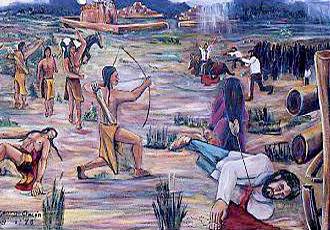
Before dawn in August 1680, runners carried knotted cords between Pueblo communities across northern New Mexico. Each day, leaders untied one knot. When the final knot was removed, the uprising was to begin. Spanish officials discovered the plan and seized two messengers, forcing the rebels to act early. What followed was one of the most successful Indigenous revolts in the history of European colonization in North America.
Within less than two weeks, Pueblo forces destroyed missions, surrounded Santa Fe, cut its water supply, and drove Spanish settlers south toward El Paso del Norte. Spanish authority did not return successfully for twelve years. The victory was neither sudden nor simple. It grew from eight decades of coerced labor, religious persecution, violence, food demands, drought, and political disruption. It also required communities speaking different languages and guarding their own autonomy to coordinate against a common colonial system.
The Pueblo Revolt is sometimes called “the first American revolution.” The phrase captures its anti-colonial achievement but can impose a later national idea on people pursuing their own forms of sovereignty. Its deeper importance lies elsewhere: Pueblo peoples expelled an imperial regime, rebuilt ceremonial life on their own terms, and permanently changed how Spain governed New Mexico after returning.
New Mexico Before Spanish Colonization
“Pueblo” is a Spanish word for a town or village, not the name of one tribe. The Pueblo peoples of the Southwest belonged—and still belong—to distinct sovereign communities with different languages, histories, ceremonial systems, and political traditions. Their settlements were linked by trade, kinship, migration, and shared agricultural practices, but they did not form a single centralized state.
Long before the Spanish arrived, Pueblo communities cultivated maize, beans, and squash in a demanding environment. Irrigation, water management, stored food, and collective labor helped sustain permanent settlements. Religious life was tied to land, ancestors, seasonal cycles, and ceremonial spaces, including kivas. Authority varied among communities and could be distributed across civil, religious, clan, and war leaders.
This diversity makes the coordination of 1680 extraordinary. The revolt did not express an ancient political unity waiting to be awakened. It created cooperation across divisions that Spanish officials had often exploited. Understanding that achievement requires abandoning the colonial habit of treating all Pueblo peoples as interchangeable while also recognizing the real alliances they built.
Conquest Brought Missions, Tribute, and Violence
Juan de Oñate led a Spanish colonizing expedition into New Mexico in 1598. The colony sought souls, labor, food, territory, and strategic influence on the northern frontier of New Spain. Franciscan missionaries established churches in Pueblo communities, while governors and settlers demanded tribute and service. Religious and civil authorities sometimes competed with one another, but both depended on Pueblo resources.
The brutality of conquest was demonstrated at Acoma in 1599, after fighting that killed settlers including Oñate’s nephew. Spanish forces attacked the mesa settlement, killing hundreds by Spanish accounts and sentencing many survivors to servitude. Punishments recorded by the colonial regime included mutilation. The details and numbers in surviving documents require careful reading, yet the event’s function is unmistakable: terror enforced colonial submission.
Over subsequent decades, encomienda and other labor demands diverted goods and work toward colonists. Pueblo people transported supplies, worked fields, built churches, and supplied food. The colonial economy did not replace Indigenous exchange overnight, just as European settlers elsewhere adapted existing Native systems such as the wampum trade of colonial New England. In New Mexico, however, economic extraction operated alongside an explicit campaign against Pueblo religion.
Religious Persecution Reached Into Daily Life
Franciscan missionaries intended conversion to transform far more than public worship. They condemned ceremonies, sacred objects, dances, and spiritual specialists as idolatry or sorcery. Mission authorities destroyed ritual items and sometimes closed or desecrated kivas. Baptism and church attendance became part of a wider colonial demand that Pueblo communities abandon religious practices embedded in social and agricultural life.
Conversion was never a simple choice between Christianity and tradition. Pueblo people incorporated, resisted, concealed, or reinterpreted Christian elements in different ways. Some accepted parts of Catholic practice while continuing ancestral ceremonies. Others used the mission system strategically. Franciscan reports that celebrated conversions therefore cannot be read as transparent evidence that older beliefs disappeared.
Conflict intensified when missionaries punished practices that communities considered necessary for rain, health, fertility, and social balance. From a Pueblo perspective, the suppression of ceremonies could threaten collective survival. From the friars’ perspective, tolerating those practices endangered souls and the divine purpose of the colony. The unequal power behind that disagreement turned religious tension into systematic persecution.
Drought and Raiding Deepened the Crisis
The 1660s and 1670s brought severe environmental and political stress. Drought damaged crops, and hunger weakened communities already burdened by colonial demands. Raids by Apache and Navajo groups increased in some areas, while Spanish defenses proved unable to guarantee security. The labels in colonial sources can conceal shifting alliances, trade, and conflict among many Indigenous peoples, but the insecurity was real.
Spanish officials continued demanding food and labor even when harvests failed. Missionaries sometimes interpreted drought and disease as punishment for improper belief, while Pueblo religious leaders could point to colonial interference as the source of disorder. Scarcity therefore intensified a contest over spiritual and political legitimacy.
The revolt cannot be reduced to drought. Environmental hardship does not automatically produce unified rebellion, and colonial New Mexico had survived earlier crises. Drought mattered because it exposed the failure of a regime that demanded obedience while disrupting practices and resources on which survival depended. It made long-standing grievances immediate.
The Arrests of 1675 and the Rise of Po’pay
In 1675, Governor Juan Francisco Treviño ordered the arrest of forty-seven Pueblo religious leaders accused of witchcraft. Several were sentenced to death; others were whipped or imprisoned. Pueblo representatives gathered at Santa Fe and demanded the prisoners’ release. With colonial forces stretched thin, Treviño yielded.
Among those released was Po’pay, often rendered Popé in older sources, a Tewa religious leader from Ohkay Owingeh. He later moved to Taos, beyond the closest reach of Spanish surveillance, and became the figure most strongly associated with organizing the revolt. His authority did not make him an absolute commander over every Pueblo. Coordination depended on many local leaders, messengers, and communities.
The 1675 confrontation taught two lessons. Religious persecution could create solidarity across Pueblo boundaries, and Spanish power was not unlimited. Later testimony claimed that Po’pay communicated with spiritual beings and demanded a complete rejection of Spanish religion and customs. That testimony is valuable but was recorded by Spanish interrogators after the revolt; it cannot reproduce Po’pay’s words without distortion.
Knotted Cords Coordinated the Uprising
Planning a simultaneous revolt across widely separated communities required secrecy and a communication system. Runners carried cords tied with knots, and participating leaders were instructed to untie one each day. The final knot marked the appointed date, commonly identified as August 11, 1680.
Two young messengers from Tesuque were captured, and Spanish officials learned enough of the plan to begin preparing. The Pueblo leadership advanced the uprising to August 10. Coordination was not perfect: some communities received information late, declined to participate, or faced local circumstances that changed their actions. Nevertheless, attacks occurred across a vast region with remarkable speed.
The cord story is supported by Spanish investigations and later testimony, but popular versions often turn it into a romantic legend about one mastermind commanding a united nation. The more significant reality is collective organization. Runners crossed linguistic borders; leaders trusted one another sufficiently to risk simultaneous action; and communities recognized that isolated resistance would be easier to destroy.
The Revolt Swept Across New Mexico
Rebels attacked missions, killed friars and colonists, freed captives, and destroyed symbols of Spanish authority. Approximately twenty-one Franciscan missionaries and several hundred settlers died, though exact numbers vary slightly by source and category. Pueblo deaths are harder to establish and should not be repeated with false precision.
The violence was purposeful but not uniform. Missions embodied religious coercion and control over labor, making them primary targets. Some individuals were spared, sheltered, or allowed to flee, while others were killed because of their offices, behavior, or association with the colonial regime. Local grievances shaped events alongside the larger plan.
Surviving Spaniards concentrated in Santa Fe and at Isleta. Governor Antonio de Otermín attempted to organize a defense as Pueblo forces gathered around the capital. The speed of the revolt prevented distant settlements from assisting one another. Spain’s thin network of missions and farms, usually an instrument of expansion, became vulnerable when communication collapsed.
The Siege of Santa Fe Forced a Retreat
Pueblo forces surrounded Santa Fe and cut or controlled its water supply. Refugees crowded into the town with soldiers, settlers, servants, and livestock. Otermín launched attacks but could not restore Spanish authority across the province. With supplies strained and no relief force approaching, he decided to evacuate.
On August 21, the Spanish column left Santa Fe and moved south. The refugees eventually gathered around El Paso del Norte, near present-day Ciudad Juárez. Around two thousand colonists and allied people escaped, although totals differ among reconstructions. For the first time since permanent colonization began, Spain no longer governed New Mexico.
The outcome was not merely a successful battle. Pueblo communities had dismantled a colonial system across hundreds of miles. They captured livestock, tools, weapons, and horses. The Smithsonian’s National Museum of the American Indian notes that the large number of horses left behind contributed to their wider movement through Native trade networks, although the spread of horse cultures across the Plains had multiple routes and cannot be attributed to this event alone.
Twelve Years Without Spanish Rule
After victory, many communities destroyed churches, washed away baptismal identities, reopened ceremonial spaces, and restored practices suppressed by missionaries. Spanish accounts claimed that Po’pay ordered people to erase every trace of Christianity and return to ancestral ways. Such reports reflect genuine religious revitalization, but also the colonial desire to depict revolt as apostasy directed by a tyrant.
Independence did not create a single Pueblo state. Communities resumed local autonomy, and disagreements emerged over leadership, trade, land, and relations with neighboring peoples. Po’pay’s influence appears to have declined. Drought and raiding continued, while the departure of the Spanish did not eliminate every political conflict produced before or during colonization.
Older histories sometimes treated this fragmentation as proof that the revolt failed. That judgment assumes unity must resemble a European state to be meaningful. The coalition achieved its shared objective: expelling Spanish authority. Pueblo independence lasted twelve years despite internal diversity, and some communities remained beyond secure Spanish control even longer.
What Spanish Sources Can—and Cannot—Tell Us
Much written evidence comes from Spanish officials, missionaries, and interrogations. Otermín’s reports described the siege and retreat. Testimony recorded from Pueblo prisoners, including the 1681 declaration attributed to Pedro Naranjo, explained motives and alleged instructions from Po’pay. These documents are indispensable because they preserve names, events, and Indigenous statements otherwise absent from the colonial archive.
They are not neutral transcripts. Prisoners spoke through interpreters while under the authority of people seeking intelligence and justification for reconquest. Questions reflected Spanish assumptions about conspiracy, idolatry, and obedience. Scribes translated unfamiliar religious concepts into categories intelligible to colonial courts.
Archaeology, oral tradition, Pueblo scholarship, architecture, and material culture provide different evidence. Burned missions, altered settlements, restored ceremonial spaces, and objects made or repurposed after 1680 show changes that official letters could not fully describe. A responsible history compares these sources rather than allowing the most detailed colonial document to become the unquestioned Pueblo voice.
Diego de Vargas and the Spanish Return
Spain attempted unsuccessful expeditions before mounting a more durable return under Diego de Vargas. In 1692, he entered Santa Fe with a relatively small force and negotiated declarations of submission, using promises of clemency as well as the threat of violence. The event was later celebrated by Spaniards as a “bloodless reconquest,” but that phrase describes only an initial stage.
When colonists returned in force in 1693, conflict resumed. Pueblo resistance in Santa Fe ended with executions and enslavement. Further revolts erupted in 1696, and Spanish reprisals were severe. Some Pueblo people fled to distant settlements or joined other Indigenous communities. Reconquest was a process of negotiation, warfare, punishment, and resettlement rather than one peaceful ceremony.
Spain reestablished authority, but it could not simply restore the world that existed before 1680. Pueblo communities had demonstrated the cost of unrestricted religious repression and extraction. Colonial survival now required accommodation alongside coercion.
How the Revolt Changed Spanish Colonial Rule
After returning, Spanish officials and Franciscans generally tolerated more Pueblo ceremonial practice, especially when conducted away from direct missionary scrutiny. Catholicism remained powerful, missions were rebuilt, and coercion did not disappear. Yet the campaign to eradicate Pueblo religion was never restored with the same confidence or reach.
The colonial government also recognized Pueblo landholding through grants and relied increasingly on negotiated alliances. Shared threats from raiding and rival imperial expansion encouraged cooperation in some periods. None of this created equality. Spanish courts, settlers, officials, and missionaries continued to exert power, and Pueblo communities continued defending land and autonomy.
The revolt’s success therefore lies not only in the twelve-year expulsion. It altered the bargain under which Spain could remain. Pueblo cultural survival was not a gift of later tolerance; it resulted from Indigenous resistance, strategic adaptation, and the limits imposed on colonial power.
Was It the “First American Revolution”?
Calling the Pueblo Revolt the first American revolution can correct histories that begin anti-colonial resistance with British colonists in 1776. In 1680, Indigenous communities overthrew an imperial government, removed its institutions, and governed themselves. The comparison forces readers to recognize Native political action as central to American history.
But the phrase also carries risks. “America” as a later nation-state was not the rebels’ political project. Pueblo peoples fought for community sovereignty, ceremonial freedom, resources, and survival, not to establish the United States or a liberal republic. Describing Po’pay as a president-like founding father distorts the political world in which he acted.
The most accurate conclusion is that the revolt was revolutionary on its own terms. It transformed power, restored suppressed institutions, and created consequences that survived military reconquest. It need not be made into an earlier version of another revolution to be historically important.
Po’pay Between Evidence and Legend
Po’pay is rightly remembered as a central organizer, and New Mexico selected his statue for the United States Capitol’s National Statuary Hall Collection. Yet many details of his life remain uncertain. No contemporary portrait exists, and most written descriptions came from enemies or later recollections. Even the spelling of his name reflects translation across Tewa, Spanish, and English.
Heroic narratives sometimes credit him with personally designing and commanding every part of the uprising. Colonial narratives portrayed him as a deceptive sorcerer and despot. Both simplify a coalition that relied on numerous leaders and autonomous communities. Recognizing collective organization does not diminish Po’pay; it places his achievement in the network that made success possible.
Pueblo memory also resists the idea that the story ended with his death. The revolt belongs to living nations whose languages, religions, and political institutions survived colonization. Po’pay’s historical importance is inseparable from that continuing sovereignty.
Why this episode still matters
The Pueblo Revolt succeeded because grievances accumulated across generations and because communities converted shared danger into coordinated action. Religious persecution, labor demands, violence, hunger, and failed colonial protection created the conditions. Po’pay and other leaders built communication across political and linguistic boundaries, while local communities supplied the decisions, knowledge, and fighters that turned planning into victory.
The revolt was violent, and its aftermath was neither peaceful nor unified. Spanish colonists returned; Pueblo resistance continued; and coercive colonial rule survived. Yet reconquest did not erase 1680. Spain governed differently afterward, and Pueblo ceremonial life endured with greater room than missionaries had previously allowed.
The knotted cords remain a powerful symbol because they represent more than secrecy. They show autonomous communities counting down together toward a common act. For twelve years, they removed Spanish rule from New Mexico. For centuries afterward, the consequences of that victory shaped religion, land, diplomacy, identity, and memory across the Southwest. The Pueblo Revolt was not a failed prelude to later American history. It was a successful Indigenous revolution with a history and legacy of its own.
Research and further reading
For readers who want to verify details or continue researching this subject, these external reference collections provide useful starting points: