In July 1905, workers in the Matumbi Hills of German East Africa pulled cotton plants from the ground. The act looked small, but the crop embodied an entire colonial system: compulsory labor, taxes, appointed chiefs, physical punishment, and an export economy designed far from the fields where Africans worked. Within weeks, resistance spread across much of what is now southern Tanzania. Communities with different languages and political traditions entered a shared war against German rule.
The conflict became known as the Maji Maji Rebellion because fighters carried water—maji in Swahili—prepared through a sacred ritual. Popular retellings often reduce the story to warriors who believed water would turn bullets aside. That version mistakes one element for the whole movement. The uprising of 1905–1907 was a political, economic, military, and spiritual response to colonial domination. Its suppression destroyed harvests and villages, contributing to a famine that killed far more people than battle alone. The precise total remains disputed, but the devastation is not.
German East Africa Was Built Through Coercion
Germany entered the imperial partition of Africa in the 1880s. A chartered company first claimed authority along the East African coast, provoking resistance that German forces suppressed. The imperial government then took direct control. By the early twentieth century, German East Africa included mainland Tanganyika, Rwanda, and Burundi, although colonial power was much stronger in some districts than others.
Officials lacked the personnel and money to govern such a large territory without African intermediaries. They used military stations, appointed local agents, police, porters, and African soldiers known as askari. Taxes pushed households toward wage labor and cash production. Road building and administrative demands consumed time that families needed for their own fields. Flogging and forced labor made colonial authority visible in daily life.
This system did not affect every society identically. Some leaders cooperated to preserve influence or oppose rivals; others resisted; many shifted strategies as circumstances changed. German power also rested on African troops and auxiliaries, a fact that complicates any simple picture of Europeans fighting a single united African nation. Yet coercion was structural. Colonial subjects had no meaningful voice in deciding the taxes, labor demands, and export policies imposed upon them.
Why Cotton Became the Immediate Flashpoint
German administrators wanted colonies to pay for themselves and supply useful commodities. In southern districts they promoted communal cotton fields, requiring villages to provide labor for an export crop. The scheme offered poor returns to the people doing the work. Cotton competed with food cultivation, and responsibility was organized collectively, allowing officials and appointed supervisors to punish communities that failed to meet expectations.
Historians therefore identify compulsory cotton cultivation as an immediate cause of the uprising, especially in the Rufiji Valley and Matumbi area. But cotton was a trigger within a larger accumulation of grievances. Hut taxes, labor recruitment, abuses by local agents, disrupted authority, and resentment of foreign rule had already created anger. Environmental pressures and food insecurity made the diversion of labor especially dangerous.
The rebellion did not begin because Africans rejected all commercial agriculture or outside change. It began because colonial administrators controlled the terms. Destroying cotton plants was a rejection of the system that made African labor serve imperial revenue while transferring risk to African households. On July 20, 1905, the symbolic attack on a cotton plot at Nandete became the conventional starting point of open revolt.
Kinjikitile Ngwale and the Meaning of Maji
At the center of the movement’s early spiritual network stood Kinjikitile Ngwale, also called Bokero in colonial records. He lived near the Rufiji River and became associated with a powerful spirit, often identified as Hongo. Followers came to his settlement seeking protection and guidance. Kinjikitile distributed sacred water mixed with ingredients such as millet and castor oil and sent messengers to carry its ritual authority outward.
The maji did more than promise physical protection. It created a shared language across communities that had no central political organization. Participants could understand themselves as part of a wider moral struggle rather than an isolated local dispute. Ritual rules demanded discipline and connected military action to a sacred order. German authorities recognized Kinjikitile as dangerous, arrested him, and executed him early in the uprising, probably in July or early August 1905. Exact dates vary among accounts.
The familiar claim that every fighter literally expected bullets to become water is too crude. Some likely understood protection literally; others may have viewed it as courage, solidarity, purification, or conditional spiritual power. Belief also changed after defeats. Treating participants as irrational hides the practical grievances that brought them to war and the rational function of ritual in coordinating resistance across distance.
How a Local Protest Became a Regional War
News and ritual messengers moved rapidly through southern and southeastern districts. Matumbi fighters attacked colonial symbols, administrative personnel, missions, and communication routes. The movement spread among Ngindo, Pogoro, Mbunga, Ngoni, and other populations, though participation varied within every named group. “Tribes” did not act as single blocks, and local histories shaped each decision.
Some communities joined because they shared grievances against taxes and labor. Others saw an opportunity to settle rivalries, remove colonial appointees, or regain autonomy. Some refused the maji message, remained neutral, or supported German forces. The coalition was therefore broad without being uniform. It lacked a central command capable of directing every campaign.
This flexibility allowed resistance to expand quickly, but it also created military problems. Fighters mobilized through local leaders and ritual networks rather than a common logistics system. They could overwhelm isolated posts and plantations, yet coordinated sieges and sustained supply were harder. German officers initially underestimated the scale of unrest, regarding it as a local disturbance. By August 1905, attacks across a wide region made clear that the colony faced its most extensive rebellion.
Mahenge Exposed the Cost of Frontal Battle
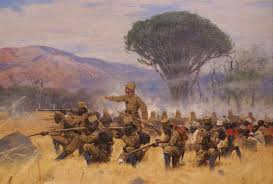
One of the best-known engagements occurred at Mahenge in August 1905. Large numbers of African fighters attacked a fortified German station defended by a small force equipped with modern rifles and machine guns. Courage and numbers could not overcome concentrated fire across exposed ground. The attackers suffered devastating losses.
Mahenge is often presented as the moment sacred water “failed.” The battle certainly demonstrated the lethal inequality between massed attackers and entrenched automatic weapons. Yet one defeat did not immediately dissolve resistance. Religious explanations could absorb failure by attributing it to broken ritual rules, while political grievances remained. In other areas, fighters used ambush, mobility, terrain, and attacks on vulnerable infrastructure rather than repeating the same tactic.
Colonial sources emphasized German discipline and African credulity, a narrative useful for defending imperial rule. A more careful reading sees an army operating with technological advantages against opponents who were experimenting with coalition warfare under extreme constraints. The strategic lesson was harsh: open assault against fortified positions was ruinous, but the Germans still lacked enough troops to occupy every rebellious district at once.
The Ngoni Decision to Join
The participation of Ngoni communities around Songea gave the war another important front. The Ngoni had strong military traditions shaped by nineteenth-century migration and state formation. Their leaders did not simply obey an outside prophetic command. They debated whether joining served local interests, and not all reached the same conclusion.
When Ngoni forces attacked German positions, they too faced rifles and machine guns. Defeat was followed by severe punishment. Colonial authorities executed leaders, including Chief Songea Mbano, whose name remains central to public memory in Tanzania. Executions at Songea on February 27, 1906, are commemorated locally, and the Maji Maji Memorial Museum preserves the history of resistance and its victims.
The Ngoni case shows why it is misleading to describe the rebellion as either a perfectly unified nationalist movement or disconnected local riots. Participants recognized a shared enemy and used a common spiritual language, but entered the conflict through their own political structures. Unity was created through action; it was real, incomplete, and constantly negotiated.
Germany Reinforced the Colony
Governor Gustav Adolf von Götzen requested reinforcements as the uprising spread. Germany sent additional troops, and forces also came from other parts of the colonial empire. The Schutztruppe combined German officers with African askari, whose training and firearms gave colonial columns substantial advantages. Steam transport, telegraph links, and access to coastal supply networks further strengthened the response.
The colonial army retook contested routes and attacked centers of resistance. Its opponents rarely possessed comparable firearms or ammunition. German casualty figures were small compared with African losses, although exact totals differ by source and by what categories are counted. The asymmetry was not proof that resistance lacked organization; it reflected radically unequal military resources.
German East Africa was already connected to an imperial world of bases, shipping, finance, and military knowledge. The region had recently witnessed another demonstration of unequal firepower in the shortest war in history, the 1896 Anglo-Zanzibar War. Maji Maji differed enormously in scale and duration, but both conflicts reveal how industrial weapons and imperial logistics could compress the battlefield choices available to African opponents.
Scorched Earth Turned War Into Famine
Unable to force a quick decision everywhere, German forces increasingly targeted the means by which resistance survived. Columns burned villages, destroyed grain stores, uprooted crops, and removed livestock. The objective was to deny fighters food and punish communities that sheltered them. This strategy blurred any distinction between combatant and civilian.
Famine became the rebellion’s most destructive phase. Drought and existing vulnerability may have worsened conditions, but deliberate crop destruction was central. People fled into forests or moved in search of safety, losing access to farms and stored food. Hunger increased susceptibility to disease. The violence continued after many large battlefield formations had been broken because destroying subsistence was itself a method of warfare.
Modern discussions sometimes ask whether German suppression constituted genocide. Legal and historical analyses differ because proving the specific intent required by the modern Genocide Convention is difficult, and the Maji Maji coalition encompassed many groups. There is less disagreement that colonial forces knowingly used starvation, devastated civilian life, and caused mass death. Applying a legal label requires argument; describing the conduct and consequences does not.
Why the Death Toll Remains Uncertain
Figures for African deaths range widely, often from about 75,000 to as many as 300,000. The upper number appears frequently in public commemoration and modern reporting. None should be treated as an exact census. Colonial records were incomplete and politically interested, while many deaths from hunger and disease occurred beyond administrative observation.
Demographic loss is also difficult to separate into categories. A person missing from a village might have died, fled permanently, joined relatives elsewhere, or avoided official registration. Later estimates depend on assumptions about prewar population and expected growth. Historians can establish that mortality was catastrophic without pretending to know a precise total.
The uncertainty matters because numerical competition can obscure responsibility. Most victims were not killed in dramatic charges against machine guns. They died through the destruction of food systems, displacement, exposure, and disease. A responsible account should state the range, explain its limitations, and emphasize that the policies producing famine are better documented than any single headline number.
Was Maji Maji a Nationalist Rebellion?
After independence, Tanzanian national history often presented Maji Maji as an early expression of unity against colonial rule. That interpretation had powerful value in a country seeking common identity across many communities. The maji network did cross linguistic and political boundaries, and participants understood that they confronted a foreign regime. In that meaningful sense, the war transcended local politics.
Yet projecting a fully formed twentieth-century nation backward onto 1905 simplifies the evidence. Fighters did not all imagine the same postcolonial state, follow one command, or join for identical reasons. Some communities resisted the rebellion, and African askari fought for Germany. Local rivalries and calculations continued throughout the war.
The strongest interpretation avoids choosing between national unity and local diversity. Maji Maji created an unprecedented regional coalition without erasing the societies that composed it. It was anti-colonial before modern Tanzanian nationalism had taken its later institutional form. Its memory subsequently helped Tanzanians articulate national belonging, which is part of the rebellion’s history even if it was not its original blueprint.
Defeat Brought Colonial Reform, Not Freedom
Organized resistance weakened during 1906, though fighting, pursuit, and famine continued into 1907. German authority survived. The colonial government then modified some practices, abandoning the most provocative communal cotton arrangements and paying greater attention to agricultural production and African intermediaries. Officials understood that uncontrolled coercion could threaten the colony itself.
These changes did not transform imperial domination into partnership. Taxes, racial hierarchy, land pressure, and labor demands remained. Reform was intended to make colonial rule more stable and productive, not to grant self-government. Germany retained Tanganyika until the First World War, when Allied forces conquered the colony; Britain later administered the territory under international mandate.
The rebellion’s defeat therefore produced a paradox. Armed resistance failed to expel Germany, but forced colonial rulers to recognize limits to extraction. That did not redeem the system. It demonstrated that empires sometimes adjusted after catastrophe precisely so that domination could continue.
Memory, Human Remains, and Modern Reckoning
Maji Maji remains central to Tanzanian public memory. Museums, monuments, school narratives, and annual commemorations honor those who resisted. Songea’s memorial landscape is especially important because German authorities executed leaders there and, in some cases, removed human remains. Families have continued to seek the return of ancestors whose skulls may have entered German collections.
In November 2023, German President Frank-Walter Steinmeier visited Tanzania, apologized for colonial atrocities, and asked forgiveness. He also promised efforts to clarify the whereabouts of remains, including those associated with Chief Songea Mbano. Such statements matter, but they do not settle debates over reparations, archival access, identification, and repatriation.
Modern remembrance also challenges the old colonial archive. German reports often recorded Africans as anonymous masses while carefully naming European officers. Tanzanian oral histories and local commemorations restore leaders, families, landscapes, and experiences that official files minimized. Historical research is strongest when it uses colonial documents critically rather than allowing the colonizer’s paperwork to define the limits of the story.
Why this episode still matters
The Maji Maji Rebellion began with cotton plants pulled from colonial fields, but its roots reached through taxes, forced labor, violence, political displacement, and the denial of African control over land and work. Sacred water helped communities imagine coordinated resistance. It did not create their grievances, nor does belief in it explain the war by itself.
The rebellion failed militarily because decentralized forces with limited firearms faced an empire able to reinforce its army and destroy civilian subsistence. German victory came not only through battlefield superiority but through a scorched-earth strategy that turned hunger into a weapon. Because famine deaths cannot be counted precisely, estimates vary; the uncertainty should invite care, not denial.
Maji Maji matters as both history and memory. It was a coalition assembled from distinct societies, an anti-colonial war before Tanzania existed as a nation-state, and a catastrophe whose effects survived colonial reform. Removing the caricature of “magic water versus bullets” reveals a more important story: people confronting an extractive empire, building unity through political and spiritual innovation, and paying an immense price when that empire chose collective devastation over relinquishing control.
Research and further reading
For readers who want to verify details or continue researching this subject, these external reference collections provide useful starting points: