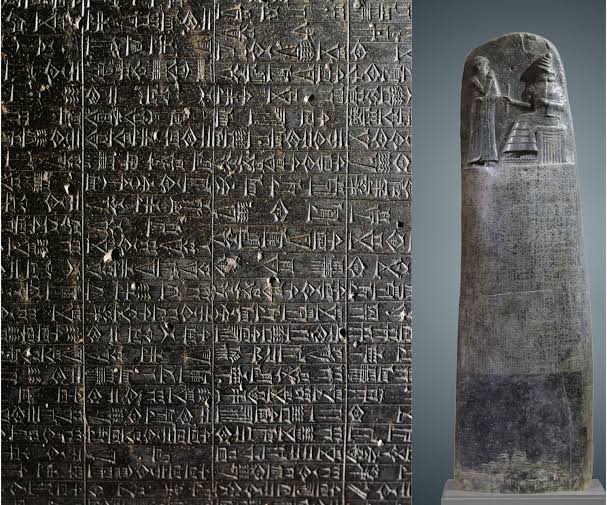
At first glance, the Code of Hammurabi looks like the ancient world’s version of a law book: nearly three hundred rules carved into a black stone monument, covering theft, trade, marriage, injury, wages, and runaway slaves. That image is powerful—and incomplete. The famous stele was less a handbook for judges than a public claim about what a good king was supposed to do. It announced that Hammurabi of Babylon had received authority to establish justice, protect the vulnerable, and impose order on a crowded, unequal kingdom.
That does not make the text unimportant as law. Its provisions reveal much about Babylonian society in the eighteenth century BCE, including its sharp social distinctions and its practical concern with contracts, property, and family. But it is misleading to call it the world’s first law code, or to imagine every Babylonian court mechanically consulting it. The Code of Hammurabi is best understood as a carefully composed royal inscription: a document that joined legal precedent, political ideology, religious language, and the hard realities of rule.
A monument that survived its kingdom
The object now called the Code of Hammurabi is a basalt stele about 2.25 metres high. French archaeologists found it in 1901 at Susa, in present-day Iran, where it had been carried as war booty by an Elamite ruler centuries after Hammurabi’s death. Today it is held by the Louvre. At its top, Hammurabi stands before Shamash, the Mesopotamian sun god associated with justice. Shamash appears to hand the king a rod and ring, symbols often connected with measuring, ordering, and royal authority. The visual scene matters: the laws below were presented as divinely sanctioned, but their execution belonged to the king.
Most of the stele is covered in Akkadian written in cuneiform. The text has three parts. A long prologue lists the gods, cities, temples, and achievements through which Hammurabi defines his rule. The central collection contains the numbered paragraphs conventionally called laws. A lengthy epilogue praises the king as a just shepherd, invites a wronged person to read the inscription, and invokes curses against future rulers who alter or disregard it.
The stele is not the only witness to the text. Fragments from other copies have been found, which strongly suggests that the laws circulated in more than one monumental or scribal form. Yet the original setting of the Louvre stele remains uncertain. It may have stood in Babylon or in another Babylonian city. Its rediscovery in Susa tells us more securely about Elamite conquest than about its first audience.
The monument’s survival has distorted its reputation. Because it is visually dramatic and unusually complete, it can seem to stand alone. In fact, it belongs to a long Mesopotamian tradition of royal law collections and justice proclamations. Its importance lies not in being the first attempt to write law, but in the exceptional scale, literary ambition, and preservation of the surviving text.
Hammurabi and the world he ruled
Hammurabi ruled Babylon from about 1792 to 1750 BCE, under the middle chronology commonly used in modern scholarship. Babylon was initially one city-state among several powers in southern Mesopotamia. During the first part of his reign, Hammurabi strengthened canals, temples, fortifications, and administration while navigating alliances with rivals such as Larsa, Eshnunna, Mari, and Assyria. His many surviving letters show a ruler involved in military logistics, irrigation, local disputes, officials’ conduct, and the movement of goods.
In the final decades of his reign, Hammurabi defeated major rivals and brought much of southern Mesopotamia under Babylonian control. The resulting realm was large, but it was not a modern centralized state with a uniform bureaucracy. It depended on cities with distinct local traditions, temple institutions, agricultural estates, merchants, soldiers, and provincial officials. Law had to operate in a society where documents, witnesses, oaths, family networks, and local authorities all mattered.
The prologue to the code turns political expansion into moral order. Hammurabi claims that the gods Anu and Enlil selected Marduk and Babylon for prominence, then commissioned him to make justice visible in the land. Such language was not a neutral report. It was royal self-presentation. Like other Mesopotamian rulers, Hammurabi called himself a shepherd: a metaphor that implied both care for subjects and the right to direct them.
This context explains why the collection reaches far beyond spectacular punishments. It is concerned with irrigation, herds, rental arrangements, debt, transport, building work, divorce, inheritance, and professional responsibility. Conquest needed more than battles. A king who governed farming communities and commercial towns needed predictable procedures, obligations, and officials whose authority could be presented as legitimate.
Not the first code—and not a modern codebook
The phrase “the first written laws” is one of the most persistent simplifications attached to Hammurabi. Earlier Mesopotamian law collections are known. The laws of Ur-Namma, ruler of Ur around the late third millennium BCE, predate Hammurabi by several centuries. The Laws of Lipit-Ishtar from Isin and the Laws of Eshnunna are also earlier. These texts differ in length and survival, but they disprove the idea that Babylon suddenly invented written law.
Nor was Hammurabi’s text a code in the modern legislative sense. Modern codes generally aim to provide comprehensive, systematically arranged rules enacted by a recognized legislature and applied through institutions with defined jurisdiction. The Babylonian collection is arranged by subject only imperfectly. Its paragraphs are often case formulas: “If X happens, then Y follows.” Some rules may record established practice; others may offer exemplary judgments or articulate royal ideals. The text does not tell us how often judges cited it, and court records rarely quote its wording directly.
That absence does not mean the collection was irrelevant. It means historians must distinguish two questions: what the stele says justice ought to look like, and how legal disputes were actually handled. Thousands of economic and legal tablets from Mesopotamia preserve contracts, receipts, sales, loans, adoptions, marriage settlements, and court proceedings. They show a legal culture that was written, practical, and adaptive. A dispute could involve witnesses, sealed tablets, sworn statements, local judges, and appeals to authorities. The Code of Hammurabi belongs to that culture, but it did not replace it.
Calling it “the first code” therefore minimizes earlier Mesopotamian achievement. Calling it merely propaganda goes too far in the opposite direction. The collection used legal language seriously, while also making a political argument: a competent king knew how to protect order across every part of society.
How the laws work: cases, status, and proof
Many provisions begin with a conditional situation. If someone accuses another of murder but cannot prove it, the accuser may face severe consequences. If a builder constructs a house that collapses, responsibility can fall on the builder. If a tenant farmer neglects a field, he may owe compensation based on an expected harvest. These formulas are memorable because they turn social problems into recognizable scenarios.
Proof was central. Written contracts, witnesses, and oaths before the gods recur throughout the collection. In a world without police investigations in the modern sense, testimony and documentation carried enormous weight. Certain difficult cases used the river ordeal: an accused person was sent into a river, and survival or drowning was interpreted as divine judgment. This was not a routine rational procedure; it shows how legal uncertainty could be transferred to the gods.
Status shaped outcomes. The text distinguishes the awīlum, often rendered a free or high-status man; the muškēnum, a socially dependent or lower-status free person; and the wardum or enslaved person. Translation is debated because these categories do not map neatly onto modern social classes. What is certain is that penalties could vary according to the rank of victim and offender. A bodily injury to one man might require retaliation, while a comparable injury to another could require monetary payment.
The familiar phrase “an eye for an eye” comes from this setting. It did not mean that all people received equal treatment, nor did it create a universal rule of personal vengeance. It expressed a principle of proportion in specified cases among persons of comparable status. Elsewhere the collection uses fines, restitution, or corporal penalties. The popular image of one single rule governing Babylonian justice is false; the text is a patchwork of remedies calibrated to property, intention, office, and social standing.
Family, property, and the limits of protection
The family laws are among the most revealing and uncomfortable sections. Marriage was bound to property, kinship, labor, and inheritance. The text regulates dowries, bridewealth, divorce, widowhood, children, adoption, and the claims of different heirs. These rules could protect some women’s economic interests: a wife’s dowry was recognized as hers, and certain abandoned or widowed women had claims on household property. But protection was conditional and embedded in a patriarchal system headed by male householders.
Divorce provisions illustrate the complexity. A husband could divorce a wife, but financial consequences depended on whether she had borne children and on the circumstances described. A woman who sought to leave could be judged differently depending on allegations about her conduct and the husband’s behavior. The text is not a straightforward charter of either female rights or female powerlessness. It records a society in which women could own property, conduct some business, and invoke legal claims, while their lives remained constrained by family authority and unequal standards.
Enslavement is equally impossible to soften. Enslaved people appear as workers, property, family members, and persons with limited legal recognition. The laws regulate harboring fugitives, injuries to enslaved people, and the status of children born in mixed households. Debt could also lead to temporary service, though this was not identical to chattel slavery. The collection’s concern for “the weak” was real as royal rhetoric, but it did not abolish hierarchy. Justice meant order as Hammurabi’s society understood it, not equal freedom.
Property rules likewise show the state’s interest in dependable production. Fields, orchards, canals, herds, deposits, shipping, and houses all receive attention because livelihoods and royal revenue depended on them. The code’s world is intensely local: a damaged embankment or a careless herdsman could endanger a neighbor’s harvest and provoke a dispute worth regulating.
Crime and punishment beyond the stereotypes
Hammurabi’s laws are often introduced with a catalogue of brutal penalties. Some are brutal. Death, mutilation, drowning, burning, and impalement appear in particular provisions. There is no honest way to turn the collection into a humane document by modern standards. Yet a list of punishments alone misses its legal logic and exaggerates how uniformly such penalties were applied.
Many paragraphs require restitution rather than physical retaliation. Theft could demand repayment at multiples of the stolen value. Negligence could lead to compensation. A physician whose treatment failed under certain circumstances might face an extreme penalty, but other professional mistakes called for financial remedies. The scale and type of punishment depended on the offense and on the people involved.
It is also risky to assume every stated penalty was a routine sentence. Royal law collections can be prescriptive, exemplary, and ideological. Actual court practice had room for settlements, local custom, evidentiary problems, and administrative judgment. Legal tablets demonstrate that Babylonian society made extensive use of documents and negotiated transactions; they do not provide a simple record of every penalty in the stele being carried out.
The code’s harshest images nevertheless served a purpose. They communicated that the king’s order had consequences. In the prologue and epilogue, Hammurabi repeatedly presents himself as someone who prevents the strong from oppressing the weak. The tension is obvious: this royal promise coexisted with deep inequalities of gender, status, and bondage. Rather than erase that tension, the text makes it visible. Ancient justice was not a stepping stone toward modern equality; it was a distinct system that combined protection, hierarchy, deterrence, and royal power.
Was the stele meant for ordinary readers?
The epilogue imagines a person with a grievance coming before the monument, reading its words, and finding justice through the king’s example. This passage is often treated as proof that the stele functioned like a public noticeboard. The idea should be handled carefully. Literacy in cuneiform was specialized, and the monument’s dense writing was not easily accessible to most people. A scribe or official may have mediated the text for anyone who encountered it.
That does not make public display meaningless. Monuments communicate through size, material, location, and images as well as through literal reading. A polished basalt stele topped by a king before Shamash would have projected authority even to non-readers. For scribes, officials, and educated visitors, its text supplied a detailed vocabulary of royal justice. For others, its presence could signal that the king’s order was fixed, sacred, and enduring.
Similar political uses of writing appear across Mesopotamia. Inscriptions named builders, commemorated victories, defined temple gifts, and cursed anyone who damaged a monument. The Code of Hammurabi’s epilogue fits that world. It addresses future rulers as much as present subjects, warning them not to remove the inscription or change its words. Its intended audience was therefore broad in symbolic reach but selective in literacy.
The text’s later movement to Susa adds another layer. As captured prestige material, it outlived the political world that produced it. The stele’s value was not only legal. It was an object associated with a formidable Babylonian king and with the authority of ancient kingship itself.
What scholars debate—and what can be stated firmly
Some points are secure. Hammurabi was a historical Babylonian king. He ruled in the eighteenth century BCE. A large Akkadian legal collection is associated with him, and the Louvre stele is its best-known surviving copy. Earlier law collections existed. The text reflects a society structured by hierarchy, written transactions, religion, agriculture, and royal administration.
Other questions remain open. Scholars debate the precise relationship between the collection and everyday court practice. Did it codify active law, serve chiefly as a model of ideal judgments, or do both at once? The evidence supports caution rather than a single answer. The text clearly draws on legal realities, but it is also deliberately literary and political. Its arrangement, prologue, and curses show that it was designed to glorify a ruler, not simply to file rules for clerks.
Translations also matter. Words for social ranks, marriage payments, and legal acts can carry shades of meaning not captured by a single English equivalent. A translation that calls one person a “noble” and another a “commoner” can make Babylon look too much like a later European society. Good historical writing preserves the categories where possible and explains their uncertainty rather than forcing them into familiar boxes.
Finally, the code has been burdened by later expectations. It is sometimes portrayed as the ancestor of every legal system or as direct evidence of a universal ancient morality. Neither claim holds. It is one remarkable text from a particular Mesopotamian kingdom. Its influence on modern imagination is enormous, but historical influence must be traced, not assumed.
Why the Code of Hammurabi still matters
The Code of Hammurabi endures because it asks a question that has never disappeared: what does a ruler owe the people who live under his power? Hammurabi’s answer was not democratic and not egalitarian. It located justice in a king chosen by the gods, supported by officials, documents, oaths, and punishments. But it also insisted that power needed a public justification. A king was expected to prevent arbitrary oppression, settle disputes, and make order legible.
That claim is why the stele is more than an archaeological curiosity. It lets us see an ancient state explaining itself in its own language. Its famous rules are important, but its larger achievement is rhetorical: it turns administration into a moral performance. The king is presented not merely as a conqueror, but as the guarantor of a world in which fields are cultivated, contracts are honored, and grievances can be heard.
Reading the code alongside the broader history of Mesopotamia, including places such as the rediscovered Sumerian city of Girsu, also corrects the myth of sudden invention. Babylon inherited centuries of urban government, scribal practice, and legal thought. Hammurabi’s monument was extraordinary precisely because it refined and advertised that inheritance so powerfully.
Its lesson is not that civilization began when laws were carved in stone. It is that law has long been inseparable from institutions, social inequality, memory, and persuasion. The Code of Hammurabi survives because it preserves all of those things at once: a set of rules, a king’s ambition, and an ancient argument about justice that remains difficult to ignore.