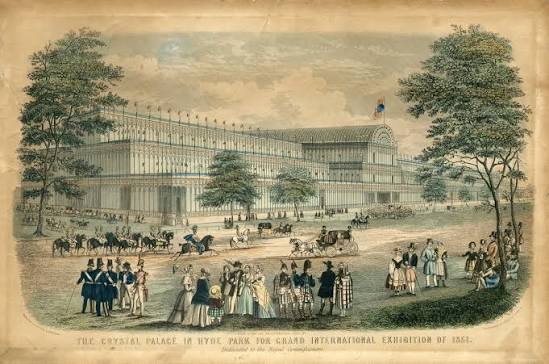
On 1 May 1851, Queen Victoria entered a building unlike anything London had seen. Sunlight passed through acres of glass, full-grown elm trees rose inside the structure, and the noise of working machinery mingled with music and a crowd dressed for ceremony. The official name—The Great Exhibition of the Works of Industry of All Nations—promised a peaceful survey of human ingenuity. The setting made that promise look almost plausible.
For five and a half months, the Great Exhibition of 1851 turned Hyde Park into a temporary capital of manufactured things. Around 14,000 exhibitors sent objects ranging from steam engines and power looms to furniture, ceramics, scientific instruments, jewelry, and agricultural machinery. More than six million visits were recorded before the doors closed on 15 October. Yet the exhibition was never merely a giant trade show. It was also a carefully staged argument about Britain: its industry, its political stability, its empire, and its place in an increasingly connected world.
That argument contained genuine internationalism alongside national rivalry, public education alongside commercial promotion, and impressive access alongside obvious inequality. Understanding the exhibition therefore requires more than repeating the familiar story of Prince Albert, Joseph Paxton, and the Crystal Palace. It requires looking at who organized the event, what visitors actually encountered, whose labor and resources filled the displays, and why the money and institutions left behind mattered long after the famous glass building disappeared.
Why Britain wanted an international exhibition
The exhibition emerged from a longer European tradition. France had organized national exhibitions of industrial products since the late eighteenth century, and a major exposition in Paris in 1844 attracted foreign attention. British manufacturers, reformers, and members of the Society of Arts studied these precedents. The common claim that London invented industrial exhibitions from nothing is therefore misleading. What distinguished the 1851 project was its declared international scope, extraordinary scale, and attempt to bring manufactured goods from many nations together under one roof.
Prince Albert, Queen Victoria’s German-born husband, became the project’s most prominent advocate. As president of the Society of Arts, he supported the belief that manufacturers could improve by comparing materials, methods, and design. Henry Cole, a civil servant and energetic design reformer, supplied much of the organizational drive. Their interests overlapped with a broader concern: Britain led the world in many forms of industrial production, but critics believed British goods were often poorly designed. An exhibition could celebrate output while exposing weaknesses in taste and workmanship.
The Crystal Palace solved an urgent building problem
The organizers needed an enormous temporary building, yet their first design competition produced no fully acceptable solution. A committee eventually advanced a heavy conventional scheme that would have required vast quantities of brick and substantial alterations to the park. Critics complained about cost, construction time, and the damage a permanent-looking structure might cause. Joseph Paxton, celebrated for the great conservatory at Chatsworth, entered the discussion late with an alternative based on greenhouse engineering.
Paxton proposed a modular framework of cast iron, wrought iron, timber, and standardized glass. The design could be manufactured in repeated units, assembled quickly, and dismantled afterward. Its famous arched transept accommodated several mature elm trees that campaigners did not want cut down. Contractors Fox, Henderson and Company translated the scheme into a building roughly 1,850 feet long and more than 400 feet wide. Its floor covered about 19 acres, while hundreds of thousands of glass panes created an interior whose brightness astonished visitors.
What visitors found inside the Great Exhibition
The exhibits were classified principally by raw materials, machinery, manufactures, and fine arts related to industry. Britain and its empire occupied the western half of the building, while foreign countries filled much of the eastern half. This broad division made the claim of international equality immediately uneasy: the host nation enjoyed the largest and most prominent platform, and imperial possessions were often presented within a British framework rather than as independent participants.
Machinery attracted enormous attention because many devices operated in front of the public. Steam engines drove belts and shafts; textile machines transformed fiber; pumps, presses, lathes, and printing equipment turned production into performance. Visitors did not simply inspect finished products. They could watch mechanical processes that were usually hidden inside factories. The moving-machinery courts converted industrial labor into spectacle, often emphasizing precision and power while leaving working conditions outside the palace largely invisible.
Among the celebrated objects were the Koh-i-Noor diamond, displayed by the East India Company; a huge hydraulic press designed by Robert Stephenson; American firearms associated with Samuel Colt; agricultural equipment, including reaping machinery; ornate furniture; ceramics; clocks; and scientific instruments. The variety was the point. A modest household implement and an enormous engine could both be treated as evidence of inventive capacity. Some objects won prizes after assessment by juries, creating commercial prestige that manufacturers used afterward.
Six million visits did not mean six million different people
The commonly quoted attendance figure—just over six million—records admissions, not unique individuals. Londoners could return repeatedly, season-ticket holders did so often, and members of the royal family made numerous visits. Even with that qualification, the total was extraordinary for a country whose population in the 1851 census was about 27 million. On the busiest days, the Crystal Palace absorbed crowds larger than many contemporary towns.
Pricing changed during the exhibition. Expensive season tickets and higher admission charges shaped the opening weeks. Later, five-shilling days, half-crown days, and especially one-shilling days broadened access. Research based on the commissioners’ financial records indicates that more than five million paid admissions were taken at the doors and that the great majority occurred on the cheapest days. The arrangement combined revenue management with social sorting: wealthier visitors could pay for less crowded surroundings, while mass attendance concentrated on low-price dates.
Railways were indispensable. Companies offered excursion services that brought provincial visitors to London, sometimes after long overnight journeys. Organized parties came from factories, schools, churches, and associations. The exhibition thereby became part of the emerging culture of mass tourism. A skilled worker from the Midlands could encounter products from India, the United States, France, and the German states without crossing the Channel, although the journey, food, lodging, and lost wages still placed limits on who could attend.
Industry was displayed without the factory system’s full cost
The exhibition presented industrial production as ordered, clean, and progressive. Machines gleamed inside a bright palace; raw materials appeared ready for transformation; manufactured goods seemed to embody disciplined ingenuity. This presentation did not invent the technologies on display, but it detached many of them from the environments in which they normally operated. Visitors saw a power loom without necessarily seeing the long hours, noise, injury, low wages, or labor discipline of a textile mill.
Britain in 1851 was experiencing rapid urbanization and severe public-health problems. Cholera had struck London only two years earlier. Industrial districts contained wealth and technical expertise alongside overcrowding and pollution. Reform legislation had begun to regulate factories and mines, often after investigations exposed dangerous conditions. None of this means the exhibition’s engineering achievements were false. It means the palace selected which parts of industrial reality would stand for the whole.
The connections are visible in individual technologies. Automated textile equipment built on generations of experimentation and on the labor of mechanics and operatives. The logic of punched-card control, developed for weaving and explored in this site’s account of the Jacquard loom, showed how industrial devices could organize complex repeated actions. At the Great Exhibition, machines of this kind became symbols of abstract ingenuity rather than products of contested workplaces.
Empire supplied objects, resources, and political symbolism
Modern accounts cannot treat imperial displays as decorative background. Britain’s industrial economy drew on colonial raw materials, markets, shipping networks, investment, and coercive institutions. Cotton offered the clearest example: British textile manufacturing depended heavily on fiber produced by enslaved labor in the United States, while India remained both a source of materials and a market subjected to imperial policy. The finished fabrics in London concealed relationships extending across oceans.
India’s displays included textiles, metalwork, carved objects, weapons, jewelry, natural products, and the Koh-i-Noor. They demonstrated sophisticated craft traditions, but British organizers often classified them through assumptions about an “exotic” or timeless East. Indian producers did not control the full political meaning of their work inside the palace. Objects could be admired aesthetically while the exhibition implied that British rule collected, ordered, and improved the resources of the subcontinent.
The exhibition’s language of “all nations” thus coexisted with an imperial map in which many peoples did not appear as sovereign nations at all. This is not a hidden flaw added by present-day critics; it was embedded in administration and display. Recognizing it does not require denying the event’s international reach. It explains how Victorian cosmopolitanism could welcome foreign goods while preserving a hierarchy favorable to the host empire.
Peace festival, commercial contest, or political performance?
Supporters liked to imagine the Great Exhibition as a peace congress conducted through objects. Europe had been shaken by revolutions in 1848, and Britain’s ruling classes valued the contrast between continental upheaval and apparent domestic stability. Opening the palace with royal ceremony allowed the monarchy to associate itself with constitutional order, industry, and public improvement rather than remote privilege alone.
Free-trade ideals also had limits. Commerce might connect nations, but markets were structured by unequal wealth, tariffs, naval power, colonial rule, and access to capital. The exhibition offered no mechanism for resolving those inequalities. Nor did it prevent war: the Crimean War began less than three years after the palace closed. Claims that the fair inaugurated an age of peace are contradicted by subsequent history.
The most accurate description is therefore not either-or. The Great Exhibition was a peace festival expressed through commercial contest and political performance. Its contradictions were functional: the rhetoric of universal progress made competition respectable, while competition gave universalism urgency. Nations were invited to cooperate by proving themselves before one another.
Profit turned a temporary fair into permanent institutions
The exhibition succeeded financially. After expenses, it produced a surplus of roughly £186,000, a considerable sum. The Royal Commission used the money to purchase land in South Kensington and pursued Prince Albert’s aim of strengthening education in science, art, and industry. The district that later gained the informal name “Albertopolis” developed into a dense landscape of museums, colleges, and cultural institutions.
The Victoria and Albert Museum, Science Museum, Natural History Museum, Imperial College, Royal College of Music, and Royal Albert Hall all belong to this wider South Kensington story, but their origins and funding histories differ. It is inaccurate to say that ticket profit simply built every institution outright. The surplus enabled strategic land purchases and an educational program that interacted with government departments, later grants, collections, and separate organizations over decades.
The exhibition also strengthened the museum as a tool of industrial improvement. Reformers believed that manufacturers and workers could learn by studying exemplary design. The Museum of Manufactures, an ancestor of the V&A, opened in 1852 at Marlborough House before moving to South Kensington. Collections were not intended solely for connoisseurs; they were integrated into a program connecting taste, production, and national competitiveness.
What happened to the Crystal Palace after 1851
The Hyde Park building was always supposed to be temporary. Parliamentary debates show that admirers tried to preserve it for public instruction and recreation, while opponents invoked the original agreement, park access, neighborhood interests, and principle. The effort to keep the structure on its site failed. It was dismantled in 1852, demonstrating the reversibility that had made Paxton’s system attractive.
A private company purchased components and erected a much enlarged version at Sydenham in south London. Opened in 1854, the new Crystal Palace contained educational courts, entertainment spaces, displays of art and natural history, and extensive landscaped grounds. It borrowed the prestige and much of the material fabric of the Hyde Park palace, but it was not simply the unchanged exhibition building moved intact. Its design, scale, purpose, and ownership were different.
Fire destroyed the main building on 30 November 1936. The dramatic blaze encouraged a compressed popular story in which “the Crystal Palace” survived from 1851 until it burned. The accurate sequence is more interesting: a temporary Hyde Park structure was dismantled; many components contributed to a redesigned building at Sydenham; that second palace developed its own eight-decade history before the fire.
Myths and oversimplifications about the Great Exhibition
“It was the first industrial exhibition.” Not in an absolute sense. France and other places had organized influential exhibitions before 1851. London’s stronger claim is to have staged the first great international exhibition that became the model for the modern world’s fair.
“Prince Albert personally invented it.” Albert’s patronage, leadership, and political visibility were crucial, but Henry Cole, the Society of Arts, commissioners, contractors, exhibitors, workers, and foreign committees made the event possible. Single-founder stories turn an institution into a biography.
“The Crystal Palace was a flawless miracle erected almost overnight.” Its rapid modular construction was extraordinary. It also depended on earlier greenhouse design, standardized manufacture, extensive labor, testing, logistics, and environmental adjustments. Engineering success becomes more impressive, not less, when its collective basis is visible.
“Six million Britons attended.” There were just over six million admissions. Repeat visits mean the number of individual people was lower. The total still demonstrates mass popularity, especially on one-shilling days.
“The exhibition proved British superiority.” It was designed in part to display British strength, and Britain dominated major industrial sectors. Yet foreign machinery and design also impressed or unsettled British observers. The fair stimulated reform because comparison exposed shortcomings as well as advantages.
“It celebrated peaceful progress, not empire.” Peace and international exchange were explicit ideals, but imperial power shaped objects, categories, resources, and representation. The Koh-i-Noor is the clearest symbol of the collision between glittering display and coerced acquisition.
“Its profits built South Kensington.” The surplus was foundational, particularly for land purchase and the commission’s continuing work. The museum and educational district emerged through a longer combination of institutions, public decisions, collections, and funding.
These corrections do not reduce the exhibition to fraud. They replace a polished Victorian legend with a more credible achievement: a vast, contested experiment whose participants did not agree on what modernity meant.
Why the Great Exhibition of 1851 still matters
The Great Exhibition created a durable format for making the future visible. Later world’s fairs copied its combination of spectacular architecture, national sections, machinery, consumer goods, education, entertainment, and political symbolism. Modern trade shows, technology launches, museum blockbusters, and expos still use similar techniques: gather selected objects, arrange them as a story, and let the setting convert commerce into cultural meaning.
Its history also warns against treating technology as self-explanatory. The Crystal Palace and its contents were genuine accomplishments, but their meaning came from choices about classification, admission, publicity, and national representation. What visitors did not see—labor conditions, coerced transfers, ecological extraction, and unequal markets—was as structurally important as the machines they did see.
At the same time, the event demonstrated the productive power of temporary projects. The palace vanished from Hyde Park, yet the surplus financed land, the commission endured, museums grew, design education expanded, and the world’s-fair movement accelerated. Temporariness did not prevent institutional permanence.
The strongest conclusion is neither triumphalist nor cynical. In 1851, organizers built a remarkably accessible international event with innovative architecture and lasting educational consequences. They also arranged the world through Victorian categories shaped by class and empire. Both statements are supported by the record. The Great Exhibition matters because it made the promises and costs of industrial modernity visible in one luminous, crowded interior—and because debates over innovation, global exchange, public culture, and hidden labor have not left us.
Sources and further reading
- Historic England, “Base of the Southern Water Tower to the Crystal Palace” — an official account distinguishing the 1851 Hyde Park building from the later Sydenham palace.
- UK Parliament, Hansard, “Exhibition of 1851,” 29 July 1851 — a primary-source debate over preserving the Hyde Park structure.
- UK Parliament, Hansard, “Exhibition of 1851—Crystal Palace,” 29 April 1852 — contemporary arguments about public instruction, access, and removal.
- Royal Collection Trust, Prince Albert’s papers relating to the Great Exhibition — archival material documenting official preparation and diplomacy.
- Stephen P. Walker, “Managing a Shower of Silver: Accounting, Control and Audit at the Great Exhibition, 1851” — scholarly analysis of admissions, cash handling, and financial administration.