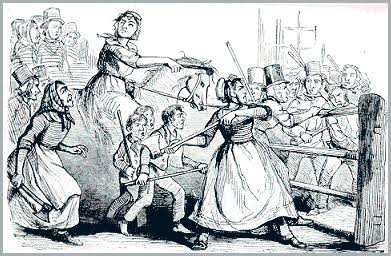
On a dark night in rural Wales, a horn sounded and a crowd gathered at a wooden gate. Many of the men had blackened their faces; some wore borrowed gowns, shawls, or bonnets. Their target was not a castle or a government office but a toll barrier. After a ritual exchange with a figure called “Rebecca,” the gate came down. Such scenes made the Rebecca Riots one of nineteenth-century Britain’s most visually memorable protests. Yet the costumes can distract from what was at stake: who paid for roads, who controlled rural government, and how close farming families had come to financial collapse.
Between 1839 and 1843, protesters attacked tollgates across west and southwest Wales. Turnpike charges supplied the immediate grievance, but the movement drew strength from rents, tithes, the New Poor Law, bad harvests, and mistrust of an elite that often combined the roles of landlord, magistrate, and road trustee. Rebecca was therefore neither a quaint folk custom nor a simple tax revolt. It was a local insurgency shaped by the economic pressures and unequal institutions of early Victorian Britain.
Why a Wooden Tollgate Mattered So Much
To understand the Rebecca Riots, it helps to begin with lime. Much of west Wales was farmed by tenants on small or medium holdings. Acidic soils could be improved with lime, which farmers carted from kilns or coastal sources. Coal, animal feed, building materials, and produce also moved by road. Every gate placed between a farm and its market, mill, quarry, or limekiln could turn an ordinary journey into a chain of payments.
Britain’s turnpike system had developed from the seventeenth century onward. Parliament authorized local trusts to borrow money, maintain designated roads, and repay their debts from tolls. In principle, the arrangement linked payment to use and improved routes that parishes could not maintain adequately. In practice, conditions varied. Some roads improved; some trusts accumulated debt; and travelers complained that toll schedules were confusing or unfair. “Side bars” and “catch gates” could intercept people trying to avoid a main gate by taking a minor route.
The burden was especially visible because it was collected in cash at a physical barrier. A rent increase might arrive annually, but a tollkeeper demanded payment while a cart stood in the road. The National Archives notes that an eight-mile trip carrying lime could incur charges totaling five shillings, a formidable sum for a tenant farmer. Exemptions could deepen resentment when local people believed trustees or their tenants received preferential treatment.
It would be misleading, however, to describe every turnpike trustee as corrupt or every charge as illegal. The deeper problem was legitimacy. The same landed families could influence trusts, sit as magistrates, and own the farms whose tenants paid the tolls. Even when accounts were defensible, the structure looked like government by interested parties. A wooden gate thus embodied a much larger imbalance of power.
The First Outbreak at Efailwen in 1839
The first celebrated episode occurred at Efailwen in Carmarthenshire on 13 May 1839. A newly erected tollgate was destroyed by a crowd. When authorities rebuilt it, protesters demolished it again in June. A gate at nearby Llanboidy was also attacked. The actions were organized enough to alarm officials but geographically limited, and the authorities helped restore calm by declining to replace some of the disputed barriers.
This initial outbreak matters because it shows that Rebecca did not begin as a continuous four-year campaign directed from a central headquarters. The disturbances of 1839 subsided. The larger wave began only in late 1842, when worsening economic conditions and new toll arrangements reignited anger. Treating everything from 1839 to 1843 as one uninterrupted rising hides the pauses, local decisions, and changing objectives that gave the movement its character.
Evidence for the early attacks is uneven. Government correspondence, witness statements, newspapers, estate papers, and later recollections were produced by people with different interests. Officials wanted names and prosecutable offenses; newspapers wanted dramatic stories; participants often needed anonymity. Historians can establish the destruction of particular gates and the broad sequence of events more securely than they can reconstruct every midnight speech or identify every masked participant.
Who Were “Rebecca and Her Daughters”?
The movement’s name was theatrical and deliberately unsettling. A leader commonly appeared as Rebecca, while followers were called her daughters. Men wore women’s clothing, sometimes crudely, and concealed their faces. They might stage a dialogue in which Rebecca asked why a gate blocked the road and ordered her children to remove it. The performance announced authority before the crowd carried out the destruction.
A frequently repeated explanation connects the name to Genesis 24:60, in which Rebekah is blessed with the hope that her descendants will possess the gate of their enemies. This biblical allusion is plausible in a Welsh society steeped in chapel culture, and contemporary evidence associates the movement with the name. It should not be presented as a proven account of the exact moment or person who coined it. Folklore offers competing stories, including claims about a local woman named Rebecca or a borrowed disguise. Those traditions illuminate later memory more reliably than they settle the origin.
The cross-dressing also invites overconfident interpretation. It offered disguise, mockery, spectacle, and a symbolic reversal of ordinary hierarchy. Welsh rural communities already knew forms of popular justice in which masked or costumed groups punished alleged misconduct. Historians have connected Rebecca with customs such as the ceffyl pren, or “wooden horse,” a ritualized shaming procession. That connection is useful, but the riots were not merely an old custom applied to new gates. They adapted familiar performance to modern conflicts over infrastructure, law, and political economy.
Why the Riots Returned in 1842
The second phase began near St Clears after the construction of a new gate at the Mermaid. During the winter of 1842, gates at Pwll-trap, Trevaughan, and elsewhere were attacked. By December, the gates around St Clears had been destroyed. The movement then spread across Carmarthenshire and into Cardiganshire and Pembrokeshire, becoming far larger than the events of 1839.
Timing was crucial. Poor harvests in 1837 and 1838 had weakened rural households, and a severe commercial depression in 1842 reduced demand and squeezed prices. Population growth increased competition for farms and employment. Tenants could not easily absorb higher transport costs when their margins were already thin. A toll that looked manageable during a good year could become intolerable after successive setbacks.
Road administration magnified the strain. The spread of catch gates meant that a farmer might pay repeatedly on a short journey. Suspicion flourished that trustees managed routes for their own convenience or protected favored tenants. In a memorandum dated 2 November 1843, official investigator George Ellis acknowledged the “multiplication of catch gates” as an error and discussed the unequal burden imposed on people carrying lime and coal. His observations do not validate every accusation, but they confirm that grievances about the system were more than rumor.
The Crisis Was Bigger Than Road Tolls
Tollgates supplied clear targets, yet they cannot explain the full range or intensity of the Rebecca Riots. Tenant farmers faced rents determined by landowners at a time when pressure on land was high. Some estates consolidated holdings or changed terms. The annual tithe remained resented because a predominantly Nonconformist population helped support the established Anglican Church. County rates and other obligations added to the sense that rural producers paid into institutions they did not control.
The New Poor Law of 1834 introduced another source of fear. Its workhouse system was designed to make public relief less attractive than the lowest-paid labor. For families accustomed to parish assistance, the workhouse threatened separation, discipline, and stigma. In June 1843, a crowd numbering perhaps around 2,000 attempted to attack and burn Carmarthen workhouse before troops intervened. That episode demonstrates how far the agitation had moved beyond road finance.
Cultural division sharpened economic conflict. Many ordinary inhabitants spoke Welsh and worshipped in Nonconformist chapels. Much of the landed and administrative elite was Anglican and more closely associated with English language and culture. These categories were not absolute—Welsh society contained many overlapping loyalties—but the contrast influenced how people experienced authority. A magistrate, landlord, and turnpike trustee might be the same man or belong to the same social circle.
The riots were not a nationalist war for Welsh independence, and projecting later political programs onto them distorts the evidence. Yet language, religion, and unequal access to government undeniably mattered. For wider context on the society behind those cultural continuities, see this account of community and ritual in early medieval Wales. The periods are far apart, but both histories caution against treating Wales as a mere regional backdrop to an English story.
How Rebecca Organized Without a Single Commander
Victorian officials searched for ringleaders, but Rebecca was not a conventional army. Local groups assembled at night, used horns or other signals, posted notices, sent threatening letters, and relied on shared knowledge. A bilingual handbill preserved by the National Archives shows that protest could move through print as well as oral communication. Anonymous messages signed by “Rebecca” transformed a hidden network into an apparently omnipresent personality.
Decentralization also created limits. Rebecca could speak with many voices, including voices that demanded more than toll reform. Some notices threatened landlords, tithe collectors, or informers. Groups intervened in disputes over debt and personal conduct. The Barricades research project describes this broader activity through the idea of a “moral economy”: communities enforced their sense of fair dealing when formal law seemed to protect the powerful.
The Summer of 1843: From Gate-Breaking to Open Crisis
Violence accelerated during the spring and summer of 1843. Gates around Carmarthen were destroyed in May. The attempted workhouse attack followed in June. Disturbances spread eastward, reaching parts of Glamorgan, including Pontardulais and Llangyfelach, by August. Large crowds could now confront an expanding state response that included police, yeomanry, and soldiers.
The spectacle was impressive but did not make the protesters invulnerable. Troops could guard selected sites, patrol roads, and support arrests, though they struggled to cover a scattered rural landscape. The government faced a dilemma: harsh repression risked worsening a legitimate grievance, while inaction made lawful authority look powerless. Home Secretary Sir James Graham eventually combined stronger enforcement with investigation.
Not every gathering sought bloodshed. Much of Rebecca’s violence was directed at property, especially gates and tollhouses, and ritual warnings sometimes preceded an attack. That distinction is historically important, but it should not be romanticized. Crowds carried weapons, threatened individuals, intimidated witnesses, and created situations in which people could be killed. Participants did not control every consequence once a confrontation began.
The crisis also attracted national press attention. Outside observers sometimes reduced west Wales to a land of ignorance and disorder. Such accounts reflected contemporary prejudice as much as careful reporting. Later inquiries into Welsh education, culminating in the notorious 1847 “Blue Books,” repeated hostile assumptions about Welsh language, religion, and morality. Rebecca became evidence in a wider debate over whether rural society was oppressed, backward, or both.
The Death of Sarah Williams and the Limits of the Legend
The movement’s darkest episode occurred at Hendy Gate in September 1843. During an attack, tollkeeper Sarah Williams was shot and killed. Accounts differ in detail, and assigning individual responsibility remains difficult, but her death is not disputed. It exposed the lethal potential behind the movement’s theatrical language and damaged the idea that Rebecca’s justice was inherently controlled or benevolent.
The killing strengthened the case for arrests and helped isolate more militant action. Informers, policing, prosecutions, and the visible presence of troops eroded the protection on which local groups depended. Some convicted rioters received imprisonment; others were transported. Bangor University’s research highlights the case of John Hughes, known as Jac Tŷ Isha, who was sent to Tasmania—a reminder that the state’s punishment could remove a person to the other side of the world.
Government Investigation and the 1844 Settlement
Repression alone did not end Rebecca. In October 1843, the government established a commission to investigate the causes of unrest, including the operation of turnpike trusts. Official correspondence shows a growing recognition that road governance required reform. George Ellis examined accounts and complaints, including the proliferation of catch gates, favoritism, and unequal charging for agricultural necessities.
The resulting legislation in 1844 consolidated and reorganized turnpike administration in south Wales, reduced some of the most objectionable practices, and changed how toll liabilities were handled. It did not abolish all tolls overnight or transfer political power to tenant farmers. Nevertheless, it addressed the grievance that had given Rebecca her clearest target. Reform made renewed mass gate-breaking harder to justify and easier to portray as ordinary crime.
Other economic changes also mattered. Conditions improved from the depths of the depression. Railway expansion gradually reduced the strategic importance of turnpike roads. The repeal of the Corn Laws in 1846 and modifications in the administration of poor relief formed part of a broader transformation, though none can be credited solely to Rebecca. Movements rarely produce a neat line from protest to statute.
What the Rebecca Riots Actually Changed
The most immediate achievement was to make the west Welsh turnpike system a national political problem. Complaints that could be dismissed individually became impossible to ignore when hundreds of gates were threatened. The inquiry translated some popular accusations into administrative findings, and Parliament altered the system. Rebecca demonstrated that people excluded from formal power could impose costs on an institution until reform became preferable to stalemate.
The movement also exposed the narrowness of Victorian rural government. Landowners’ concentration of economic, judicial, and administrative influence did not automatically prove misconduct, but it weakened public trust. Later reforms of county government, church finance, and political representation had their own histories; Rebecca did not single-handedly cause them. Still, the riots belong to the longer process by which deferential local rule became more difficult to defend.
Reading Rebecca Through the Surviving Evidence
The Rebecca Riots left no central archive created by the movement. Much of what survives passed through hostile or cautious hands: police reports, Home Office files, magistrates’ letters, witness examinations, and newspaper accounts. Anonymous threats reveal language and demands but not always authorship. Later memories may preserve genuine local knowledge while reshaping events to fit heroic legend.
Primary documents nevertheless allow unusually close views. A December 1842 letter signed “Becca & children” shows the adopted family language in use during the disturbances. The August 1843 statement of toll collector William Rees records the experience of an official at ground level. A bilingual handbill from June 1843 demonstrates communication across Welsh and English. Ellis’s November memorandum, written from within the government investigation, admits structural problems in road administration.
Estate archives add another perspective. Research at Bangor University uses the correspondence of landowner Jane Walters and estate agent Thomas Cooke to explore how the landed interest perceived unrest and paternal obligation. These voices should neither be accepted uncritically nor ignored. They reveal how authority defended itself, where it felt vulnerable, and how individuals interpreted duties within a hierarchical society.
Responsible history emerges from comparison. A claim supported only by a later anecdote should be labeled as tradition. A date appearing across official correspondence and contemporary reporting can be treated with greater confidence. The evidence firmly establishes widespread gate destruction, broader social grievances, government inquiry, and reform. It does not support a perfectly unified secret army led by one undisputed Rebecca.
Conclusion: A Revolt About the Price of Belonging
The Rebecca Riots began with tollgates because tollgates made inequality tangible. Every barrier asked rural travelers to pay into a road system controlled by people they could scarcely hold accountable. When harvest failure, depression, rent, tithe, and fear of the workhouse narrowed the margin of survival, the gate became a verdict on who bore the costs of society.
Rebecca’s answer combined careful targeting, communal performance, intimidation, and, at its worst, lethal violence. The movement succeeded enough to compel inquiry and turnpike reform, but not enough to remake rural Wales. Its most famous symbols—the horn, the gown, the biblical name—should be read as political tools rather than picturesque folklore.
The enduring lesson is not that disguise defeated the state. It is that infrastructure is never merely technical. Roads connect farms to markets, but the rules used to finance them distribute power and risk. In the early 1840s, thousands of people in west Wales decided those rules had lost legitimacy. By breaking the gates, they forced Britain to look at the system built behind them.