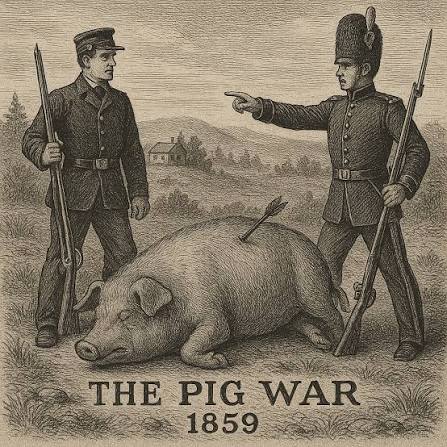
On 15 June 1859, an American settler on San Juan Island found a black boar rooting through his potato patch. Lyman Cutlar shot the animal. The pig belonged to Charles Griffin, an Irishman managing the Hudson’s Bay Company’s nearby Belle Vue Sheep Farm. What began as a rural quarrel—livestock, damaged crops, and disputed compensation—soon drew in civil officials, soldiers, warships, and senior diplomats from two great powers.
The confrontation became known as the Pig War. No British or American soldier died, and the pig remained its only casualty. Yet the comic name can obscure a dangerous crisis. Britain and the United States had not agreed where their maritime boundary ran through the islands between Vancouver Island and the North American mainland. Both claimed San Juan, settlers challenged corporate authority, and local commanders acted before their national governments understood what was happening.
The popular version says that one pig nearly caused a war. That is memorable but incomplete. The animal’s death was a trigger, not the underlying cause. The real story concerns an ambiguous treaty, competing empires, Indigenous dispossession, settler colonialism, military initiative, and the patient diplomacy that prevented a small incident from becoming a major conflict.
The Unfinished Boundary of the Oregon Treaty
For decades, Britain and the United States had competed over the vast Pacific Northwest, then commonly called the Oregon Country. American politicians popularized expansionist slogans, while the Hudson’s Bay Company built trading networks and settlements under British protection. Neither country wanted the dispute to provoke an expensive war, especially when both faced other strategic priorities.
The Oregon Treaty of 1846 drew the continental boundary along the forty-ninth parallel to the coast. From there, it was to continue through “the middle of the channel” separating the continent from Vancouver Island and then through the Strait of Juan de Fuca to the Pacific. The language appeared practical but did not identify a specific channel.
That omission mattered because the San Juan archipelago sits between two major passages. Haro Strait runs west of the islands, placing them on the American side. Rosario Strait runs east, placing them on the British side. Smaller channels and imperfect contemporary maps further complicated the geography. Each government adopted the interpretation that favored its interests, and the treaty supplied no attached map capable of ending the argument.
Why San Juan Island Mattered
San Juan Island offered fertile ground, protected anchorages, fisheries, and a strategic position on approaches to Vancouver Island. Britain’s colonial center at Victoria lay nearby. Control of the islands could affect navigation, defense, customs enforcement, and the future shape of the regional border. This was not simply a quarrel over an isolated pasture.
The Hudson’s Bay Company established Belle Vue Sheep Farm on San Juan in 1853. Its flock and agricultural operations strengthened the British claim through physical occupation. The company was a commercial corporation, but in the Northwest it also performed functions closely tied to imperial policy. Its employees represented a visible British presence.
American settlers arrived as well, encouraged by the expansion of Washington Territory and by land laws that they believed supported their claims. Local American officials attempted to tax Hudson’s Bay Company property. Company representatives rejected the taxes, maintaining that the land was British. Seizures, protests, and mutual accusations had already made the island tense before Cutlar encountered Griffin’s pig.
The People Already Living in the Islands
Accounts centered only on Britain and the United States can make the archipelago seem empty until rival settlers arrived. It was not. Coast Salish peoples had used, inhabited, managed, and traveled among the San Juan Islands for generations. The islands formed part of a maritime world structured by fishing, seasonal movement, kinship, trade, and cultural ties.
Imperial boundary-making ignored much of that reality. British and American negotiators treated the region as territory to be divided between states. Agricultural settlement, resource extraction, and military occupation restricted Indigenous access and transformed familiar landscapes. Treaties made elsewhere did not erase Indigenous relationships with the islands.
This wider context changes the meaning of the “bloodless” Pig War. It was bloodless in the narrow sense that the opposing military forces did not shoot one another. The settlement of the international boundary nevertheless belonged to a broader colonial process that displaced Indigenous authority. Celebrating diplomatic restraint should not require pretending that no one lost land or power.
Lyman Cutlar, Charles Griffin, and the Pig
Lyman Cutlar was a recent American settler who planted potatoes on land also claimed by the Hudson’s Bay Company. Charles Griffin managed the company farm. According to the standard account, Griffin’s pig repeatedly entered Cutlar’s garden. On 15 June, Cutlar finally shot it.
Cutlar acknowledged responsibility and offered compensation, but the amount became disputed. Later retellings often supply witty dialogue in which one man says it was up to the other to keep his potatoes out of the pig. Such lines capture the conflict’s absurdity, but historians should treat polished quotations cautiously when their earliest documentation is uncertain.
More important than the exact words was the question of jurisdiction. British authorities threatened legal action or arrest, while American settlers insisted that British officials had no authority over them. A dead farm animal became evidence in a sovereignty dispute. Paying a fine might imply acceptance of British law; refusing it could transform a property disagreement into political defiance.
American Settlers Call for Military Protection
American residents appealed to Brigadier General William S. Harney, commander of the U.S. Army’s Department of Oregon. Harney was assertive, strongly expansionist, and already critical of British influence in the region. Rather than treating the episode as a minor civil dispute, he interpreted it as evidence that American settlers required protection.
Harney ordered Captain George E. Pickett to occupy San Juan Island. Pickett, later famous for his role as a Confederate general at Gettysburg, landed with a small American force in late July 1859. His orders spoke of preventing interference with American citizens and resisting attempts to remove them.
The landing changed the crisis fundamentally. Soldiers represented national power in a way that farmers did not. Pickett selected a position near Griffin Bay and prepared to defend it. Reinforcements increased the American presence to several hundred men with artillery. Actions taken by regional commanders now created risks that Washington and London had not deliberately chosen.
Governor Douglas and the British Response
James Douglas, governor of Vancouver Island and a former Hudson’s Bay Company official, viewed the American occupation as an alarming intrusion. His experience tied colonial administration to the company whose property and authority were being challenged. He sent officials and naval forces to the area while seeking to prevent permanent American possession.
Royal Navy ships appeared near San Juan. At the height of the crisis, British vessels carried far greater firepower than Pickett’s isolated camp. The visual imbalance could have encouraged either intimidation or panic. A nervous sentry, an aggressive boat movement, or misunderstood order might have started shooting.
Douglas favored a firm response, but naval officers resisted reckless escalation. Rear Admiral Robert Lambert Baynes, commander of British naval forces in the Pacific, is commonly credited with rejecting an order or proposal to land marines and dislodge the Americans. The exact chain of orders deserves care, but professional judgment at sea helped prevent combat.
How Close Did the Pig War Come to Battle?
The phrase “nearly started a war” is justified, but it can invite exaggerated scenes of two armies seconds from firing. The forces confronted one another, commanders issued defiant statements, and weapons were present. Still, neither national government had decided to fight, and several officers understood that opening fire would be disastrous.
Pickett reportedly declared that he would resist a British landing. British commanders had the capacity to overpower his original detachment, but doing so could have killed American soldiers and forced retaliation. Each side therefore faced a classic escalation problem: backing down might weaken its claim, while pressing forward could create a conflict far larger than the island.
The danger lay less in a formal plan for war than in fragmented authority. Harney, Pickett, Douglas, naval officers, and local officials possessed different instructions and temperaments. Communications with distant capitals took weeks. The crisis demonstrates how frontier agents can narrow the choices available to governments that never intended the confrontation.
Washington and London React
When accurate reports reached national leaders, both governments were astonished that a livestock dispute had produced a military standoff. The United States was moving toward its own sectional crisis, while Britain had little reason to fight over an unsettled island claim. Restraint served both sides.
President James Buchanan sent Lieutenant General Winfield Scott to the Pacific Northwest. Scott was the senior officer of the U.S. Army and an experienced negotiator as well as soldier. His long journey from the East Coast signaled that the administration wanted to regain control of events from Harney and Pickett.
British representatives were similarly willing to de-escalate without surrendering their legal position. Scott and Douglas negotiated a reduction of forces and an interim arrangement. Their achievement was not a final boundary settlement. It was a mechanism for preventing accidental war while leaving sovereignty unresolved.
The Joint Military Occupation
Britain and the United States agreed to a joint occupation of San Juan Island. Small forces would remain, representing each claim without attempting to expel the other. American Camp stood on the southern part of the island, while English Camp was established in the north.
The arrangement lasted for roughly twelve years. It turned a potential battlefield into a prolonged military coexistence. The camps maintained separate routines, flags, and chains of command, but relations were generally cordial. Soldiers visited, exchanged news, competed in sports, and attended social events. Cooperation did not erase the dispute, yet it made violence progressively less likely.
Modern memory often presents the occupation as an inspiring friendship from the beginning. That interpretation should not flatten uncertainty or tension. The camps existed because the border remained contested. Their peaceful relationship was an accomplishment produced by rules, distance, discipline, and time—not proof that the crisis had never been serious.
A Border Dispute Delayed by Civil War
The San Juan question remained unsettled as the United States descended into civil war in 1861. George Pickett left the U.S. Army and joined the Confederacy. Harney’s military career also became entangled in the national crisis. The international dispute persisted, but it was no longer Washington’s most urgent concern.
Britain formally remained neutral during the American Civil War, though Anglo-American relations suffered repeated strains. Neither side wanted San Juan to become another source of conflict. The joint occupation provided a stable holding pattern while larger events consumed attention.
Delay also changed the political setting. Canada became a confederation in 1867, although foreign policy remained under British authority. In the United States, postwar diplomacy addressed several unresolved disputes with Britain. San Juan could eventually be considered within a broader effort to regularize relations.
The Treaty of Washington and German Arbitration
The 1871 Treaty of Washington created mechanisms for resolving multiple Anglo-American disagreements. The San Juan boundary question was submitted to arbitration by German Emperor Wilhelm I. Arbitration allowed each side to state its legal and geographical case while accepting a third party’s decision.
Britain argued for Rosario Strait; the United States argued for Haro Strait. The issue was not whether to split the islands according to convenience but which channel best matched the Oregon Treaty’s intended boundary. Maps, navigation, diplomatic correspondence, and treaty language all became evidence.
In October 1872, the arbitrator accepted the American position and chose Haro Strait. The San Juan Islands therefore went to the United States. British troops withdrew from English Camp, and the American camp later closed as well. A dispute that began with ambiguity in 1846 and exploded in 1859 ended through legal-diplomatic procedure rather than battlefield victory.
Was the Pig Really the Only Casualty?
Within the military confrontation, the familiar claim is essentially correct: no British or American service member was killed in combat, and the pig was the sole direct casualty. There was no battle in the conventional sense. Calling it a “war” was always partly humorous.
Even so, the formula can conceal other forms of harm. The armed occupation reinforced settler claims and imperial control over Indigenous land. Military camps altered the environment and local economy. American and British settlement had consequences that cannot be measured by a battle casualty list.
The pig’s fate also became detached from the property conflict that produced it. Griffin lost an animal; Cutlar faced threats and became a symbol; neither man controlled what followed. Once states and armies adopted the incident, a local disagreement was retold as national drama. The small scale of the trigger does not make the political consequences imaginary.
Myths, Quotations, and Historical Oversimplifications
The most common oversimplification is that two countries almost went to war only because of a pig. The shooting supplied an immediate crisis, but the underlying causes were thirteen years of treaty ambiguity, competing settlement, taxation disputes, and imperial rivalry. Without those conditions, the incident would probably have remained a compensation case.
A second simplification presents George Pickett as the single reckless villain or heroic defender. Pickett did act aggressively, but Harney sent him, American settlers requested protection, and British colonial leaders also applied pressure. Responsibility was distributed across a system in which local actors could escalate events faster than governments could respond.
Finally, memorable dialogue and dramatic force totals vary across popular accounts. Some details come from later reminiscence rather than immediate records. Reliable interpretation rests on official correspondence, maps, military reports, and contemporary documents, while acknowledging where historians disagree. The episode needs no invented flourish to be remarkable.
Diplomacy, Deterrence, and the Value of Delay
The Pig War is often praised as proof that good humor can prevent conflict. Humor became important in later memory, but the actual tools of peace were more practical: officers declined provocative orders, governments overruled local decision-makers, forces were reduced, and a joint occupation bought time.
Delay is frequently portrayed as diplomatic failure. Here it was useful. By separating the immediate need to prevent shooting from the difficult question of sovereignty, negotiators avoided an all-or-nothing choice. The joint occupation allowed national prestige to survive while conditions became more favorable for settlement.
Arbitration then converted incompatible claims into a procedure both parties could accept. A similar spirit of managed rivalry appears in the much later Whisky War over Hans Island, although the contexts were different. In both cases, limited confrontation left room for law and negotiation.
How the Pig War Is Remembered Today
San Juan Island National Historical Park preserves American Camp and English Camp. The landscape allows visitors to see the geographical scale of the confrontation and the distance between the military positions. Historic structures, archaeological evidence, exhibits, and public programs interpret both the crisis and the island’s broader human history.
The park was established partly to commemorate peaceful resolution. Annual ceremonies and local storytelling have emphasized cooperation between the United States and Canada. That message gained importance in the twentieth century, when communities sought a usable past centered on friendship rather than nineteenth-century expansion.
Recent scholarship and interpretation have broadened the story. The dispute is now more often placed within Indigenous history, settler colonialism, environmental change, and the politics of historical memory. This does not erase the striking success of de-escalation. It explains more fully what territory meant and whose perspectives older celebrations omitted.
Conclusion: The Crisis Behind the Comic Name
The Pig War survives in popular culture because its premise sounds like satire: a pig eats potatoes, a farmer fires, armies arrive, and an emperor eventually decides the border. Every major element is grounded in fact, yet the comedy can distract from the structural forces that made the sequence possible.
Ambiguous words in the Oregon Treaty left strategically important islands in dispute. Rival settlers and the Hudson’s Bay Company turned competing national claims into daily conflicts over land, taxes, and law. Harney and Pickett militarized the quarrel; Douglas responded; naval officers refused escalation; and distant governments built a face-saving exit.
The lasting lesson is not that wars begin for silly reasons. It is that seemingly trivial incidents can activate deeper rivalries, especially where authority is divided and communication is slow. The Pig War ended peacefully because individuals chose restraint and institutions created time for negotiation. Its only battlefield casualty was a pig, but avoiding human casualties required far more than luck.
Sources and Further Reading
- National Park Service, “The Pig War”.
- Washington State Archives, “Pig War: A Pig and an International Boundary Dispute”.
- Library of Congress, “Bungled Borders in the Pacific Northwest, Part 2”.
- U.S. Department of State, historical documents on the San Juan boundary.
- Legislative Assembly of British Columbia, “1846: 49th Parallel Becomes International Boundary”.