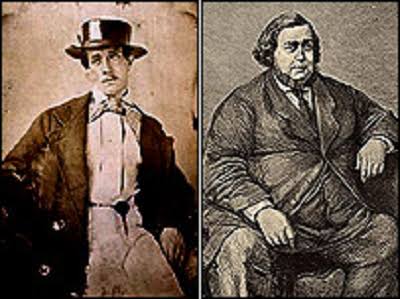
In 1866, an overweight butcher from rural Australia announced that he was Sir Roger Tichborne, the missing heir to one of England’s old Catholic families. The real Roger had disappeared twelve years earlier when the ship Bella was lost in the Atlantic. His mother had refused to accept his death and advertised across Australia for news of him. When the claimant appeared, she embraced him as her son.
Most of the Tichborne family saw an impostor. The man’s appearance, education, memories, language, and habits seemed radically unlike Roger’s. Yet he attracted former servants, army acquaintances, lawyers, journalists, and thousands of working-class supporters. Two enormous trials followed. Together they became one of Victorian Britain’s most consuming legal spectacles.
The Tichborne Claimant is usually identified as Arthur Orton, a butcher’s son from Wapping who had migrated to Australia and used the name Thomas Castro. The evidence against him was overwhelming, but the case mattered far beyond identity fraud. It exposed anxieties about class, inheritance, mass newspapers, courtroom procedure, and whether elite institutions treated ordinary people fairly.
Who Was Roger Tichborne?
Roger Charles Tichborne was born in Paris in 1829. His father belonged to the landed Tichborne family of Hampshire, while his French mother, Henriette, raised him largely in France. Roger grew up speaking French more naturally than English and remained culturally marked by that upbringing after entering English family life.
As heir to a baronetcy and valuable estates, his identity carried financial and social weight. He studied at the Catholic school Stonyhurst and later served in the British Army’s 6th Dragoon Guards. Letters, schoolmates, officers, servants, and relatives created an unusually large body of people and documents against which any returning heir could be tested.
Roger’s relationship with his family was not simple. He formed a close attachment to his cousin Katherine Doughty, but the hoped-for marriage did not take place. Restless and disappointed, he left Britain for South America in 1853. His travels would later give an impostor room to invent adventures far from witnesses in England.
The Loss of the Bella
After traveling in South America, Roger boarded the small vessel Bella at Rio de Janeiro in April 1854, bound for Jamaica. Days later, wreckage and an overturned boat were found at sea. No confirmed survivor returned, and Roger was presumed drowned.
Legally and practically, the family moved on. Roger’s younger brother Alfred became the heir. When Alfred later died, his infant son inherited the baronetcy and estates. That succession meant that a returning Roger would not merely recover a name: he could displace the existing heir and transform control of a large fortune.
Roger’s mother, however, remained convinced that he had survived. Reports of rescue at sea and rumors of unidentified travelers sustained her hope. Her refusal to mourn definitively created the opening on which the later claimant depended.
Lady Tichborne’s Search Reaches Australia
Lady Tichborne placed advertisements seeking information about her son, including notices circulated in Australian newspapers. The descriptions were not always precise, and intermediaries sometimes handled the search carelessly. A determined reader could learn what story the family wished to hear.
In Wagga Wagga, New South Wales, a butcher and hotelkeeper known as Thomas Castro responded. He claimed that he had survived the Bella, been rescued at sea, and eventually made a life in Australia. He supplied enough suggestive detail to attract the attention of Lady Tichborne’s agents.
The claimant was married and in financial difficulty. Presenting himself as the lost heir offered an extraordinary escape from debt and obscurity. Whether he began with a fully formed plan or expanded the story as others encouraged him is harder to establish. What is clear is that the claim quickly became deliberate and sustained.
Thomas Castro or Arthur Orton?
Investigators traced the claimant toward Arthur Orton, born in Wapping, London, in 1834 to a butcher’s family. Orton had gone to sea and reached South America before living in Australia. His movements and trade fit important parts of the claimant’s known background better than Roger Tichborne’s.
The claimant complicated the inquiry by admitting that he knew Orton while insisting they were different men. He gave shifting explanations for his use of the Castro name and for contacts with the Orton family. Soon after returning to England, he made inquiries connected to Wapping—behavior difficult to reconcile with his supposed identity as Roger.
Modern summaries often say the courts scientifically proved that the claimant was Orton. Nineteenth-century identity testing was less tidy. There was no fingerprint database or DNA analysis. The case rested on testimony, handwriting, biography, physical marks, memory, and contradictions. The cumulative evidence was compelling, but each item had to be argued before juries.
A Mother Recognizes Her Son
The claimant returned to Europe in 1866 and met Lady Tichborne in Paris. She accepted him with striking speed. Her recognition became the emotional center of his case: who, supporters asked, could know a son better than his mother?
Recognition was powerful but not neutral. Lady Tichborne had spent years expecting survival and had advertised for confirmation. She was estranged from some relatives and eager to defeat their certainty that Roger was dead. Her desire may have shaped what she saw, while the claimant had already learned details useful for the meeting.
She granted him an income and treated his wife and children as family. Her endorsement persuaded people who might otherwise have dismissed the claim immediately. Yet she died in 1868, before the great trials could test her belief under sustained cross-examination.
The Physical and Cultural Mismatches
Roger had been remembered as slender, refined, and strongly French in speech and upbringing. The claimant was very large, spoke no convincing French, and displayed manners associated by observers with a very different social world. Such contrasts damaged his story but were not decisive on their own. Twelve difficult years could change a person’s body and habits.
More damaging were failures of intimate knowledge. The claimant forgot people, places, and experiences Roger should have known, while sometimes recalling details that could have been learned from supporters. He made mistakes about schooling and military life. Coaching by former servants and acquaintances further blurred the line between authentic memory and acquired information.
Physical identification also became controversial. Witnesses discussed tattoos, scars, genital characteristics, and family resemblance in extraordinary detail. Victorian newspapers converted private anatomy into public entertainment. The evidence shows the period’s confidence in bodily signs, but also their ambiguity when memory and loyalty influenced observers.
Why So Many Witnesses Believed Him
Some former soldiers, servants, tenants, and acquaintances said the claimant was Roger. Their testimony cannot all be reduced to bribery or foolishness. Recognition after many years is vulnerable to suggestion, especially when a confident claimant knows fragments of the past and respected people have already endorsed him.
Class expectations cut both ways. Opponents thought an unpolished butcher could not be a baronet, while supporters argued that hardship and colonial life explained the transformation. Every mismatch could be reinterpreted as proof of suffering, memory loss, or elite prejudice.
The claimant was also personally effective. He could appear genial, patient, and accessible. He spoke directly to crowds and cultivated loyalty. His body, once treated as evidence against him, became part of a populist image: an ordinary-looking man confronting wealthy relatives and intimidating lawyers.
The Civil Trial: Tichborne v Lushington
To obtain the estates, the claimant brought a civil action that reached the Court of Common Pleas in 1871. Formally, the litigation concerned possession, but its real issue was identity. Could this man prove that he was the missing Roger Tichborne?
The hearing stretched across more than one hundred court days. Witnesses arrived from Britain, Europe, South America, and Australia. Lawyers reconstructed childhood, travel, military service, family secrets, handwriting, and anatomy. The expense was immense, and newspapers reported the proceedings in exhaustive detail.
The case collapsed in March 1872 after cross-examination exposed major contradictions and the claimant’s counsel abandoned the action. He was immediately arrested on perjury charges. Failure in a property suit had become potential criminal fraud based on sworn statements he had made to support the claim.
The Criminal Trial and a Courtroom Marathon
The criminal proceedings, commonly styled Regina v Castro, began in 1873 and lasted 188 sitting days before ending in February 1874. It was among the longest criminal trials in English history. The printed record ran to thousands of pages.
The prosecution did not need to solve every mystery of the Bella. It had to show that the defendant knowingly swore false statements when claiming to be Roger. Evidence linked him to Arthur Orton and contradicted key parts of his supposed life as the missing heir.
The jury found him guilty of perjury. The judges imposed two consecutive seven-year terms, producing a fourteen-year sentence. The verdict established legally that his sworn identity claims were false, although devoted supporters continued to call him Sir Roger.
Edward Kenealy and the Defence
The claimant’s leading barrister in the criminal trial was Edward Kenealy, a talented but increasingly erratic advocate. His defence attacked witnesses, judges, institutions, and supposed conspirators with extraordinary aggression. The style turned the courtroom into a struggle between the claimant’s movement and the establishment.
Kenealy’s conduct drew professional condemnation. After the trial, he was removed from his inn of court and could no longer practice as a barrister. He responded by taking the campaign into politics and publishing the Englishman, a newspaper devoted to the claimant’s cause.
In 1875 Kenealy won a parliamentary by-election at Stoke-upon-Trent, demonstrating that Tichborne enthusiasm retained electoral force. Parliament did not reopen the verdict, and Kenealy’s political influence faded. Still, the episode showed that a courtroom defeat could fuel rather than extinguish a mass grievance.
The Claimant as a Working-Class Cause
Why did thousands defend a man whose story contained obvious holes? For many supporters, the case was no longer only about whether he was Roger. It represented suspicion that judges, aristocrats, and lawyers protected one another. The claimant became a vessel for anger about privilege.
Support associations raised funds through subscriptions, bonds, meetings, souvenirs, and publications. Crowds attended speeches. Ballads, cartoons, pamphlets, and portraits circulated widely. Participation created a political community in which belief could express demands for fair play even when the underlying identity claim was weak.
The movement was not a unified democratic program. It included opportunists, conspiracy theorists, sincere reformers, and people drawn to spectacle. Yet dismissing all supporters as gullible misses the social meaning of their commitment. They used the case to argue about who received credibility in Victorian Britain.
Newspapers, Photography, and Celebrity
The trials unfolded during the expansion of mass literacy and an increasingly competitive press. Daily reports allowed readers across Britain and the empire to follow testimony almost as serialized drama. The same public that visited the Great Exhibition of 1851 as a showcase of Victorian modernity now consumed a legal spectacle produced by print, railways, telegraphy, and empire.
Photographs gave the affair a visual archive. The claimant, family members, lawyers, judges, witnesses, and even minor courtroom figures appeared in portrait albums and cartes-de-visite. Viewers could inspect faces and bodies for resemblance, becoming informal jurors at home.
Images did not settle identity. A photograph that looked fraudulent to one viewer suggested family resemblance to another. Reproduction multiplied evidence while also multiplying interpretation. The case anticipated modern celebrity trials in which legal proceedings, journalism, images, and partisan communities become inseparable.
What Happened After the Verdict?
The claimant served about ten years before release in 1884, earlier than the full sentence. Outside prison he attempted to revive public interest through appearances, writings, and performances. The movement, however, had lost much of its energy, and financial security remained elusive.
He sometimes made ambiguous statements about his identity, generating fresh headlines without providing reliable resolution. Newspapers continued to treat him as a curiosity from an earlier era. He died in poverty in 1898.
Even his death retained the controversy. Reports noted that the name Sir Roger Tichborne appeared in connection with his burial, a final concession to the identity under which he had become famous rather than proof that the claim was accepted. Arthur Orton remained the identification favored by courts, investigators, and most historians.
Was There Any Real Mystery?
The strongest historical conclusion is that the claimant was not Roger Tichborne and was almost certainly Arthur Orton. His links to the Orton family, biographical contradictions, lack of French, false memories, and shifting stories form a cumulative case that alternative theories do not plausibly overcome.
Uncertainty survives around particular details. Historians can debate when the fraud became deliberate, who coached him, whether some witnesses convinced themselves honestly, and how much assistance he received. Those questions do not require treating his central claim as equally credible.
The romantic possibility of a shipwreck survivor returning transformed is precisely what gave the story power. A responsible account separates that dramatic premise from the evidence. Mystery belongs mainly to motive, collaboration, and belief—not to whether the claimant truly was the missing baronet.
The Legal and Cultural Legacy
The enormous trials exposed weaknesses in prolonged procedure and the handling of complex evidence. Later commentators connected the affair with debates about criminal trial reform, judicial summing-up, defendants’ rights, and the organization of courts. It did not single-handedly create one reform, but it became a prominent example of legal excess.
Culturally, the case inspired novels, plays, songs, journalism, caricature, and later film. “The Claimant” became a recognizable type: the returned heir whose identity destabilizes family and property. The story combined Gothic inheritance drama with modern mass politics.
Archives now preserve not only official legal documents but also photographs, broadsides, pamphlets, and supporter material. That range matters because the affair cannot be understood from the verdict alone. Its history includes the people who rejected the verdict, the media that prolonged the controversy, and the institutions forced to defend their authority.
Conclusion: An Imposture Larger Than One Man
The Tichborne Claimant failed because he could not sustain Roger’s biography under detailed examination. A grieving mother’s recognition gave him entry, coaching supplied fragments of memory, and public sympathy financed years of litigation. Cross-examination and investigation eventually exposed the structure beneath the performance.
Yet the affair grew larger than a fraud. It asked Victorians whether identity belonged to family memory, bodily resemblance, documentary evidence, social behavior, or legal judgment. It also revealed how distrust of elites could turn a weak personal claim into a mass political cause.
The claimant was almost certainly Arthur Orton, not a miraculous survivor of the Bella. The enduring historical puzzle is why so many people wanted him to be Roger Tichborne. Their answer lay less in the Hampshire estate than in the unequal Britain they believed the trial placed on display.
Sources and Further Reading
- Hampshire Cultural Trust, The Tichborne Trials Archive.
- State Library of New South Wales, “The Tichborne Case: A Victorian Melodrama”.
- National Portrait Gallery, The Tichborne Claimant Trial Album.
- Bodleian Libraries, John Johnson Collection guide to the Tichborne case.
- Alexander Cockburn, The Tichborne Trial (1874), contemporary published record.