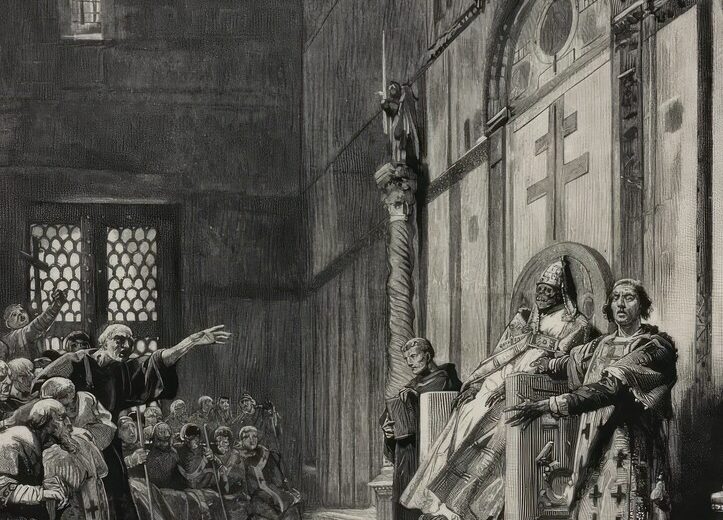
In the winter of 897, Rome witnessed one of the strangest and most disturbing spectacles in political history: a pope’s corpse was dug up, dressed in papal robes, propped on a throne, and put on trial. The defendant was Pope Formosus, who had been dead for months. The judge was his successor and enemy, Pope Stephen VI. The charges were absurd on their face and deadly serious in their implications. Formosus was accused of having broken church law, of coveting power, and of illegitimately occupying the chair of Saint Peter. Yet the Cadaver Synod was never really about theology alone. It was a raw display of factional revenge, a public humiliation meant to settle a political score in a city where papal authority, noble ambition, and military control were tangled together.
The image of the dead pope facing judgment has echoed through the centuries because it captures something unsettling about the medieval papacy: the office was sacred, but it was also political, contested, and vulnerable to force. In late ninth-century Rome, popes did not simply inherit spiritual authority; they had to navigate aristocratic alliances, imperial claims, and violent competition among powerful families. The Cadaver Synod was the extreme expression of that instability. To understand it is to understand how fragile the papacy could be when elections, dynasties, and foreign powers all sought to shape the Church from within.
Rome in Crisis: the papacy as a political battleground
By the late ninth century, Rome was not a stable ecclesiastical capital but a city torn by shifting alliances and anxious elites. The papacy had become a prize worth fighting over because the pope was more than a spiritual leader. He was a ruler with land, influence, and access to imperial legitimacy. In a world where the Carolingian Empire was fragmenting, the Roman see became entangled with the ambitions of local noble families and rival claimants to imperial power. A pope could crown emperors, endorse factions, and tip the balance in struggles that extended far beyond the city walls.
Formosus himself had risen in this turbulent environment. Before becoming pope, he had served as bishop of Porto and had already been drawn into wider political struggles. He was connected to the faction that favored Arnulf of Carinthia over the Spoleto line in the competition for imperial control in Italy. That alignment mattered. In medieval Rome, choosing sides was not a side issue; it was the essence of politics. A pope who backed one ruler over another could expect supporters, but also enemies who would remember, wait, and retaliate when the balance of power shifted.
Stephen VI, who would preside over the Cadaver Synod, inherited a papacy in which the office had become almost inseparable from factional warfare. According to later accounts, his own rise was closely tied to the anti-Formosan camp, especially to the interests of the Spoletan faction. The point was not simply to condemn a dead man. It was to erase a political legacy. In Rome at that moment, the papacy was a weapon in the hands of contending groups, and the body of Formosus became the most chilling possible target because it symbolized that struggle so vividly. The Cadaver Synod was therefore not an isolated act of madness; it was the culmination of a political culture in which authority was contested after death as well as during life.
Why Formosus was exhumed and brought to trial
Formosus had died in April 896, but his reputation did not die with him. His enemies saw him as a dangerous reminder of a political program they wanted to overturn. One of the first steps in such a reversal was to invalidate his acts as pope, especially any decisions that had strengthened rival claimants or challenged the interests of the Spoletan party. Exhuming his body was therefore a deliberate act of political theater. It transformed a deceased pontiff into a visible symbol of illegitimacy and allowed his opponents to dramatize their condemnation in the most public way possible.
The body was reportedly removed from its tomb and dressed in papal vestments for the proceedings. That gruesome preparation mattered. It was not enough to denounce Formosus in absentia; he had to be made present. The trial asserted that the authority of a pope did not end with death if the political stakes were high enough. By dragging his corpse into court, Stephen VI and his allies could stage a judgment that looked legal while functioning as revenge. The ritual created an illusion of order around what was, in essence, a purge.
The charges brought against Formosus reflected the deeply political nature of the case. He was accused of violating canon law by moving from one bishopric to another, since he had served as bishop of Porto before becoming pope. He was also charged with having coveted the papacy unlawfully and, more broadly, with betraying the obligations of his office. Behind these formal accusations lay the real grievance: he had sided with the wrong camp. His support for Arnulf and his opposition to the Spoletan interests made him intolerable to those who now controlled Rome. The body on trial was less a corpse than a political argument. By condemning Formosus, Stephen VI hoped to delegitimize his decisions, weaken his supporters, and announce that the victorious faction intended to rewrite the recent past.
The Cadaver Synod: a courtroom scene unlike any other
The trial itself remains one of the most extraordinary episodes in the history of the medieval papacy. Held in Rome in January 897, it was presented as a synod, which gave it the appearance of an ecclesiastical legal proceeding. But the spectacle quickly moved beyond anything that resembled sober judgment. Stephen VI sat in authority while Formosus, dead and unable to defend himself, was represented by a deacon acting as his voice. This setup underscored the cruelty of the event. The deceased pope could not answer for himself; the trial was structured to convict him.
Accounts describe the corpse as being placed on a throne or stool, robed in papal garments, with the atmosphere of the proceedings steeped in menace and mockery. The questions posed to Formosus were formal, but the situation was grotesque. He was asked whether he had unlawfully sought the papacy, whether he had violated church discipline, and whether his consecrations and official acts were invalid. The absurdity of trying a dead man did not make the event less serious to those present. On the contrary, the ritualized form of the trial made the political point more forcefully. Law was being used as a language of victory.
The verdict was damning. Formosus was found guilty, stripped symbolically of his papal insignia, and the papal acts associated with his reign were declared void. In a final act of contempt, the fingers of his right hand, the ones used for blessing, were reportedly cut off. His body was then subjected to further humiliation, thrown into the Tiber according to some accounts. The entire affair was an effort to desecrate not only a person but a memory. It was a political exorcism, designed to purge a rival legacy from Rome’s institutional life. Yet the very extremity of the ritual ensured that the Cadaver Synod would outlive its authors as one of history’s most infamous examples of power turned theatrical and cruel.
Backlash, reversal, and the instability of Roman politics
The Cadaver Synod did not achieve the lasting control its architects may have hoped for. Instead, it helped expose the instability that made such a grotesque trial possible in the first place. Stephen VI’s actions shocked many contemporaries, and the political ground beneath him soon shifted. Rome in this period was governed by changing coalitions rather than durable institutions, and what one faction celebrated, another could condemn. The violence done to Formosus’s body became a liability for Stephen, not only morally but politically. The spectacle had gone too far, even by the standards of a brutal age.
Stephen VI was eventually overthrown and died in prison in 897, only months after the trial. That swift downfall is telling. It suggests that the Synod, rather than stabilizing the papacy, deepened the sense that the office had become hostage to vendetta. Formosus’s memory was partially restored by later popes who reversed the condemnations imposed on him. His acts were reinstated, and the legal judgments of the Cadaver Synod were repudiated. These reversals reveal something important about medieval politics: legitimacy was not fixed. It could be dismantled by a faction one year and revived by another the next.
The aftermath also shows how the papacy’s claims to continuity were undermined by the realities of Roman power struggles. The Church needed to project permanence, but popes were often elected under pressure, constrained by secular families, and vulnerable to violent correction. The Cadaver Synod was horrifying precisely because it made that vulnerability visible. It showed that even the dead could be dragged into factional warfare if their legacy mattered enough. In broader terms, the episode reminds us that political history is not only about battles and dynasties. It is also about the control of memory, the rewriting of legitimacy, and the lengths to which rivals will go to erase one another.
What the Cadaver Synod reveals about power, memory, and the papacy
It is easy to focus on the sensational details of the Cadaver Synod and miss the deeper lesson. The trial of Formosus was not an eruption of random madness; it was a political act shaped by the contradictions of late ninth-century Rome. The papacy occupied a unique position. It was sacred, universal in aspiration, and yet trapped in local power struggles. That tension made the office both extraordinarily influential and extraordinarily vulnerable. When institutions are weak, ritual can be weaponized. The Cadaver Synod used the language of law, ceremony, and ecclesiastical authority to settle a factional dispute through public degradation.
It also reveals how central memory was to political survival. Formosus’s enemies were not satisfied with replacing him. They wanted to destroy the legitimacy of his reign retroactively. That is why the trial mattered so much. By condemning the dead pope, they hoped to invalidate the world he had helped shape. This kind of politics is familiar across history, even if the Cadaver Synod remains one of its most extreme expressions. Whenever a regime seeks to rewrite the past to secure the present, it is engaging in the same basic struggle over narrative and authority.
For modern readers, the episode can seem almost unbelievable, but its logic is deeply human. Power breeds retaliation, and retaliation often reaches beyond the grave. The dead cannot defend themselves, which makes them convenient targets when living factions want to dramatize their victory. The Cadaver Synod stands as a warning about what happens when institutions are unstable, political rivalry is personal, and justice becomes a costume worn by the powerful. In that sense, the trial of Formosus is more than a bizarre footnote. It is a stark reminder that political history is often driven not by ideal principles, but by fear, revenge, and the need to control the meaning of authority itself.
Seen from the distance of more than a millennium, the image of a corpse on trial still carries a strange force. It reminds us that the struggle for power is never only about who rules in the moment. It is also about who gets to define legitimacy, who gets remembered as rightful, and whose legacy is left to rot—or, in Formosus’s case, is dug up and judged all over again.
Related reading: Petition Against Annexation: The 1897 Hawaiian anti-annexation petition, Young Turk Revolution.
Research and further reading
For readers who want to verify details or continue researching this subject, these external reference collections provide useful starting points: