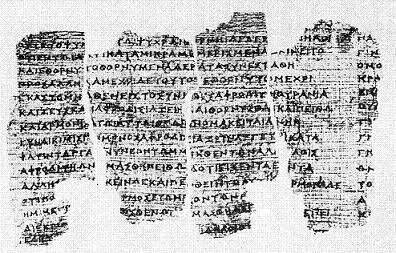
In 1962, archaeologists working beside a road north of Thessaloniki lifted a blackened mass from the remains of an ancient funeral pyre. It looked less like a book than a bundle of burnt leaves. The fire had destroyed much of a papyrus roll, yet it had also performed an unlikely act of preservation: by carbonizing the surviving layers, it protected them from the damp Greek soil that normally destroys papyrus.
That object is now known as the Derveni Papyrus. Copied around 340–320 BCE, it is commonly described as the oldest surviving book from Europe. Its contents are as remarkable as its survival. The roll moves from rituals for the dead to an elaborate interpretation of a poem attributed to the mythical singer Orpheus. Gods, violent successions, cosmic births, air, intelligence and matter all meet in the argument of an author whose name remains unknown.
The papyrus is not a lost Greek Bible, a secret code or proof of ancient monotheism, despite claims sometimes made about it. It is a fragmentary philosophical and religious commentary written in a culture where ritual practice, poetic authority and natural speculation overlapped. Understanding it requires separating what the object securely tells us from what modern readers would like it to say.
What Was Found at Derveni in 1962?
Derveni lies roughly ten kilometres north of Thessaloniki, near ancient Lete. In January 1962, rescue excavations connected with road construction uncovered a cemetery used by prosperous Macedonians in the later fourth century BCE. The graves contained weapons, bronze vessels, pottery and other rich goods. Near one cist grave, conventionally called Tomb A, excavators found the carbonized papyrus among the remains of a funeral pyre.
The surviving roll had broken into more than two hundred pieces. Only the upper part of many columns remained, because the lower portion had been more completely consumed. Conservators painstakingly joined fragments into a sequence of twenty-six columns, generally preserving about fifteen lines in each of the better sections. Even reconstructed, it is only part of the original work.
The archaeological context matters, but it does not identify the writer or owner. The cemetery has often been associated with the military elite of the kingdom of Philip II and Alexander the Great. A wealthy man was cremated nearby, and the roll was probably burned during his funerary rites. It is tempting to imagine him as the papyrus’s philosopher-reader, but no inscription connects the text to the dead man. The book may have been his possession, a ritual offering or an object supplied for the ceremony. The evidence cannot choose among those possibilities.
How a Funeral Fire Saved a Papyrus Roll
Papyrus survives best in exceptionally dry conditions. Egypt has therefore yielded tens of thousands of texts, including the documents and literature discussed in the Oxyrhynchus Papyri. Greece’s wetter soil is far less forgiving. A papyrus buried at Derveni without burning would probably have decomposed until no readable fibres remained.
The pyre altered that fate. Heat drove off moisture and converted the plant material into brittle carbon. The result was not undamaged preservation: the lower roll vanished, edges curled, sheets fused and ink became difficult to distinguish from the darkened surface. Yet carbonization slowed biological decay. The same paradox is familiar from the Herculaneum Papyri, although those Roman-era rolls were carbonized by the eruption of Vesuvius rather than by a cremation.
Calling the fire a preservation technique would therefore be misleading. Nobody deliberately baked the Derveni roll for a future library. Its survival was an accident produced by destruction. That accident also explains why the object is unique rather than representative. Ancient Greeks read and circulated many papyrus books; almost all of the copies used within Greece have disappeared. The Derveni Papyrus is a rare survivor from a much larger lost world of writing.
Is It Really Europe’s Oldest Book?
The Archaeological Museum of Thessaloniki and UNESCO describe the Derveni Papyrus as the oldest surviving book in Europe. The designation is defensible if “book” means a substantial literary text preserved on a papyrus roll found in Europe. Paleographers date its handwriting to approximately 340–320 BCE, making it centuries older than most surviving Greek literary manuscripts.
The phrase needs limits. It does not mean that Europeans had no writing before the fourth century BCE. Linear B tablets, archaic inscriptions, laws carved on stone and messages scratched on pottery are much older. Nor is the papyrus a codex with bound pages like a modern book. It was a scroll, the ordinary book technology of the Greek world. Other ancient texts survive through inscriptions and later medieval copies, while some papyrus fragments may contest particular record categories.
There is also a difference between the physical copy and the composition it preserves. The hand belongs to the late fourth century BCE, but linguistic and intellectual evidence suggests that the anonymous treatise was composed earlier, probably around the end of the fifth century BCE. UNESCO’s nomination dossier proposes roughly 420–410 BCE. The roll may therefore be a copy made decades after the author wrote the work. “Oldest European book” describes the surviving artifact, not necessarily the oldest European literary composition.
The First Columns: Souls, Sacrifice and the Dead
The beginning of the preserved text is badly damaged, but it is not merely an introduction to literary criticism. Columns I–VI refer to sacrifices, prayers, libations, souls, daimones, Erinyes and signs interpreted by ritual experts. The author appears concerned with the fate of souls and with rites meant to address divine or underworld powers. He criticizes people who perform ceremonies without understanding what their words and actions mean.
Some lines mention magoi, a Greek term that can refer to Persian priests but also to ritual practitioners more broadly. Translating it simply as “magicians” imports assumptions that the passage may not support. The text also mentions initiates and sacred rites, yet it gives no complete handbook for initiation. Much is missing, and its polemical tone makes it uncertain whether the author is describing approved practice, rivals’ practice or both.
These columns are essential because they prevent an overly neat label. The papyrus is not solely a commentary on a poem and not solely a funerary text. It links correct ritual with correct understanding. The transition around column VII addresses people able to recognize hidden meaning, preparing the way for a long interpretation of Orphic verse. For the author, religious speech is effective or valuable only when its riddling language is understood.
Who Was Orpheus, and What Does “Orphic” Mean?
Orpheus was a legendary singer whose music could charm animals, move stones and cross the boundary of death. Greek authors associated his name with poems about the gods, initiations, purification and the soul. Texts attributed to him acquired authority precisely because he belonged to a mythical past. The Derveni commentator quotes hexameter verses presented as the words of Orpheus and treats them as deliberately enigmatic.
This does not mean that the mythical Orpheus wrote the papyrus. An anonymous intellectual composed the prose commentary, and the quoted poem was itself the product of human poets working under Orpheus’s prestigious name. Scholars usually call the poem Orphic because of that attribution and its religious-cosmogonic subject.
“Orphism” can also be misleading when it suggests a single organized church with a fixed creed and canonical scripture. Ancient evidence points instead to overlapping poems, ritual specialists, initiatory practices and ideas about purity and the afterlife. Their relationships remain debated. The Derveni Papyrus proves that an Orpheus-attributed theogonic poem was being closely interpreted by the late fifth or fourth century BCE. It does not prove that every person using an Orphic verse belonged to one unified sect, or that the roll was the standard scripture of such a community.
A Poem About the Gods Recast as Physics
From approximately column VII onward, the commentator proceeds through an Orphic poem line by line. The quoted story resembles a theogony: divine generations struggle for rule, Zeus receives power, and extraordinary acts establish a new cosmic order. Read literally, some episodes are violent, sexual or impossible. The commentator insists that Orpheus spoke in riddles and that superficial listeners misunderstand him.
His solution is allegorical interpretation. Names and actions of gods refer to components or processes of the natural world. Zeus can be related to air and an ordering intelligence; divine births and unions describe the combination and separation of matter; “swallowing” need not mean a god physically consuming another being. Myth becomes a coded account of how the cosmos acquired its present arrangement.
This is not modern science hidden inside ancient poetry. The explanation depends on speculative cosmology, traditional divine names, etymologies and assumptions about purposeful language. Nevertheless, it belongs to the intellectual world of early Greek natural philosophy. The commentator tries to make an authoritative sacred poem agree with a reasoned account of nature. Rather than discarding myth, he argues that a wise poet had already expressed physical truth in a form designed to conceal it from the uncomprehending.
Heraclitus, Anaxagoras and the Intellectual Background
The author does not interpret Orpheus in isolation. The papyrus explicitly quotes Heraclitus, the famously compressed thinker from Ephesus. Its cosmology also has strong affinities with Anaxagoras and thinkers influenced by him, especially in the role assigned to intelligence, air and the ordering of an original mixture. These connections place the treatise within debates that transformed Greek explanations of the cosmos during the fifth century BCE.
Anaxagoras had argued that nous, mind or intellect, initiated cosmic rotation and imposed order. The Derveni author uses related concepts while speaking in a religious vocabulary. Whether he was a direct disciple, an independent interpreter or part of a broader intellectual environment cannot be proved. A recent Oxford study argues that he may have been a late Presocratic philosopher active in Athens and close to the circle of Archelaus, but that remains a scholarly reconstruction rather than an identified biography.
How the Commentator Read Words as Clues
The Derveni author assumes that Orpheus chose every important word deliberately. A change in grammatical form, an unusual epithet or a name that resembles another word can unlock the poet’s concealed meaning. The commentary therefore uses etymology, synonym, sound resemblance and contextual reinterpretation. Some arguments strike modern linguists as fanciful, but they reveal an early, sustained attempt to explain how a difficult text signifies.
This makes the papyrus one of the most important documents in the history of literary interpretation. It is not the earliest occasion on which a Greek explained poetry, but it is the oldest surviving extended Greek commentary on a literary work. The physical format supports that description: short quotations from the poem are followed by prose explanations, column after column.
The method also tells us about authority. The commentator does not accuse Orpheus of confusion when a verse appears scandalous. He relocates the problem in the audience. The poet knowingly concealed wisdom; ordinary people heard only a bizarre story; the trained interpreter restores the intended truth. This structure—authoritative text, surface difficulty and expert explanation—would recur in many later philosophical and religious traditions, although the Derveni Papyrus should not be treated as the single ancestor of all of them.
What the Papyrus Reveals About Literacy and Books
The roll was a crafted object before it became an archaeological treasure. Papyrus sheets were joined, written in columns and rolled for reading. Its small script and dense argument imply a reader comfortable with demanding prose and poetry. Copying it required materials, an exemplar and a trained scribe, placing it within an economy of education and status.
Its presence in Macedonia complicates pictures of Greek intellectual life centered only on Athens. The work may have originated in an Athenian environment, but the surviving copy reached the northern kingdom while Macedonian power was remaking the Greek world. Still, one exceptional grave cannot establish how widely it was read. The roll could have been a private enthusiasm, a specialist’s tool or a prestigious possession; it does not reveal a regional literacy rate or a community-wide creed.
The Unknown Author and the Limits of Attribution
Scholars have proposed authors ranging from Diagoras of Melos to Stesimbrotus of Thasos and Euthyphro, but no attribution has won general acceptance. Similar vocabulary or doctrine can suggest an intellectual setting; it cannot supply a signature. The handwriting dates the copy to about 340–320 BCE, while language and philosophical context place the underlying composition around 400 BCE, perhaps slightly earlier.
The author seems familiar with late fifth-century Athenian debates. One recent Oxford study places him near the circle of Archelaus, but this remains a reconstruction. Preserving anonymity is more accurate than choosing a famous name. The text reveals a rarely documented kind of thinker—part ritual critic, poetic exegete and cosmologist—without securely recording his biography.
Does the Text Teach Monotheism?
Popular accounts sometimes claim that the papyrus reveals secret Greek monotheism because the commentator identifies several divine names with a single cosmic reality or gives Zeus an all-encompassing role. That goes too far. Cosmic unity is not automatically belief in one exclusive, personal god in the later Jewish, Christian or Islamic sense.
The author keeps a crowded divine vocabulary while explaining gods as powers, names and natural processes. His system can be called unifying, naturalizing or allegorical, but scholars still debate how theological or materialist it is. The papyrus shows inherited religion being renegotiated through philosophy, not simply replaced. That historical process is more revealing than forcing the text into a modern choice between polytheism and monotheism.
From Black Fragments to a Readable Text
Decipherment took decades. Black ink lay on a carbonized surface, while broken fibres and overlapping layers obscured letters. Conservators arranged pieces, photographers enhanced contrasts and papyrologists compared traces with possible Greek forms. An unauthorized transcription circulated before the full 2006 edition by Theokritos Kouremenos, George M. Parássoglou and Kyriakos Tsantsanoglou gave scholars a more stable text, apparatus and translation.
Debate continues as imaging and physical study refine readings and joins. Every smooth translation rests on editorial decisions: scholars restore letters, divide words, supply punctuation and choose among alternatives. Broad features are secure, but some individual lines remain disputed. The responsible reader distinguishes the surviving marks from the reconstruction that makes them intelligible.
Why the Derveni Papyrus Matters
The papyrus is important for several histories at once. For archaeology, it is a rare organic survivor whose funerary context links text, object and ritual. For the history of the book, it preserves a Greek literary roll copied in the era of Philip II and Alexander. For religious history, it supplies early evidence for Orphic poetry, initiation language and reflection on souls. For philosophy, it shows Presocratic cosmology being used to interpret traditional myth.
It also changes the history of criticism. The commentator builds a systematic case for reading an authoritative poem whose intentional, layered meaning is accessible to informed interpreters rather than every listener.
In 2015, UNESCO added the Derveni Papyrus to the Memory of the World Register, and it became Greece’s first entry. The designation recognizes both the object’s rarity and the intellectual crossings preserved in it. Today the papyrus is held by the Archaeological Museum of Thessaloniki, where its dark fragments make an understated exhibit. The spectacle lies not in gold or monumental size, but in the survival of thought on material that nearly vanished.
Conclusion: A Book Preserved by Its Own Destruction
The Derveni Papyrus survives because a funeral fire almost destroyed it. That paradox gives the artifact its dramatic appeal, but its deeper significance lies in the text that emerged from the ashes. An anonymous author confronted sacred-sounding poetry with the tools of grammar, etymology and natural philosophy. He treated myth not as childish error but as deliberately concealed knowledge, while criticizing ritual performed without understanding.
What is certain is substantial: the roll was copied around 340–320 BCE, burned at a Macedonian cemetery, reconstructed into twenty-six fragmentary columns and recognized as the oldest surviving substantial literary papyrus found in Europe. What remains uncertain is equally important: its owner, its author, the precise shape of its missing beginning and ending, and the best reading of many damaged lines.
The papyrus therefore resists both sensationalism and tidy classification. It is neither a complete Orphic scripture nor an ancient science textbook. It is a rare encounter with a mind working across categories that modern scholarship often keeps apart. The flames left only part of the book, but that part is enough to show how ancient Greeks could argue about death, poetry, gods and the structure of the universe on the same roll.
Sources and Further Reading
- UNESCO Memory of the World: The Derveni Papyrus
- UNESCO nomination dossier for the Derveni Papyrus
- Archaeological Museum of Thessaloniki: Exhibition Highlights
- Archaeological Museum of Thessaloniki: Collections
- Oxford Academic: Studies on the Derveni Papyrus
- Oxford Academic: The Author of the Derveni Papyrus