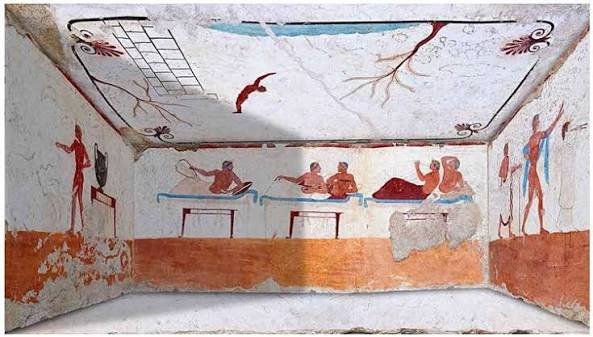
A young man hangs forever between stone and water. His body is stretched into a clean arc, arms reaching toward a narrow blue pool while two delicate trees frame the scene. He has no name, no audience, and no visible fear. For almost 2,500 years, the image remained sealed above a dead person in a small stone grave outside the Greek city of Poseidonia, later known as Paestum.
Archaeologists discovered the Tomb of the Diver in 1968. Its painted lid immediately became one of the most recognizable images from the ancient Mediterranean. The four walls below it show a very different world: men reclining at a symposium, drinking wine, playing music, conversing, embracing, and competing at kottabos. Together, the solitary diver and the crowded banquet form a pictorial program unlike any other complete Greek painted tomb known from the early Classical period.
The temptation is to decode the dive as a simple symbol of the soul entering the afterlife. That may be part of its meaning, but there is no explanatory inscription and no exact parallel. Scholars have proposed Orphic initiation, Pythagorean philosophy, aristocratic memory, erotic youth, literal athletic experience, and the creative reuse of familiar banquet imagery. The monument is important precisely because it preserves evidence while refusing a single certain answer.
What Is the Tomb of the Diver?
The Tomb of the Diver is a stone cist grave built from four side slabs and a large cover slab, all painted on the surfaces facing the burial. It dates to approximately 480–470 BCE, at the transition from the late Archaic to the early Classical period. The tomb is now reconstructed and displayed in the National Archaeological Museum of Paestum in southern Italy.
Its side walls depict a Greek symposium. Male participants recline on couches, drink from cups, listen to music, and interact in pairs. One short wall includes figures arriving or moving in procession; another centers activity around a large mixing vessel. On the underside of the lid, hidden once the grave was closed, the diver leaps toward water.
The monument is often described as the only known fifth-century BCE tomb in the Greek world with a complete cycle of figurative wall paintings. That claim concerns a specific category and state of survival, not the assertion that Greeks never painted walls. Literary sources and scattered archaeological remains show that large-scale Greek painting existed, but remarkably little has survived intact.
Poseidonia: A Greek City in Southern Italy
The tomb belonged to the world of Poseidonia, a Greek colonial city founded on the coast of Campania, probably by settlers connected with Sybaris. Romans later called it Paestum. Its surviving temples make the city famous, but the surrounding cemeteries reveal a population shaped by contact among Greeks, local Italic communities, Lucanians, and wider Mediterranean networks.
This mixed setting matters to interpretation. The impulse to decorate a tomb with large figurative paintings has strong parallels in Etruria, while many individual poses resemble Greek painted pottery. Technical studies increasingly suggest a local workshop tradition. The tomb may be best understood not as a foreign import but as a creation of Poseidonia’s own elite culture.
The 1968 Discovery at Tempa del Prete
Archaeologist Mario Napoli directed the excavation that uncovered the tomb in June 1968 at the Tempa del Prete necropolis, roughly two kilometers south of ancient Poseidonia. The grave appeared modest from outside. Its extraordinary decoration was on the interior, designed to disappear from human view when the lid was placed over the burial.
The chamber was just large enough for the deceased and a small group of grave goods. The skeleton had largely disintegrated. An Attic lekythos—a vessel associated with perfumed oil—and remains identified as parts of a lyre were among the finds. These objects support, but do not conclusively determine, the interpretation of the deceased as a young elite man connected with music and symposium culture.
Why the Paintings Are So Rare
Ancient Greek writers praised monumental painters such as Polygnotos, Zeuxis, and Parrhasios, but most of their works were created on perishable panels or exposed architectural surfaces. Weather, rebuilding, reuse, and the passage of time destroyed them. Greek vase painting survives in far greater quantity because fired ceramic is durable and tombs protected many vessels.
The Tomb of the Diver offers something different: a complete painted environment preserved in its original architectural relationship. A viewer can examine how images on separate slabs surrounded the body and how the lid closed that visual world. The paintings were not independent pictures later assembled by collectors.
How the Tomb Was Painted
The artists applied a thin lime-based plaster to the stone slabs and painted while the surface was still moist, using a fresco technique. Analytical research has identified mineral pigments and differences in preparation, brushwork, and execution. Red, black, blue, and other tones create figures with economical outlines rather than heavy modeling.
A 2020 comparative archaeometric study examined the Tomb of the Diver alongside other painted tombs from Paestum. Mortars, pigments, and techniques linked it to local production, particularly the roughly contemporary Tomb of the Palmettes. The authors argued that the work should not be forced into a choice between “Greek” and “Etruscan”; technically and culturally, it expressed a local Paestan tradition.
The Symposium on the Long Walls
The long walls show men reclining in pairs on couches. They hold cups, gesture toward one another, wear wreaths, and participate in conversation, music, and play. The symposium was a structured drinking party central to elite male sociability in many Greek communities. Wine was mixed with water, entertainment followed the meal, and participants performed status, education, wit, desire, and belonging.
In a grave, the banquet acquires additional meanings. It can surround the deceased with familiar pleasure, display the identity of a cultured elite, imagine continuing fellowship, or preserve social memory among survivors. Whether it represents a literal afterlife banquet is uncertain; the walls do not label the participants as dead, divine, or mythological.
Music, Poetry, and the Lyre
Several symposiasts make or respond to music. Stringed instruments and pipes were common in banquet imagery, where poetry and song turned private drinking into a performance of education and memory. The reported lyre fragments in the grave make the musical theme especially suggestive.
One scholarly interpretation connects music with kleos, the lasting fame created through song and poetry. On this reading, the deceased survives not because the painted feast is a literal paradise, but because companions continue to sing of him. The symposium becomes a machine of social immortality.
Kottabos and the Playful Side of the Banquet
One participant prepares to play kottabos, a drinking game in which a player flicked the last drops of wine from a cup toward a target. Success could bring a prize, prestige, or flirtatious association. The game demanded style as much as accuracy and appears frequently on Greek pottery.
Some interpretations link the trajectory of thrown wine to the diver’s movement above, treating the lid and walls as a coordinated visual game. Such readings are imaginative, but they depend on how the slabs are mentally unfolded and have not won universal acceptance. The safe conclusion is that both images emphasize controlled motion at a suspended instant.
The Solitary Diver on the Lid
The cover slab strips the composition to a few elements: the naked diver, a built platform, water, two trees, and a sparse horizon. Unlike the sociable walls, it contains one human figure. The contrast between noisy banquet and silent leap is central to the tomb’s power.
The structure from which he dives has been called a tower, pier, platform, or boundary marker. The water is similarly ambiguous: pool, sea, river, or symbolic threshold. The painter gives enough detail to make the act recognizable but not enough to identify a real location.
Because the image faced downward, it was made for the dead and perhaps for gods or ritual observers imagined within the tomb. Living participants could have seen it briefly before closure. Its hidden position suggests that its role exceeded public display, although secrecy alone does not reveal a specific doctrine.
Does the Dive Represent Death?
The most widely accepted broad interpretation sees the leap as a passage from life into death. The diver leaves a solid structure, crosses open air, and approaches an unknown depth. The image suits a burial because it captures irreversible transition without depicting a corpse or the terrors of the underworld.
Yet “symbol of death” is a starting point, not a complete translation. The body is graceful and vigorous. Diving can express youth, courage, erotic beauty, purification, sport, danger, or renewal. The image may hold several associations at once.
No inscription says “this is the soul.” No surviving Greek text identifies this exact scene as a standard funerary emblem. A responsible description therefore uses language such as “probably,” “may,” and “often interpreted,” rather than presenting the afterlife reading as a decoded fact.
Orphic and Pythagorean Interpretations
Southern Italy was associated with Pythagorean communities and with religious movements that modern scholars group under “Orphic” traditions. Both have been linked to ideas about the soul, purification, death, and rebirth. The tomb’s unusual dive and banquet encouraged interpretations involving initiation into secret knowledge.
The difficulty is evidentiary. There is no Orphic gold tablet, doctrinal inscription, named initiate, or unmistakable ritual symbol in the grave. “Orphism” itself was not a single church with a fixed creed, and later reports about Pythagorean beliefs cannot automatically explain an early fifth-century image.
R. Ross Holloway argued that the program may owe more to familiar Attic vase imagery and painters’ invention than to complex philosophy. Other scholars continue to find religious or eschatological resonance persuasive. The debate remains open because context supports the possibility of special beliefs without identifying them securely.
Was the Diver a Real Athlete?
A literal interpretation is also possible: the deceased or his social circle may have valued swimming and diving. Greeks knew coastal athletics, bathing, and dangerous leaps. A vivid real-world action can become meaningful in a grave without being part of an organized mystery religion.
The distinction between literal and symbolic may itself be too rigid. Ancient images often gained power by connecting recognizable actions with broader ideas. A beautiful dive could evoke lived experience and the passage into death simultaneously.
Greek, Etruscan, Italic, or Paestan?
Early discussions often asked which culture “owned” the monument. The symposium and figure styles appeared Greek; painted tomb chambers had strong Etruscan parallels; details could be Italic. The question reflected modern categories more sharply separated than the ancient communities themselves.
Poseidonia participated in a connected Mediterranean. Artists saw imported pottery, patrons encountered neighboring customs, and workshops adapted techniques across cultural boundaries. Hybridity is not evidence of confusion or inferior imitation. It was a normal condition of art in a colonial port city.
Scientific analysis strengthens the local explanation. Materials and methods cluster with Paestan tomb production rather than identifying an imported Etruscan crew. The Tomb of the Diver remains part of Greek art history, but it also challenges any history that treats Greek art as something made only in mainland Greece.
Who Was Buried in the Tomb?
The skeletal remains were too poorly preserved to provide the kind of biological profile modern readers want. The decoration and goods suggest status, and the symposium strongly evokes elite male identity, but the occupant’s age, name, family, and precise origins remain unknown.
The naked diver is often assumed to represent the dead man. That is plausible, not certain. Funerary figures can embody ideals, myths, companions, or transitions rather than portraits. Even if the diver stands for the deceased, the body is generalized rather than individually recognizable.
Claims that the occupant was definitively a Pythagorean, an athlete, a lover, or a foreigner turn hypotheses into headlines. The honest answer is more limited: someone with access to skilled painters and culturally rich imagery received an exceptional burial in the territory of Poseidonia.
What the Tomb Reveals About Ancient Sexuality
Some reclining men are shown in intimate pairs, and scholars have discussed the scene in relation to elite Greek practices of male courtship and desire. Symposium spaces could include erotic performance, flirtation, and age-structured relationships. The paintings should not be erased from histories of ancient sexuality.
The best interpretation recognizes homoerotic elements without converting them into certainty about one person’s life. Ancient sexuality was organized through status, age, role, and social context in ways that do not map neatly onto modern categories.
What Archaeometry Added to the Debate
Portable imaging and spectroscopic instruments allow researchers to study pigments without taking large samples. Small laboratory samples can then reveal the mineral composition and structure of plaster. Together, these methods identify technical choices invisible to ordinary viewing.
The comparative 2020 study found continuity between the Tomb of the Diver and later painted tombs at Paestum, while also identifying early local markers. It showed that debates based only on visual resemblance—Greek figures versus Etruscan tombs—were too narrow.
Science did not decode the diver. Chemical analysis can identify how and where a work was made more confidently than why a patron selected an image. The strongest scholarship combines material evidence, burial context, visual comparison, and careful limits on interpretation.
Common Myths About the Tomb of the Diver
The first myth is that it is the only surviving ancient Greek painting. Painted pottery, architectural fragments, Macedonian tombs, and other works survive. Its distinction is the completeness, date, context, and figurative program of a painted tomb associated with a Greek city.
A second myth says the dive has been conclusively deciphered as the soul entering the afterlife. That is the leading general interpretation, but no inscription confirms it. A third says the tomb proves the deceased belonged to an Orphic or Pythagorean cult. Such connections remain debated.
Finally, describing it as purely Greek or purely Etruscan ignores Poseidonia’s local culture. The monument’s significance lies partly in its combination of traditions and in the evidence for a skilled workshop operating in southern Italy.
Why the Tomb of the Diver Matters
The Tomb of the Diver preserves an art form largely lost from the Greek world and places it in a complete funerary setting. Like the frozen survival of the Pazyryk Carpet, its value comes not only from beauty but from the rare chain of circumstances that protected a fragile work.
It also demonstrates the danger of treating uniqueness as isolation. The paintings connect vase imagery, banquet practice, musical culture, Etruscan funerary traditions, local craftsmanship, and changing ideas about death. One small grave opens onto a network of Mediterranean exchange.
Most of all, the tomb teaches disciplined uncertainty. Archaeology can establish date, materials, techniques, location, and much of the visual content. Meaning must be argued from those facts rather than announced as revelation. The diver remains compelling because the painter transformed ambiguity itself into an image.
Conclusion
The Tomb of the Diver was created around 480–470 BCE for an unknown person buried outside Poseidonia. Its walls evoke the communal world of the symposium; its lid isolates one youth in a graceful leap. The paintings are technically connected to local Paestan production while drawing on Greek and neighboring traditions.
The dive probably addressed death and transition, but its full meaning is not recoverable. Religious initiation, poetic memory, elite identity, youthful beauty, and painters’ invention remain competing or overlapping possibilities. Rather than diminish the monument, that uncertainty preserves its central achievement: a body poised at the boundary between a familiar world and an unseen one.
Sources and Further Reading
- Archaeological Parks of Paestum and Velia, National Archaeological Museum and Tomb of the Diver.
- Archaeological Parks of Paestum and Velia, “The Tomb of the Diver Reopens to the Public”.
- R. Ross Holloway, “The Tomb of the Diver,” American Journal of Archaeology 110.3 (2006).
- M. F. Alberghina et al., “The Tomb of the Diver and the frescoed tombs in Paestum,” PLOS ONE 15.4 (2020).
- Angela Bellia, “Images of Music in Magna Graecia: The Case of the Tomb of the Diver,” University of Bologna repository.
- Smarthistory, “Tomb of the Diver”.