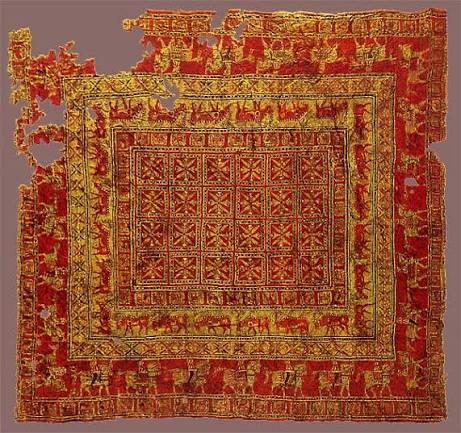
In 1949, Soviet archaeologists opened a burial mound high in the Altai Mountains and found a chamber locked in ice. Inside lay sacrificed horses, carved wood, felt, leather and textiles that should have disappeared more than two thousand years earlier. Among them was a nearly complete wool carpet, its red field still carrying processions of horsemen, deer and griffin-like creatures.
The Pazyryk Carpet is commonly called the world’s oldest carpet. More precisely, it is the oldest nearly complete knotted-pile carpet securely recovered by archaeology. Small fragments of other pile fabrics may be older, and flat-woven textiles have a much deeper history. What makes Pazyryk extraordinary is the survival of an entire sophisticated design rather than a scrap.
The carpet also sits at the center of a long argument. Its imagery draws on Achaemenid Iranian art, its animals fit the visual world of the Eurasian steppe, and its knotting has been claimed by modern Armenian, Persian, Turkish and Central Asian traditions. None of those labels can be assigned with certainty. The object is most valuable not as a national trophy, but as evidence of an interconnected Iron Age world.
What Is the Pazyryk Carpet?
The carpet is a woolen knotted-pile textile measuring approximately 1.83 by 2 meters. It has a dense pile tied with symmetrical knots, about 3,600 knots per square decimeter, or 36 per square centimeter. That amounts to well over a million individual knots across the surviving surface.
Its central field contains twenty-four framed squares, each holding a stylized floral or cross-shaped motif. Multiple narrow guard bands surround the field. Broader borders show rows of griffin-like creatures, deer with lowered heads, and twenty-eight horses accompanied by mounted or walking men.
Red, yellow, blue and darker tones once produced a much stronger effect than the aged surface suggests today. The design is disciplined and carefully planned, yet small adjustments near corners show that the weavers solved spacing problems as they worked. It is a handmade textile, not a mechanically perfect diagram.
The Frozen Tombs of the Altai
Pazyryk lies in the Altai Mountains of southern Siberia, near routes connecting the Eurasian steppe, Central Asia, western China and the Iranian world. Elite dead were buried in timber chambers sunk into the ground and covered by earth and large stone mounds called kurgans.
The stone covering insulated the ground from summer heat. Water entering the chambers froze, creating lenses of ice that preserved organic materials. Ancient robbers opened some tombs and removed conspicuous valuables, but their disturbance also allowed water to enter. What they left behind later froze.
This preservation was exceptional, not normal for steppe burials. Wool, felt, leather, wood, human bodies and horse carcasses ordinarily decay. Like the waterlogged conditions that preserved the Vindolanda Tablets, the Pazyryk ice produced an archive by interrupting the biological processes that usually erase organic life.
Sergei Rudenko and Kurgan 5
Archaeologists had investigated Altai mounds since the nineteenth century, but the major Pazyryk excavations were led by Sergei Rudenko in the late 1940s. The carpet came from Kurgan 5 during the 1949 season. It entered the State Hermitage Museum in Leningrad, now St Petersburg.
Kurgan 5 was the largest of the principal mounds and had been robbed in antiquity. Excavators nevertheless recovered an extraordinary collection: a dismantled wagon, horse equipment, carved and gilded objects, textiles from several cultural regions and frozen remains. The carpet was one element in a carefully assembled elite funerary world.
Rudenko’s publications made the find internationally famous, but some of his conclusions have been revised. Archaeological chronologies, textile comparisons and scientific dating have changed since the mid-twentieth century. The excavation remains foundational while no longer supplying the final word on every object.
How Old Is the Pazyryk Carpet?
The carpet is often dated to the fifth century BCE, especially in museum labels and popular summaries derived from early scholarship. Later studies have placed Pazyryk Kurgan 5 toward the end of the fourth or beginning of the third century BCE. The wider cemetery developed over several decades rather than in a single moment.
Dating depends on more than one laboratory number. Scholars compare tree rings from wooden chambers, associated objects, imported Chinese silks, artistic styles and radiocarbon evidence. Each method has uncertainties, and the age of a tomb need not equal the exact year every grave good was manufactured.
The cautious conclusion is that the carpet is roughly 2,300 to 2,500 years old and belongs to the later Iron Age. Stating “exactly 500 BCE” gives a precision the evidence does not support. Its historical importance does not depend on winning a competition for the earliest possible date.
How a Knotted-Pile Carpet Is Made
A pile carpet begins with lengthwise warp threads stretched on a loom. The weaver ties short pieces of yarn around adjacent warps, creating a row of knots, then inserts horizontal wefts and beats the structure tight. The projecting ends form the pile and are clipped to an even surface.
The Pazyryk carpet uses the symmetrical knot, in which the yarn loops around two warp threads and emerges between them. Older carpet literature often calls this the Gördes or “Turkish” knot, while the asymmetrical form is sometimes called “Persian.” Those geographic labels are misleading because both structures have been used across wide regions.
Knot type alone cannot identify ethnicity. Technique moves through migration, apprenticeship, trade and imitation. The carpet’s fine density proves experienced production, but it does not reveal the language or modern nationality of the workshop.
Reading the Central Field
The twenty-four compartments in the center contain repeated forms sometimes described as lotus buds, rosettes or crosses. Their ultimate ancestry may lie in ancient Near Eastern floral ornament. Yet naming a motif does not automatically explain what it meant to the people who made or owned the carpet.
Repetition creates order and makes the field appear stable against the moving animals in the borders. The design may have marked a prestigious interior space, served in ceremonial display or belonged to funerary equipment. A suggestion that the squares made the carpet a game board has attracted attention but lacks decisive evidence.
Modern viewers often search for a hidden code in the numbers twenty-four and twenty-eight. Numerical correspondences may be meaningful, but they can also result from the practical division of a rectangular surface. Without a text explaining the design, symbolism should remain a hypothesis.
Horsemen, Horses and Political Imagery
The broad outer procession alternates mounted men with figures walking beside horses. The men wear fitted clothing and headgear; the horses have carefully represented bridles, blankets and decorated manes. In a steppe society where wealth, travel and warfare depended on horses, the subject was hardly incidental.
Scholars have compared the walking attendants with tribute processions carved at Persepolis, the ceremonial center of the Achaemenid Empire. That resemblance helped generate the theory that the carpet was Persian. However, Persepolis horsemen generally lead rather than alternate between riding and walking, and the Pazyryk design is not a direct copy.
The border may reflect an Achaemenid visual language transformed for another audience. It could depict a ceremonial parade, elite retainers or ideal horse ownership. Calling every figure a Persian tribute bearer goes beyond what the wool itself can prove.
The Deer and the Animal Style of the Steppe
Another border shows spotted deer or elk moving with lowered heads. Their bodies carry decorative bands and the “dot-and-comma” convention used to mark muscles in ancient Near Eastern art. At the same time, the naturalistic posture and choice of animal fit traditions of Central Asia and Siberia.
Pazyryk art repeatedly features animals, predators, antlers and bodies twisted into dynamic forms. Carved wood, felt appliqué, tattoos and horse equipment from the tombs all display a rich steppe animal style. Imported motifs were not passively received; local makers selected and transformed them.
The carpet therefore resists a choice between “Persian” and “nomadic.” Its imagery participates in both western Asian court art and Altai visual preferences. Cultural mixture is not evidence of confusion. It is evidence that objects, artists and ideas traveled.
What the Colors Reveal
Ancient dyers needed to clean wool, prepare colorants and use mordants that fixed dyes to fibers. The Pazyryk palette survived because of both freezing and skilled preparation. Faded today, it originally depended on deliberate control of chemistry long before chemistry became a formal science.
Recent synchrotron X-ray microscopy examined individual red fibers and detected how metal-organic pigments were distributed inside the wool. Researchers compared the ancient fibers with wool dyed through traditional processes and found evidence of exceptionally sophisticated treatment, probably including fermentation before dyeing.
Scientific analysis can identify elements, molecular compounds and production traces, but it cannot by itself assign a nation to the textile. A dye source may occur across several regions, while finished yarn or a completed carpet could travel far. As the study of Maya Blue shows in another ancient context, material science is strongest when combined with archaeology rather than used as a shortcut to cultural ownership.
Was the Carpet Persian?
A Persian or Achaemenid origin was proposed soon after discovery. The processional organization, floral motifs and resemblance to Persepolis offered real grounds for comparison. A luxury carpet could have traveled north through exchange, diplomatic gifts, tribute or raiding.
However, the revised date for Kurgan 5 may fall after the Achaemenid Empire ended in 330 BCE. A design can outlive the political court that popularized it. Encyclopaedia Iranica cautions that the carpet has too often been called Persian as though the identification were settled.
Some features also diverge from canonical Achaemenid imagery, especially the horsemen’s alternating actions and the treatment of the deer. Achaemenid influence is easier to defend than manufacture inside imperial Persia. “Persian-style” and “made in Persia” are not equivalent statements.
Armenian, Central Asian and Local Claims
Armenian-origin arguments point to the symmetrical knot, possible dye sources, Transcaucasian animals and similarities between the horse procession and Armenian delegations shown at Persepolis. These comparisons have been influential, particularly in national histories of carpet weaving.
Yet the symmetrical knot is not uniquely Armenian, and dye species or motifs do not map neatly onto modern borders. A workshop in the Armenian highlands remains possible, but the carpet lacks an inscription or documented archaeological trail from that region.
Other scholars favor western or Central Asian manufacture, while some consider a local or near-local workshop capable of adapting imported designs. The most responsible answer is that origin remains disputed. Claims of certainty often reveal modern competition for heritage more clearly than ancient production.
Was It Made by the Pazyryk People?
The people buried at Pazyryk left no written account of their identity. They are frequently called Scythians, Saka or Pazyryk people, terms that overlap imperfectly. “Pazyryk culture” is an archaeological label based on burial practices and material patterns, not a self-recorded ethnic name.
Penn Museum scholars interpreted the pile carpet and several pictorial woolens as imports from western or Central Asia, contrasting them with locally made felts and plain textiles. Other researchers allow more local production. Technical excellence does not rule out mobile or semi-mobile communities; nomadic elites supported skilled crafts and long-distance exchange.
Ownership is clearer than manufacture. The carpet was selected for Kurgan 5 and placed within a Pazyryk funeral. Whatever its workshop origin, it had entered the social world of the Altai elite and acquired meaning there.
Why “The World’s Oldest Carpet” Needs Qualification
The Pazyryk Carpet is the earliest well-preserved knotted-pile carpet known. It is not the earliest textile, the earliest floor covering or necessarily the first pile carpet ever woven. Earlier fragments and indirect evidence show that its technique had predecessors.
At Bashadar in the Altai, a tomb roughly a century earlier produced fragments of an even finer knotted carpet, although too little survives to reconstruct its design or function. Ancient stone reliefs and written references may also depict soft floor coverings, but identification is uncertain.
The Pazyryk object’s sophistication itself argues against invention by its makers. Dense knotting, planned borders and controlled dyes belong to an established craft tradition. It is the oldest great survivor, not the beginning of carpet weaving.
What the Carpet Says About Iron Age Exchange
Kurgan 5 contained Chinese silk, western or Central Asian woolens and objects shaped by local steppe art. These materials show an exchange network centuries before the routes later grouped under the name Silk Road reached their most famous form.
Trade was not the only mechanism. Goods could move as diplomatic payments, marriage property, tribute, gifts, wages or booty. After arrival, expensive textiles might be cut apart, mounted on felt or repurposed as horse equipment. Pazyryk consumers actively transformed foreign luxury.
The carpet survived intact enough to dominate modern attention, but it belonged to this wider assemblage. Its mixed artistic language is exactly what should be expected at a mountain crossroads linking mobile pastoralists and powerful settled states.
Conservation and Modern Scientific Study
Removing an object from ice does not end the danger. Wet organic fibers can shrink, distort, fade or support microbial growth during drying. Conservators had to stabilize the carpet, clean it without destroying ancient color and mount it so that its own weight would not damage weakened threads.
Modern researchers use microscopy, spectroscopy, radiocarbon dating and imaging to study fibers and dyes while minimizing sampling. Each method answers a narrow question. Microscopy can reveal structure; spectroscopy can detect compounds; dating can estimate age. None independently explains who designed the border.
The carpet is now held by the State Hermitage Museum. Its continued survival depends on controlled light, humidity, temperature and support. The famous ice preservation was an accident of burial; museum preservation is an ongoing technical responsibility.
What Is Confirmed, Disputed and Oversimplified?
Confirmed: the carpet came from Pazyryk Kurgan 5, excavated by Rudenko’s team in 1949. It is wool, uses symmetrical knotted pile, measures about 1.83 by 2 meters and preserves more than a million knots arranged in elaborate fields and animal processions.
Strongly supported: the tomb belongs to the later Iron Age, probably late fourth or early third century BCE in revised chronologies. Ice formed within the burial mound and preserved organic goods that would normally have decayed.
Disputed: the carpet’s exact workshop and cultural origin. Persian, Armenian, western or Central Asian and local production theories draw on genuine evidence, but none has achieved universal agreement.
Oversimplified: the claims that it is simply “the first carpet,” that a symmetrical knot proves Turkish or Armenian authorship, or that Persepolis-like figures establish Persian manufacture. Technique and imagery traveled across the ancient world.
Conclusion: A Carpet Made by Connections
The Pazyryk Carpet owes its fame to an unlikely partnership between human skill and environmental accident. Expert weavers tied more than a million knots and dyers fixed vivid colors into wool. Tomb builders, robbers, groundwater, stone and Altai cold then created the conditions that carried it into the modern world.
Its imagery does not identify a single nation. Horsemen echo imperial ceremony, deer belong comfortably within steppe art, and the entire carpet rested in the grave of an Altai elite. Those layers are not obstacles to interpretation; they are the central historical fact.
The oldest nearly complete knotted carpet is therefore more than a record-holder. It is evidence that Iron Age Eurasia was connected, technically accomplished and visually inventive. The argument over who “owns” it becomes less useful than the question it answers so beautifully: how far ideas and luxury objects could travel long before modern borders existed.
Research and Further Reading
- State Hermitage Museum, Pazyryk Carpet — official collection record for the carpet.
- State Hermitage Museum, Early Cultures — museum catalogue placing the carpet within the Pazyryk collection.
- Encyclopaedia Iranica, “Carpets VI: Pre-Islamic Carpets” — dimensions, design, chronology, knot density and origin debate.
- Penn Museum, “The Textiles from Pazyryk” — academic discussion of preservation, chronology, exchange and artistic influence.
- Scientific Reports, “X-ray microscopy reveals the outstanding craftsmanship of Siberian Iron Age textile dyers” — peer-reviewed fiber and dye analysis.
- Archaeological Research in Asia, “Results of repeated study of the frozen tomb of the Fifth Pazyryk Barrow” — modern reassessment of Kurgan 5.