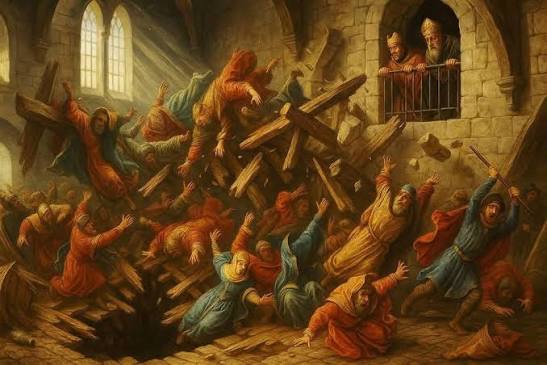
On July 26, 1184, a royal effort to settle a political feud in Erfurt ended in one of medieval Europe’s strangest recorded disasters. A crowded upper floor gave way beneath a gathering of princes, counts, clerics and retainers. The falling assembly smashed through the level below and plunged into a latrine pit. Some victims died under timber and masonry; others, medieval chroniclers reported, suffocated in the filth.
The event is now known as the Erfurt latrine disaster, or Erfurter Latrinensturz. Modern retellings commonly say that about sixty nobles died while the future emperor Henry VI survived by clinging to a stone window. The broad outline is well attested, but the story has accumulated confident details that its surviving sources do not always support.
What happened at Erfurt was more than a grotesque accident. It interrupted negotiations among some of central Germany’s most powerful men, exposed the physical limits of a high-status meeting place and left chroniclers trying to turn chaos into a meaningful account. Reconstructing it requires separating near-contemporary testimony from later legend—and resisting the temptation to treat the Middle Ages as little more than a catalogue of bizarre deaths.
Erfurt in the Twelfth-Century Holy Roman Empire
Erfurt was one of the most important urban centers in Thuringia. It stood at the intersection of trade routes and belonged politically to the archbishops of Mainz, even though Mainz lay far to the west. Churches, monasteries, markets and ecclesiastical residences made the city both a commercial center and a suitable place for rulers to hold court.
The Holy Roman Empire was not a centralized state with a permanent capital. Kings governed by traveling through their realms, confirming privileges, hearing disputes and assembling leading men at temporary courts. A royal Hoftag was therefore an event rather than a fixed parliament. Its authority came from the king’s presence and from the princes, bishops and nobles who attended.
This mobile political culture placed heavy demands on local buildings. Residences designed for ordinary clerical or administrative use could suddenly receive a dense crowd of armed nobles, servants and spectators. Prestige required hospitality, but medieval structures were not engineered for modern occupancy calculations.
Why Henry VI Came to Erfurt
Henry was the son of Emperor Frederick I Barbarossa and had already been crowned king of the Romans. In 1184 he was still a teenager, acting within his father’s political system; he would not become emperor until 1191. Calling him “Emperor Henry VI” at the time of the accident is therefore anachronistic.
He came to Erfurt to mediate a conflict involving Landgrave Louis III of Thuringia and Archbishop Conrad I of Mainz. The dispute grew from competing territorial claims and authority in Thuringia. Louis had spent years expanding his power and resisting ecclesiastical lords, while Conrad sought to recover rights and possessions associated with the archbishopric.
The affair was not merely a personal quarrel. In the empire, rights to castles, towns, offices and revenues overlapped. A feud could draw in vassals and neighboring lords, damage church property and challenge the public peace. Royal mediation offered a way to convert armed rivalry into a settlement recognized by the wider political community.
The Gathering on July 26, 1184
The court assembled around the feast of Saint James, generally dated to July 25–26. Counts, clerics, ministerials and urban notables crowded into an upper room. The presence of so many high-ranking men reflected the seriousness of the dispute and the public nature of princely reconciliation.
The exact venue is less certain than popular summaries suggest. Several accounts place the meeting in the cathedral provost’s residence associated with the collegiate church of St Mary. Other later traditions locate it in an archiepiscopal building or connect it with the Petersberg monastery. These sites were close within Erfurt’s ecclesiastical landscape, encouraging later conflation.
The distinction matters. A cathedral provostry, an archbishop’s residence and the monastery on Petersberg were not interchangeable institutions. The safest description is that the meeting occurred in an ecclesiastical building in or near Erfurt’s cathedral precinct, with the provostry favored by major source compilations.
How the Floors Collapsed
The assembled crowd overloaded the upper floor. Its timber supports failed, dropping people and debris onto the floor below. That level then also collapsed, sending part of the gathering farther down into a cesspit or latrine chamber beneath the building.
Later retellings often specify that the beams were old and rotten. This is plausible, and wooden members exposed to moisture or neglected maintenance can lose strength. Yet the earliest accounts emphasize the weight of the crowd and the sequence of collapse more securely than they document a modern structural diagnosis. “Rotten beams” should be treated as a likely explanation, not a surviving engineer’s report.
The failure was progressive: the upper floor fell, its impact overloaded the next level, and the combined mass reached the space below. Falling timbers, flooring, furniture and bodies would have injured people before they reached the pit. The disaster was not simply a roomful of nobles sliding intact through a trapdoor.
Why There Was a Latrine Pit Beneath the Building
Medieval urban sanitation varied widely. Some privies projected from exterior walls; others emptied into drains, yards or cesspits. A substantial residence could have latrine chutes or seats serving an enclosed pit that required periodic cleaning. Archaeological evidence from European towns shows many practical arrangements rather than one universal “medieval toilet.”
A cesspit beneath or beside a building was not inherently absurd by contemporary standards. It kept waste localized and could be emptied by laborers. Problems arose when pits were neglected, leaked or accumulated gases, and when floors or covers above them failed.
The Erfurt accounts use language that later translators render as a privy, latrine or “secret chamber.” They do not provide a measured plan of the building. Modern diagrams that show a neat two-story structure directly above a vast open tank go beyond the evidence. What is clear is that at least some victims reached a waste-filled space and could not escape.
How Did the Victims Die?
The chroniclers describe deaths from the fall and from suffocation in excrement. “Drowned in sewage” captures part of the event but not every fatal mechanism. People may have been crushed by collapsing material, pinned beneath others, injured beyond rescue or deprived of air in the pit.
Decomposing waste can produce methane, hydrogen sulfide and other gases, but the sources cannot establish toxic concentrations. Claims that victims were scientifically proven to have died from poisonous fumes are retrospective speculation. The chroniclers’ language of suffocation may describe immersion, compression, foul air or a mixture of hazards.
Rescue from a collapsed floor above a confined pit would have been exceptionally difficult. Survivors had to be pulled through broken timbers and crowded debris without cranes or organized emergency services. The degrading setting made the deaths memorable, but the physical dangers were those of a structural collapse compounded by confinement.
How Many People Died?
Modern accounts usually give a death toll of approximately sixty. That number is traditional and reasonable as an estimate, but it should not be mistaken for a complete contemporary register. Medieval chroniclers named prominent casualties and summarized the rest, often describing many lesser men without identifying them.
Named victims included Friedrich of Abenberg, Heinrich of Schwarzburg, Gozmar of Ziegenhain, Burgrave Friedrich of Kirchberg, Burchard of Wartburg and Beringer of Meldingen or Wellingen, depending on the form used by the source. Genealogical spellings vary, and later storytellers sometimes confused titles or split one person into two.
Elite names survived because chroniclers considered their deaths politically important. Servants, lower-status attendants and townspeople may be hidden behind collective phrases. The social hierarchy of remembrance is therefore built into the casualty list: absence of a name does not mean absence from the room.
How Henry and the Leading Princes Survived
Henry, Archbishop Conrad and Landgrave Louis survived. A widely repeated account says that Henry and Conrad were seated in a stone window recess that did not collapse; rescuers later brought ladders to reach them. Louis supposedly fell but was pulled out alive.
The window-seat story fits the architecture of thick-walled elite buildings, where a stone-lined opening could remain after timber floors failed. It also offers a vivid contrast between the protected ruler and falling courtiers. But the fullest details come through later transmission, so they should be presented as reported rather than certain.
Henry’s survival had major consequences. Had Barbarossa’s heir died in 1184, the succession of the Staufen dynasty, his later marriage to Constance of Sicily and the politics of Germany and southern Italy might have taken a radically different course. Counterfactual possibilities explain why the image of the king above the pit became central to the story.
The Political Dispute Behind the Meeting
Louis III was a powerful regional prince and a relative and occasional supporter of Barbarossa. He had fought rivals, acquired the Saxon palatine dignity and defended Ludowingian interests with force. Conrad of Mainz, restored to his archbishopric in 1183, attempted to regain lands and rights lost during his predecessor’s tenure.
Their collision illustrates how ecclesiastical and secular lordship overlapped. An archbishop was both a churchman and a territorial prince. A landgrave could be a royal ally while resisting another prince’s legal claims. Violence and negotiation were not opposites; feuding parties often fought to improve their position before mediation.
The floor collapse apparently ended the proceedings without a durable settlement. Henry left Erfurt soon afterward, according to the chronicle tradition. Yet the broader conflict did not disappear, and later royal interventions remained necessary. The disaster interrupted politics rather than resolving it through some convenient act of fate.
What the Erfurt Chronicles Actually Say
The principal textual evidence includes the Cronica S. Petri Erfordensis moderna, associated with St Peter’s in Erfurt, and the Cronica Reinhardsbrunnensis, linked to the Thuringian monastery of Reinhardsbrunn. Modern scholars consult them through editions published in the Monumenta Germaniae Historica.
These works confirm the royal gathering, the collapsing floors, deaths in the privy and several victims’ identities. They were not neutral transcripts. Monastic chroniclers selected events according to institutional interests, moral expectations and regional politics. The Reinhardsbrunn tradition was particularly connected to the Ludowingian landgraves.
Source criticism does not mean dismissing the episode as fiction. Independent traditions and precise names make the core event credible. It means asking which details are contemporary, how language was copied or expanded, and why a chronicler highlighted certain deaths while ignoring others.
Chronicle, Memory and Later Folklore
Over centuries, the accident became a story told for shock, comedy and moral judgment. Nineteenth-century collector Ludwig Bechstein included a legend in which a count who habitually invoked drowning in a privy as an oath met exactly that fate. The tale supplies poetic justice absent from the terse medieval notices.
Folklore altered names, locations and political terminology. Some versions call the gathering a “Reichstag,” which evokes a later formal imperial diet more strongly than the flexible twelfth-century Hoftag. Others place the accident securely at Petersberg or describe a sewer where the source suggests a cesspit.
These changes are historically revealing even when factually unreliable. They show how communities make an old disaster memorable by sharpening irony and assigning moral meaning. The filthiest possible death became a warning against pride, careless speech or aristocratic arrogance.
Was Medieval Europe Uniquely Filthy?
The Erfurt disaster is often presented as proof that medieval towns were universally dirty and irrational. That stereotype flattens a complex history. Urban residents built drains, wells, privies and regulations, although systems were uneven and frequently inadequate by modern standards.
Cesspits were a practical response where waterborne sewers did not exist. Waste could be removed and reused as fertilizer, while rules attempted to control dumping near streets and water. The existence of sanitation infrastructure does not mean it was safe; neither does one catastrophic failure prove that nobody managed waste.
The accident reveals vulnerability at the intersection of architecture, maintenance and crowding. Comparable structural failures occur in later societies with far more advanced engineering. The difference is that modern building codes, inspection regimes and occupancy limits formalize lessons that medieval authorities handled through custom and local responsibility.
A Medieval Structural Disaster
No surviving investigation calculated load paths, timber strength or soil conditions. Nevertheless, the sequence resembles what engineers call progressive collapse. One local failure transferred a sudden load to elements not designed to carry it, causing the next floor to fail in turn.
High-status buildings were often modified over generations. Partitions moved, floors were patched and dampness attacked hidden timber. A room adequate for ordinary use might not support an exceptional political assembly. Without original plans or archaeology securely tied to the room, precise reconstruction remains impossible.
The responsible historical conclusion is therefore limited: an unusually dense gathering exceeded the capacity of a timber floor, whether because of decay, poor construction, alteration or some combination. Assertions about the exact beam that broke belong to illustration, not evidence.
Why the Event Matters Beyond Its Strangeness
The grotesque setting attracts attention, but the disaster opens a window onto itinerant kingship. Henry’s authority was exercised face to face, in a borrowed or ecclesiastical room crowded with men whose cooperation mattered. Imperial government depended on physical gatherings as much as on charters and seals.
Finally, Erfurt demonstrates how accidents become legends. The better a detail satisfies irony—the king on a stone seat, the proud count drowning in filth—the more likely it is to survive. Historical method asks not whether a story is entertaining, but when each part first appears and what evidence supports it.
What Is Confirmed, Probable and Uncertain?
Confirmed by medieval narrative sources: a royal court gathering occurred at Erfurt in July 1184; an upper floor collapsed through a lower level; numerous people died, some in a privy or waste pit; prominent nobles were among the victims; and Henry, Louis and Conrad survived.
Probable: crowd weight overwhelmed weakened timber supports, and the meeting took place in the cathedral provostry or a closely associated ecclesiastical residence. Around sixty deaths is a useful traditional estimate, although the exact total cannot be audited.
Uncertain: the precise architecture, whether decay or design was the dominant structural cause, the exact position of every survivor and the mechanism of each death. No contemporary engineering report, floor plan or complete casualty list survives.
Legendary or embellished: later oath stories, perfectly scripted last words and confident claims that every victim drowned. The accident itself is historical; its neatest ironies belong largely to its afterlife.
Erfurt and the Wider History of Medieval Disaster
Medieval disasters are often known through brief annals rather than administrative inquiries. Chroniclers recorded earthquakes, fires, famines, battles and building collapses, but they rarely supplied the standardized figures modern readers expect. Their categories of explanation could include sin, fortune, political judgment and practical causation at the same time.
Erfurt was a sudden local catastrophe. The later Great Famine of 1315 unfolded across years and regions, yet both show the historian’s problem of measuring deaths from incomplete records. Medieval numbers are often approximations shaped by what institutions chose to write down.
Reading such sources carefully preserves their value without forcing false precision upon them. The goal is not to strip the past of drama, but to distinguish the drama witnessed by contemporaries from the details supplied by later imagination.
Conclusion: The History Beneath the Punchline
The Erfurt latrine disaster really happened. A political assembly collapsed through timber floors into a waste pit, killing prominent nobles and unnamed attendants while the young king survived. That core is supported by medieval chronicles and later source compilations.
Yet the familiar internet version is too polished. The meeting place is debated, the sixty-person toll is approximate, rotten beams are an inference and the most cinematic rescue details require caution. Even the word “latrine” can suggest a more standardized structure than the sources describe.
Seen critically, the event becomes more compelling, not less. It connects court politics, urban sanitation, building practice and unequal remembrance. Beneath the irresistible punchline lies a serious historical lesson: extraordinary stories demand the same careful sourcing as wars and coronations, especially when later generations have had eight centuries to improve them.
Research and Further Reading
- Monumenta Germaniae Historica, Scriptores 30/1 — critical edition containing the Erfurt and Reinhardsbrunn chronicle traditions.
- Monumenta Erphesfurtensia, MGH SS rer. Germ. 42 — edited Erfurt historical texts, including the chronicle of St Peter.
- Regesta Imperii IV, 2, 4, no. 2778 — scholarly regest of Henry’s Erfurt mediation and the collapse.
- Deutsche Biographie, “Ludwig III of Thuringia” — political background to the landgrave’s conflicts and royal mediation.
- Bayerischer Rundfunk, “Erfurter Latrinensturz” — German public-history account comparing venue traditions and later retellings.
- Benjamin Arnold, Princes and Territories in Medieval Germany — academic context for princely power and territorial politics in the empire.