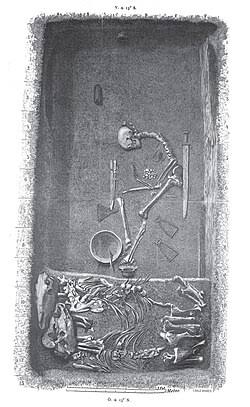
In 1878, Swedish archaeologist Hjalmar Stolpe opened an underground chamber near the fortified Viking Age town of Birka. The dead person sat surrounded by a sword, axe, spears, shields, arrows, riding equipment, two horses, and a gaming set. For more than a century, the grave—catalogued as Bj 581—served as a textbook example of an elite male warrior burial. The weapons seemed to settle the question before anyone closely examined the bones.
Then osteology and ancient DNA overturned the assumption. The skeleton was biologically female. When genomic confirmation was published in 2017, headlines declared that science had finally proved the existence of a female Viking commander. Critics replied that weapons in a grave could not prove a life spent fighting. The argument quickly expanded beyond one burial into a public struggle over Vikings, women, identity, and archaeological authority.
The evidence is both firmer and more limited than either slogan suggests. The Birka Warrior Grave contained one biologically female adult in an exceptionally martial burial context. The integrity of the skeleton and its association with Bj 581 are well supported. It is reasonable to interpret the deceased as a high-status warrior, but DNA cannot reveal occupation, battlefield experience, gender identity, or command rank. Those conclusions depend on the grave’s archaeological context and on how funerary ritual is understood.
Birka: A Viking Age Town Connected to the World
Birka stood on the island of Björkö in Lake Mälaren, west of present-day Stockholm. Founded around the middle of the eighth century, it developed into an important center of trade, craft production, and political power. Merchants and travelers linked the town to the Baltic, western Europe, the Islamic world, and routes reaching into Eurasia.
The settlement’s “Black Earth” occupation area was protected in part by a rampart and hillfort. Cemeteries spread around the town, containing thousands of visible graves. Burial practices varied: some people were cremated, others placed in coffins or wooden chambers, and grave goods ranged from modest personal objects to weapons, imported textiles, animals, and luxury materials.
Birka was therefore not an isolated farming community. It was a mobile, multilingual place in which people, silver, weapons, clothing styles, and ideas crossed long distances. That setting matters because Bj 581 combined Scandinavian burial customs with clothing and objects that pointed toward wider eastern connections.
How Hjalmar Stolpe Excavated Grave Bj 581
Stolpe excavated more than a thousand Birka graves during the late nineteenth century. His methods were advanced for their time: he used measured plans, recorded object positions, and labeled skeletal material. By modern standards, information was still lost, but his documentation allows researchers to reconstruct Bj 581 far better than many contemporary excavations.
The burial lay high on a rocky promontory outside the hillfort’s northern gate, near a route linking the fortress and town. A large boulder marked it, making the grave visible from the settlement and lake. The wooden chamber had decayed, but its outline and the arrangement of surviving objects remained legible.
Stolpe considered it one of the most remarkable graves in the cemetery. He identified the deceased as male because of the weapons and the absence of jewelry conventionally associated with women. That judgment illustrates an important archaeological problem: objects used to infer sex can turn an interpretation into an apparent fact before skeletal evidence is considered.
What Was Found Inside the Chamber
The weapon assemblage was unusually complete. It included a sword, an axe, a large fighting knife, two spears, two shields, and a group of armor-piercing arrowheads representing a bow and quiver. These were arranged around the body rather than deposited casually in one corner.
Riding equipment accompanied two horses—a mare and a stallion—placed on a platform beside the chamber. The burial also contained stirrups, bridles, and other equestrian gear. Such an investment required substantial resources and linked the deceased with mobility, status, and mounted activity.
A bag of gaming pieces lay near the body, with a gaming board positioned beside it. One piece has been interpreted as a king. Researchers have suggested that the set symbolized strategic skill or command, since games could model conflict and hierarchy. That is plausible, but a game board is not an ancient officer’s certificate. It may express education, elite identity, leisure, ritual symbolism, or several meanings at once.
Clothing, Date, and High Status
Fragments indicate clothing influenced by fashions of the Eurasian steppe, including silk and silver ornament. The outfit differed from the familiar modern image of a Viking in rough wool and fur. Birka’s elite drew prestige from distant materials and styles, and clothing could communicate rank, affiliations, travel, or cosmopolitan identity.
A silver coin fragment helped date the burial to the tenth century, probably around the middle decades. The grave belongs to a period when Birka was deeply involved in eastern trade networks and when the nearby hillfort and garrison environment were significant.
Almost every aspect of the funeral required wealth: the chamber, prominent location, two horses, imported textiles, weapons, and carefully arranged objects. Whatever the person’s precise role in life, the burial presented them as someone of exceptional standing.
The First Osteological Reassessment
The assumption of a male warrior persisted through generations of scholarship. When osteologists later examined the pelvis and other skeletal traits, they identified the remains as probably female. Because that finding conflicted with the grave’s established interpretation, it did not immediately transform the literature.
Osteological sex estimation uses patterns in skeletal anatomy, especially the pelvis and skull. It is probabilistic rather than magical, and incomplete remains can limit confidence. In Bj 581, the surviving bones supported a female assessment strongly enough that researchers sought independent genomic confirmation.
This sequence matters. DNA did not unexpectedly change a previously male skeleton into a woman. It confirmed an osteological conclusion that had been difficult to reconcile with assumptions about weapons and gender. The surprise lay as much in the history of interpretation as in the biology.
What the 2017 DNA Study Established
The 2017 study generated genome-wide data from the skeleton. The researchers found no Y chromosome and detected two X chromosomes, confirming that the individual was biologically female. The genomic work also supported the integrity of the sampled remains and explored the person’s broader genetic affinities.
Ancient DNA answers specific biological questions. It can help estimate chromosomal sex, genetic ancestry, and family relationships when preservation and sampling permit. It cannot directly show whether someone fought, commanded troops, identified socially as a woman, or performed a particular occupation.
The paper’s title, “A female Viking warrior confirmed by genomics,” compressed two different arguments. Genomics confirmed the biological sex. The “warrior” interpretation came from the grave goods, location, and long-established archaeological reading. Public debate often blurred that distinction.
Were the Correct Bones Tested?
One immediate objection was that nineteenth-century collections can become mixed. Perhaps the bones labeled Bj 581 came from another grave, or perhaps a male warrior had originally occupied the chamber with a woman whose bones survived. Those possibilities deserved investigation rather than dismissal.
The research team compared labels, measurements, archival records, and the surviving skeletal inventory. Stolpe’s documentation showed a single individual in the chamber, and the bones marked Bj 581 formed a consistent skeleton. The later 2019 reassessment supplied extensive source-critical detail and rejected the idea of an unrecorded second body.
No archaeological archive is beyond doubt, but skepticism must respond to the actual record. At present, the strongest evidence supports one biologically female adult associated with the objects documented in Bj 581. Continuing to imply that the sexed skeleton probably wandered in from elsewhere requires evidence, not merely discomfort with the result.
Does a Weapons Grave Prove a Warrior?
Burials are staged acts created by the living. Grave goods can represent the dead person’s occupation, family claims, ideals, inherited objects, ritual requirements, or identities constructed specifically for the funeral. A sword beside a body is powerful evidence, but it is not a photograph of that person using the weapon.
This caution applies to male and female graves alike. If weapons cannot demonstrate anything about the Birka woman’s role, then thousands of “male warrior graves” also require reassessment. Archaeologists should not demand an impossible standard only when biological sex challenges expectation.
Bj 581 is persuasive because the case does not rest on one sword. The nearly complete martial assemblage, horses, riding gear, gaming equipment, high-status dress, prominent location, neighboring weapon graves, hillfort, and garrison context reinforce one another. Together they make a warrior identity a strong interpretation, though not an experimentally proven biography.
Was She a Commander?
The gaming set has often been presented as evidence that the deceased planned battles or held command. Games involving unequal pieces and strategic movement could certainly symbolize tactical intelligence. The unusual richness and organization of the grave also imply rank.
Yet “commander” is more specific than the evidence allows. No inscription gives a title, no written biography names the person, and no battlefield record identifies her. The burial could represent a professional warrior, military retainer, elite household member, ritual specialist associated with warfare, or a combination unfamiliar to modern categories.
A careful description is therefore “a high-status person buried with an exceptionally complete martial assemblage, plausibly as a professional warrior.” Command is possible, perhaps even likely in the researchers’ view, but it remains an interpretation rather than a genetic result.
The Absence of Battle Injuries
The skeleton reportedly shows no clear healed or fatal weapon trauma. Popular critics sometimes treat this as proof that the person never fought. That conclusion is too strong. Many people who participated in warfare died from disease, accident, age, or injuries that left no surviving skeletal mark.
Conversely, lack of trauma cannot be used positively to prove a safe command role. Bones record only certain injuries, and preservation is incomplete. Battlefield participation is an activity, not a skeletal trait automatically visible after death.
The absence of trauma should be stated because it limits the biography that can be reconstructed. It neither overturns the burial context nor confirms romantic images of a battle-hardened shield-maiden.
Biological Sex, Gender, and Identity
The genomic result concerns chromosomal sex. Gender is a social identity shaped by culture, status, dress, work, kinship, and personal experience. Archaeologists cannot assume that Viking Age categories matched modern Western labels exactly.
The deceased may have lived socially as a woman in a recognized martial role. She may have crossed or combined gendered expectations, or the society around her may have understood her identity in terms for which no clear written record survives. Modern labels such as transgender or non-binary can prompt useful questions, but assigning them to one tenth-century person as established fact goes beyond the evidence.
The safest approach is to keep categories explicit. The skeleton was biologically female. The funeral was strongly martial. The person’s self-understanding and everyday social presentation remain unknown. Uncertainty here is not evasion; it is the boundary of what the evidence can support.
Shield-Maidens, Valkyries, and Written Sources
Old Norse literature includes women who fight, encourage warfare, or possess supernatural martial power. Shield-maidens appear in legendary narratives, while Valkyries belong to mythic traditions connected with battle and the dead. These texts helped modern audiences imagine the occupant of Bj 581 before the grave was reinterpreted.
Most surviving narratives were written down centuries after the Viking Age and combine memory, literary convention, mythology, and later social concerns. They cannot simply be read as eyewitness reports proving that organized female warrior units existed.
Nor should archaeology and literature be kept completely separate. A secure female weapons burial changes the questions scholars ask of stories, images, and other graves. The sources can illuminate possible cultural ideas while remaining different kinds of evidence.
Why the Debate Became So Intense
The 2017 paper received enormous international attention because it challenged a familiar stereotype while confirming another popular image: the Viking warrior woman. Supporters sometimes treated the grave as proof that gender equality characterized Viking society. Opponents sometimes searched for alternative explanations that had rarely been demanded when the deceased was assumed male.
Both reactions loaded one grave with more weight than it can carry. A single exceptional burial cannot describe the normal division of labor across Scandinavia or reveal how common female warriors were. Exceptional evidence proves possibility more readily than frequency.
The controversy also exposed cumulative bias in archaeological classification. Weapons had created a male identity; that assumed male identity then strengthened the belief that weapons signaled men. Scientific reassessment interrupted the circle, much as environmental and settlement evidence has revised older stories about the disappearance of Norse Greenland. Archaeological interpretations are strongest when different methods challenge inherited assumptions.
What Bj 581 Does—and Does Not—Prove
Bj 581 proves that a biologically female adult received one of Birka’s most elaborate martial funerals. The grave was not a modest burial with one ambiguous knife; it contained a broad weapon set, horses, riding equipment, strategic gaming pieces, imported clothing elements, and a highly visible location beside a military landscape.
It strongly supports the existence of at least one woman whom her community represented through warrior identity. It makes blanket claims that Viking Age warfare was exclusively male harder to sustain. It also requires scholars to reconsider the sexing of other burials based only on grave goods.
It does not prove that women commonly fought, that the deceased led an army, that every literary shield-maiden was historical, or that Viking society practiced modern gender equality. Those claims require larger datasets and different evidence.
Common Myths About the Birka Warrior Grave
Myth: DNA proved she was a military commander. DNA confirmed biological sex. Rank and warrior status are archaeological interpretations based on the burial.
Myth: the researchers tested random bones from a museum box. The remains were labeled, measured, and checked against Stolpe’s records. The best available evidence links them securely to Bj 581.
Myth: weapons always belonged to the buried person. Funerary objects can have symbolic and social meanings. Their interpretation depends on the complete context, not automatic ownership.
Myth: no injuries mean no combat experience. Many forms of military participation leave no skeletal trace, although the lack of trauma limits what can be claimed.
Myth: one grave proves Viking armies routinely included women. The grave demonstrates possibility and perhaps a recognized role, not prevalence.
Why the Grave Still Matters
Bj 581 is important not only because the deceased was female. It is a case study in how archaeology creates knowledge. Nineteenth-century field records, twentieth-century osteology, twenty-first-century genomics, object analysis, landscape context, and gender theory all changed the meaning of the same unchanged assemblage.
The grave also shows why scientific techniques do not replace interpretation. A chromosome result can be exceptionally secure while the social biography remains debated. Archaeology advances when laboratory evidence and contextual reasoning are kept connected but not confused.
Most of all, the burial warns against treating assumptions as observations. Stolpe recorded weapons and inferred a man. Later scholars inherited the inference until the bones forced a reassessment. Future discoveries may similarly expose categories that currently appear self-evident.
Conclusion: A Warrior, a Woman, and an Archaeological Lesson
The person buried in Bj 581 was biologically female, laid alone in a chamber filled with weapons, horses, riding gear, gaming pieces, and elite dress beside Birka’s fortified landscape. Those are the secure foundations of the case.
Interpreting her as a high-status warrior is reasonable and, taken across the whole context, compelling. Describing her as a battlefield commander, a saga shield-maiden, or proof of widespread female military service goes further than the evidence. Rejecting the warrior interpretation merely because the skeleton is female is equally unjustified.
The Birka Warrior Grave matters because it preserves both a Viking Age funeral and the history of modern scholarship. It shows how gendered expectations can shape archaeological facts, how new methods can correct old assumptions, and how certainty must be separated from possibility. Bj 581 does not answer every question about Viking women at war. It ensures that the question can no longer be dismissed.
Research and Further Reading
- American Journal of Physical Anthropology: “A female Viking warrior confirmed by genomics”
- Antiquity: “Viking warrior women? Reassessing Birka chamber grave Bj.581”
- Antiquity supplementary material and grave documentation
- Uppsala University: research announcement and study context
- UNESCO World Heritage Centre: Birka and Hovgården