In the winter of 1683–84, the River Thames froze hard enough for Londoners to build booths, roast meat, print souvenirs and turn the ice into a temporary street. The scene has become a ready-made illustration of the “Little Ice Age”: Europe shivering beneath a weakened Sun while astronomers searched in vain for spots on its surface. The two stories overlap so neatly that they are often treated as one.
They are not. The Maunder Minimum was a real and extraordinary episode of very low solar activity, conventionally dated from about 1645 to 1715. The seventeenth century also contained bitter winters, failed harvests and advancing glaciers. Yet the wider cool interval called the Little Ice Age began before the Maunder Minimum, continued after it, and varied sharply by region and season. Modern research therefore asks a subtler question than whether a quiet Sun “caused” a cold age: how much did reduced solar activity contribute alongside volcanic eruptions, ocean–atmosphere variability and other forces?
That question matters because the Maunder Minimum sits at the meeting point of history, astronomy and climate science. Its evidence comes not only from telescope drawings, but also from tree rings, polar ice, aurora reports, glacier records and computer models. Together, these sources confirm a grand solar minimum while challenging the appealing idea of a single celestial switch that turned down Earth’s temperature.
What Was the Maunder Minimum?
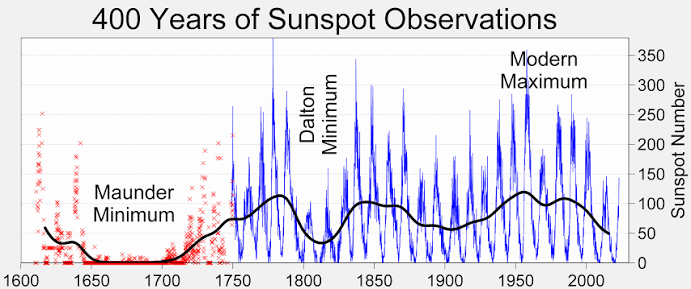
The Sun usually follows an approximately eleven-year cycle. Near a solar maximum, many dark sunspots appear on its visible surface and magnetic disturbances become more frequent. Near a minimum, spots grow scarce. Individual cycles differ, but from the mid-seventeenth to early eighteenth century several successive cycles were exceptionally weak. This prolonged state is known as the Maunder Minimum.
The customary dates, 1645–1715, are useful boundaries rather than exact astronomical doors that opened and closed in particular years. Activity declined before the core minimum and recovered unevenly afterward. Nor was the Sun literally spotless. Surviving observations record occasional spots, while later analysis suggests that weak cycles continued. The essential fact is not a complete shutdown, but an unusually deep and long suppression of the normal sunspot cycle.
Solar physicists classify it as a “grand minimum,” a distinct low-activity state lasting several cycles. Reconstructions based on cosmogenic isotopes indicate that comparable grand minima occurred repeatedly during the Holocene. The Maunder Minimum is special because it unfolded after telescopic astronomy began, allowing indirect natural archives to be compared with written observations made by identifiable people.
How Seventeenth-Century Astronomers Watched the Sun
Telescopic study of sunspots began around 1610. Thomas Harriot drew spots in England; Johannes and David Fabricius published observations; Galileo Galilei and the Jesuit astronomer Christoph Scheiner famously disputed their nature. By the 1640s, European scholars knew that spots belonged to or closely accompanied the Sun and could be used to trace its rotation.
Observing the Sun remained difficult. Looking directly through an early telescope was dangerous, so astronomers increasingly projected the solar image onto paper. Weather, wars, illness, travel and patronage interrupted observing programs. Surviving notebooks are uneven, and a day without a recorded spot is not automatically proof that somebody carefully inspected a clear solar disc and found none.
Even so, the minimum cannot be dismissed as an archival accident. Johannes Hevelius observed from Danzig; Giovanni Domenico Cassini, Jean Picard and Philippe de La Hire worked within organized programs at the Paris Observatory; other observers left dated reports across Europe. Their records show long spotless intervals and very few active days compared with ordinary cycles. Careful modern catalogues correct obvious mistakes and distinguish explicit spotless observations from silence, but the broad pattern remains.
The Maunders and the Making of a Historical Minimum
The period was not called the Maunder Minimum by the people who lived through it. Its modern identity emerged from nineteenth- and twentieth-century efforts to reconstruct past solar behavior. German astronomer Gustav Spörer drew attention to the seventeenth-century scarcity of sunspots. Edward Walter Maunder of the Royal Observatory, Greenwich, later publicized the episode, particularly in an 1894 paper.
Anne Russell Maunder, an astronomer and skilled analyst who married Edward in 1895, was central to the couple’s solar work. Because institutional rules forced women at Greenwich into poorly paid “computer” positions and required Anne to resign after marriage, her contribution was long obscured. She photographed eclipses, analyzed sunspot latitudes and helped develop the celebrated “butterfly diagram,” which shows spots migrating toward the solar equator during a cycle. Works published under Edward’s name often grew from their collaboration.
The label “Maunder Minimum” became common only after the American solar astronomer John A. Eddy’s influential 1976 study revived interest in the episode. The name is therefore a history of historical research as much as a description of the seventeenth-century Sun. It honors important work, but it should not erase Spörer, Anne Maunder or the early modern observers whose manuscripts made reconstruction possible.
What the Sunspot Records Really Show
Older popular accounts sometimes repeat a dramatic comparison: only a few dozen sunspots were seen over several decades when tens of thousands should have appeared. Such figures capture the scale of the decline but can mislead. Historical observers counted spots and groups differently, covered different numbers of days and used instruments of unequal quality. Modern sunspot-number series therefore require calibration rather than simple addition.
Reassessments still find extremely low activity. During the core minimum, only a small fraction of reliably observed days contained spots. Peaks around the mid-1650s, 1670s, 1680s and early 1700s indicate weak cyclic behavior rather than a dead solar dynamo. Most recorded spots appeared in the Sun’s southern hemisphere, a striking asymmetry also visible in reconstructed latitude data.
Uncertainty survives at the margins. Scholars debate the reliability of generic claims that the Sun was spotless for long runs, and the exact amplitude and length of individual cycles. Those debates refine the minimum; they do not erase it. The responsible conclusion is that the telescopic record is incomplete but strongly supports a prolonged grand minimum with occasional spots and persistent, unusually weak cycles.
Tree Rings and Ice Cores Confirm a Quiet Sun
Nature kept an independent record. Energetic cosmic rays entering Earth’s atmosphere help create rare isotopes, including carbon-14 and beryllium-10. A strong solar magnetic field and solar wind deflect more cosmic rays; when solar activity weakens, more reach the atmosphere and cosmogenic isotope production generally increases. Carbon-14 becomes fixed in annual tree rings, while beryllium-10 settles into polar ice.
These proxies are not direct thermometers or sunspot counters. Carbon cycling, atmospheric transport, precipitation and geomagnetic-field changes must be modeled. Researchers compare multiple archives and smooth short-term noise to reconstruct solar activity. The resulting records show elevated cosmogenic isotope production during the Maunder Minimum, independently supporting the testimony of telescopic observers.
The proxies also reveal residual cycles. That finding matters: sunspots were greatly suppressed, but the Sun’s magnetic engine continued operating. Aurora records provide another clue. Auroras became rare at many European latitudes during the core minimum, although they did not vanish. Together, spots, isotopes and auroras describe a magnetically subdued Sun, not a star that stopped changing or lost all activity.
What Historians Mean by the Little Ice Age
The phrase “Little Ice Age” sounds like a smaller version of a geological ice age. It was nothing of the kind. Continental ice sheets did not return, and the world did not enter one uniform, continuously cold climate. The term describes a broad interval, commonly placed somewhere between the fourteenth and nineteenth centuries, when many regions experienced cooler conditions than in the twentieth century and glaciers expanded in several mountain ranges.
Its timing depended on the indicator and location. Alpine glacier advances, Icelandic sea ice, European harvest records, Chinese phenology, Andean ice and North American tree rings do not all peak together. Some decades and seasons were severe; others were mild. Recent scholarship often prefers precise regional and seasonal descriptions to treating the Little Ice Age as a single global event.
This chronology immediately weakens the simplest solar explanation. Cooling and glacier growth were underway before 1645. Important cold episodes occurred after 1715, including the later eighteenth and early nineteenth centuries. The Maunder Minimum coincided with part of the Little Ice Age, especially a memorable cluster of European winters, but coincidence across several decades cannot establish sole causation.
The Frozen Thames: Evidence, Icon and Trap
London’s frost fairs provide unusually vivid evidence of cold weather. The most famous opened during the winter of 1683–84, when the Thames remained frozen for weeks. Printers set up presses on the ice, vendors sold food and drink, and crowds walked where ships normally moved. This happened during the Maunder Minimum, making the fair a seductive illustration of solar influence.
Yet the river was not a neutral thermometer. Old London Bridge stood on closely spaced piers protected by timber structures. Ice and debris caught around them, impeding tidal flow and helping the broad, shallow river freeze. The Thames was later embanked, the old bridge was demolished, and river flow changed. Frost fairs were rare even in the coldest era, not annual features of seventeenth-century life.
The episode confirms that southern England suffered an exceptionally cold winter; it does not measure global temperature or identify the cause. Weather is a particular event, climate a longer statistical pattern, and local infrastructure can amplify natural conditions. The Thames fair belongs in the history, but using it alone to prove that a quiet Sun froze the planet mistakes a memorable picture for a causal experiment.
How a Quieter Sun Could Affect Climate
Sunspots are dark, but active solar periods are not colder overall. Bright magnetic features called faculae more than compensate for sunspot darkening, so total solar irradiance is slightly higher near a modern solar maximum. During a grand minimum, reduced magnetic activity probably lowered the energy reaching Earth. The size of the long-term change, especially in the Sun’s quiet background output, remains less certain than the well-measured variation across recent eleven-year cycles.
A small global forcing can still influence atmospheric circulation. Solar ultraviolet radiation varies more strongly than total irradiance and affects stratospheric ozone and temperature. Those upper-atmosphere changes may propagate downward, shifting winds, pressure patterns and winter weather. This offers a plausible route by which weak solar activity could favor cold winters in some regions without cooling every place equally.
Climate models generally produce modest global cooling from reconstructed Maunder-era solar forcing, with potentially larger regional or seasonal effects. Results depend on the irradiance reconstruction and model physics. The mechanism is credible and solar forcing likely contributed, but present evidence does not support a solar change large enough to explain the full scale, timing and geography of Little Ice Age climate by itself.
Volcanoes Complicate the Story
Explosive tropical eruptions can inject sulfur gases into the stratosphere, where sulfate aerosols reflect sunlight and cool the surface for several years. Ice cores record clusters of large eruptions during the centuries associated with the Little Ice Age. Repeated shocks may have helped sea ice expand and altered ocean circulation, allowing cooling to persist beyond the brief atmospheric lifetime of each volcanic veil.
Not every cold winter followed a known eruption, and eruption dates and magnitudes become less certain deeper in the past. Nevertheless, volcanic forcing offers a powerful explanation for abrupt cooling episodes and for why significant cold began before the Maunder Minimum. It also explains later shocks. The 1783 Laki fissure eruption, discussed in our article on the Laki eruption and its European consequences, occurred long after the Sun had left the Maunder state and created its own complex pattern of haze, heat, cold and mortality.
The strongest modern accounts do not replace a solar monocause with a volcanic monocause. They combine explosive volcanism, weaker solar forcing and internal feedbacks. A volcano may perturb the climate; sea ice and oceans may prolong or redistribute the response; solar variability may alter the background conditions. The Little Ice Age was a moving outcome of interacting systems.
What Climate Models Changed
Early discussions often relied on visual correlation: a trough in sunspot counts appeared beside a trough in reconstructed temperature. Modern attribution uses quantified forcing histories and climate models. Researchers estimate solar irradiance, volcanic aerosols, greenhouse gases and land-cover change, then test how ensembles of simulated climates compare with proxy reconstructions. Multiple runs help separate forced responses from internal variability.
The conclusion is not that the Maunder Minimum was climatically meaningless. It is that “cause” must be scaled correctly. A modest global forcing can alter odds, reinforce other cooling and affect circulation without accounting for every frozen river or failed harvest. Models turned a binary argument—Sun or no Sun—into a problem of interacting contributions.
Could Another Maunder Minimum Stop Modern Warming?
The historical episode is sometimes invoked to suggest that a future grand solar minimum could reverse human-caused warming. This comparison confuses forcings of very different size. Satellite measurements and modern physics constrain the likely cooling from a prolonged solar minimum. Studies find that it would only modestly reduce warming for a time, not cancel the much larger and continuing effect of anthropogenic greenhouse gases.
NASA’s climate assessment of the claim is explicit: even an unusually deep solar minimum would not produce a new ice age, and greenhouse-gas warming would dominate. When solar activity recovered, its temporary offset would diminish while accumulated carbon dioxide remained in the atmosphere.
The Maunder Minimum therefore offers no climatic escape hatch. Its real lesson is more valuable: natural forcing matters, climate responds through complex regional pathways, and attribution requires multiple independent records. The same methods that identify a seventeenth-century solar minimum also allow scientists to distinguish it from the dominant causes of present warming.
What Is Confirmed, Disputed and Oversimplified?
Confirmed: solar activity was exceptionally low for several cycles around 1645–1715. Contemporary telescopic records, cosmogenic isotopes and auroral evidence converge on that conclusion. Sunspots were rare rather than entirely absent, and weak cyclic activity persisted. Several severe European winters occurred during this interval.
Strongly supported but still quantified with uncertainty: the Sun’s reduced magnetic activity slightly lowered solar forcing and probably influenced climate, including some regional circulation. Estimates of the irradiance change differ, so the magnitude of the response is a range rather than a single settled number.
Disputed or incomplete: the precise amplitude of individual weak cycles, the reliability of some historical “spotless day” entries, and the relative contribution of solar, volcanic and internal factors to particular decades and regions. Claims about a land-use contribution also remain actively assessed.
Oversimplified: “the Maunder Minimum caused the Little Ice Age.” The chronology is too broad, cooling was too uneven, and other forcings were too important. Also misleading are claims that the Sun had no spots, that the Thames froze every winter, or that a new grand minimum would neutralize modern greenhouse warming.
Conclusion: A Quiet Sun, Not a Single Culprit
The Maunder Minimum was neither legend nor observational illusion. Between roughly 1645 and 1715, the solar cycle entered an exceptional low state: sunspots became scarce, activity concentrated mainly in one hemisphere, auroras declined and cosmogenic isotopes recorded weaker solar magnetic shielding. It remains the best-observed grand minimum before the modern instrumental age.
But the Little Ice Age was not simply its shadow on Earth. Cooling began earlier, lasted longer and varied across seasons and regions. Volcanic eruptions supplied strong short-term forcing; sea ice, oceans and atmospheric circulation shaped persistence and geography; human institutions determined whether a harsh season became famine or merely inconvenience. Reduced solar activity probably contributed, but it did not act alone and cannot explain every celebrated winter.
The frozen Thames endures because it turns climate into a scene we can picture. The more accurate historical image is less theatrical but more illuminating: astronomers projecting a pale solar disc onto paper, trees and glaciers storing environmental signals, and societies confronting hazards produced by several forces at once. The Maunder Minimum’s deepest lesson is not that one quiet star froze a world, but that good history begins where simple explanations end.
Research and Further Reading
- Ilya G. Usoskin, “A History of Solar Activity over Millennia,” Living Reviews in Solar Physics (2023) — a comprehensive review of direct observations, cosmogenic proxies and grand minima.
- Mathew J. Owens and colleagues, “The Maunder Minimum and the Little Ice Age” (2017) — an assessment combining solar reconstructions and climate simulations.
- IPCC Sixth Assessment Report, Working Group I, Chapter 2 — authoritative context for paleoclimate change and natural solar and volcanic forcing.
- NASA, “There Is No Impending ‘Mini Ice Age’” — explains why a future solar minimum would not offset anthropogenic warming.
- London Museum, “Frost Fairs: Festivities on a Frozen River Thames” — museum evidence for the history and material culture of the frost fairs.
- Bidya Binay Karak, “Models for the Long-Term Variations of Solar Activity” (2023) — a modern review of solar dynamo behavior and grand minima.