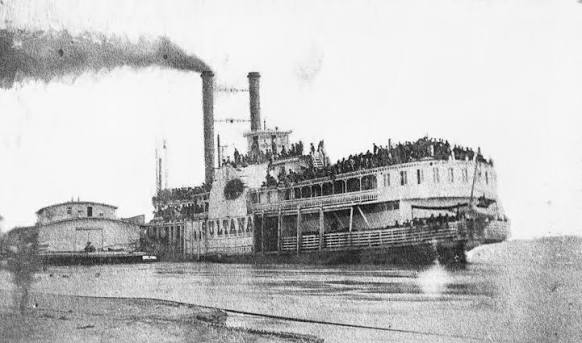
Shortly after two o’clock on the morning of April 27, 1865, a flash split the darkness above the Mississippi River. The boilers of the side-wheel steamboat Sultana had burst about seven miles north of Memphis. Decks crowded with Union soldiers were torn apart, burning timbers fell across sleeping passengers, and hundreds of men were thrown into a river swollen by spring floods. Many had survived battle, starvation and Confederate prison camps only to die while finally going home.
The Sultana disaster is widely described as the deadliest maritime tragedy in United States history. More than 2,100 people were aboard a vessel licensed for only 376 passengers, and modern estimates place the death toll above 1,100. Older accounts often give 1,500 to 1,800 deaths, illustrating how badly the passenger lists and casualty records were handled. Whatever precise number is accepted, the catastrophe was enormous—and preventable.
What Was the Sultana?
The Sultana was a wooden side-wheel steamboat built at Cincinnati in 1863. About 260 feet long, she carried freight and passengers on the Mississippi system, commonly working between St. Louis and New Orleans. Four horizontal fire-tube boilers generated steam for her engines, while large paddle wheels on either side drove the vessel through the river.
River steamers were vital infrastructure during the American Civil War. They moved soldiers, animals, food, ammunition, cotton and civilian goods across a landscape where roads were poor and rail networks incomplete. The work was lucrative but punishing. Boats ran long distances against strong currents, stopped frequently, consumed enormous quantities of fuel and operated with machinery exposed to sediment-heavy river water.
By April 1865 the Sultana was only about two years old, yet age alone did not determine condition. Continuous service, imperfect maintenance and the stresses imposed on boilers mattered more. Her captain and part-owner, James Cass Mason, was an experienced river man, but experience did not insulate him from commercial pressure or from decisions that would prove fatal.
The War Was Ending, but the Prisoners Were Not Yet Home
General Robert E. Lee surrendered the Army of Northern Virginia on April 9, 1865. Across the South, thousands of Union prisoners released from Confederate camps began difficult journeys toward exchange points and transportation home. Many had endured severe malnutrition, disease, exposure and violence. They were free, but medically fragile and still under military control.
Large groups converged on Camp Fisk near Vicksburg, Mississippi. They included former prisoners from Andersonville in Georgia and Cahaba in Alabama. Cahaba’s death rate was lower than Andersonville’s, but it had been overcrowded and flooded; neither camp left men in good condition. Soldiers waited impatiently for northbound transport to Cairo, Illinois, from where rail and river routes could carry them onward.
The Army hired private steamboats for the task. The federal government paid a set amount for each soldier carried—commonly reported as five dollars for an enlisted man and ten dollars for an officer. This arrangement encouraged speed and volume. It did not automatically require reckless loading, but it created a financial incentive to put as many eligible passengers as possible on one vessel.
A Boiler Warning at Vicksburg
Before taking on the former prisoners, the Sultana arrived at Vicksburg with a leaking boiler. A local boilermaker examined a bulged section and reportedly recommended a more substantial repair that would have required cutting out and replacing damaged metal. Such work would take days. Mason feared delay would cost him the valuable government transport assignment.
A smaller patch was fitted instead. A metal plate was placed over the weakened area, allowing the boat to resume service quickly. The patch was not the only weakness in the system, and historians should avoid claiming that one visible repair alone explains the later rupture. Yet it is a well-documented warning: a serious defect was treated under intense time and financial pressure with a temporary solution.
The choice links mechanical failure to human organization. The boiler did not enter the river as an isolated object. Owners needed revenue, military officers needed transportation, prisoners wanted to leave, and rival captains competed for government business. Each pressure made postponement easier to reject, even though postponement was the safest option.
How the Sultana Became Catastrophically Overcrowded
On April 24, military authorities began directing paroled prisoners toward the Sultana. Exact totals vary, but more than 1,900 former prisoners were loaded, along with other soldiers, civilian passengers and a crew. The overall number aboard exceeded 2,100 and may have approached 2,200. The vessel’s licensed passenger capacity was 376.
Men filled almost every available space. They lay shoulder to shoulder across the main deck, boiler deck and hurricane deck, crowded around stairways and cabins, and occupied areas never designed for such a concentration of people. The famous photograph taken at Helena, Arkansas, on April 26 shows soldiers packed along the rails and covering the upper decks. It is not merely an illustration made after the event; it is direct visual evidence of the load.
Overcrowding did not necessarily create the initial boiler rupture, but it magnified every consequence. Extra weight increased the vessel’s workload against the current. A high, shifting mass of passengers affected stability. When the blast came, collapsing decks killed and trapped men, narrow routes prevented escape, and the number needing rescue overwhelmed the available boats and shoreline response.
Greed, Favoritism and the Limits of the Evidence
The loading process has often been described as a straightforward bribery conspiracy. Quartermaster Reuben B. Hatch, Captain George A. Williams and others were accused in later accounts of steering prisoners to Mason’s boat in return for a share of the government payment. Hatch already had a reputation for irregular administration and benefited from political connections.
There is strong evidence of favoritism, negligence and an incentive system vulnerable to corruption. Rival vessels reportedly had room, and officers who saw the crowding objected. Yet the exact private arrangements are harder to prove than popular retellings suggest. Some claims about specific kickbacks rest on later testimony or inference rather than a surviving signed agreement.
The distinction matters. Calling every detail proven makes the history fragile; ignoring the pattern makes it falsely innocent. Authorities concentrated an extraordinary number of weakened men on one boat despite obvious alternatives and a recent boiler repair. Whether every participant received illicit money or not, the system rewarded the dangerous decision and failed to stop it.
The Explosion at Two in the Morning
At about 2 a.m., near a group of river islands commonly called the Hen and Chickens, three of the four boilers ruptured in rapid succession. The blast tore upward through the densely occupied decks. The pilothouse was destroyed, smokestacks fell, and sections of the upper structure collapsed onto passengers below.
Steam and scalding water killed or injured those nearest the boilers. Others were crushed by timber or trapped as fire spread through the wooden superstructure. Without effective steering or propulsion, the wreck drifted downstream. Men faced a terrible choice between flames and the dark river.
Some clung to wreckage; others used cabin doors, boards or floating debris. Many former prisoners were too weak to swim for long. The current carried people away from the vessel and dispersed bodies over miles of flooded country. The wreck eventually burned down and sank near the Arkansas side of the river.
Rescue on the Flooded Mississippi
Survival often depended on chance: where a person slept, whether debris shielded him, whether he was thrown clear, and whether something buoyant floated within reach. Men who could not swim sometimes survived on fragments, while strong swimmers succumbed to cold, injury or exhaustion.
Crews from nearby vessels responded, as did people along both banks. Boats moved through darkness and floating wreckage, pulling survivors from the water. Memphis hospitals received burned, broken and nearly drowned men. Some initially counted among the rescued died later from scalds, exposure, infection or injuries, one reason casualty totals changed.
Survivor testimony describes both panic and cooperation. Men fought for supports, but many also held others above water, shared debris or returned to help companions. These accounts resist a single heroic narrative. The disaster produced terror, self-preservation, sacrifice and luck in the same few hours.
Why the Death Toll Remains Disputed
The number aboard was never securely established before departure. Military rolls contained errors, names were duplicated or omitted, civilian passengers and crew were imperfectly recorded, and some men may have left at intermediate stops. The explosion destroyed documents and killed people able to clarify the lists. Bodies continued to be recovered downstream for weeks, while others were never found.
Early official and newspaper estimates ranged widely. Figures of roughly 1,500, 1,700 or 1,800 deaths became common in twentieth-century retellings. The Library of Congress research guide reflects that traditional range, while some older federal counts gave different totals. Recent name-by-name research has generally lowered the probable toll.
The National Park Service has used an estimate of 1,169 deaths, and current scholarship often places the total around 1,164–1,200. That does not make earlier historians dishonest; it shows how casualty accounting changes when rosters, hospital records, survivor lists and pension files are reconciled. The safest formulation is that more than 1,100 people died, while acknowledging that no final count can be proven.
What Actually Caused the Boilers to Explode?
The nineteenth-century inquiry emphasized low boiler water, the boat’s side-to-side listing and the recent repair. Because the four boilers were interconnected, water could shift as the vessel careened through bends. One traditional theory holds that exposed sections overheated and were then struck by returning water, producing a violent surge of steam pressure.
Later engineering analysis has complicated that explanation. The Sultana used closely packed fire-tube boilers that were difficult to clean. Muddy Mississippi water could leave sediment and scale around the tubes, insulating metal from water and creating hot spots. Repeated heating weakened the wrought iron, while the patched bulge provided additional evidence of distress.
Engineers therefore point to a combination rather than one magic trigger: boiler design, metal quality, sediment, uneven water distribution, demanding operation and inadequate repair. Overloading increased the vessel’s instability and the human cost, but “too many passengers made the boiler explode” is too simple. The disaster emerged when multiple safety margins disappeared at once.
Was the Sultana Sabotaged?
Years later, stories claimed that a Confederate agent named Robert Louden had hidden a “coal torpedo”—an explosive disguised as a lump of fuel—in the boat’s coal supply. Louden had connections to wartime sabotage, and explosives concealed in coal were real devices. The story gained drama from the bitter final weeks of the Civil War.
There is no persuasive contemporary evidence that a coal torpedo destroyed the Sultana. The reported origin and pattern of the boiler rupture do not fit an explosion in the firebox well, and the machinery already had documented defects. The alleged confession surfaced decades later through another person. No physical artifact has been securely connected to such a device.
The sabotage story is therefore a legend built from a plausible technology and an actual saboteur, not a confirmed explanation of this event. It survives because intentional attack feels more narratively satisfying than accumulated maintenance failures, incentives and administrative negligence. The mundane cause is less cinematic—and more instructive.
Investigations Without Accountability
The Army investigated how so many prisoners had been placed aboard. Captain Frederic Speed was court-martialed for neglect of duty connected with the loading. He was convicted, but the Judge Advocate General later overturned the finding, concluding that Speed’s role had been subordinate and that responsibility lay elsewhere.
Mason and key members of the crew died in the disaster. Hatch avoided meaningful examination and did not comply with efforts to secure his testimony. Other officers disputed responsibility or remained protected by institutional relationships. No individual ultimately received lasting punishment proportionate to the scale of the catastrophe.
This result helped shape the disaster’s memory. Boiler failure could be called an accident, overcrowding could be spread across several commands, and dead decision-makers could not testify. The inquiry documented failures without producing a satisfying public reckoning. Administrative fragmentation became a shield.
Was the Sultana Really Forgotten?
Newspapers did report the explosion. Harper’s Weekly published a dramatic engraving, and local papers followed the recovery of victims. It is therefore inaccurate to say that the country heard nothing. The better question is why the disaster failed to become a lasting national reference point.
Timing was decisive. Lincoln was assassinated on April 14 and died the next morning. His funeral train carried the president’s body through northern cities while authorities hunted John Wilkes Booth. Booth was cornered and killed on April 26, only hours before the Sultana exploded. The Confederacy was collapsing, soldiers were returning, and four years of mass death had exhausted public attention.
The victims were mostly enlisted men from the interior states rather than famous officers or wealthy travelers. Survivors organized reunions and preserved testimony, but repeated efforts to obtain a major national monument failed. The event was remembered intensely by families and communities while remaining peripheral to the national story.
Comparing the Sultana with the Titanic
The Sultana is frequently advertised as “worse than the Titanic.” The comparison can attract attention, but it needs care. Traditional high estimates for the Sultana exceed the approximately 1,500 deaths associated with the 1912 liner. Modern lower estimates do not. The disasters also occurred under radically different recording systems and circumstances.
The useful comparison is not a competition. Both involved preventable risk, regulatory weakness, disputed decisions and later mythmaking. Our article on the claim that the novel Futility predicted the Titanic shows how maritime tragedies attract stories that grow cleaner and stranger than the evidence.
The Titanic had international passengers, prominent victims, extensive inquiries and a global press culture. The Sultana exploded amid national upheaval, carried many men whose health and movements were poorly recorded, and left no intact wreck accessible to contemporary investigators. Their different afterlives reveal how social setting shapes remembrance.
Confirmed Facts, Disputed Claims and Common Myths
Confirmed: the Sultana carried more than 2,100 people despite a licensed passenger capacity of 376; a boiler had received a rushed patch at Vicksburg; three boilers ruptured early on April 27, 1865; and more than 1,100 people died. Most victims were recently released Union prisoners.
Supported but not completely quantified: commercial incentives, favoritism and administrative negligence drove the overcrowding. The boat’s boiler design, muddy water, weakened metal, water management and inadequate repair all contributed to failure. The precise sequence within the boilers cannot be reconstructed with modern forensic certainty.
Disputed: the exact passenger total, final death toll and details of alleged payments between officials and the captain. Estimates should be labeled rather than presented as exact counts.
Legend: a Confederate coal torpedo destroyed the vessel. Sabotage was technically possible during the war, but evidence specific to the Sultana is late, indirect and inconsistent with the strongest mechanical explanation. Also oversimplified is the claim that newspapers entirely suppressed the story; they covered it, but competing events and later memory pushed it aside.
Conclusion: A Disaster Built from Vanishing Safety Margins
The Sultana did not explode because of one villain, one patch or one overloaded deck. A defective boiler was returned to service, fragile machinery fought a powerful river, passengers crowded every level, government payment rewarded volume, and authority was divided among people who could pass responsibility elsewhere. When the boilers failed, the vessel had almost no remaining margin for survival.
The tragedy’s uncertain toll should encourage precision, not diminish its scale. At least 1,100 lives—and probably more—were lost within sight of a war’s end. The victims had survived prison camps and expected reunion. Their deaths expose how liberation on paper could still be followed by neglect in practice.
Remembering the Sultana means resisting both oblivion and melodrama. It was reported, yet overshadowed; investigated, yet left without accountability; explained by engineering evidence, yet surrounded by sabotage legend. Its enduring lesson is brutally modern: disasters often begin long before the explosion, in ordinary decisions that steadily remove every safeguard.
Research and Further Reading
- Library of Congress, “Sinking of the SS Sultana: Topics in Chronicling America” — primary newspaper research guide and event timeline.
- Library of Congress, “Helena, Arkansas. April 26, 1865. Ill-fated Sultana” — catalogue record for the photograph of the overloaded vessel.
- U.S. National Archives, Records of the Commissary General of Prisoners — archival description covering casualty and survivor records.
- National Park Service, “Valmore Lambert” — an individual prisoner’s route from Andersonville to the Sultana.
- Sultana Disaster Museum, “The Sultana Disaster” — museum overview of the vessel, passengers and institutional failures.
- Patrick Jennings, “What Happened to the Sultana?” — a technical reassessment presented through the National Board of Boiler and Pressure Vessel Inspectors.