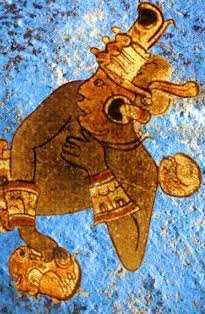
A blue figure still stands against the walls of Bonampak after more than a thousand years of heat, moisture, roots, microbes, and political upheaval. The color is neither a surviving patch of ordinary plant dye nor a naturally blue stone ground into paint. It is Maya Blue, a deliberately made hybrid of an organic colorant and a mineral clay—one of the most durable pigments created in the ancient world.
Its survival is startling because tropical environments are usually hostile to painted surfaces. Organic dyes fade; plaster breaks down; rain and vegetation attack exposed masonry. Yet Maya Blue can resist weathering, solvents, alkaline substances, and even many acids. Modern materials scientists have reproduced versions of it, but the precise ways ancient craftspeople made, varied, and understood it are still being investigated.
The pigment therefore tells two histories at once. One concerns Maya artists, ritual specialists, miners, traders, and builders. The other concerns twentieth- and twenty-first-century researchers who used diffraction, spectroscopy, microscopy, experimental archaeology, and mineral surveys to explain an ancient technology. The confirmed core is clear: Maya Blue joins indigo with a fibrous clay, usually palygorskite, through processing that typically involves heat. Around that core remain important uncertainties about recipes, workshops, regional variants, and ritual meanings.
What Maya Blue Actually Is
Maya Blue is best described as an organic–inorganic hybrid pigment. Its color comes principally from indigo, an organic molecule that can be obtained from plants including Indigofera suffruticosa. Its mineral framework is generally palygorskite, a magnesium-aluminum silicate clay with a fibrous microscopic structure, narrow channels, and grooves along its surfaces. Neither ingredient alone has all the properties of the finished material.
Indigo is a powerful colorant, but in ordinary circumstances it can be vulnerable to chemical attack and environmental degradation. Palygorskite is pale rather than blue, yet its structure can host or bind small amounts of the dye. When the ingredients are combined and processed, the resulting material gains a distinctive turquoise-to-blue appearance and far greater stability than loose indigo.
The popular phrase “ancient nanotechnology” captures something real but can mislead if treated literally. Maya makers were not working from modern atomic theory or measuring particles in nanometers. They were, however, manipulating matter at a very small scale through a repeatable craft process. The label is most useful as a modern description of the material’s structure, not as proof that ancient artisans conceived the chemistry in modern terms.
Where the Pigment Appears
Maya Blue is associated most famously with the ancient Maya, but its history extends across Mesoamerica and into the colonial period. Researchers have identified related blue pigments on murals, ceramics, sculpture, codices, and other painted surfaces. Well-known examples include the murals of Bonampak in Chiapas and material from Chichén Itzá in Yucatán. Comparable pigment traditions also appear beyond the Maya heartlands, including central Mexican contexts.
Chronology requires care. Older summaries sometimes present a single invention date, usually in the later first millennium CE. Archaeometric work continues to refine when and where the technology emerged, and identification depends on whether surviving blue material has been sampled and analyzed. It is safer to say that the pigment was established in Classic-period Mesoamerica and remained in use for centuries than to claim one undisputed moment of invention.
Why Blue Was Difficult to Make
Producing a lasting blue has challenged many societies. Earth pigments readily provide reds, yellows, browns, and blacks because iron oxides, carbon, and other minerals are common. Strong blue minerals are less widely available, and many blue plant dyes work well on fibers but poorly as permanent paint. Indigo is especially valuable as a textile dye, yet turning it into a stable pigment for plaster and ceramics poses different problems.
The Maya solution did not imitate lapis lazuli or Egyptian blue. It used materials available within Mesoamerica and created a composite whose behavior exceeded that of its ingredients. A small quantity of indigo could color much more clay, while the mineral environment protected and immobilized the colorant. The result was not simply dye painted over clay; it was a new material formed through controlled preparation.
Palygorskite: The Mineral Framework
Palygorskite is central to most accepted explanations of Maya Blue. Unlike sheet-like clays, it has a fibrous structure containing microscopic channels. Water occupies parts of that structure, and heating can remove different forms of water while changing how indigo interacts with the mineral. Experimental studies show that palygorskite–indigo mixtures can become highly resistant after controlled heating.
The Yucatán Peninsula contains palygorskite deposits, and modern mineralogical research has compared archaeological pigments with potential sources. That geographic availability made the clay accessible, but access was not necessarily simple or universal. Communities may have obtained it from particular deposits, traded prepared clay, or moved finished pigment. Identifying a mineral does not by itself reconstruct the social route between quarry and painted wall.
Some experiments have produced blue materials with sepiolite or other clays, and archaeological samples are not perfectly uniform. Nevertheless, palygorskite consistently performs especially well in acid-resistance tests. The broad composition is therefore well established, while the range of acceptable mineral mixtures and local substitutions remains a productive field of research.
Indigo: The Organic Colorant
The blue component is usually identified as indigo, a molecule formed through processing plants that contain colorless precursors. Leaves are not simply crushed to release ready-made blue paint. Traditional indigo production involves biochemical transformations, exposure to air, precipitation, and drying. Ancient Mesoamerican terminology and colonial descriptions offer clues, but they do not preserve one complete, universally followed Maya Blue recipe.
Only a small proportion of indigo is required to color the clay. That helps explain why the finished pigment behaves more like a mineral paint than a mass of plant dye. Analytical techniques, including Raman spectroscopy and other forms of molecular identification, can detect indigo even when the amount is low and the artifact cannot surrender a large sample.
It is often assumed that every surviving blue-green Maya surface contains Maya Blue. That is an oversimplification. Artists could use other mineral pigments, mixtures, layered paints, or altered colors, and centuries of burial can change appearance. Proper identification depends on laboratory evidence and archaeological context rather than color alone.
How Heat Changes the Mixture
Heat is the crucial bridge between clay and dye in many reconstructed recipes. Researchers have mixed indigo with palygorskite and heated the combination, producing a blue material that resembles archaeological samples in color and resistance. Heating drives water from the clay and encourages interactions between indigo molecules and the mineral’s channels or surface grooves.
The exact microscopic explanation has evolved. Some models emphasize indigo entering the internal channels; others stress attachment in surface grooves, pore entrances, or structural defects. Hydrogen bonding, physical confinement, and chemical changes in indigo may all contribute. Different experiments can produce durable pigment under different conditions, so one simplified diagram cannot stand for every ancient batch.
Temperature also demands nuance. Maya artisans did not need industrial furnaces capable of extreme heat. Experiments show that useful transformations can occur at comparatively moderate temperatures available from braziers, hearths, pottery firing, or burning incense. Yet “the Maya heated indigo and clay” is only the outline of a method. Duration, atmosphere, moisture, proportions, and the order in which ingredients were combined all mattered.
The Chichén Itzá Evidence
One of the most influential archaeological arguments links production to ritual activity at Chichén Itzá. A three-footed bowl recovered from the Sacred Cenote carried residues that researchers identified as palygorskite and indigo. The vessel’s form, traces of heat, and association with copal incense supported an experiment-based interpretation: incense burning may have provided conditions that brought clay and dye together while forming Maya Blue.
The context is powerful because objects, pigment, and ritual practice converge. Spanish colonial accounts and archaeological discoveries indicate that offerings—including valuable objects and human victims—were cast into the cenote in ceremonies associated with rain and supernatural powers. Blue coatings on materials from the site strengthen the connection between color, water, sacrifice, and ritual performance.
But the famous finding does not prove that every batch of Maya Blue everywhere was created as incense. It demonstrates one plausible and archaeologically grounded production context. Workshops could have used other heating arrangements, and craftspeople may have made pigment before ceremonies rather than as an incidental by-product during them. Evidence from Chichén Itzá should illuminate regional practice without becoming an automatic universal recipe.
Color, Rain, and Sacred Power
Blue and blue-green colors in Maya thought were associated with more than one idea. They could evoke water, rain, vegetation, precious feathers, jade, fertility, and the life-giving qualities expressed by the broad color category often rendered as yax. Modern English separates “blue” and “green” sharply, but ancient Maya language and symbolism did not necessarily map onto that division.
The association with the rain deity Chaak is especially relevant at Chichén Itzá, where the Sacred Cenote formed part of a landscape of water, offerings, and petition. Painting a body or object blue could have marked it for a particular ritual role. Yet meanings varied with place, image, period, and object. A blue background on a mural cannot automatically be interpreted exactly like blue pigment on an offering vessel.
There is also danger in describing the color as “the sacred Maya blue,” as though it had a single permanent meaning across a civilization lasting many centuries. The pigment was used by different communities in different political circumstances. Its unusual durability may have contributed to its prestige, but archaeology cannot recover every intention from chemistry alone.
Bonampak and the Survival of Painted History
The Bonampak murals are among the most celebrated survivals of Classic Maya painting. Created near the end of the eighth century, they show courtly ceremony, musicians, captives, warfare, elite costume, and ritual bloodletting in a complex narrative program. Blues and blue-greens help organize figures, garments, backgrounds, and architectural details.
The murals are important not because Maya Blue miraculously preserved every part of them. Plaster movement, water, salts, microorganisms, and environmental change have affected the rooms. Rather, the pigment’s stability helped portions survive. Set beside evidence from the Tikal LiDAR discovery, Bonampak also shows how material science and landscape archaeology recover different scales of Maya history.
Reading the murals still requires art history, epigraphy, archaeology, conservation, and political context. Pigment analysis answers questions about material composition; it does not by itself identify every person or explain the full sequence of events. The paintings are historical evidence precisely because multiple methods can be brought together without pretending that one method settles everything.
What Modern Science Can Confirm
Scientists identify Maya Blue through converging evidence. X-ray diffraction can characterize the clay mineral. Raman and infrared spectroscopy can detect molecular signatures. Electron microscopy examines microstructure. Thermal analysis tracks changes during heating, while synchrotron and neutron methods offer more detailed information about atomic arrangements. No single technique is sufficient in every case, especially when samples are tiny or altered.
Laboratory reconstructions provide another kind of evidence. Researchers can vary clay type, temperature, heating time, acidity, and dye concentration, then compare the products with ancient samples. These experiments show that indigo–palygorskite systems can reproduce the color and exceptional resistance associated with Maya Blue.
What science cannot confirm so easily is a unique ancient recipe. Several procedures may yield similar end products, and archaeological objects preserve outcomes more often than instructions. Even highly precise measurements must be interpreted within excavation histories and conservation records. The strongest conclusions combine chemical results with where an object was found, how it was used, and whether contamination is possible.
Why the Pigment Is So Durable
Maya Blue’s durability comes from protection at the molecular scale. When indigo becomes associated with palygorskite, the mineral restricts the dye’s movement and shields it from substances that would readily damage free indigo. Studies differ over the exact locations occupied by the molecules, but physical confinement and strong interactions with the clay are fundamental.
Its reputation should not be exaggerated into indestructibility. Experiments show that sufficiently aggressive acid treatment, prolonged heating, or deterioration of the painted substrate can damage the material. A pigment may survive while the plaster holding it flakes away. Conservation therefore cannot assume that a blue surface is safe simply because its chemistry is robust.
The distinction matters: resistance is not immortality. Maya Blue endured because of its unusual structure, because some objects entered protective archaeological contexts, and because modern conservators worked to stabilize what remained. Its survival is both a technological achievement and a matter of preservation history.
Rediscovery and the “Lost Recipe” Story
Modern researchers began treating the blue as a distinct scientific problem in the twentieth century. Early investigators noticed that it behaved differently from familiar pigments. Mid-century diffraction studies established the importance of clay, and later work identified indigo, tested reconstructions, and proposed increasingly detailed structural models.
Calling this a “lost recipe rediscovered” makes a good headline, but it compresses a long scholarly process. Researchers did not uncover a single Maya instruction tablet. They assembled an explanation from artifacts, mineral samples, colonial texts, experiments, and competing models. New instruments refined older claims rather than delivering one final revelation.
The discovery narrative can also obscure Indigenous continuity. Plant dyeing, mineral knowledge, and local terminology did not vanish simply because academic chemistry had not yet described the pigment’s structure. A responsible history distinguishes the modern scientific identification of a material from the much older knowledge traditions that created it.
Common Myths and Oversimplifications
Myth: Maya Blue was one secret formula. The evidence supports a family of related practices built around indigo and fibrous clay. Regional differences and multiple heating methods are plausible, and not every blue sample has identical composition.
Myth: it was invented accidentally in the Sacred Cenote ritual. The Chichén Itzá vessel provides direct evidence connecting pigment ingredients, heat, and ceremony, but it does not locate the first invention or explain every production setting.
Myth: the pigment cannot be destroyed. It is exceptionally resistant, not invulnerable. Strong treatment can degrade it, and the support beneath a painted layer may fail.
Myth: scientists have completely solved its structure. The main ingredients and the role of heat are well established. The precise placement, bonding, and transformations of indigo within archaeological variants remain subjects of research.
Myth: every Maya blue-green surface is Maya Blue. Identification requires analysis. Visual appearance alone can confuse different pigments, mixtures, surface changes, and restoration materials.
Why Maya Blue Matters Beyond Archaeology
Maya Blue demonstrates that ancient materials can inspire modern research without being stripped of their cultural setting. Scientists studying hybrid pigments have explored how clay matrices stabilize organic dyes, seeking durable and potentially less toxic alternatives for modern applications. The ancient material offers a model for designing color through structure rather than relying only on new synthetic molecules.
For conservation, the pigment is both an advantage and a diagnostic tool. Its composition can help identify original painted areas, compare objects, and evaluate deterioration. Yet sampling must be restrained: every removed fragment comes from an irreplaceable artifact. Non-invasive and micro-invasive techniques are therefore increasingly valuable.
For historians, its greatest lesson is methodological. Chemistry confirms ingredients and mechanisms; archaeology supplies dates and contexts; art history interprets images; linguistics and ethnohistory clarify categories and practices. Maya Blue becomes most meaningful when these fields correct one another rather than compete for a single dramatic answer.
Conclusion: A Color Made to Endure
Maya Blue survived because ancient Mesoamerican makers learned how to transform a plant dye and a pale clay into something neither material could become alone. They selected, combined, heated, and applied their ingredients with enough control to produce a pigment that outlasted buildings, dynasties, and the environments surrounding them.
The central facts are secure: indigo supplies the blue; palygorskite usually provides the mineral framework; processing, commonly involving heat, creates extraordinary stability. The open questions are equally important. Researchers still debate the range of microscopic structures, recipes, production settings, and regional traditions hidden beneath the single modern name.
That balance between certainty and uncertainty is what makes the pigment historically valuable. Maya Blue is not a magical substance, an isolated accident, or a solved riddle with one recipe. It is evidence of skilled experimentation embedded in ritual, art, trade, and political life. Its color endures, but so does the harder intellectual task it poses: understanding an ancient technology without reducing the people who made it to a modern scientific curiosity.
Research and Further Reading
- Antiquity: “The first direct evidence for the production of Maya Blue”
- Developments in Clay Science: “The Maya Blue Pigment”
- Archaeometry: “Synthesis and Acid Resistance of Maya Blue Pigment”
- The Metropolitan Museum of Art: Maya whistle with preserved Maya Blue
- Getty Art & Architecture Thesaurus: Maya Blue pigment record