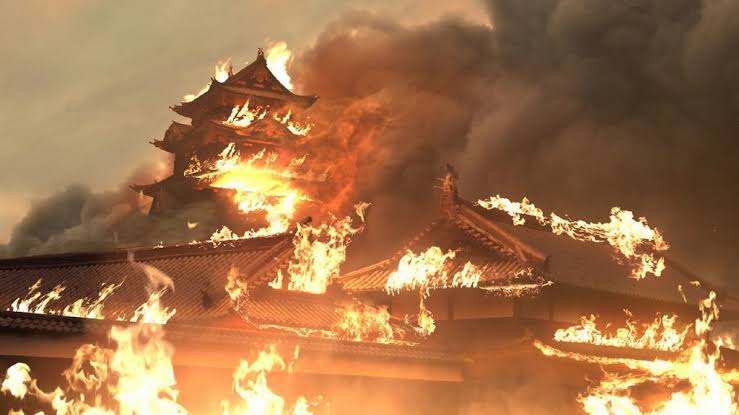
In March 1657, fire crossed Edo faster than the authorities could understand it. Flames leapt through dense wooden districts, shifted direction with the wind, surrounded people seeking open ground, and reached the seat of Tokugawa power itself. By the time the disaster ended, a large part of the city had burned. Tens of thousands were dead, although no precise total can be recovered, and Edo Castle had lost its towering keep.
The catastrophe is remembered as the Great Fire of Meireki. It was not simply an unusually destructive accident. It exposed the risks created by Edo’s astonishing growth into one of the world’s largest cities, and it forced the Tokugawa shogunate to reconsider roads, bridges, temples, elite residences, emergency organization, and access to land beyond the Sumida River. A later legend blamed the fire on a cursed kimono. The historical evidence points instead to a far more revealing combination of weather, construction, congestion, and urban government.
Edo before the flames
Tokugawa Ieyasu established his military government in Edo in 1603, transforming a regional castle town into the administrative center of a new political order. The emperor remained in Kyoto, but the shogun ruled from Edo. Daimyo, the lords of domains across Japan, maintained residences there under systems that tied them to the Tokugawa government. Their households brought samurai, servants, artisans, merchants, laborers, and suppliers into the city.
Edo consequently expanded at remarkable speed during the first half of the seventeenth century. The castle formed its political center. Around it lay extensive daimyo compounds, samurai districts, temples and shrines, and crowded neighborhoods occupied by merchants and craftspeople. Canals and waterways carried goods through a city that depended on rice, fuel, timber, food, and manufactured items arriving from outside.
This growth created prosperity, but also concentrated danger. Most buildings were made largely of wood, paper, bamboo, plaster, and thatch or wooden shingles. Open flames were indispensable for cooking, heating, lighting, and workshops. Winters were often dry, and strong winds could turn a small fire into a moving front of sparks and burning debris. Narrow streets and densely packed structures made evacuation and firefighting difficult.
Edo was therefore a “city of fires” long before 1657. Later residents would treat repeated burning as a normal feature of urban life, but the Great Fire of Meireki was exceptional in scale. It struck a city whose population and physical footprint had expanded faster than its capacity to control a multi-district disaster.
How the Great Fire of Meireki unfolded
The fire began on the eighteenth day of the first month of Meireki 3, corresponding to March 2, 1657, in the Gregorian calendar. Traditional accounts place the first outbreak at Honmyōji, a temple in the Hongo area. Strong northwesterly winds drove the flames southeast through tightly built districts. Firebrands travelled ahead of the main blaze, igniting roofs and creating new fronts.
The catastrophe was not one continuous wall of flame from a single source. Contemporary and later records describe multiple outbreaks over roughly three days. A second major fire began in another part of the city while the first was still consuming neighborhoods, and a third followed. Whether every outbreak had an independent accidental cause cannot be established with certainty. What is clear is that changing winds and the city’s combustible fabric made containment extraordinarily difficult.
Flames entered samurai compounds, commoners’ districts, temples, warehouses, and parts of Edo Castle. The castle’s great tenshu, usually translated as keep or tower, burned and was never reconstructed. Important storehouses and administrative facilities were damaged, though the Tokugawa government survived and continued to function. The loss of the keep became the most visible symbol of the disaster’s reach into the heart of political authority.
People fled toward bridges, riverbanks, temple grounds, and other spaces they hoped would provide safety. Congestion itself became lethal. Routes narrowed or were blocked by possessions, carts, collapsing buildings, and crowds moving in different directions. Some who reached open spaces were overtaken when winds changed or nearby stores of combustible goods ignited.
How many people died?
The number most often repeated is 100,000 deaths. It conveys the disaster’s enormity, but it should not be presented as a modern statistical count. Seventeenth-century authorities did not possess a complete civil registry capable of recording every resident, migrant, servant, child, or unclaimed body. Surviving reports vary, and later writers sometimes repeated rounded figures as fact.
Historians generally accept that the death toll reached many tens of thousands and may have approached 100,000. The uncertainty is not evidence that the fire was less catastrophic. It reflects the difficulty of counting victims in a city with mobile populations, socially divided jurisdictions, destroyed records, and bodies that could not always be identified.
Physical circumstances multiplied mortality. People suffocated in smoke, burned in buildings or streets, drowned while trying to escape, and were crushed in crowds. A particularly grim episode occurred at a large enclosure or prison area where people were trapped or released too late, though details differ among accounts. Cold weather, injury, homelessness, and disruption of food supplies also threatened survivors after the flames were extinguished.
Enormous numbers of corpses were collected and buried east of the Sumida River at a site later associated with Ekōin temple. Memorial practice mattered politically as well as religiously: the dead included people without families able to claim them, and the shogunate needed to restore moral order after a disaster that had erased ordinary social distinctions. The burial ground and commemorative temple became part of Edo’s landscape of memory.
The cursed kimono legend
The best-known story says that a long-sleeved kimono, or furisode, was owned in succession by three young women who each died before marriage. Their grieving families supposedly donated the garment to a temple. When a priest attempted to burn it, a sudden gust carried the flaming cloth into the temple roof, beginning the inferno. The disaster is consequently sometimes called the Furisode Fire.
This is a compelling tale, but it is not reliable evidence for the fire’s cause. The story circulated in forms shaped by later popular culture and moral storytelling. Its repeated pattern of three dead girls, a beautiful garment, frustrated desire, and supernatural retribution has the structure of legend. It gives an immense and confusing catastrophe a single memorable object and a human-scale origin.
The legend should not simply be discarded as foolishness. It reveals how people made sense of urban disaster. Clothing could carry emotional and economic value; temples received possessions from the dead; and fire itself had religious as well as practical meanings. The tale transformed collective trauma into a story about attachment, death, and ritual failure.
What it cannot do is replace the material explanation. Edo was dry, windy, densely built, and filled with open flames. Firefighting arrangements were limited, water access uneven, and large compounds could obstruct movement. Even if a fire began at Honmyōji, no surviving evidence proves that a cursed garment caused it. The kimono belongs to the history of memory, not the established chain of ignition.
Why firefighting failed
Edo did have organized firefighters before 1657. The shogunate had assigned groups of daimyo to provide firefighting forces, and neighborhoods possessed local responsibilities. Yet these organizations were not designed to defeat several wind-driven conflagrations moving across a vast city. Their equipment and tactics were limited, and command could be fragmented by the city’s administrative divisions.
Early modern Japanese firefighting often focused on demolition rather than pouring sufficient water onto a major blaze. Teams pulled down buildings to create gaps that might deprive a fire of fuel. This could work when a fire was identified early and wind conditions allowed a defensible line. During the Meireki catastrophe, flames and embers repeatedly crossed such barriers.
Urban form made coordination harder. Daimyo estates covered large areas and were governed differently from commoner districts. Gates, walls, canals, and narrow lanes controlled daily movement but could become obstacles during evacuation. Authorities also feared disorder, theft, and unauthorized entry into elite or military spaces. Measures designed for social control did not always serve emergency movement.
The failure was therefore institutional as well as technological. No single firefighting innovation could have protected Edo. The disaster required changes to space, responsibilities, communications, and the distribution of people and buildings. Later improvements did not make the city fireproof, but they recognized that fire was an urban systems problem rather than merely the result of careless individuals.
Relief, burial, and emergency government
The Tokugawa shogunate responded with food distribution, temporary shelter, recovery of bodies, and controls intended to stabilize prices and public order. Rice and other necessities were released or supplied to victims. Officials attempted to prevent merchants from exploiting scarcity, while reconstruction generated intense demand for timber, labor, tools, and transport.
Relief was shaped by status and administration. Daimyo were responsible for their households and compounds; towns had their own officials and mutual obligations; temples provided space and services. The government’s response was neither a modern national disaster agency nor a purely private effort. It combined shogunal orders with domainal, neighborhood, religious, and commercial resources.
The dead posed an immediate logistical and spiritual crisis. Removing bodies reduced health fears and restored movement, but mass burial also acknowledged people who otherwise risked disappearing anonymously. Ekōin, established in connection with the victims, became a place where prayers could be offered for those without relatives or known identities.
Recovery also tested political legitimacy. Tokugawa rule claimed to maintain peace and social order. A disaster that burned the castle and much of the capital-like city could be read as a failure or ominous sign. Effective relief and visible rebuilding helped the regime present itself as guardian of the population, even while reconstruction decisions imposed burdens and displaced communities.
Rebuilding Edo as a less concentrated city
The shogunate did not rebuild every district exactly as it had stood. Authorities widened selected streets, created or expanded firebreaks, relocated temples and shrines, and shifted some daimyo residences. Large open areas could slow flames and provide places for evacuation. These spaces were not always kept empty forever—commerce and entertainment often returned—but the principle of breaking up uninterrupted combustible districts became clearer.
Expansion east of the Sumida River was especially important. The construction of Ryōgoku Bridge improved access to the eastern bank and encouraged development in Honjo and Fukagawa. Moving people and institutions outward reduced some pressure on the old center and gave Edo additional routes and spaces. The bridge itself became both infrastructure and a symbol of the post-fire city.
Officials also reconsidered the scale and location of elite architecture. The Edo-Tokyo Museum notes that the magnificent upper residence of Matsudaira Tadamasa, destroyed in the fire, was not rebuilt in the same luxurious form. After 1657, practical concerns carried greater weight in the arrangement of some daimyo compounds. The castle keep likewise remained a ruin rather than being restored.
These measures should not be mistaken for a comprehensive modern master plan executed at once. Reconstruction was negotiated, uneven, and shaped by property rights, status, cost, and political priority. Fires continued to plague Edo. Nevertheless, the response altered the city’s geography and helped turn the disaster into a major episode in the history of urban planning.
Why Edo Castle’s keep was never rebuilt
The destruction of the castle keep invites a simple question: why did the Tokugawa, who possessed enormous authority, leave such a potent symbol unbuilt? One traditional explanation credits Hoshina Masayuki, a senior adviser and half-brother of Shogun Tokugawa Iemitsu, with arguing that resources should be directed toward relief and reconstruction instead of an obsolete military monument.
The exact wording of later anecdotes cannot always be verified, but the broader decision is real. By 1657, the Tokugawa regime had ruled for more than half a century. The castle remained central to government, yet a towering keep was no longer necessary for immediate defense. Rebuilding it would have consumed timber, labor, money, and time when vast sections of the city required assistance.
Leaving the keep unreconstructed also illustrates a change in political display. Tokugawa authority depended on institutions, alliances, domainal control, ceremony, and administration—not solely on a monumental tower. The surviving base remained visible, but government continued without the lost structure. Practical governance could itself communicate stability.
Popular accounts sometimes romanticize the decision as an entirely altruistic choice made for commoners. Relief priorities undoubtedly mattered, but the shogunate was also protecting the functioning of its own capital and political system. The decision is most convincing when understood as both pragmatic and symbolic: the regime chose urban recovery over restoring a structure whose military value had diminished.
What changed—and what did not
The Great Fire of Meireki accelerated changes in firefighting and urban management, but it did not end Edo’s vulnerability. The city remained overwhelmingly wooden, open flames remained essential, and strong winds continued to spread fires. Later shogunal administrations expanded organized firefighting, including the famous town fire brigades of the eighteenth century, but repeated conflagrations remained part of urban life.
Residents adapted culturally as well as institutionally. Warehouses used thicker plaster where owners could afford it; households learned to move valuables; merchants planned for rebuilding; and neighborhood groups treated fire watches and emergency action as communal duties. Destruction became woven into Edo’s economic rhythms. Carpenters and suppliers benefited from reconstruction, while poorer households could lose everything repeatedly.
Urban disaster also produced leisure spaces. Firebreaks and broad open grounds sometimes attracted stalls, performances, and crowds when they were not needed for emergencies. Ryōgoku developed into a major entertainment district. This was not simply careless reuse. Open spaces near transport routes naturally became valuable civic places, demonstrating the tension between safety and the everyday pressures of a dense city.
Edo’s experience belongs beside later episodes in which catastrophe reshaped infrastructure and public policy. As with London’s Great Stink, crisis made long-standing urban weaknesses impossible for authorities to ignore. The causes differed—fire in Edo, polluted river and sanitation failure in London—but both show that cities often undertake structural reform only after ordinary risks become politically unbearable.
The lasting meaning of the Great Fire of Meireki
The fire’s confirmed history is dramatic enough without supernatural explanation. It devastated a rapidly growing wooden city during dry, windy weather; killed an unknowable but enormous number of people; destroyed elite and commoner districts; burned Edo Castle’s keep; and prompted a broad reconstruction that changed the city’s expansion and emergency geography.
The disputed elements are equally instructive. The exact death toll cannot be known. The number of separate ignition points and their immediate causes remain uncertain. The cursed furisode is a legend, not a demonstrated cause. Treating those uncertainties honestly does not weaken the story. It prevents a complex urban disaster from being reduced to an attractive myth or a falsely precise statistic.
Most importantly, the Great Fire of Meireki reveals how the physical and political city were connected. Edo’s density reflected the Tokugawa system: daimyo attendance, samurai households, specialized districts, waterways, gates, and concentrations of commerce. The same arrangements that made Edo powerful also made evacuation and containment difficult. Rebuilding therefore became an act of government, not just construction.
Modern Tokyo bears little visual resemblance to the city of 1657, yet its history of disaster, reconstruction, and outward expansion began long before earthquakes, wartime bombing, and modern redevelopment. The Great Fire of Meireki stands at the center of that longer history. It was not the tale of one cursed garment. It was the moment when an early modern metropolis confronted the costs of its own extraordinary success.