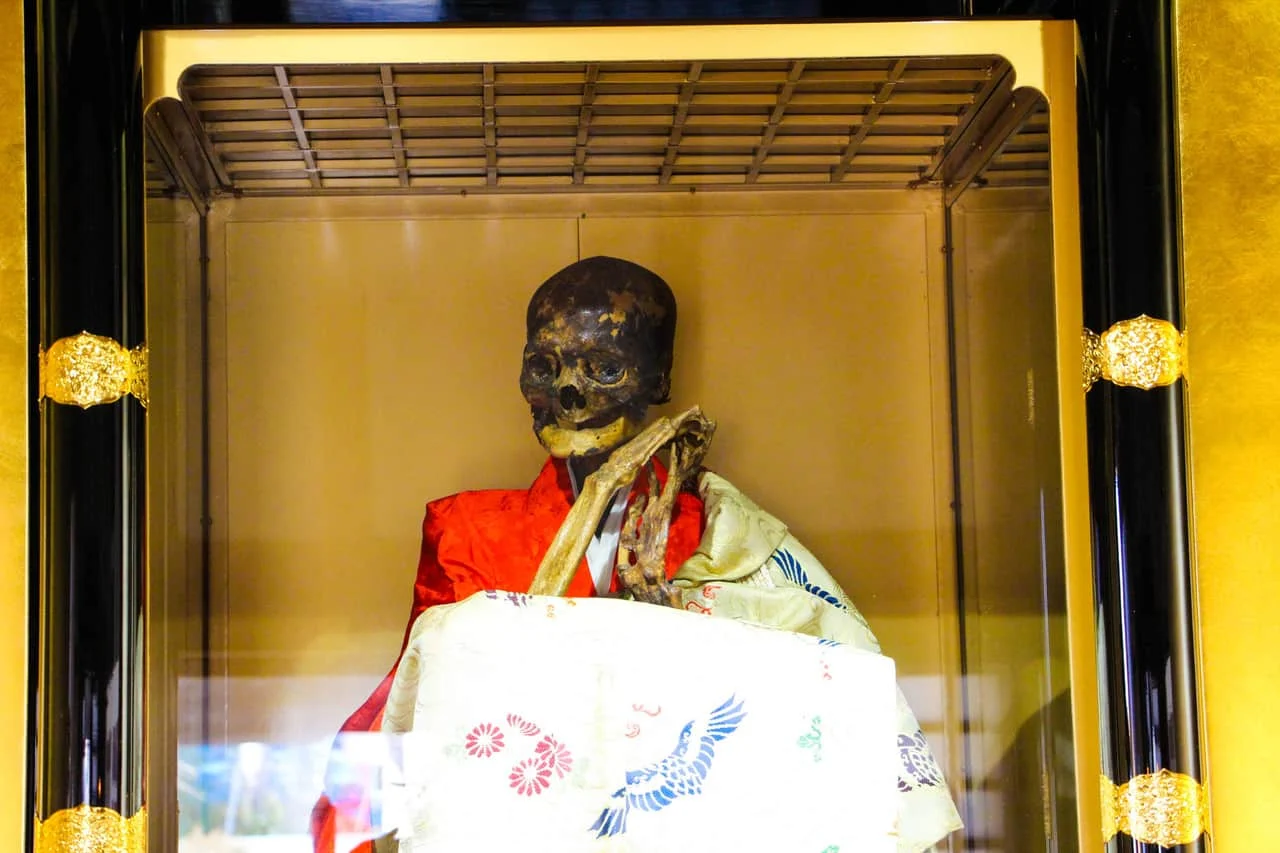
For many readers encountering the idea for the first time, the thought of monks intentionally mummifying themselves sounds almost mythical, like a legend that drifted out of a distant and mysterious past. Yet this practice was very real, carefully documented, and deeply rooted in religious belief. Between the eleventh and nineteenth centuries, particularly in Japan, certain Buddhist monks undertook an extreme spiritual discipline known as Sokushinbutsu. Over the course of years, and ultimately a final thousand days, these monks gradually withdrew from the physical needs of the body. By reducing food and water to almost nothing, they aimed to transcend mortality itself. To modern sensibilities, the process appears harrowing and even incomprehensible, but within its historical and spiritual context it was understood as a profound act of devotion rather than self-destruction.
The story of Sokushinbutsu is not merely about death. It is about the boundaries between body and spirit, about how religious traditions have historically interpreted suffering, discipline, and enlightenment. These monks believed that by conquering physical decay, they could achieve a living form of Buddhahood, remaining eternally present to guide future generations. Their preserved bodies were not hidden away as curiosities; they were revered, displayed in temples, and treated as sacred presences. Understanding why such an extreme practice emerged requires careful attention to history, doctrine, environment, and human psychology. Only by exploring all of these dimensions can we begin to grasp why Sokushinbutsu was once seen as the highest possible spiritual achievement.
The religious and cultural roots of Sokushinbutsu
Sokushinbutsu did not arise in a vacuum. Its origins are closely tied to the development of esoteric Buddhism in Japan, particularly within the Shingon tradition that flourished from the early medieval period onward. This form of Buddhism emphasized the possibility of achieving enlightenment within one’s own lifetime, rather than deferring liberation to future rebirths. Enlightenment was not only a distant metaphysical goal but something that could be embodied physically, here and now. For some monks, this belief opened the door to radical interpretations of spiritual discipline, where the body itself became both the obstacle and the instrument of awakening.
Japanese religious culture during this period was deeply shaped by ascetic practices. Mountain asceticism, known as Shugendō, blended elements of Buddhism, Shinto, and folk belief, encouraging practitioners to seek spiritual power through isolation, endurance, and communion with nature. Monks spent years in harsh mountain environments, fasting, chanting, and subjecting themselves to physical trials meant to purify the mind. Sokushinbutsu emerged as an extreme extension of this worldview. If lesser forms of asceticism could bring insight and merit, then complete renunciation of bodily sustenance promised the ultimate transformation.
Cultural attitudes toward death also played an important role. In Japanese Buddhism, death was not always seen as a sharp boundary but as a transition within a continuous cycle of existence. The idea that a highly disciplined individual could arrest decay after death was interpreted as proof of spiritual mastery. A naturally preserved body suggested that the monk’s meditation and purity had altered the very laws of nature. Rather than being feared, such remains inspired awe and reassurance. They were tangible signs that enlightenment was not merely a philosophical concept but an attainable reality.
The thousand-day path toward self-mummification
The process of Sokushinbutsu was not a sudden act but a prolonged and carefully structured journey that unfolded over many years. Monks who chose this path began by radically transforming their diet. For the first stage, which could last several years, they consumed only nuts, seeds, and berries gathered from the surrounding mountains. This severe restriction stripped the body of fat, which would otherwise accelerate decomposition after death. At the same time, the monk engaged in intense physical labor and meditation, further reducing bodily mass and strengthening mental discipline.
In the next stage, the diet became even more austere. Solid foods were almost entirely eliminated, replaced by small amounts of roots and bark. Some monks consumed a tea brewed from the sap of the urushi tree, which is mildly toxic. This substance induced vomiting and dehydration, further purging the body of moisture and discouraging bacteria and insects that cause decay. From a modern medical perspective, this stage was extremely dangerous, but within the religious framework it was seen as a necessary purification, expelling worldly attachments from both body and mind.
The final thousand days represented the culmination of the process. The monk would withdraw into a small stone chamber barely large enough to sit upright. An air tube allowed limited breathing, and each day the monk rang a bell to signal continued life. When the bell stopped, disciples sealed the chamber. After three years, it was reopened to see whether mummification had been successful. If the body had naturally preserved, the monk was declared a Sokushinbutsu and enshrined. If not, the remains were buried respectfully, acknowledging the monk’s devotion even if the ultimate goal had not been achieved.
Enlightenment, immortality, and the meaning of preserved bodies
To understand why Sokushinbutsu was considered a path to true enlightenment, it is essential to look beyond the physical act and into its symbolic meaning. In Buddhist philosophy, attachment to the body is often described as one of the greatest obstacles to liberation. Hunger, thirst, pain, and fear bind individuals to the cycle of suffering. By gradually relinquishing these needs, the monk demonstrated absolute mastery over desire. Self-mummification was thus interpreted as the final proof that the individual had transcended the ordinary human condition.
Preserved bodies carried powerful spiritual significance for local communities. They were believed to remain in a state of deep meditation, continuing to work for the benefit of all beings. Unlike relics, which are fragments of a holy person, Sokushinbutsu were complete, recognizable individuals. Devotees prayed to them for protection, healing, and guidance, seeing them as living Buddhas rather than deceased monks. This belief reinforced the idea that enlightenment could manifest in tangible, visible ways.
At the same time, the practice reflected a uniquely Japanese synthesis of Buddhist doctrine and local belief. While Buddhism elsewhere often emphasized detachment from the physical world, Sokushinbutsu elevated the transformed body as a sacred object. The mummy was not a rejection of material existence but its ultimate sanctification. This paradox helps explain why the practice inspired both reverence and controversy. It challenged conventional distinctions between life and death, presence and absence, reminding observers that spiritual ideals could take forms that defied ordinary logic.
Historical examples and regional variations
Although Sokushinbutsu is often discussed as a single practice, it varied across regions and historical periods. Most known examples are concentrated in northern Japan, particularly in mountainous areas where harsh climates and isolation supported ascetic lifestyles. Temples in these regions preserved the remains of monks who had undergone the process, creating local traditions centered on specific individuals. Each Sokushinbutsu carried a personal story shaped by regional conditions, temple lineages, and historical circumstances.
Some monks undertook the practice during times of social unrest or natural disaster, believing their sacrifice could protect their communities. In these cases, self-mummification was framed not only as a personal quest for enlightenment but as an act of compassion. The monk’s suffering was offered as a spiritual shield, absorbing misfortune and restoring balance. Historical records and temple legends often emphasize these altruistic motivations, portraying Sokushinbutsu as guardians rather than isolated ascetics.
Over time, attitudes toward the practice evolved. As Japan entered the early modern period, religious reforms and changing political priorities brought increased scrutiny. By the nineteenth century, the Japanese government, influenced by modern medical knowledge and Western ideas, officially banned Sokushinbutsu. The practice came to be seen as incompatible with new definitions of religion and human life. Nevertheless, existing mummies continued to be revered, and their stories preserved, creating a complex legacy that bridges premodern spirituality and modern ethical concerns.
Modern perspectives on Sokushinbutsu
Today, Sokushinbutsu occupies an uneasy position between religious heritage and ethical controversy. Modern observers often struggle to reconcile the monks’ intentions with contemporary views on self-harm and bodily autonomy. From a medical standpoint, the process is undeniably lethal, involving prolonged starvation and dehydration. As a result, discussions about Sokushinbutsu frequently raise difficult questions about how to interpret historical practices without imposing modern moral frameworks too rigidly.
Scholars tend to emphasize context. In the medieval and early modern periods, life expectancy was lower, medical understanding limited, and religious worldviews more central to daily existence. For monks committed to Sokushinbutsu, the practice was not an act of despair but a meaningful, voluntary choice grounded in deeply held beliefs. Recognizing this does not require endorsement, but it does demand empathy and historical awareness. Museums and temples that display Sokushinbutsu remains often include explanatory materials to help visitors understand this context rather than react with shock alone.
In recent decades, interest in Sokushinbutsu has grown, fueled by documentaries, academic research, and global curiosity about extreme religious practices. This renewed attention has sparked dialogue about the limits of asceticism, the nature of enlightenment, and the human capacity for belief-driven endurance. While no longer practiced, Sokushinbutsu continues to challenge modern assumptions, reminding us that the boundaries of spirituality have been drawn very differently across time and cultures.
Environment, climate, and the science behind natural mummification
While Sokushinbutsu was fundamentally a religious practice, environmental factors played a crucial supporting role in its occasional success. Northern Japan’s mountainous regions provided conditions that unintentionally favored natural mummification. Cold temperatures slowed bacterial growth, while dry air reduced moisture that would otherwise accelerate decay. These environmental elements, combined with the monk’s extreme dietary preparation, created a rare convergence of spiritual intention and physical circumstance.
The monks themselves did not possess modern scientific knowledge, but they developed practical insights through observation and tradition. The elimination of body fat and fluids was central to the process, as these elements are key drivers of decomposition. By consuming toxic teas and drastically limiting water intake, monks effectively altered their internal chemistry. From a modern perspective, this resembles a crude form of preservation, though achieved through immense suffering rather than external treatment. The fact that only a small percentage of attempts resulted in successful mummification underscores how uncertain the process remained, even under favorable conditions.
Today, scientists who study Sokushinbutsu emphasize that these mummies are examples of natural preservation rather than artificial embalming. There were no chemicals injected, no organs removed, and no deliberate manipulation after death. This distinguishes Sokushinbutsu from other forms of mummification found around the world. The preserved bodies stand as rare intersections of human physiology, environment, and belief, offering researchers unique opportunities to study how cultural practices can unintentionally align with natural processes.
The enduring legacy of self-mummifying monks
The legacy of Sokushinbutsu lies not only in preserved bodies but in the questions they continue to provoke. These monks pushed the human body to its absolute limits in pursuit of a spiritual ideal. Whether viewed as saints, extremists, or tragic figures, they force us to confront uncomfortable truths about faith, suffering, and the desire for transcendence. Their lives suggest that religious conviction can motivate acts that defy instinct and common sense, reshaping the meaning of sacrifice.
From a historical perspective, Sokushinbutsu offers valuable insight into how Buddhism adapted to local environments and cultural expectations. It shows that religious traditions are not static but evolve in dialogue with social, political, and ecological conditions. The practice also highlights the diversity within Buddhism itself, challenging simplistic notions of uniform doctrine. By examining these monks’ choices, historians gain a deeper understanding of how spiritual ideals were lived, contested, and embodied.
Sokushinbutsu endures because it resists easy interpretation. It sits at the intersection of devotion and danger, enlightenment and extinction. In contemplating these self-mummifying monks, we are invited to reflect on our own assumptions about meaning and mortality. Their preserved forms are silent, yet they continue to speak across centuries, asking what we are willing to endure for what we believe is true.
Research and further reading
For readers who want to verify details or continue researching this subject, these external reference collections provide useful starting points: