When people talk about discoveries that changed the way we see the past, Sutton Hoo belongs near the top of the list. In the summer of 1939, just weeks before the outbreak of the Second World War, archaeologists uncovered a ship burial in Suffolk that seemed to arrive out of nowhere and yet somehow felt like a missing piece of English history. The objects inside were astonishing: gold and garnet jewellery, silver tableware, a ceremonial helmet, weapons, a shield, and the imprint of a great ship laid beneath a mound in the ground. What had seemed like a quiet corner of eastern England turned out to hold one of the most important archaeological finds in the country.
For historians and archaeologists, Sutton Hoo did more than produce beautiful artefacts. It transformed ideas about early medieval England, a period often imagined as murky, impoverished, and poorly documented. The burial revealed a world of wealth, international contact, craftsmanship, political power, and ritual sophistication. It also raised compelling questions: who was buried there, why was the ship so important, and what did the grave goods say about the society that created them? The answers were not immediate, and in many ways the mystery is part of the site’s lasting power.
At the center of the story are two remarkable figures: Edith Pretty, the landowner who sensed the importance of the mounds on her property, and Basil Brown, the self-taught archaeologist whose careful work brought the burial to light. Their collaboration, followed by later excavations and scholarly debate, reshaped not only Sutton Hoo but the broader study of early medieval archaeology. The site remains a vivid example of how discovery can change history itself.
The summer of 1939 and the first breakthrough at Sutton Hoo
The story of Sutton Hoo begins with a landscape of ancient burial mounds overlooking the River Deben in Suffolk. Long before the famous excavation, local people knew the mounds were there, but their meaning was uncertain. In 1938, Edith Pretty, the owner of the estate, became interested in whether the mounds might contain graves. She was not a professional archaeologist, but she had the curiosity and judgment to recognize that the site deserved proper investigation. She turned to Basil Brown, a skilled and methodical excavator who had worked for the Ipswich Museum. Brown was not university-trained, yet he possessed the practical experience and patience that archaeology often needs most.
Brown began by investigating several of the mounds. Most yielded disappointing results or signs of earlier disturbance, but Mound 1 proved extraordinary. As he dug deeper, he encountered rivets in a pattern that suggested the outline of a ship. This was the first great turning point: the realization that the burial was not simply a grave with goods, but a ship burial, the kind of elite funeral treatment associated with high-status societies across northern Europe. Yet Sutton Hoo was on a very different scale from most comparators. The vessel’s size and the arrangement of the burial indicated something exceptional, perhaps even royal.
The timing of the discovery gave it added resonance. The excavation unfolded on the eve of war, and the broader public context was one of uncertainty and growing tension. Even so, the work continued long enough for the most important features to be identified and recorded. The actual human remains had largely vanished in the acidic soil, but the impression of the burial chamber, along with the placement of the artefacts, told archaeologists that they were dealing with a carefully staged funerary rite. The mound had not simply concealed treasure; it preserved evidence of ceremony, power, and identity.
This first breakthrough also became part of the site’s mythology. Browning soil, rivet lines, and faint outlines in the earth were transformed into a revelation about early England. Sutton Hoo showed that archaeology could uncover history not only through spectacular objects but through careful observation of what the ground itself was still able to remember.
The ship burial and the objects that changed early medieval history
What made Sutton Hoo unforgettable was not only the ship but the extraordinary richness of the grave goods found within and around the burial chamber. The objects recovered from Mound 1 included a ceremonial helmet, a shield, sword fittings, buckles, shoulder clasps, purse lid ornaments, a shoulder-clasp pair, and elaborate garnet-inlaid jewellery. There were also silver bowls and spoons, mounting pieces, drinking vessels, and fragments of imported or specially made items that suggested wide cultural connections. The grave goods were not piled randomly. They were arranged with care, and their selection seems to have been designed to communicate status, lineage, and perhaps spiritual preparation for the afterlife.
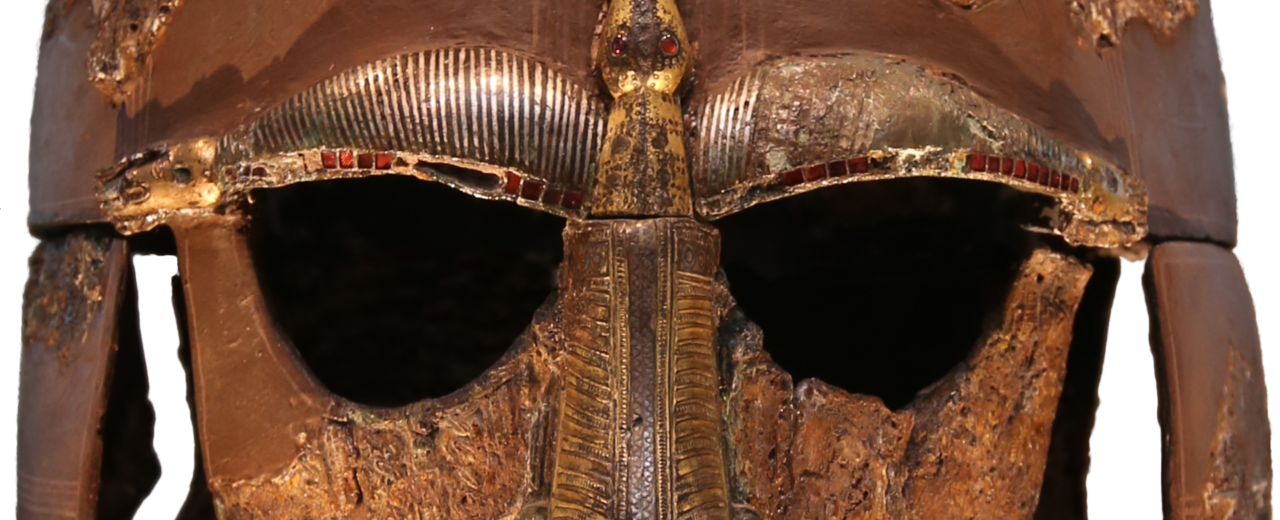
The helmet became one of the most iconic objects in British archaeology. Its reconstructed faceplate, embossed decoration, and protective framework speak to martial symbolism, craftsmanship, and political authority. The shield and sword were equally significant, not merely as weapons but as signs of rank. The gold belt buckle, purse lid, and shoulder clasps reveal the artistry of early medieval metalworkers, while the silverware suggests participation in a wider elite world that extended beyond local boundaries. Sutton Hoo was not an isolated or backward place. It was connected to a broader North Sea cultural sphere in which prestige items circulated among rulers, warriors, and courts.
One of the most striking aspects of the burial is that it lacked a body in the usual sense. The soil conditions at Sutton Hoo are acidic, so bones did not survive well, especially in the main burial chamber. That absence has prompted generations of interpretation. Was the grave symbolic? Was the ship intended as a cenotaph? Did the body decay completely, leaving only trace evidence? Even without a preserved skeleton, the tomb clearly represented a person of immense importance. The burial was built around the idea of rank and remembrance.
The objects also altered historical assumptions. Before Sutton Hoo, the early medieval period in England was often treated as a dim interlude between Roman Britain and later medieval monarchy. The discovery challenged that view. It revealed a culture capable of producing sophisticated art, sustaining political power, and engaging in exchange with distant regions. In some respects, the artistry of Sutton Hoo echoes the deep human impulse to create meaning through objects, something reflected across time from the first known artworks to the ceremonial treasures of an Anglo-Saxon king.
Edith Pretty, Basil Brown, and the human story behind the excavation
One reason Sutton Hoo remains a subject of study is that its discovery was shaped by people whose roles were distinct and deeply human. Edith Pretty deserves great credit for recognizing the potential importance of the mounds and for allowing excavation to proceed. She had the vision to understand that the site could contribute to historical knowledge rather than simply serve private curiosity. Her decision to invite excavation was generous and historically consequential. Without her initiative, the ship burial might have remained hidden much longer, or been disturbed in a far less careful manner.
Basil Brown’s role is equally central. He worked with precision, humility, and a deep respect for the evidence. Although later excavations brought university archaeologists into the project, Brown had already made the crucial discovery and established the basic framework for understanding Mound 1. His careful methodology allowed the shape of the ship to emerge in the soil, and his documentation made it possible for others to interpret the site properly. In the history of archaeology, there are moments when patience matters as much as theory, and Brown embodied that ideal.
The relationship between the amateur landowner, the local archaeologist, and the academic experts who later joined the excavation also reflects the social history of archaeology in the early twentieth century. Sutton Hoo is not just a story of the past; it is also a story about who gets to study the past and who receives credit for discovery. Brown’s contribution was long underappreciated in popular memory, even though his work was foundational. Modern discussions of Sutton Hoo increasingly emphasize that the site’s recovery depended on collaboration, though not always equal collaboration, between local expertise and institutional scholarship.
That human dimension matters because archaeology is not only about objects in the ground. It is also about decisions, relationships, and interpretation. Edith Pretty’s instinct and Basil Brown’s skill changed the trajectory of English history. Their partnership ensured that the burial was excavated in a way that preserved knowledge rather than just trophies. The result was a discovery that could speak not only to specialists but to anyone interested in how the past survives. Sutton Hoo reminds us that great historical finds often depend on the judgment of individuals willing to look carefully, ask questions, and trust the evidence beneath their feet.
Later excavations and the evolving interpretation of the mounds
Although the 1939 excavation produced the headline discovery, Sutton Hoo did not stop there. Later investigations, especially those carried out after the war, refined and expanded what archaeologists understood about the site. Additional work revealed that the burial ground was more complex than a single spectacular tomb surrounded by ordinary mounds. It formed part of a wider funerary landscape with multiple burials and traces of long-term ritual activity. The site’s meaning became richer as archaeologists compared one mound with another and examined the spatial arrangement of the cemetery as a whole.
These later excavations were crucial for moving beyond the idea of Sutton Hoo as merely a “treasure burial.” They showed that the site was carefully organized and that the ship burial was one part of a broader ceremonial and political landscape. Some mounds contained cremations; others contained different kinds of grave deposits. The diversity suggests that Sutton Hoo was used over time by a community with changing burial practices and perhaps shifting expressions of authority. It was not a static monument but a place of repeated memory-making.
As interpretation developed, scholars also revisited the question of the burial’s identity. The ship burial has often been associated with King Rædwald of East Anglia, who ruled in the early seventh century and died around the time many scholars place the burial. This identification is plausible rather than certain, but it fits the evidence of wealth, scale, and royal symbolism. Rædwald was known as a significant ruler in a period of political consolidation, and the Sutton Hoo burial appears to belong to that same world of emerging kingship. Even if the occupant cannot be named with absolute confidence, the grave clearly reflects royal-level status.
What matters most is that later excavations turned Sutton Hoo from a remarkable find into a major historical archive. The site became a key reference point for understanding early Anglo-Saxon burial customs, elite display, craftsmanship, and state formation. It also confirmed that archaeology can revise long-held assumptions. The soil had not simply preserved objects; it had preserved a structure of meaning that could only be recovered gradually. Sutton Hoo became a site where each new generation of scholars could ask new questions and test older ones.
Why Sutton Hoo still matters in archaeology and English history
Sutton Hoo remains significant because it altered the emotional as well as the scholarly landscape of early English history. Before the discovery, the period after Roman rule was often presented in broad strokes, with limited sense of the political and cultural sophistication of its rulers. Sutton Hoo offered something concrete and dazzling: a burial that demonstrated wealth, power, and craftsmanship at a scale that rivaled famous royal tombs elsewhere in Europe. It gave shape to a world that had previously been hard to imagine.
The site also broadened understanding of how archaeology can challenge written history. For early medieval England, surviving texts are limited, partisan, and incomplete. The burial evidence at Sutton Hoo provided an independent line of historical testimony. It suggested that elite authority in seventh-century England was expressed through ceremony, imported luxury goods, and symbolic control over land and memory. The ship itself may have represented a voyage into the next world, but it also marked the earthly prestige of the person buried within it. In that sense, Sutton Hoo is both a burial and a political statement.
Public fascination has endured because the find combines beauty, mystery, and historical importance. The reconstructed helmet is instantly recognizable, yet the site continues to provoke new research on trade networks, metallurgy, burial ritual, and identity. Sutton Hoo has also become a powerful case study in heritage preservation, showing why careful excavation and responsible stewardship matter. The site’s legacy extends beyond the museum gallery. It has shaped public awareness of the Anglo-Saxon world and encouraged a more nuanced appreciation of early medieval England as a period of creativity and complexity.
There is also something timeless about the story itself. A woman notices the significance of a place on her land. A local archaeologist digs with patience and care. A ship hidden in the earth opens a window onto kings, warriors, and artisans from more than a millennium ago. That chain of events is part accident, part insight, and part discipline. Sutton Hoo endures because it reveals how history can emerge from the ground when curiosity meets method. For archaeology and discoveries, few stories are more compelling. It is not simply that a tomb was found; it is that an entire chapter of English history came into focus because someone looked closely enough to see it.
More than eighty years after the first excavation, Sutton Hoo still feels alive with questions. The burial mound has become a symbol of discovery, but it is also a reminder that the past is never fully settled. Each generation brings new tools, new interpretations, and new ways of understanding the evidence. That ongoing conversation is part of the site’s greatness. Sutton Hoo did not just reshape early medieval English history in 1939. It continues to reshape it now.
Related reading: The first known artworks date back roughly 100,000 years ago, 100 million years ago, the Sahara Desert was inhabited by galloping crocodiles.
Research and further reading
For readers who want to verify details or continue researching this subject, these external reference collections provide useful starting points: