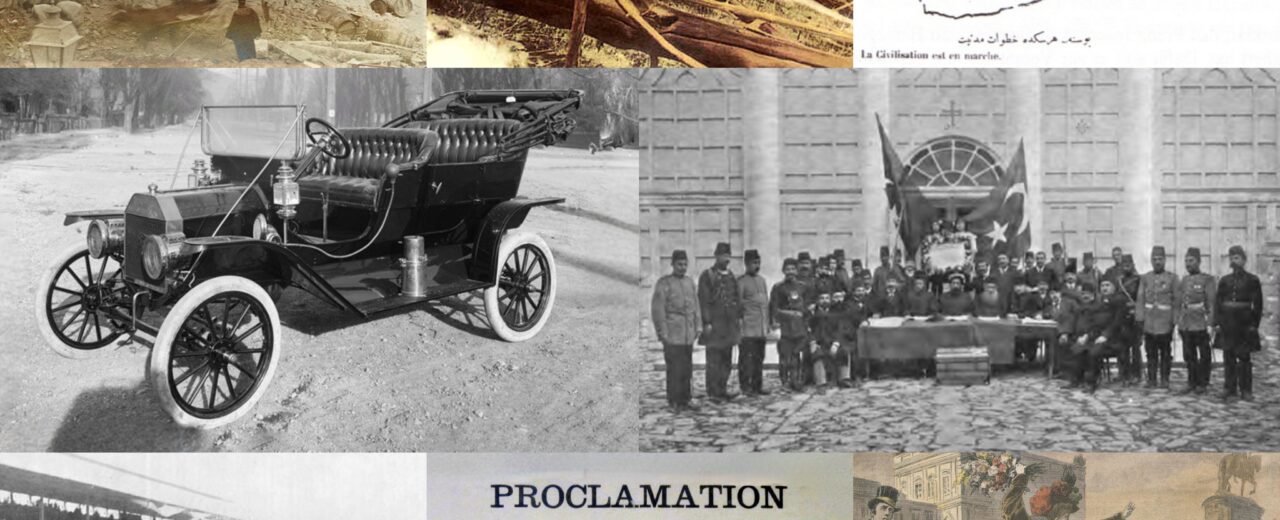
In the summer of 1908, a crisis on the Ottoman Empire’s European frontier suddenly turned into a constitutional resurrection. What began as unrest among officers and troops in Macedonia soon spread into a political shockwave that reached Istanbul and forced Sultan Abdülhamid II to restore the Ottoman constitution of 1876. The Young Turk Revolution did not simply replace one political mood with another. It revealed how fragile the empire had become, how deeply its army had been politicized, and how urgently many Ottomans believed reform was needed if the state was to survive. In that sense, the revolution was not just a palace drama or a military mutiny. It was one of the defining moments of modern political history.
At the center of the upheaval stood a network of reform-minded officers and civilian intellectuals associated with the Committee of Union and Progress, or CUP. They were not all alike, and they did not always agree on what the future should look like. But they shared a conviction that the old order, dominated by autocracy and stagnation, could no longer defend the empire against internal decay and external pressure. Their gamble succeeded in the short term: the constitution was brought back to life, elections were promised, and a new era of Ottoman politics began. Yet the revolution also opened the door to new conflicts, counterrevolutionary violence, and a more unstable political landscape across the Balkans and beyond.
To understand why a military revolt in Macedonia mattered so much, it helps to see the Ottoman Empire not as a fading backdrop, but as a state under extraordinary strain. By 1908, the Balkans were a powder keg of nationalism, great-power rivalry, and imperial anxiety. The Young Turk Revolution emerged from that volatile setting and changed it. Its effects would be felt in Istanbul, in provincial towns, in European diplomacy, and in the final decades of the empire itself.
The Ottoman Empire on the Edge Before 1908
By the early twentieth century, the Ottoman Empire was a vast but badly shaken polity. It still controlled territories in southeast Europe, Anatolia, the Arab provinces, and parts of North Africa, but its authority was increasingly contested. Nationalist movements had already reshaped the Balkans in the nineteenth century, and the remaining European provinces of the empire—especially Macedonia—had become a zone of overlapping ethnic claims, revolutionary agitation, and international attention. The Ottoman government faced not one crisis but many: administrative weakness, debt, military setbacks, and a widening gap between the center and the provinces.
Sultan Abdülhamid II had ruled since 1876 with an emphasis on centralized authority and political caution. The constitution promulgated in that year had been suspended in 1878 after the empire’s defeat in the Russo-Turkish War, and for decades the sultan governed without allowing parliamentary life to resume. His regime had strengths: it preserved the state from collapse for a time and maintained a degree of order in a dangerous environment. But it also bred resentment among officials, students, intellectuals, and officers who believed that modernization required constitutional government, accountable institutions, and a more professional administration.
Macedonia became especially important because it symbolized the empire’s vulnerability. There, insurgent groups, foreign intervention, and local unrest constantly undermined Ottoman control. The Balkan setting mattered in wider international politics too. The region was one of the most dangerous fault lines in Europe, much like other high-stakes imperial confrontations that tested the balance of power, from the Fashoda Incident: the 1898 Nile standoff that nearly brought Britain and France to the brink of war. In the Ottoman case, however, the danger was not just between empires. It was also inside the empire itself, where local tensions and military frustrations were reaching a breaking point.
Against this backdrop, the call for constitutional rule gained new urgency. For many younger Ottoman officers, the issue was not abstract political theory. It was survival. They believed that a reformed state, disciplined by law and energized by patriotism, might still preserve imperial unity. Without change, they feared the empire would continue to fragment under pressure from separatists and foreign powers. That conviction set the stage for the officers in Macedonia who would force history’s hand in 1908.
Why Macedonia Became the Revolution’s Flashpoint
Macedonia was where the revolution became real. The region’s strategic importance lay in its geography, its ethnic complexity, and its distance from the capital. Ottoman officers stationed there experienced the daily weakness of imperial rule more sharply than officials in Istanbul did. They saw corruption, inefficiency, and insecurity firsthand. They also saw how rival national movements and European consuls exploited local grievances. The province was not only difficult to govern; it was a proving ground for the empire’s inability to manage modern crisis.
Many of the officers who later joined the revolution had been shaped by military schools and by service in peripheral regions where the empire’s weakness was impossible to ignore. These men often believed that the army, not the palace, had become the institution best suited to rescue the state. Among them were figures such as Ahmed Niyazi and Enver, whose names became closely associated with the movement. They were not acting as simple rebels. They viewed themselves as patriots restoring the legal order that the sultan had set aside. That distinction mattered deeply to their supporters, who framed their uprising as a constitutional renewal rather than a coup for personal power.
The Committee of Union and Progress provided the broader organizational framework. Originally a clandestine reform movement, it helped connect sympathetic officers, students, and administrators across the empire. The CUP’s strength was its secrecy, its discipline, and its ability to turn discontent into coordinated action. In Macedonia, this meant encouraging desertions, building networks of trust, and transforming scattered frustration into open defiance. As army units began to mutiny or refuse orders, the old imperial chain of command became harder to maintain.
The revolution’s Balkan setting also made it especially explosive. Europe was already watching the region closely, and the Ottoman state knew that any sign of weakness could invite further intervention. The situation was far from isolated from broader continental tensions. The Balkans had become one of the main danger zones of prewar international politics, as later events would show in the crisis-ridden decade before World War I. The Ottoman officers in Macedonia were therefore not just protesting domestic misrule. They were reacting to a geopolitical emergency in which the survival of the empire itself appeared to be in doubt.
The Army Mutinies and the Turning Point of July 1908
The revolution came to a head in July 1908, when military discipline began to collapse in Macedonia. Mutinies and refusals to obey orders spread among troops and officers who sympathized with the constitutional cause. The movement succeeded because it combined pressure from below with leadership from within the army. This was not a mass popular revolution in the modern street-politics sense, though popular support later became important. It was first and foremost an officers’ uprising, built on the fact that the army was one of the few institutions still capable of imposing decisive political change.
A key feature of the crisis was that the mutiny was not isolated to one barracks or one town. It spread through the region, creating the impression that the empire’s military apparatus was slipping beyond the control of the palace. The rebels presented their demands in constitutional terms and threatened escalation if the sultan did not act. This mattered enormously, because it forced the government to choose between repression and concession at a moment when repression might have triggered wider collapse. With no easy military solution, Abdülhamid II yielded and restored the constitution.
The speed of events gave the revolution its dramatic character. In a matter of weeks, the political atmosphere of the empire changed. Censorship weakened, elections were announced, and public discussion expanded. Newspapers, clubs, and political associations emerged with a new intensity. The promise of a constitutional regime energized many Ottomans who had long hoped for a more participatory state. Yet the revolution also contained contradictions from the start. The army had helped create constitutional government, but that meant the military would remain deeply entangled in politics. The line between reform and coercion was never clear.
For the CUP, the mutinies were proof that disciplined action could produce national salvation. But they were also a warning. If the empire’s survival depended on officers taking political initiative, then civilian politics would begin under a shadow of military authority. That tension would remain a central feature of Ottoman political life after 1908. The revolution had restored the constitution, but it had not resolved the deeper problem of who truly controlled the state. In that sense, the mutinies were both the revolution’s greatest achievement and the source of its future instability.
The Committee of Union and Progress and the Promise of Reform
The Committee of Union and Progress was the revolution’s indispensable engine. It was less a single party in the modern sense than a broad and shifting network of conspirators, reformers, and activists united by the belief that the empire needed constitutional life to survive. Its members ranged from idealists committed to liberty and parliamentary rule to hard-nosed political operators who saw centralized reform as the only way to preserve Ottoman power. That mix gave the movement flexibility, but it also made future conflict almost inevitable.
After the constitution was restored, the CUP moved from underground politics into open competition for power. This was a moment of real excitement. The empire suddenly seemed capable of political renewal, and many observers hoped that constitutionalism would stabilize relations among the state’s diverse populations. The CUP promoted the idea that all Ottomans, regardless of religion or ethnicity, could participate in a common civic order. Yet such optimism was fragile. Competing nationalisms, local elites, and conservative religious forces all had different ideas about what constitutional rule should mean.
One of the most important implications of the revolution was that it transformed the relationship between state and society. The CUP helped create a new political language in which sovereignty, citizenship, reform, and patriotism were discussed in more modern terms. The movement’s leaders believed that a stronger Ottoman political identity could restrain separatism and strengthen the state. Their hopes were ambitious, but they were rooted in genuine concerns about imperial disintegration. In this respect, the revolution was part of the broader reshaping of political life that defined the early twentieth century, when empires everywhere were struggling to adapt or perish.
The CUP’s rise also influenced the career of Mustafa Kemal, later Atatürk, whose early military and political development took place in the climate created by these reforms. His later biography is inseparable from the larger story of Ottoman political transformation. For a broader look at his role in the next chapter of Turkish history, see no approved internal link available here. More importantly, the CUP helped establish a new precedent: officers and reformers could claim legitimacy not merely by serving the sultan, but by acting in the name of the state’s survival and constitutional renewal. That precedent would echo far beyond 1908.
Why the Young Turk Revolution Mattered Beyond Istanbul
The significance of the Young Turk Revolution extended far beyond the Ottoman capital. First, it changed the balance of politics within the empire. Constitutional government created new expectations and new conflicts. It gave political groups a public arena but also intensified the competition among them. The restoration of the constitution did not settle the empire’s problems; it exposed them more clearly. Old loyalties were challenged, new parties and factions emerged, and the political system became more open but also more unstable.
Second, the revolution affected the Balkans and the international system. European governments, neighboring states, and nationalist movements watched closely because any shift in Ottoman strength could alter the region’s strategic map. The empire’s constitutional turn did not end foreign pressure. Instead, it occurred during an era of accelerating crisis in southeastern Europe. The years after 1908 saw worsening tensions that contributed to the Balkan Wars and, to the wider destabilization of Europe before 1914. The Ottoman constitutional revival was therefore part of the same chain of events that made the Balkans one of the most dangerous regions in world politics.
Third, the revolution mattered because it showed that military force and political ideology could be fused in revolutionary change. The officers in Macedonia did not simply overthrow a ruler. They claimed to restore legality, defend the empire, and modernize the state all at once. That blend of nationalism, militarism, and reform would become a recurring feature of twentieth-century politics well beyond the Ottoman world. It was a reminder that constitutional language could be used both to expand liberty and to justify strong centralized power.
Finally, the revolution matters because it was a turning point in the long end of the Ottoman Empire and the birth of modern Turkey’s political environment. It did not create a stable democratic order, but it did make possible a new debate about sovereignty, citizenship, and state authority. The officers in Macedonia had forced the constitution back into life, and in doing so they reshaped the political imagination of an entire region. Even the eventual failures of the Young Turk project cannot erase its importance. It was a revolution that revealed the limits of empire, the power of the army, and the unfinished struggle to build a modern political order from the ruins of an old one.
Looking back, the Young Turk Revolution of 1908 stands out not because it solved the Ottoman Empire’s problems, but because it showed how urgently those problems had to be confronted. The officers in Macedonia understood that the state could not continue unchanged. Their mutiny forced a constitutional compromise, but it also exposed the deep fault lines that would continue to shake the empire until its final collapse. In that sense, the revolution was both a rescue operation and a warning. It revived constitutional life, but it also revealed just how much life remained to be fought for.
Related reading: Fashoda Incident: the 1898 Nile standoff that nearly, Adolf Hitler’s nephew fought against the Nazis in World War II.
Research and further reading
For readers who want to verify details or continue researching this subject, these external reference collections provide useful starting points: