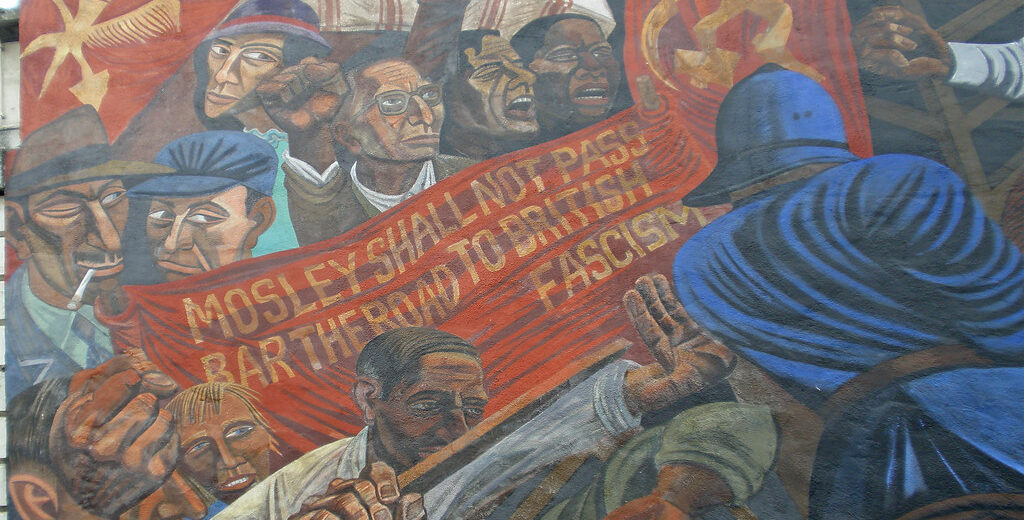
On a damp October day in 1936, a London street became much more than a street. Cable Street, tucked into the East End, was transformed into a political battleground where local residents, anti-fascist activists, police, and Oswald Mosley’s Blackshirt marchers collided in a confrontation that still echoes through British public life. The Battle of Cable Street has often been remembered as a spontaneous act of defiance, and it was that. But it was also something else: a turning point in the way the British state thought about public order, political extremism, and the management of dissent.
What happened on Cable Street did not simply reveal the passions of an anxious decade. It helped shape the modern relationship between protest and policing in Britain. The clash exposed the limits of old assumptions about neutral crowd control, highlighted the political danger of policing public space too rigidly, and contributed to a legal response in the form of the Public Order Act 1936. If modern Britain expects demonstrations to be monitored, contained, negotiated, and often rerouted rather than confronted as outright insurrection, then part of that history runs through the narrow roads of the East End.
The East End before the confrontation
To understand Cable Street, it helps to begin with the East End itself, a district long associated with overcrowding, poverty, labour radicalism, and immigrant life. By the 1930s, the area had become home to many Jewish families whose roots lay in migration from Eastern Europe, as well as Irish communities and a strong culture of trade unionism and socialist politics. This was not simply a neighbourhood in the geographic sense. It was a working-class political world, one shaped by memory, mutual aid, and constant awareness of exclusion.
That made the East End a tempting target for the British Union of Fascists, which under Oswald Mosley had increasingly adopted antisemitic rhetoric and public spectacle as a way of projecting strength. Mosley understood the theatre of the street. His marches were designed not just to show force but to provoke fear, draw publicity, and present fascism as an energetic alternative to parliamentary weakness. The proposed march through the East End in October 1936 was therefore deliberate: it was intended to move through a neighbourhood with a significant Jewish population and to demonstrate that fascists could claim public roads wherever they wished.
The response was equally deliberate, though it emerged from many sources rather than one organisation. Jewish anti-fascists, Irish dockworkers, socialists, communists, local residents, and sympathisers from across London prepared to resist the march. For them, this was not an abstract dispute over freedom of assembly. It was a direct threat to community safety and dignity. The famous slogan “They shall not pass” captured this sense of moral urgency. It also echoed a wider European language of anti-fascist resistance at a time when the violence of the continent was becoming ever harder to ignore.
The key point is that Cable Street was rooted in a local setting with global implications. The East End’s social geography mattered: its dense streets, working-class networks, and history of collective action created the conditions for defiance. The confrontation was therefore not an accident of crowd behaviour. It was the product of a neighbourhood that recognised a political threat and moved to stop it.
How the battle unfolded on 4 October 1936
The police presence that day was enormous, with officers deployed to ensure that Mosley’s march could proceed, even if the route had to be altered. The state’s immediate priority was to preserve order and avoid the appearance of surrendering the streets to a mob. Yet the very scale of the operation revealed the problem. Once a march is protected by the police from mass opposition, the police are no longer merely maintaining peace; they are actively enabling one political force’s movement through contested space.
As the Blackshirts approached the East End, crowds gathered in multiple locations. Protesters used whatever was available to block roads, confuse movement, and slow the march. There were improvised barricades, overturned vehicles, and clashes at several points. Women, men, children, and older residents were all present in the wider atmosphere of resistance, which gave the event a distinctly communal character. Rather than one decisive confrontation, the battle was a series of tense, shifting encounters as police tried to clear paths and demonstrators fought to close them again.
Popular memory often centres on Cable Street itself, but the wider action included nearby streets and junctions, particularly around Aldgate and the approach routes into the East End. This mattered because the confrontation was not merely symbolic. It was physical control of urban space, street by street. In that sense, Cable Street resembled other moments in British political history where the state tested its authority against collective resistance, whether in military crisis, industrial unrest, or constitutional strain. The Curragh Incident and the Whiskey Rebellion may belong to different contexts, but they share the same central question: what happens when authority meets mass opposition and finds that legitimacy is not always enough?
In the end, police commanders decided to divert Mosley’s march away from the East End rather than force a direct route through the densest resistance. For supporters of the anti-fascist blockade, this was a victory. For the police and the Home Office, it was evidence that public order could not be handled by brute insistence alone. The day demonstrated both the power of collective protest and the fragility of policing strategies that assumed compliance.
Policing, crowd control, and the problem of public order
Cable Street mattered so much to the history of policing because it exposed a practical and political dilemma: how should the state respond when the public itself rejects the legitimacy of a march, meeting, or procession? Before 1936, British policing had long relied on a mixture of local discretion, visible authority, and the expectation that officers could contain unrest with limited force. But the growth of mass politics, ideological extremism, and large-scale street demonstrations made that model increasingly strained.
What unfolded in the East End showed that crowd control was not just a matter of moving bodies. It required intelligence, planning, communication, route management, and a judgment about proportionality. The police were caught between two risks. If they used too much force, they could provoke outrage and deepen support for the protesters. If they used too little, they risked appearing unable to enforce the law. Cable Street demonstrated that a public march could become a test of state authority even when the state wanted only to preserve routine.
The event also revealed how policing can shape the meaning of protest. The decision to protect the fascist march was not politically neutral in its effects, even if it was justified in legal terms. For many residents, police lines seemed to stand between them and a threatening movement rather than between law and disorder. That perception has a long afterlife in British history, where arguments about “neutrality” often conceal the fact that policing always operates within a political context. The lesson was not that police should abandon order, but that order itself is contested.
This is why Cable Street is often treated as a foundational moment in modern protest policing. It helped push the idea that officers should not merely confront crowds but manage the conditions under which crowds form. The logic of containment, negotiation, and selective intervention would gradually become more familiar in Britain’s public order tradition. The state learned that preventing escalation was sometimes wiser than asserting authority in the most direct possible way. In that sense, Cable Street was not only a clash over fascism. It was a rehearsal for the modern politics of demonstration.
The Public Order Act 1936 and the state’s legal response
The political aftermath moved quickly. The most visible legislative result was the Public Order Act 1936, a response to the anxieties of the year: fascist paramilitarism, political violence, and the fear that the streets might become the arena in which democracy itself was weakened. The Act did not arise from Cable Street alone, but the battle gave urgency to reform. Parliament understood that unrestricted political marching by organised extremist groups could inflame communities and destabilise public confidence.
The Act introduced controls over political uniforms, which struck directly at the visual identity of Mosley’s Blackshirts. It also addressed public processions and the powers available to the authorities when demonstrations threatened disorder. These measures were not simply administrative. They represented a decision by the British state to draw firmer lines around political spectacle. In effect, the law acknowledged that public order could be endangered not just by riots but by movements that used disciplined display, intimidation, and propaganda as tools of pressure.
That legal response is significant because it shows how protest policing and legislation can evolve together. The state does not only react with officers on the street; it also reacts through statutes, regulations, and new definitions of what counts as acceptable public conduct. Cable Street became one of those moments when law followed experience. The state had witnessed how march routes could become flashpoints, and it responded by giving authorities more tools to shape the conduct of political groups before violence escalated.
Yet the Act also reflected a broader ambiguity at the heart of liberal democracy. Controls on processions could protect communities from intimidation, but they also set precedents for limiting expression. That tension is still familiar in Britain today whenever the police decide whether to permit, reroute, or restrict a protest. Cable Street did not create the tension, but it made it unavoidable. It forced the state to admit that public order is not self-maintaining. It has to be designed, and that design always carries political consequences.
Memory, myth, and the legacy of protest policing
In the decades since 1936, Cable Street has become more than a local victory over fascism. It has turned into a symbol of popular anti-fascism, immigrant self-defence, and the idea that communities can claim moral ownership of the streets. Murals, commemorations, and anniversary events have kept the memory alive, while historians have continued to debate exactly how spontaneous, organised, or symbolic the resistance was. That debate is useful because it reminds us that political memory is never neutral. It selects, simplifies, and gives shape to past conflict in ways that serve present concerns.
For modern protest policing, the battle’s legacy lies in its lessons about escalation and legitimacy. British policing would go on to develop more sophisticated approaches to demonstrations, including route planning, liaison with organisers, and a stronger emphasis on keeping opposing groups apart. Those methods did not emerge overnight, and they are not without controversy, but Cable Street helped demonstrate why they were needed. The old model of simply holding the line was no longer enough in an age of mass politics and ideological confrontation.
The deeper significance of Cable Street is that it shows how protest policing is made in moments of crisis. Police methods, laws, and public expectations are often forged when authorities confront events that reveal the limits of existing practice. Just as other political crises have reshaped state authority in different settings, the East End clash changed how Britain thought about public space, extremist mobilisation, and the management of dissent. In that sense, Cable Street belongs not only to anti-fascist history but to the history of the modern state itself.
What remains compelling about the story is its combination of courage and consequence. Ordinary people stood in the way of a movement they believed threatened their community, and they helped force a rethinking of public order. At the same time, the state learned that policing is at its strongest when it understands the politics of the crowd rather than merely its size. The streets of the East End became a classroom for modern Britain. The lesson was painful, contested, and incomplete, but it endures: when democracy is tested in public, the way authority responds can shape the future long after the crowd has gone home.
Research and further reading
For readers who want to verify details or continue researching this subject, these external reference collections provide useful starting points: