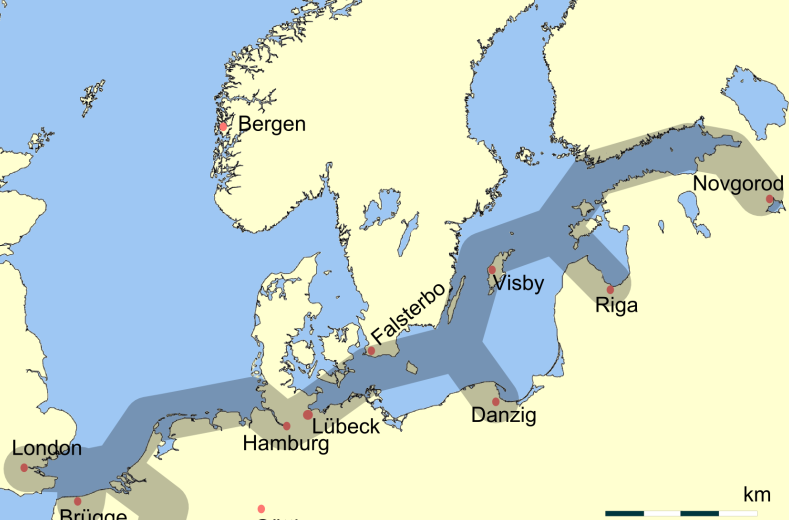
For centuries, northern Europe’s most powerful trading network had no king, no capital, no permanent parliament, and no army that it alone commanded. Yet merchants identified with the Hanseatic League could negotiate privileges with princes, impose blockades, protect convoys, and help decide which towns flourished. The Hanseatic League was neither a country nor a modern company. It was a changing association of merchants and towns whose influence rested on access to markets, shipping expertise, credit, and the ability to act together when trade was threatened.
That is why the familiar picture of a neat federation of “Hanseatic cities” is too simple. The league evolved over centuries, included communities in very unequal ways, and never had a fixed membership list that settled every dispute. Its history is nonetheless one of the clearest examples of medieval commercial cooperation. It connected the North Sea and Baltic worlds, carried bulk goods and luxury products across immense distances, and left a durable imprint on cities from London to Novgorod.
What “Hanse” meant before there was a league
The word Hanse originally referred to a group, company, or convoy. It did not initially name a pan-European institution. In the twelfth and thirteenth centuries, merchants from north German towns increasingly travelled, bargained, and sought protection together. Their shared interests were practical: foreign rulers could tax them, local competitors could exclude them, pirates could seize cargo, and a merchant alone had little leverage in a distant port.
Lübeck became central to this development. Founded in the mid-twelfth century near the route between the North Sea and the Baltic, it offered a remarkably efficient connection between the two maritime worlds. German-speaking merchants were already active in Gotland and elsewhere in the Baltic, but Lübeck’s rise gave trade a powerful urban base. From there, merchants and towns developed partnerships that eventually became known collectively as the Hanseatic League.
There was no single founding date. Older accounts sometimes treat 1241, when Lübeck and Hamburg made an agreement concerning routes and protection, as the league’s birth certificate. It was important, but it did not instantly create a finished organization. The Hansa emerged from many agreements, privileges, conflicts, and habits of cooperation. Its identity became clearer gradually, especially as towns discovered that their individual trading rights could be defended more effectively through collective pressure.
This gradual origin matters. The Hansa was not designed from a constitutional blueprint. It was built by merchants who needed secure passage, reliable weights and measures, warehouses, legal support, and access to foreign markets. Its unusual flexibility was a strength, but it also meant that unity could never be taken for granted.
A trading world shaped by sea, river, and season
The Hansa’s commercial geography was immense. Baltic routes connected ports in present-day Germany, Poland, Estonia, Latvia, Sweden, Denmark, and Finland. North Sea routes led to England, the Low Countries, Norway, and beyond. Rivers carried goods inland, while overland transport linked ports to mining districts, grain regions, and manufacturing towns. Water made bulk trade possible on a scale that roads rarely could match.
Goods moved in both directions. Grain, timber, tar, pitch, wax, furs, fish, iron, copper, and amber travelled westward or southward from the Baltic and northern regions. Cloth, salt, wine, metal goods, and finished products moved north and east. Salt was particularly important because it preserved herring and other fish; English wool and Flemish cloth likewise connected Hanseatic merchants to high-value markets. The league did not create every one of these trades, but it helped organize and protect many of them.
Shipping was dangerous and seasonal. A merchant had to consider storms, ice, shipwreck, piracy, war, customs dues, and the possibility that a foreign ruler would revoke a privilege. Cargoes were divided among investors; merchants used agents, partnerships, letters, seals, and account books to manage risk. The merchant’s world was therefore not simply adventurous. It was legal, documentary, and intensely dependent on trust.
The old image of a medieval economy made up of isolated local markets cannot explain this system. Hanseatic trade connected distant producers and consumers long before the industrial age. But it was not “globalization” in the modern sense. Communication was slow, information incomplete, and political boundaries could abruptly close a route. The network succeeded because its participants learned to manage those limitations together.
Kontors: the league’s foreign trading stations
The Hansa is often best understood through its four major kontors, or foreign trading communities: London, Bruges, Bergen, and Novgorod. Each operated under local conditions and privileges, and none was a colony in the modern sense. They were enclosed or organized places where Hanseatic merchants could live, store goods, worship, settle disputes, and bargain collectively.
In London, the Steelyard stood on the Thames and gave merchants from German towns a valuable base in the English wool and cloth trade. Its privileges provoked resentment from English merchants, who complained that foreign traders enjoyed advantages denied to locals. Such friction reveals a basic fact about the Hansa: its prosperity depended on negotiated exemptions, and those exemptions were always politically vulnerable.
Bruges in Flanders was a great international market where Hanseatic merchants met Italian, English, Iberian, and local traders. It was less a remote outpost than a crossroads. Yet the Hansa’s relationship with Bruges could become strained when urban unrest, access problems, or disputes over privileges disrupted business. Merchants sometimes relocated temporarily to pressure the city into concessions.
Bergen, in Norway, was crucial to the stockfish trade. The German merchants associated with the Bryggen district acquired a distinctive presence in a city dependent on imports and exports. Novgorod, far to the east, opened access to furs, wax, and other goods from the Rus’ lands. Its Peterhof compound was tightly regulated, reflecting both opportunity and the suspicion with which foreign commercial enclaves could be viewed.
These kontors were not identical branches of a headquarters. Their rules, languages, local allies, and trading goods differed. Together, however, they gave the Hansa a network of institutional footholds in markets where individual merchants would have been much weaker.
How towns cooperated without becoming one state
At its height, the Hansa included or associated with many towns, but the exact number depends on the period and on what counts as membership. Lübeck played a leading role, especially in diplomacy and coordination, yet it could not simply command other cities. Major towns protected their own interests, and smaller communities could participate unevenly. The league was a coalition, not a centralized government.
Delegates met at Hansetage, assemblies at which towns discussed trade disputes, privileges, embargoes, diplomacy, and discipline. Decisions depended on negotiation and consent. The league could declare a boycott or demand that a town comply with collective policy, but enforcement relied on the willingness of members to act. It had no permanent tax base able to compel obedience across all territories.
This decentralized structure created a paradox. It made the Hansa adaptable, because local merchants understood their own markets and could respond quickly. But it also made unified action difficult. A town that benefited from a particular relationship might resist a blockade desired by others. Inland cities and seaports did not always share priorities. Political rulers could exploit these divisions by offering privileges to some merchants while excluding others.
Modern language can obscure this. The Hansa was not an early European Union, a medieval corporation, or a nation-state in waiting. Those comparisons may be useful only if their limits are clear. It was a durable association organized around commercial privilege and mutual protection, operating through meetings, correspondence, urban governments, and merchant communities rather than a sovereign center.
War, blockades, and bargaining power
Commerce did not make the Hanseatic world peaceful. The league used economic pressure and, at times, military force to defend its interests. Its conflict with Denmark in the fourteenth century is the best-known example. Danish royal power could threaten routes through the Øresund and the herring markets of Scania, both vital to Baltic trade. Hanseatic towns responded by cooperating with allies and fielding naval power.
The Treaty of Stralsund in 1370 followed this conflict and is often described as the high point of Hanseatic influence. It secured major privileges and influence in the Scania herring trade. But it did not make the league sovereign over Denmark or turn it into an empire. The agreement resulted from a particular balance of military, financial, and political forces; it should not be mistaken for permanent control of the Baltic.
Boycotts were another weapon. If a ruler or a foreign city restricted merchants’ rights, Hanseatic towns could suspend trade, move a kontor, or deny access to their own markets. Such measures were costly for everyone involved, which gave them leverage. They also required solidarity, and solidarity was frequently fragile. A merchant who could profit by ignoring a boycott had a powerful reason to do so.
The Hansa’s armed actions expose the limits of the myth that trade alone creates power. Credit, ships, and commercial expertise mattered, but privileges survived because towns could sometimes coordinate coercion. Conversely, the costs of war could weaken the very commerce the league sought to protect. Its leaders had to balance force with negotiation continually.
People behind the merchandise
Hanseatic history is not only a story of city councils and wealthy merchants. Sailors loaded ships in dangerous ports; clerks copied contracts; warehouse workers handled barrels and bales; craftspeople made goods for export; and farmers, fishers, miners, and forest workers supplied the raw materials that moved through the network. Many of these people appear only indirectly in surviving documents, which were usually produced by institutions and elites.
Women also participated in urban economies, although their roles varied by place, status, and marital position. Widows could continue businesses, manage property, and sometimes appear in legal records; women worked in households, crafts, retail, brewing, and credit networks. It would be wrong to imagine the Hansa as a world of male merchants alone, but equally wrong to project modern equality onto it. Formal long-distance merchant institutions were predominantly male and embedded in patriarchal urban law.
The network’s prosperity could have harsh consequences. Trading privileges protected outsiders at the expense of local competitors. Demand for grain, timber, fish, and furs linked regions with unequal bargaining power. In some towns, foreign merchant communities acquired autonomy that provoked resentment. The Hansa was not a humanitarian project; it was a mechanism for securing advantage in competitive markets.
At the same time, its ordinary working life generated skills and connections that transformed northern cities. Shipbuilding, accounting, language learning, legal practice, and craft production all developed within a commercial environment that demanded reliability over long distances. The league’s legacy therefore belongs to social history as much as to maps of trade routes.
Why the Hansa declined
There was no single moment when the Hanseatic League “collapsed.” Its influence eroded unevenly from the late fifteenth century onward. New political powers strengthened their control over trade, while Dutch and English merchants expanded their own shipping and commercial reach. Some old routes mattered less; some products and ports lost importance; and competition grew in markets the Hansa had once dominated.
Internal division was equally significant. The league had always depended on cooperation among towns with different interests. As political conditions changed, maintaining common embargoes or diplomatic positions became harder. Lübeck retained prestige, but it could not force every city to bear the costs of collective policy. The flexible structure that had helped the Hansa grow became a weakness when competitors were supported by increasingly capable states.
Changes at the kontors illustrate this process. Novgorod’s Peterhof was closed after Muscovy took control in 1494, though contact and trade did not simply disappear overnight. Bruges declined as a commercial center for northern merchants, while Antwerp’s rise shifted the geography of exchange. London’s Steelyard lost privileges under Elizabeth I in the late sixteenth century. Bergen continued longer, but its special position also changed.
The old explanation that the league died because “new ocean routes replaced the Baltic” is incomplete. Atlantic expansion mattered, but so did state formation, military competition, urban politics, and changing commercial institutions. The Hansa did not vanish instantly; its final assembly met in 1669. By then, however, its collective capacity no longer matched the world that had made it powerful.
Reading the Hansa without nostalgia
Modern visitors to restored quays and brick warehouses can easily inherit a flattering image: a northern European community joined by commerce, practical intelligence, and picturesque civic independence. The surviving buildings are real evidence of prosperity, but they can also conceal conflict. Warehouses concentrated wealth; market privileges excluded rivals; and cities that appeared autonomous were still entangled with princes, bishops, kings, and regional elites. The Hansa’s visual legacy should therefore be read alongside its charters, lawsuits, and coercive policies.
Its archives also remind us that “merchant” was not one uniform identity. A Lübeck councilman, a young factor in Bruges, a skipper carrying grain, and a local producer supplying tar did not have equal resources or influence. Nor did all towns gain in the same way from the network. The league gave participants a language of mutual interest, but that language could disguise fierce competition within and between cities.
These distinctions make the Hansa more, not less, significant. It was a practical experiment in organizing trade across jurisdictions before national governments supplied predictable commercial law. Its members built institutions for information, dispute settlement, collective discipline, and risk sharing, then continually tested them against changing political realities. The result was neither a golden age of free commerce nor a failed state. It was a medieval network whose achievements and contradictions help explain why northern European towns became such important actors in the centuries that followed.
Seen this way, the Hansa’s long afterlife is understandable. It offers a historical case of cooperation without full political unity—a case that resists easy celebration precisely because it was built on privilege as well as partnership. Its history remains valuable when treated not as a ready-made model, but as evidence of how trade, power, and urban society shaped one another.
Myths, evidence, and the Hansa’s real legacy
Several popular claims need correction. The Hansa was not a unified empire controlling northern Europe. It did not possess a fixed list of member cities across its whole history. It was not the first multinational trading network, nor was it a medieval version of free trade without rules. Its influence rested precisely on privileges, regulations, exclusive communities, and political bargaining.
The evidence for its history is rich but uneven: town records, account books, correspondence, treaties, archaeological finds, merchant regulations, and the surviving fabric of port cities. These sources make some things clear—such as the importance of Lübeck, the kontors, and the Baltic-North Sea connection—while leaving other experiences harder to recover. The daily voices of sailors, laborers, and women are often less visible than those of councils and merchants.
Its urban legacy is still tangible in the brick Gothic architecture and waterfronts of northern Europe. Cities associated with the Hansa developed institutions, warehouses, and commercial cultures that outlasted the league itself. The network also belongs to the larger story of medieval Europe: a world in which towns could exercise remarkable collective power even while kings, princes, and bishops remained indispensable.
The Hansa matters because it forces us to rethink what power can look like. It shows that an institution need not be a state to shape politics, law, and everyday life across borders. Its merchants made northern seas into corridors of exchange, but they did so through cooperation that was always contested, unequal, and vulnerable. That is a more complicated story than a league of prosperous cities—and a far more useful one.