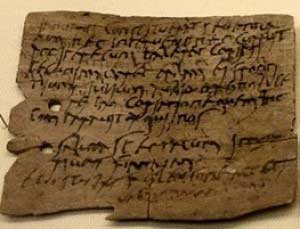
Most surviving Roman texts were meant to last. Laws were carved in stone, emperors’ names struck on coins, and literary works recopied by generations of scribes. The Vindolanda tablets are different. They preserve the disposable writing of a frontier community: duty lists, requests for beer, accounts, invitations, complaints, military reports, and letters between people who never expected their words to survive two thousand years.
Found in waterlogged deposits at Vindolanda in northern England, these thin wooden documents have transformed the study of Roman Britain. They do not offer an unfiltered transcript of every inhabitant’s life, and they are not the first writing ever produced in Britain. Their authors belonged largely to a literate military and administrative environment. Even so, the tablets bring soldiers, officers, merchants, enslaved workers, and elite women into view with an immediacy that monumental inscriptions rarely provide.
Vindolanda before Hadrian’s Wall
Vindolanda lies near the later line of Hadrian’s Wall in modern Northumberland, but the settlement is older than the wall. Roman forces established the first timber fort there around AD 85, during the consolidation of imperial power in northern Britain. The site stood beside the Stanegate, an important east-west road linking military positions across the region.
The early fort was repeatedly demolished and rebuilt. Archaeologists have identified successive timber phases beneath the later stone remains. These layers matter because many tablets come from deposits associated with forts occupied between the late first and early second centuries AD, especially roughly AD 85 to 130. Hadrian’s Wall construction began in AD 122, so a large part of the archive documents frontier life before or during the wall’s creation rather than life behind a long-established barrier.
Auxiliary units stationed at Vindolanda included the First Cohort of Tungrians and the Ninth Cohort of Batavians, troops recruited from regions that are now parts of Belgium, the Netherlands, and Germany. Officers and soldiers served Rome far from their communities of origin. Their networks extended to other forts, supply centers, and civilian markets across Britain.
Vindolanda was never only a set of barracks. Officers’ households, servants, craftspeople, traders, and families formed a community around military occupation. The tablets illuminate that mixed world, though unevenly. Commanders and administrators generated more writing than poor laborers, while some people appear only as names in accounts or orders.
The discovery that looked like wood shavings
The first major group of writing tablets was recognized during excavations led by Robin Birley in 1973. Archaeologists working in deeply waterlogged levels found thin pieces of wood that could easily have been mistaken for packing material or shavings. When the surfaces were examined, traces of ink and writing became visible.
The tablets survived because of unusual burial conditions. Waterlogged, oxygen-poor soil slowed the microorganisms that normally destroy wood and other organic material. Vindolanda has consequently preserved not only writing tablets but also leather shoes, textiles, wooden objects, and plant remains that would usually vanish from an archaeological site.
Recovery is only the beginning. The tablets can be fragile, dark, warped, and difficult to read. Conservation must prevent the wood from drying and breaking. Infrared photography greatly improves the contrast between carbon-based ink and the wooden surface, allowing letters invisible to the naked eye to emerge. Specialists then identify handwriting, expand abbreviations, reconstruct damaged passages, and compare names and phrases across the archive.
More tablets and fragments have continued to appear in later excavations. The total is now commonly described as around 1,700, although counts can vary depending on whether fragments or joined pieces are treated separately. Not every tablet preserves a readable text, and many documents are incomplete. The archive’s power comes from accumulation: hundreds of partial messages combine to reveal routines that no single spectacular artifact could show.
How Roman ink tablets were made and used
Many Vindolanda texts were written in ink on wafer-thin sheets of wood, often called leaf tablets. The wood was cut and smoothed, then folded so that the written surfaces could face inward. A sender could address the outside and tie or seal the folded document. These were light, inexpensive materials suited to everyday correspondence and temporary records.
This format differed from the wax tablet familiar from Roman art and archaeology. A wax tablet had a recessed surface filled with wax and was written on with a stylus. Wax could be smoothed and reused. Stylus tablets have also been found at Vindolanda, but their texts are harder to recover because the wax rarely survives; scholars must interpret scratches accidentally made through the wax into the wood beneath.
The ink tablets were written with a pen, probably a cut reed in many cases, using carbon-based ink. Handwriting was cursive and often rapid. Letters connected, abbreviations proliferated, and individual hands varied. Reading them requires expertise in Roman cursive rather than simply knowing printed Latin.
The physical documents also reveal writing practices. Some letters were dictated to scribes, then finished with a short greeting in the sender’s own hand. Drafts, accounts, and lists could be discarded once their immediate purpose ended. Their survival is therefore accidental. Vindolanda preserves an ancient waste stream, not a library carefully selected for posterity.
Military paperwork behind the Roman army
Popular images of Rome’s frontier emphasize forts, armor, and combat. The tablets show that military power also depended on paperwork. Commanders needed to know how many men were present, where detached soldiers had gone, which duties they performed, what supplies had arrived, and which requests required approval.
One famous strength report lists hundreds of men in the First Cohort of Tungrians while noting that a remarkably large number were absent on assignments elsewhere. Soldiers had been sent to locations and duties across the province. The document corrects the idea that every cohort sat fully assembled inside its home fort waiting for attack. Roman units were distributed administrative and labor forces as well as battlefield formations.
Other texts concern guard duty, leave, transport animals, weapons, clothing, and food. Reports identify sick or wounded personnel. Daily records connect individual names to tasks. The frontier appears not as a simple line between Rome and hostile outsiders, but as a managed zone held together by roads, orders, supplies, and constant movement.
The paperwork also reveals hierarchy. A prefect such as Flavius Cerialis received petitions and correspondence, while lower-ranking men reported needs through chains of authority. Formulaic language expressed respect, obligation, and patronage. Even requests for ordinary goods were shaped by rank and by the relationship between writer and recipient.
Beer, socks, and the practical frontier
The archive is famous for mundane details because those details humanize the Roman army. A request associated with the decurion Masclus asks the prefect for instructions and mentions that the men have no beer. Other letters and accounts refer to grain, meat, wine, vegetables, clothing, boots, and payments. The army could not function without an enormous supply system.
Clothing requests are often simplified into jokes about Romans being surprised by British weather. Socks and undergarments do appear in the correspondence, and footwear was a constant necessity. But the evidence does not prove that every item was an emergency adaptation unknown elsewhere in the empire. It shows that people sent garments and shoes through personal and commercial networks to individuals on the frontier.
Food likewise crossed the boundary between official ration and private consumption. Officers entertained guests and obtained delicacies; soldiers required staples; merchants pursued debts and deliveries. A letter from the businessman Octavius discusses the transport and financing of goods in language that conveys frustration as well as commercial calculation. His problems were not exotic: cash flow, unreliable partners, and delayed transport troubled ancient business too.
The tablets make logistics visible at several scales. Rome supplied units institutionally, local producers and traders served the military market, and friends or relatives sent personal packages. Frontier life depended on all three. The army’s famous roads and forts were only the durable skeleton of a system animated by thousands of perishable transactions.
Claudia Severa’s birthday invitation
The best-known Vindolanda tablet is an invitation from Claudia Severa to Sulpicia Lepidina, wife of the prefect Flavius Cerialis. Severa invites Lepidina to a birthday celebration and expresses the hope that her friend will attend. The main body was probably written by a scribe, but the closing greeting appears in another hand widely identified as Severa’s own.
It is often called the earliest surviving handwriting by a woman in Latin. That description should be used carefully. It means the earliest known and securely identified example currently surviving, not the first time a woman wrote Latin. Countless earlier writings have disappeared, and identification of an ancient hand depends on context and scholarly interpretation.
The invitation is important beyond its record-setting label. It proves that elite women lived within the social world of the northern military frontier and maintained relationships across distance. Their visits required transport, escorts, household organization, and communication. Officers’ families were not irrelevant passengers beside an exclusively male institution.
At the same time, Claudia Severa and Sulpicia Lepidina were privileged women. Their correspondence cannot represent every woman at Vindolanda. Poor women, local Britons, servants, and enslaved people are much less likely to speak in surviving letters under their own names. The tablet opens a rare window, but the view is from an elite household.
Literacy: widespread, but not universal
The tablets expanded historians’ understanding of literacy in the Roman army. Writing was used for more than formal inscriptions or literary culture. Lists, labels, accounts, reports, and quick messages circulated through daily administration. Numerous hands suggest that literacy was distributed among officers, clerks, soldiers, and civilians more broadly than a tiny scholarly elite.
That does not mean everyone could read and write fluently. Roman literacy existed in degrees. A person might recognize names and numbers, keep simple accounts, read routine orders, or sign a dictated letter without composing polished prose. Professional scribes remained important, especially for formal communication.
Language also reflected the army’s diversity. Latin served administration even when soldiers originated in regions where other languages were spoken. Writers varied in spelling, grammar, and style. Their Latin is valuable precisely because it was used rather than curated: it captures language in working conditions.
The archive therefore resists two extremes. Roman Britain was not an illiterate society in which only governors understood writing, but neither was it comparable to a modern population with universal schooling. Vindolanda shows a documentary culture concentrated around institutions that rewarded practical literacy.
What the tablets reveal about status and inequality
Warm invitations and requests for socks can make Vindolanda seem comfortably familiar. Yet the settlement belonged to an empire maintained by conquest and hierarchy. Officers lived differently from ordinary soldiers. Soldiers held power over civilians, while enslaved and dependent people performed work that appears only indirectly in the documents.
Terms translated as “slave,” “boy,” or “servant” require contextual care, but unfree labor was unquestionably part of Roman society. Household correspondence presupposes people who carried messages, prepared meals, cared for clothing, maintained buildings, and accompanied elite families. Their labor made the literate world of the tablets possible even when their own voices were not preserved.
Local Britons are similarly difficult to identify. Names and goods reveal contact across communities, but the archive was created largely within the Roman military system. It cannot tell us how every nearby population understood occupation. Trade, employment, intermarriage, recruitment, coercion, and resistance could coexist on the frontier.
This imbalance is not a reason to dismiss the archive. It is a reason to read documents against their silences. A supply list records the priorities of the person keeping the account; a command letter reflects the authority of its writer; an invitation shows elite sociability. Archaeology adds housing, food remains, shoes, tools, and refuse that can recover lives less visible in ink.
How the tablets changed Roman history
Before the discoveries, historians already knew Vindolanda from archaeology and knew the Roman army from inscriptions, papyri, legal texts, and ancient authors. The tablets did not overturn everything. They changed scale and texture. Administrative systems that had seemed abstract appeared in individual transactions, while named people could be followed through several documents.
The archive also demonstrated the value of frontier sites for studying connectivity. Vindolanda was geographically remote from Rome, yet its residents participated in imperial systems of rank, language, supply, and patronage. Troops recruited on the continent served in Britain; letters moved between forts; imported goods reached officers’ tables; local markets responded to military demand.
Comparison with durable monuments is especially revealing. A carved Roman grave marker presents an identity selected for commemoration, often emphasizing family, status, origin, or service. A Vindolanda note might record the same person asking for leave or disputing a delivery. Neither source is more “true”; they answer different questions about how Romans represented themselves and managed daily life.
The tablets have also influenced preservation practice. Archaeologists now recognize that waterlogged deposits can hold archives invisible under ordinary excavation conditions. Conservation, multispectral imaging, and digital publication allow fragile objects to be studied without relying solely on physical display.
What remains uncertain
Many readings are provisional. Wood can be damaged, ink can fade, and letters in cursive script can resemble one another. Editors indicate missing passages and uncertain expansions rather than pretending that every sentence is complete. New photographs or parallel texts can lead to revised interpretations.
Dating also depends on archaeological context, handwriting, named officials, and the sequence of forts. A tablet can often be placed within a narrow occupational phase, but not always on an exact day or year. Personal identification is strongest when names, ranks, and relationships recur; a common name alone may not prove two references concern the same person.
Popular retellings frequently remove these qualifications. The birthday invitation becomes “the first letter written by a woman,” socks become proof that Romans had never anticipated cold, and the archive becomes the private mail of legionaries building Hadrian’s Wall. Each claim contains a fragment of truth but distorts the evidence. Most troops at Vindolanda were auxiliaries, many key tablets predate the wall, and survival does not equal historical first use.
Good interpretation preserves the excitement while stating the limits. The tablets are extraordinary not because they eliminate uncertainty, but because they allow unusually precise questions about an ancient community.
Conclusion: Rome in ordinary handwriting
The Vindolanda tablets survived through a rare combination of disposal, waterlogging, excavation, conservation, and patient scholarship. Their writers did not compose for history. They wanted beer delivered, accounts settled, orders followed, friends welcomed, and superiors persuaded.
That ordinariness is their greatest historical value. The Roman frontier was not maintained by walls alone. It depended on clerks, messengers, merchants, households, supply animals, clothing, favors, and records. Military authority entered daily life through paperwork as surely as through weapons.
The archive must still be read critically. It privileges literate institutions and higher-status households, preserves only accidental fragments, and leaves many local and unfree people nearly silent. Claims about “firsts” and famous quotations require caution.
Even with those limits, few discoveries narrow the distance between ancient people and modern readers so effectively. At Vindolanda, Rome does not speak only in imperial decrees or carved epitaphs. It speaks in hurried handwriting, unfinished business, social obligation, and the small practical anxieties of another day on the frontier.