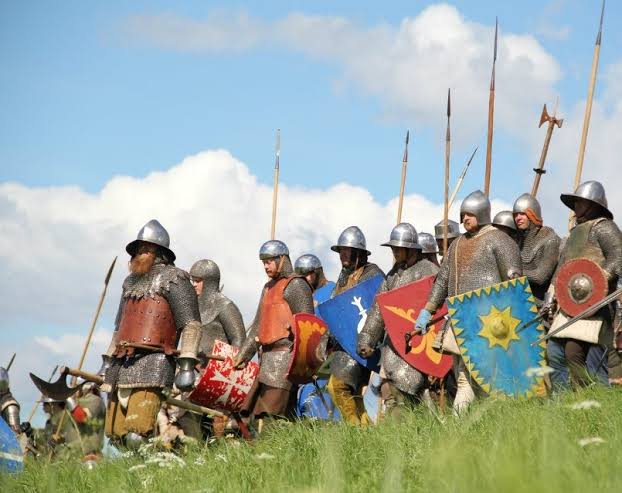
Outside the walls of Visby, archaeologists uncovered one of medieval Europe’s most disturbing archives. The dead had been buried in mass graves after a battle in July 1361. Many still wore mail, coifs, and coats reinforced with iron plates. Their bones carried cuts, punctures, and crushing injuries that recorded the violence more directly than any chronicle.
The Battle of Visby ended King Valdemar IV of Denmark’s invasion of Gotland and exposed the unequal relationship between the wealthy walled town and the island’s rural population. It is often retold as a simple clash between professional Danish soldiers and poorly armed peasants, followed by a ransom paid in three barrels of treasure. Archaeology supports the scale and brutality of the defeat, but it also complicates those familiar images. The defenders had more equipment and organization than the word “peasants” suggests, while the famous barrels belong largely to later legend and art.
Gotland and Visby before 1361
Gotland occupies a strategic position in the Baltic Sea. During the Middle Ages, its farmers, sailors, and merchants participated in trade linking Scandinavia, the German coast, the eastern Baltic, and the lands of Rus’. Visby developed into a major port whose stone churches, warehouses, and defensive wall reflected extraordinary wealth.
The town was closely connected to the commercial world later identified with the Hanseatic League, but Gotland was not politically or socially uniform. Visby’s urban merchants and the island’s rural communities possessed different institutions and interests. Conflict between town and countryside had already erupted earlier in the fourteenth century. The wall protected Visby not only from foreign armies but also marked a boundary between urban privilege and the surrounding island.
Gotland was associated with the Swedish crown, yet royal authority in the Baltic could be contested. Denmark’s King Valdemar IV, known as Valdemar Atterdag, spent much of his reign rebuilding Danish power after a period of fragmentation. By the early 1360s, expanding influence across the Baltic offered strategic advantage, revenue, and prestige.
Visby’s wealth made the invasion appear to later storytellers as an obvious act of plunder. Economic motives mattered, but the campaign also belonged to regional state-building and competition over maritime routes. Reducing it to one king’s greed turns Baltic politics into a morality tale and obscures why control of Gotland mattered.
Valdemar’s invasion of Gotland
A Danish force landed on Gotland in July 1361. Exact army sizes are uncertain because medieval narrative sources do not provide modern muster records. Valdemar’s troops probably included experienced mounted and foot soldiers, men accustomed to coordinated warfare and equipped through aristocratic, royal, and mercenary networks.
The islanders attempted to resist before the invaders reached Visby. Fighting took place near Mästerby, west of the town, where archaeological investigation has recovered weapon fragments and other evidence of battle. The engagement is sometimes overshadowed by the final massacre outside Visby, but it shows that the campaign involved several confrontations rather than one isolated event.
On July 27, the Danish army met a Gotlandic force near Visby’s walls. The defenders are conventionally described as a rural levy. Many were probably farmers and local militia rather than full-time warriors, but that distinction should not be confused with complete military ignorance. Medieval communities could train, organize by district, own weapons, and mobilize for defense without maintaining professional standing armies.
The decisive advantages likely lay in experience, command, tactical cohesion, and the quality or distribution of equipment. The Danish force defeated the islanders with catastrophic losses. The town itself did not become the scene of prolonged street fighting; after the field army’s destruction, Visby submitted to Valdemar.
Why Visby’s gates remained closed
One of the battle’s most powerful images is that rural defenders fought and died beneath Visby’s wall while the townspeople watched from safety. The city’s gates were apparently closed during the fighting. This has encouraged accusations that wealthy merchants abandoned the islanders who were defending them.
The reality is difficult to reconstruct. Visby’s authorities had to protect inhabitants, stores, and defenses against an army that might exploit an open gate. A defeated force rushing into a city could allow pursuers to enter with it. Medieval towns routinely controlled gates during emergencies for reasons that were strategic rather than purely selfish.
Yet the division between town and countryside was genuine. Visby had its own political and commercial identity, and earlier conflict had hardened distrust. The field army may have been primarily rural, while the urban community calculated that surrender offered a better chance of preserving lives, property, and privileges than joining a lost battle.
It is therefore too simple either to condemn the townspeople as cowards or excuse every decision as military necessity. The closed wall reveals fragmented authority on Gotland. The defenders outside and the negotiators inside were not one unified state acting under a single command. Their different risks shaped different choices.
The mass graves at Korsbetningen
The battlefield dead were buried near the Solberga convent, in an area later known as Korsbetningen. Human remains were encountered in the early twentieth century, and systematic excavations followed, especially under archaeologist Bengt Thordeman. Several mass graves eventually produced the remains of at least around 1,185 individuals, though the total number killed in the battle was larger.
Medieval written estimates and later calculations often place Gotlandic losses near 1,800, with substantially fewer Danish dead. These figures should be treated as approximations. The excavated graves do not contain every casualty, skeletal remains can be incomplete, and contemporary chroniclers were not conducting forensic censuses.
Burial had to proceed quickly in summer conditions. Bodies were placed densely in pits, sometimes overlapping in rows. Many still carried armor and personal equipment. Normally valuable military gear would be removed from the dead, so its survival has generated debate. Rapid decomposition, the large number of bodies, damaged or outdated equipment, and urgent disposal probably all contributed. It is unsafe to choose one explanation as universal.
The graves are not simply a collection of objects. Their arrangement preserves the aftermath of collective violence: the labor of gathering corpses, the practical crisis of burial, and the loss suffered by island communities. Archaeology records both the battle and what survivors were forced to do once it ended.
Armor buried with the dead
Visby is famous for coats of plates, garments lined or covered internally with overlapping iron plates. These defenses were ancestors of later plate armor and offered substantial protection to the torso while remaining more flexible and affordable than a complete suit of shaped plates. Mail shirts, mail coifs, gauntlets, and other equipment also survived.
The finds are exceptionally important because armor in museums often survives as elite objects from later periods. At Visby, equipment remained associated with bodies from a single dated battle. Thordeman’s monumental study, Armour from the Battle of Wisby 1361, made the assemblage foundational for historians of medieval arms.
Not every defender was well protected. Armor quality and coverage varied, and many limbs remained exposed. Some equipment may have been old, repaired, inherited, or locally adapted. This variation warns against reconstructing the Gotlandic force as either a uniformly armored army or a crowd carrying farm tools.
Armor also did not make a fighter invulnerable. A coat of plates protected the torso better than the lower legs, face, and joints. Blows could break bones without cutting through metal. Once a person fell, attackers could strike exposed areas or deliver finishing blows. The skeletons make clear that protection changed the location and mechanism of injury rather than eliminating lethal risk.
What the bones reveal about medieval combat
The remains display cuts from edged weapons, penetrating injuries, and fractures caused by blunt force. Lower legs were frequently struck. A blow below a shield or armored torso could disable an opponent, leaving him vulnerable on the ground. Head injuries show that many victims then received further attacks.
Forensic interpretation must remain cautious. A mark on bone can often be classified by broad weapon type, but identifying the exact weapon is harder. Swords, axes, polearms, arrows, crossbow bolts, hammers, and clubs can produce overlapping trauma depending on angle, force, armor, and the victim’s movement.
The distribution of wounds nevertheless undermines romantic images of orderly single combat. Battles were crowded and confusing. Groups fought in formation, men fell against one another, and successful attackers exploited openings. Violence continued at very close range. Some wounds may represent blows delivered after a victim was already incapacitated.
The skeletons also include teenagers, mature adults, and older men. Earlier accounts used this age range to portray the force as boys and elderly farmers sacrificed against professionals. There were certainly very young and older defenders, but the burial population also included many men of typical fighting age. The evidence fits an emergency mobilization drawing broadly from rural communities rather than an army composed only of the helpless.
Were the defenders merely untrained peasants?
“Peasant army” is convenient shorthand, but it carries modern assumptions. Medieval farmers could own land, participate in assemblies, maintain weapons, serve in levies, and acquire combat experience. Gotland’s rural population was connected to Baltic trade and was not uniformly poor or isolated.
The armor from the graves proves that at least some defenders possessed serious military equipment. Organization at earlier engagements also indicates planned resistance. None of this means they matched Valdemar’s troops. Equipment is only one part of military effectiveness; leadership, discipline, cavalry, missile support, terrain, and experience matter greatly.
The Danish army’s victory may have resulted from its ability to coordinate specialized fighters and exploit the islanders’ weaknesses after previous clashes. The defenders had already suffered losses and may have been forced into an unfavorable position near the wall. The precise formation and sequence of the final battle remain debated because no eyewitness tactical account survives.
A balanced description therefore recognizes an unequal contest without turning the Gotlanders into a helpless mob. They were a locally mobilized force facing an army better prepared for sustained campaigning. Their defeat demonstrates the limits of militia defense against concentrated royal power, not the absence of courage or all military skill.
The ransom of Visby and the three barrels
After the battle, Visby surrendered. Valdemar imposed payments or taxation, and the city’s relationship to Danish rule changed. The basic fact that wealth was extracted is credible and consistent with medieval conquest. The familiar scene of three enormous barrels being filled with gold and silver is far less secure.
That image was immortalized by Carl Gustaf Hellqvist’s 1882 painting of Valdemar demanding Visby’s treasure. The work is dramatic historical art, not a contemporary record. Its theatrical costumes, fearful citizens, and overflowing vessels shaped popular memory long after the battle.
Later tradition also claimed that Valdemar threatened to burn the town unless the barrels were filled. Surviving medieval evidence does not confirm the scene in the form painted. Chronicles and documentary sources support surrender and financial exactions, but the exact ritual of three barrels belongs to legend.
The distinction matters because the legend narrows the aftermath to royal extortion. Conquest involved political submission, property, hostages or guarantees, legal privileges, and Gotland’s place in wider Baltic conflict. Visby was not simply robbed and erased. The town continued to exist and trade, though the invasion marked a severe disruption and a change in power.
How certain is the battle narrative?
The date, Danish victory, mass graves, and connection to Valdemar’s campaign are secure. Archaeology confirms large-scale fighting and supplies direct evidence about equipment and injuries. The Visby town wall, nearby battlefield landscape, and excavated graves anchor the event physically.
Other details remain uncertain. Army sizes, exact casualty totals, unit formations, and the sequence of tactical decisions cannot be reconstructed with precision. Written accounts were composed with political and moral purposes, sometimes after the event. Archaeology reveals where objects and bodies were deposited, but it does not automatically explain every decision.
Even scientific analysis involves interpretation. Age estimates from skeletons have ranges. Incomplete bodies complicate minimum-individual counts. Trauma may be unmistakably violent while the exact weapon remains uncertain. New methods can refine older conclusions without making the battlefield perfectly transparent.
The best history uses the different sources together. Chronicles supply names and political sequence; documents illuminate rule and taxation; landscape archaeology traces movement; armor shows material capacity; and bones record physical consequences. No single source deserves total control of the story.
Visby in the history of battlefield archaeology
The excavations were pioneering because they treated mass graves, armor, and trauma as one assemblage. Rather than collecting spectacular weapons alone, researchers studied equipment in relation to bodies and burial positions. This helped establish methods now central to conflict archaeology.
Visby also provides a valuable comparison with much earlier sites such as the Tollense Valley battlefield. Tollense preserves scattered Bronze Age remains in a river landscape, while Visby offers densely buried medieval casualties associated with a dated campaign and written sources. Each site shows how archaeology can reveal warfare that texts describe incompletely or not at all.
The comparison also highlights preservation bias. Most medieval battlefields did not leave mass graves filled with armor. Victors stripped bodies, soil destroyed organic material, graves were disturbed, or combatants were buried elsewhere. Visby is unusually informative because a chain of circumstances preserved evidence normally dispersed.
That exceptional survival can distort expectations. Visby should not be treated as a template for every medieval battle. Its value lies in showing one conflict at extraordinary resolution while encouraging better questions about battles whose remains are less visible.
Today the assemblage also poses an ethical responsibility. Human remains are evidence, but they were people rather than illustrations of weapon damage. Museum displays and scientific studies can illuminate age, health, injury, and equipment only when the dead are treated with dignity and uncertainty is made visible. Visby’s appeal should not rest on the spectacle of shattered bones. Its deeper value is the rare ability to connect political decisions and military systems with the bodily cost paid by individuals whose names were mostly lost.
This ethical perspective changes the questions historians ask. Instead of seeking only the most lethal weapon or dramatic wound, researchers can examine nutrition, previous illness, healed injuries, community composition, burial labor, and the unequal risks of defense. The battlefield then becomes part of social history as well as military history.
Conclusion: the battle beyond the legend
The Battle of Visby was fought on July 27, 1361, after Valdemar IV’s forces invaded Gotland and defeated resistance elsewhere on the island. A rural force confronted the Danish army outside Visby and suffered devastating losses. The city then surrendered, and Danish power was imposed.
Archaeology confirms the battle’s brutality. Mass graves held more than a thousand identified individuals, varied armor, and skeletons marked by concentrated violence. These remains show defenders who were unevenly equipped but not uniformly helpless, and combat that was collective, close, and unforgiving.
Some of the best-known details require restraint. Casualty totals are estimates. The reasons armor remained on so many bodies were probably multiple. The three barrels of treasure and the threat to burn Visby are memorable traditions, not securely documented scenes.
What survives outside Visby is more powerful than the legend. The graves preserve the collision of royal ambition, urban wealth, rural defense, and medieval military skill. They remind us that a battlefield is not only a place where strategy succeeds or fails. It is also a human landscape shaped by the bodies left behind and by the stories later generations choose to tell about them.