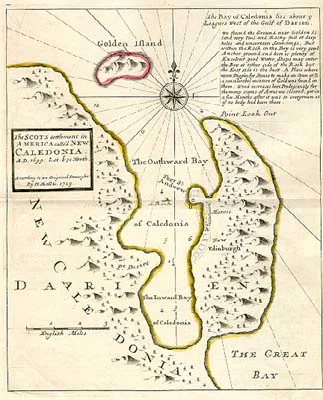
In November 1698, five Scottish ships reached a humid bay on the Caribbean coast of Panama. Their passengers believed they were about to transform Scotland into a global trading power. They named their settlement New Caledonia, raised Fort St Andrew, and imagined a commercial gateway joining the Atlantic and Pacific worlds. Within less than two years, the colony was gone. Disease, hunger, political isolation, Spanish resistance, and catastrophic planning had destroyed it.
The Darien Scheme has since become one of the most emotionally charged episodes in Scottish history. It is often told as a simple tragedy: a poor nation invested its fortune in a visionary colony, England betrayed it, and bankruptcy forced Scotland into the 1707 union. Each claim contains some truth, yet each conceals important complications. Darien was simultaneously a financial gamble, a colonial project, a geopolitical provocation, and a human disaster imposed on a region that was neither empty nor unclaimed.
Scotland’s crisis and colonial ambition in the 1690s
Darien emerged from a decade of severe anxiety. Scotland and England had shared a monarch since 1603, but remained separate kingdoms with distinct parliaments, laws, churches, and commercial interests. English trade legislation did not automatically treat Scottish merchants as English subjects. The Navigation Acts and English chartered companies restricted Scottish access to valuable imperial markets. Overseas expansion therefore appeared to many promoters as an escape from structural disadvantage.
The domestic setting made that promise especially attractive. The 1690s brought poor harvests and subsistence crisis to parts of Scotland, an ordeal remembered as the “seven ill years.” Mortality estimates remain debated because records are incomplete and conditions varied by region, but contemporary evidence establishes widespread hunger, disease, and disruption. European warfare also strained commerce. Scotland possessed ambitious merchants and skilled sailors, but lacked England’s fiscal capacity, navy, and established colonial network.
Colonization was not entirely new to Scots. Scottish people already participated in English, Dutch, Swedish, and other imperial enterprises as settlers, merchants, soldiers, and officials. Earlier Scottish ventures had targeted Nova Scotia and East New Jersey. Darien was not Scotland’s first colonial project. What made it exceptional was its scale and the intensity of public investment behind it. Supporters presented a chartered company as Scotland’s answer to powerful English and Dutch corporations, without possessing their deep credit, naval protection, or administrative experience.
The Company of Scotland and William Paterson
In 1695, the Scottish Parliament authorized the Company of Scotland Trading to Africa and the Indies. Its charter granted broad rights to trade, establish colonies, build forts, and make treaties in regions not already possessed by friendly European powers. The wording concealed a major danger: almost every strategically useful location was claimed by someone, whether or not European control on the ground was complete.
William Paterson, a Scottish merchant and financial projector who had helped establish the Bank of England in 1694, became Darien’s best-known advocate. He promoted a settlement on the Isthmus of Panama, where goods could cross overland between the Atlantic and Pacific rather than sail around Cape Horn. Later memory transformed him into a lone visionary. In fact, directors, merchants, politicians, and investors all shaped the project, and Paterson’s influence diminished after controversies inside the company. He joined the first expedition but did not command it.
Fundraising attempts in London, Hamburg, and Amsterdam faced determined opposition. English commercial interests feared competition, while King William III’s government did not want to antagonize Spain, an ally against France. English officials pressured foreign investors and warned English subjects away. Scots then supplied the capital themselves. Burghs, nobles, professionals, merchants, widows, and other investors subscribed substantial sums. Claims that Darien consumed “half of Scotland’s wealth” are too exact to trust, but the company undeniably absorbed a remarkable share of available liquid capital and turned commercial risk into a national cause.
What the Darien plan promised—and ignored
The central idea was an entrepôt on the Gulf of Darién. Ships from Europe and the Atlantic colonies would unload goods on one side of the isthmus; cargo would move overland into Pacific commerce. Promoters imagined a Scottish port becoming a “door of the seas,” shortening routes to Asian and American markets and earning profits from exchange, storage, and transport.
Calling Darien an early Panama Canal project can be misleading. The colonists could not cut a modern ship canal. Their plan depended on an overland route and a trading settlement, yet they had no reliable calculation of terrain, transport costs, local markets, or political conditions. The harbor looked attractive on maps, but dense forest, heavy rainfall, difficult routes, and tropical disease created formidable obstacles. The settlement would need regular food, customers, friendly ports, and military security; none had been guaranteed.
Most importantly, Darien was not vacant. Indigenous communities, especially the Guna, had their own territories, political interests, and relations with Europeans. Spain claimed the region as part of its American empire even though control was uneven. Scottish planners treated this contested frontier as an opportunity, but ambiguity did not erase Indigenous sovereignty or Spanish opposition. Like other imperial companies, the enterprise sought territory and profit, and some projected activities were entangled with plantation labor and the slave economy. The settlers became victims of mismanagement, but the project itself was colonial.
The first expedition and the founding of New Caledonia
The first expedition left Leith in July 1698. About 1,200 people sailed aboard five ships: the Saint Andrew, Caledonia, Unicorn, Dolphin, and Endeavour. The passengers included sailors, soldiers, craftsmen, ministers, officers, and intended settlers. Some understood overseas risks, but many were poorly prepared for the climate and the agricultural labor ahead.
After an Atlantic crossing and Caribbean stops, the fleet reached Darien in November. The settlers selected a defensible harbor called Caledonia Bay and began building New Edinburgh and Fort St Andrew. They dug earthworks, erected rough shelters, cleared land, and formed a governing council. For a brief period, the choice appeared promising: the harbor was secure, relations with some Guna leaders were workable, and nearby Spanish control was limited.
Weaknesses were visible immediately. The company had loaded goods for trade—including textiles, clothing, shoes, household objects, and other manufactured items—but much of the cargo had little local demand. Merchandise suitable for a European market could not feed a tropical colony. Provisions deteriorated in heat and rain, while poor storage accelerated spoilage. Maps and promotional descriptions could not replace agricultural knowledge, medical preparation, or agreements with trading partners. Collective leadership produced arguments when quick adaptation was essential.
Disease, hunger, and the failure to trade
Disease became Darien’s greatest killer. Malaria, yellow fever, dysentery, and other infections are often named in later accounts, although seventeenth-century observers could not diagnose them with modern precision. Fever and intestinal illness spread through people weakened by poor food, punishing work, and inadequate shelter. As deaths rose, survivors had to bury companions while maintaining defenses and searching for provisions.
The environment magnified every administrative mistake. Rain damaged stores and complicated construction. Attempts to cultivate unfamiliar land could not yield food quickly enough. Imported supplies were insufficient, spoiled, or badly managed. Alcohol was sometimes easier to obtain than nutritious food, worsening health and discipline. The colony also failed to attract the rich trade its promotional literature had promised. Political pressure discouraged nearby merchants, while the Scots had brought goods poorly matched to local demand.
No single absurd cargo or incompetent official explains the collapse. Even better merchandise would not have created customers where diplomacy blocked commerce. Better leaders would still have needed secure resupply, medical knowledge, naval protection, and recognized access to neighboring ports. Yet tropical disease alone did not doom every European settlement. Darien’s vulnerability arose from risks reinforcing one another. Months of delay between Edinburgh and Panama compounded the problem: instructions arrived after conditions changed, while optimistic rumor reached investors faster than reliable news.
England, Spain, and the colony’s isolation
English obstruction was real. William III, king of both England and Scotland, followed policies shaped by war and England’s alliance with Spain. He did not want an unauthorized Scottish colony to provoke Madrid or threaten English monopolies. Orders instructed English colonial governors not to supply or assist the Scots. Jamaica and other English possessions therefore could not become the dependable lifeline that New Caledonia required.
Many Scots believed their shared king had sacrificed Scottish lives to English interests, especially after earlier pressure against foreign investment. This grievance created the enduring story that England deliberately starved a successful colony. The policy unquestionably worsened the emergency, but it did not cause the poor reconnaissance, unsuitable goods, deficient provisioning, divided command, or epidemic disease. Nor was it reasonable to assume that Spain would tolerate a fortified foreign settlement in territory it claimed.
Spanish authorities regarded New Caledonia as an invasion. They gathered intelligence, reinforced nearby positions, and prepared military action. European imperial claims did not morally erase Indigenous land rights, but within contemporary diplomacy the Scots had challenged a recognized power without sufficient navy or alliances. The crisis was not simply Scotland against England. Scottish corporate ambition, English diplomacy, Spanish imperial defense, Guna agency, and European geopolitics intersected at Darien.
Abandonment, reinforcements, and a second disaster
By June 1699, conditions had become intolerable. Disease and hunger had killed hundreds, trade had failed, and the survivors knew English colonies would not openly support them. In July, the council abandoned New Caledonia. Evacuation became another ordeal: overcrowded ships carried weakened people away, and many died at sea or in Caribbean ports. Only a fraction of the first expedition eventually returned to Scotland.
The tragedy continued because news traveled slowly. Scotland did not learn of the evacuation soon enough to stop reinforcement ships. More settlers and supplies crossed the Atlantic toward a colony that no longer existed. The Olive Branch was destroyed by fire after reaching the region, consuming vital stores. A second major expedition arrived late in 1699 and attempted to restore the settlement, confronting the same shortages, illness, and leadership disputes.
The Scots achieved a limited success against a Spanish force at Toubacanti, an episode later celebrated in heroic accounts. It could not reverse the strategic balance. Spanish troops besieged Fort St Andrew from land and sea as sickness reduced the defenders. In March 1700, the Scots negotiated a capitulation and evacuated rather than face destruction. Months passed between information, decision, and consequence, turning determination at home into the repetition of disaster abroad.
The human and financial price of Darien
Roughly 2,500 people participated across the expeditions, and widely used estimates suggest that around 2,000 died. Exact totals vary because records are incomplete and sources count deaths differently. Some people died in the settlement, others aboard evacuation ships or after reaching another port. These numbers are informed estimates, not a perfect ledger. Survivors returned sick and impoverished; families lost relatives and income; unresolved deaths complicated inheritances and debts.
The company had raised approximately £400,000 sterling in subscribed capital, although subscriptions, paid funds, and ultimate losses cannot be equated mechanically. What matters is the extraordinary concentration of Scottish savings at risk. Landowners, burghs, merchants, professionals, and households were connected through shares and credit. A corporate failure consequently spread across elite and urban society and acquired the emotional force of a national wound.
More than a century afterward, Scottish investors and emigrants were again lured toward Central America by Gregor MacGregor’s fictional Poyais scheme. The cases were not identical: Darien was a genuine, state-chartered venture in real territory, whereas Poyais was a fraud. Both show how enticing geography, patriotic aspiration, and promised access to global commerce could overwhelm rigorous verification. At Darien, financial loss mattered especially because public authorization and patriotic marketing made blame inseparable from politics.
Did Darien cause the Acts of Union?
In 1707, seven years after the last evacuation, the Scottish and English parliaments created the Kingdom of Great Britain. Darien clearly shaped the political environment. Many influential Scots had lost money in the company. The catastrophe weakened confidence in an independent imperial strategy and demonstrated the cost of exclusion from English colonial markets. Union promised access to those markets and removed the institutional conflict that had helped isolate the colony.
The settlement included the “Equivalent,” a payment of £398,085 10 shillings to Scotland. It was officially calculated in connection with Scotland’s assumption of a share in English public liabilities and the new kingdom’s fiscal arrangements. A substantial portion reimbursed Company of Scotland shareholders with interest. It is therefore fair to say that Darien changed the incentives of some parliamentarians and made union more acceptable to investors.
It is not accurate to say England simply purchased a bankrupt Scotland. Scotland remained a functioning kingdom, resistance to union was extensive, and the Equivalent had broader fiscal purposes. Union also addressed a dangerous dispute over the Protestant succession after Queen Anne, English security fears during war with France, Scottish demands for trade access, and the economic threats of England’s Alien Act of 1705. Patronage, party maneuvering, religion, commerce, and geopolitics all mattered. Darien was an accelerant, not the sole cause.
Four myths that distort the Darien Scheme
The first myth says a sound project was destroyed only by England. English non-assistance deserves condemnation, yet the scheme also depended on weak reconnaissance, unrealistic trade assumptions, poor supplies, and disregard for Spanish power. Without English obstruction, success would still have been far from certain.
The second myth imagines an empty wilderness awaiting Scottish enterprise. The region was inhabited and politically organized. Guna communities pursued their own interests when dealing with Scots and Spaniards; they were actors, not scenery. Spain’s imperial claim did not make the land morally Spanish, but Scottish occupation did not make it Scottish.
The third turns Paterson into either a solitary genius or the sole author of catastrophe. He was influential, but a chartered company and national campaign cannot be reduced to one man. Directors revised plans, officials granted powers, investors supplied money, and councils made choices in Panama. The fourth myth treats the loss as a precisely known fraction of all Scottish wealth. Evidence shows exceptionally large exposure, but dramatic fractions vary because writers measure different things.
Darien should not be remembered solely as brave Scots victimized by greater empires. Most colonists suffered terribly and many had little authority over the decisions that trapped them. Nevertheless, the company intended to seize strategic territory and profit from an imperial Atlantic economy linked to forced labor and dispossession. Both statements can be true: Scots were marginalized inside one imperial order while attempting to construct another.
What Darien reveals about early modern empire
Darien exposes the difference between recognizing strategic geography and possessing imperial capacity. The isthmus genuinely occupied a crucial position, but location alone could not produce commerce. A viable port required local knowledge, credit, food security, military protection, diplomacy, transport, and customers. The company assembled enthusiasm and capital without the systems that could turn them into durable power.
The disaster also shows how chartered companies blurred public and private action. Shareholders sought profit, while Parliament and patriotic promoters framed the scheme as a national mission. When it collapsed, its consequences could not be contained as an ordinary business loss. The state had authorized the dream; the public interpreted the result politically. Compensation therefore became part of constitutional bargaining.
Information was itself essential infrastructure. Promotional claims traveled quickly enough to attract investors, but accurate reports from Panama moved at the speed of sailing ships. New expeditions departed on stale assumptions. Modern readers can underestimate how profoundly oceanic delay shaped policy and mortality. Darien was conceived in Scotland, yet its fate depended on Spanish commanders, Caribbean governors, Indigenous diplomacy, Atlantic weather, microbes, and supply routes.
Conclusion: a failure larger than a lost colony
The Darien Scheme failed because its ambitions exceeded its knowledge, logistics, diplomacy, and protection. Scottish planners understood that Panama connected commercial worlds, but strategic insight was not an executable plan. The settlement encountered lethal disease, inadequate food, unsuitable merchandise, divided leadership, English isolation, Spanish resistance, and the injustice of treating inhabited land as available for possession.
The consequences extended far beyond New Caledonia. Thousands died, a remarkable concentration of Scottish capital disappeared, and public anger deepened. The disaster altered political calculations surrounding the 1707 union, especially through investor losses and compensation, without causing that union by itself.
Darien endures because it resists a comfortable verdict. It was both a national tragedy and a colonial venture; both obstructed from abroad and gravely mismanaged within; both perceptive about global trade and unrealistic in execution. Seen whole, it is not merely the story of how Scotland lost a colony. It is a warning about how financial hope, patriotic politics, imperial rivalry, and incomplete knowledge can turn a persuasive idea into catastrophe.