In January 1814, a colonial governor at Red River tried to control one of the most valuable commodities on the northern plains. It was not fur, land, or ammunition. It was food. Miles Macdonell’s order restricting the export of pemmican threatened the supply system that kept North West Company canoe brigades moving across an immense trading network. The result was the Pemmican War: a struggle in which commercial rivalry, colonial settlement, and Métis political identity collided.
The name can be misleading. This was not a declared war with fixed armies and a clean beginning or end. It was a series of seizures, expulsions, blockades, arrests, raids, lawsuits, and armed encounters centered on the Red and Assiniboine river country between roughly 1814 and 1821. Its best-known episode, the Battle of Seven Oaks in 1816, left more than twenty people dead. Its deeper significance lies in a harder question: who had the authority to govern trade and territory in a region where Indigenous and Métis communities already lived, hunted, and exchanged goods?
Why Pemmican Powered the Fur Trade
Pemmican was a concentrated food made by pounding dried bison meat and combining it with rendered fat; berries were sometimes included, but not every batch contained them. Properly prepared, it packed substantial energy into a durable, portable form. Those qualities made it exceptionally useful to voyageurs hauling freight over long distances, where bulky provisions would slow canoes and where fresh food could not always be obtained.
By the late eighteenth century, the expanding inland fur trade required a provisioning economy as sophisticated as its transport routes. Hunting communities on the plains produced dried meat, grease, and pemmican for exchange. Métis families became central to that system, drawing on Indigenous knowledge, kinship networks, horses, firearms, and access to bison herds. The trade was not a secondary activity beside fur; it supplied the labor that moved furs and European goods.
The North West Company, headquartered in Montreal, depended heavily on brigades connecting its interior posts to eastern markets. Pemmican acquired around the Red River and on the plains fed those crews. The Hudson’s Bay Company had historically approached the interior from posts on Hudson Bay, but it too was pushing inland. Food therefore became strategic. Whoever controlled provisions could limit a rival’s range without capturing every trading post.
Two Companies and One Contested Region
The Hudson’s Bay Company received a royal charter in 1670 granting it expansive trading claims in Rupert’s Land, the enormous drainage basin of Hudson Bay. The North West Company challenged that dominance through an inland network built from Montreal. By the early nineteenth century, the rivals competed intensely for furs, employees, transport corridors, and alliances with Indigenous suppliers.
Neither company operated in empty country. Cree, Anishinaabe, Assiniboine, Dakota, and other Indigenous peoples shaped the trade through diplomacy, labor, knowledge, and control of resources. Métis communities emerged through generations of Indigenous and European family formation and developed distinctive economic, cultural, and political institutions. Company records are indispensable, but their tendency to describe territory as a commercial field can obscure these existing sovereignties.
Later corporate survival can also distort the story. Because the Hudson’s Bay Company eventually absorbed its rival, its archive and name became especially prominent. Even a much later HBC episode, the drifting ghost ship SS Baychimo, belongs to a company history that extended far beyond the fur-trade era. In the 1810s, however, HBC victory was not assured.
Lord Selkirk and the Red River Colony
Thomas Douglas, fifth Earl of Selkirk, promoted emigration as relief for displaced Scottish tenants and became a major HBC shareholder. In 1811, the company granted him a vast tract known as Assiniboia, covering parts of the Red River basin. The Red River Colony began receiving settlers in 1812, with Fort Douglas established near the forks of the Red and Assiniboine rivers.
Humanitarian language and corporate strategy overlapped. Selkirk genuinely sought homes for settlers, but the colony also occupied a critical North West Company supply zone. Nor’Westers suspected that settlement was designed to obstruct their trade. Métis and Indigenous residents had stronger reasons for concern: an outside company and aristocratic proprietor were claiming jurisdiction over lands, routes, and resources that they had long used.
The first colonists faced severe difficulties. Planning was poor, crops failed, and the newcomers lacked experience with prairie conditions. Some wintered farther south near Pembina and relied on provisions obtained through local networks. The colony’s vulnerability made food security urgent, but it also revealed a contradiction. The settlement sought to establish authority over the very suppliers on whom its survival depended.
The Pemmican Proclamation of 1814
On 8 January 1814, colony governor Miles Macdonell issued the order later called the Pemmican Proclamation. It prohibited the export of pemmican and other provisions from Assiniboia for a year without official permission. Macdonell justified the measure as necessary to prevent scarcity and protect settlers. Given the colony’s recent hunger, that explanation cannot be dismissed as a fabrication.
Yet the order was not neutral. It asserted that the colonial government could regulate a regional trade conducted by people who had not consented to its authority. It fell heavily on Métis producers and the North West Company, whose brigades depended on those supplies. To them, the proclamation looked less like emergency rationing than an HBC-aligned attempt to cripple a commercial rival.
Enforcement converted resentment into open confrontation. HBC-aligned men intercepted shipments, seized provisions, and pressured North West Company posts. These actions went beyond posting a notice. They demonstrated that the colony intended to make its territorial claim real through armed control of food and waterways.
From Commercial Pressure to the First Dispersal
During 1814, the struggle widened. HBC parties stopped North West Company craft and seized pemmican. At the NWC post of Fort Gibraltar, near present-day Winnipeg, provisions became a central object of dispute. Nor’Westers responded through legal pressure, persuasion, and mobilization among employees and Métis allies who regarded the colony’s rules as illegitimate.
Macdonell’s position deteriorated. In 1815, he surrendered to NWC authorities and was taken east to face charges. Many colonists were induced or compelled to leave Red River. Some accepted transportation and assistance; others experienced the departure as expulsion. Fort Douglas was occupied, and the colony appeared close to collapse.
The settlers did not disappear permanently. Colin Robertson, an experienced former Nor’Wester who had joined the HBC, brought a group back later in 1815. Robert Semple arrived as governor-in-chief. The return hardened the conflict because both companies now interpreted compromise as weakness. Each accused the other of using private force under the cover of law.
The language of contemporary sources must be handled carefully. HBC writers might call opponents rebels or banditti; NWC defenders described resistance to unlawful monopoly. Settler narratives emphasized dispossession, while Métis traditions emphasized defense of trade, land, and collective independence. These accounts disagree because the participants contested not only events but the right to define lawful authority.
The Capture of Fort Gibraltar
In March 1816, HBC men under Colin Robertson seized Fort Gibraltar. Archives of Manitoba preserves Robertson’s diaries, which record rumors, preparations, and escalating hostility from the HBC viewpoint. The post was later dismantled, and its materials were used at Fort Douglas. This was a major escalation: a rival company’s installation had been captured and effectively destroyed.
HBC officials could argue that NWC activity threatened the colony. To Nor’Westers, the seizure proved that Selkirk’s project was an instrument of corporate war. The destruction also disrupted the movement of pemmican toward NWC brigades waiting farther east. What began as a conservation order now involved forts, armed parties, and control of transport chokepoints.
Seven Oaks, or la Grenouillère
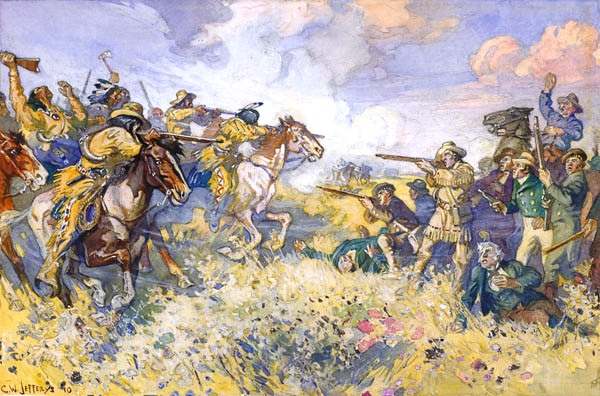
On 19 June 1816, a Métis party led by Cuthbert Grant approached the Red River settlement carrying pemmican for the North West Company. Grant’s group tried to pass around Fort Douglas. Governor Robert Semple left the fort with roughly two dozen men to intercept them near a place English-language accounts called Seven Oaks and French-Métis tradition knew as la Grenouillère, or Frog Plain.
The meeting turned violent within minutes. Semple and twenty of his men were killed; one man from Grant’s party also died. Parks Canada’s designation record states that Semple and about twenty-six men confronted Grant’s brigade and that the battle reflected conflict between the Métis and Red River settlers as different ways of life. The casualty imbalance made the encounter notorious and ended HBC control of the colony for the moment.
Who fired first remains disputed. Some accounts assigned immediate blame to the Métis; others maintained that Semple’s side initiated the shooting. Later testimony was shaped by trauma, company loyalty, criminal accusations, and litigation. The Dictionary of Canadian Biography concludes that Grant’s party arrived with hostile intentions but also notes uncertainty about the first shot. Certainty on that narrow point exceeds the evidence.
Even the event’s name carries interpretation. “Battle of Seven Oaks” suggests two armed sides; “Seven Oaks Massacre” emphasizes the killing of Semple’s defeated party; “Victory of Frog Plain” places the event within Métis national memory. A responsible account can acknowledge evidence of killings after the initial exchange without reducing every participant to either innocent victim or deliberate murderer.
Cuthbert Grant and Emerging Métis Politics
Cuthbert Grant was more than an NWC employee commanding a supply brigade. Born into the fur-trade world and educated in Lower Canada, he moved between company structures and Métis community leadership. Seven Oaks made him a celebrated and controversial figure. Pierre Falcon’s song about la Grenouillère helped carry the victory into Métis oral and musical tradition.
It would be anachronistic to imagine a fully formed modern nation-state program in 1816. Nevertheless, collective political language was developing. Métis hunters and traders defended their right to move, hunt, supply brigades, and refuse a colonial authority they had not accepted. The proclamation and subsequent seizures encouraged people with varied ties to act under a shared interest.
The North West Company benefited from this resistance and encouraged it, which has led some older histories to portray Métis participants merely as corporate agents. That view strips them of agency. The opposite simplification—treating the NWC as irrelevant to Métis decisions—is also untenable. Employment, kinship, economic interest, and political autonomy operated together.
Selkirk’s Counterstroke and the Legal War
News of Seven Oaks reached Lord Selkirk as he traveled with settlers and former soldiers. At Fort William, the North West Company’s principal inland depot, he arrested several partners and occupied the post in August 1816. He claimed legal authority as a magistrate and acted in response to the deaths at Seven Oaks. His opponents called the move an unlawful private invasion.
Selkirk restored the Red River settlement in 1817 with support from soldiers of the De Meuron regiment. That year he also concluded a treaty with Indigenous leaders regarding land along the Red and Assiniboine rivers. The written agreement is important evidence of negotiation, but its meaning and the parties’ understandings cannot be reduced to a modern real-estate purchase.
The conflict moved into colonial courts. Arrests and prosecutions occurred across different jurisdictions, while each company assembled testimony favorable to its case. François-Firmin Boucher, accused in Semple’s death, was acquitted. Charges against Grant were not successfully pursued. Selkirk himself faced legal reverses and heavy expenses.
Government investigator William Bacheler Coltman gathered extensive testimony and reported in 1818. His conclusions distributed blame rather than endorsing either company’s complete story: HBC forces had initiated serious aggression, while the NWC and its allies had exceeded lawful self-defense. The report’s value lies partly in its refusal to transform corporate propaganda into a simple verdict.
How the Pemmican War Ended
Armed tensions continued after 1818, including renewed blockades and seizures. Yet both companies were financially exhausted. Maintaining duplicate networks in the same territory had become ruinous, and British authorities wanted instability brought under control. In 1821, the Hudson’s Bay Company and North West Company merged under the HBC name.
The merger ended the corporate rivalry that had fueled the Pemmican War, but it did not settle every underlying question. A consolidated HBC gained enormous economic authority. Métis communities continued to hunt, trade, farm, and assert political interests. Land, representation, and sovereignty would again become central at Red River in 1869–70.
It is tempting to say the HBC “won,” since its charter and name survived. Economically, however, the new organization absorbed NWC personnel, routes, practices, and expertise. The combined company was not simply the old HBC continuing unchanged. Nor did merger vindicate every HBC action during the conflict.
The Red River Colony also survived. Settlers rebuilt after repeated displacement and developed a community whose history became entwined with neighboring First Nations and Métis populations. Survival did not erase the coercive foundations of the colony or make its land claim universally accepted.
Myths, Evidence, and Historical Memory
One common simplification says the Pemmican War was caused by a single food ban. The proclamation was a catalyst, but it operated within an older company rivalry and a newer colonial project. Without competition over territory, transport, and authority, a temporary export rule would not have produced years of armed conflict.
A second myth treats Seven Oaks as a planned battle between clear national armies. The participants were a Métis-NWC supply party and an HBC-colony group formed for an improvised interception. Both were armed, but neither resembled a regular army. The encounter’s speed and disputed opening help explain why memory became so polarized.
A third simplification assigns passive roles to Indigenous and Métis people while European companies drive the plot. In fact, the fur economy depended on Indigenous expertise and relationships. Métis producers and transport workers possessed leverage precisely because the trade could not function without their labor and provisions. Their choices shaped events, even when corporate employers attempted to direct them.
The source base itself demands caution. The Hudson’s Bay Company Archives contains diaries and reports written mostly from HBC perspectives. Court records preserve sworn testimony but not necessarily neutral truth. Métis songs and later oral histories express memories that official paperwork omitted. Historical confidence is strongest where independent evidence converges and weakest where rival witnesses had powerful reasons to blame one another.
Why the Pemmican War Still Matters
The conflict shows that food systems can determine imperial power. Canoes, forts, and trading licenses were useless without calories. By producing and moving pemmican, plains communities occupied a strategic position in a commercial network stretching from the Great Lakes to the continental interior. The proclamation recognized that power even as it tried to subordinate it.
The war also reveals how private corporations performed governmental functions. The HBC cited chartered authority; the NWC mobilized its own networks; both maintained armed employees and influenced courts and officials. Settlers and Métis communities encountered companies not merely as merchants but as institutions claiming the power to regulate movement, property, and justice.
Finally, Seven Oaks demonstrates why historical labels matter. “Massacre,” “battle,” and “victory” organize sympathy before the evidence is examined. The names need not be banned, but they should be explained. Commemoration has changed as Canadian institutions have taken Métis perspectives more seriously and treated the clash as a collision of economies and political claims, not simply an attack on settlers.
Conclusion: The War Behind the Food
The Pemmican War began with a practical crisis: how to feed a fragile colony and long-distance trading brigades. It became violent because control of food was inseparable from control of country. Macdonell’s proclamation claimed authority over a regional economy; Métis and North West Company resistance rejected that claim; HBC seizures and NWC countermeasures turned scarcity into confrontation.
Seven Oaks was the conflict’s bloodiest moment, not its whole meaning. The deaths of Semple, twenty of his followers, and one man from Grant’s party emerged from years of corporate escalation and contested jurisdiction. The disputed first shot cannot carry the burden of explaining everything that preceded it.
When the companies merged in 1821, commercial exhaustion ended the immediate struggle. The larger questions endured: whose law governed Red River, who could dispose of land, and whether Métis communities would be treated as a people with political rights or merely as labor within someone else’s empire. Pemmican fed the fur trade, but the fight over it exposed the foundations of colonial power.