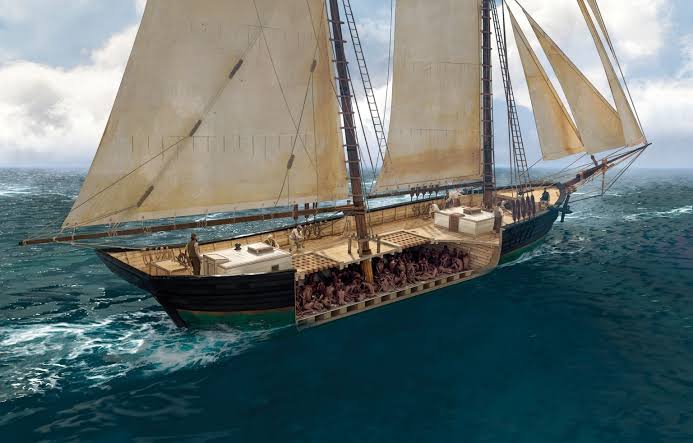
In July 1860, more than half a century after the United States had outlawed the overseas importation of enslaved people, a small schooner slipped into Mobile Bay carrying 110 captive Africans. Its organizers knew exactly what they were doing. They hid the captives, burned the vessel, and tried to erase the evidence. Yet the people transported aboard the Clotilda survived enslavement, emancipation, and official indifference. Some of them later bought land and founded the community that became Africatown.
For generations, descendants preserved the story while outsiders sometimes treated it as rumor. Archaeologists identified the wreck in 2019, but the discovery did not create the history or validate it for the first time. Documents, testimony, and community memory had long established the illegal voyage. What the wreck supplied was a rare material witness: the remains of the only American slave-trading vessel yet archaeologically identified from a voyage that landed captives in the United States.
The history of the Clotilda slave ship is therefore larger than a sensational tale of a lost wreck. It is about a deliberate federal crime, the lives of the people trafficked aboard it, the community they built, and the struggle over who controls the meaning of the past.
Why the 1860 voyage was unmistakably illegal
Congress prohibited the importation of enslaved people into the United States from January 1, 1808. The law did not abolish slavery, nor did it end the domestic trade that separated families across the American South. It did, however, make bringing captives from abroad a federal offense. Later legislation strengthened penalties, and in 1820 Congress classified participation in the overseas slave trade as piracy, potentially punishable by death.
Illegal landings nevertheless remained possible because the Gulf Coast was difficult to police and local wealth depended heavily on slavery. Enforcement was uneven, witnesses could be intimidated, and enslaved people were denied the legal power to testify freely against those claiming ownership over them. By 1860 the Atlantic trade to the United States was no ordinary commercial venture. It required planning, secrecy, and confidence that local connections could overcome federal law.
The voyage was organized by wealthy Mobile-area shipbuilder and landowner Timothy Meaher. Later accounts framed it as the result of a wager that he could evade the ban. The wager story appears in historical testimony, but it can also distract from the essential fact: Meaher financed a calculated trafficking operation for profit and prestige. Captain William Foster, who built and commanded Clotilda, accepted responsibility for obtaining captives and returning them covertly.
A schooner built for Gulf Coast commerce
Clotilda was not originally constructed as a specialized slave ship. Built in Mobile in 1855, the two-masted wooden schooner worked in regional and Caribbean trade. Its shallow draft and manageable size suited the rivers, bays, and coastal routes of the northern Gulf of Mexico. Those same qualities later helped Foster approach Mobile discreetly.
Customs records trace the vessel’s legitimate activity before its final voyage. A surviving cargo manifest records its departure from Mobile on February 27, 1860, officially bound for St. Thomas. That paperwork is important because it anchors the voyage in contemporary federal documentation. The declared destination provided cover; Foster instead crossed the Atlantic to the Bight of Benin, then a major center of an illegal trade sustained by African warfare, coastal brokers, Atlantic merchants, and overseas buyers.
Captives taken through Ouidah
Foster reached the coast near Ouidah, in the Kingdom of Dahomey, in May 1860. Dahomean forces and affiliated traders had captured people from inland communities and marched them to the coast. Foster purchased 110 men, women, and children. Their backgrounds were not identical: the group included people from several communities and linguistic traditions, though many had been taken during attacks in the region of present-day Benin and Nigeria.
Accounts from survivors describe violent capture, imprisonment in a barracoon, inspection by buyers, and separation from home. Oluale Kossola, later known as Cudjo Lewis, recalled an assault on his town and a forced march to Ouidah. Such testimony is indispensable because the customs records document the vessel but reduce human beings to cargo. At the same time, historians read recollections critically. Interviews occurred decades later, names were rendered through English-speaking interviewers, and individual memory cannot represent every passenger’s experience.
Foster packed the captives into a schooner never designed to carry so many people. The Atlantic crossing took roughly six weeks. The low hold offered little space or ventilation, while food, water, sickness, and fear shaped daily survival. All 110 captives are generally understood to have reached Alabama alive, an unusually high survival rate that should never be mistaken for humane conditions. Survival did not make the voyage less violent; it delivered the captives into five more years of enslavement.
The secret arrival in Mobile Bay
Clotilda returned to Mobile Bay in early July 1860. Foster waited for conditions that reduced the chance of interception, then transferred the captives to a river steamer and smaller boats. They were hidden temporarily in the river landscape north of Mobile before being divided among Meaher, his relatives, and associates. Some were taken farther inland and sold or assigned to other enslavers.
The secrecy reveals how well the conspirators understood the law. Their actions were not those of men who believed importation remained permissible. They separated people from the vessel, concealed them, and destroyed the primary physical evidence. Foster took the schooner into the Mobile River delta, burned it, and sank the remains.
This was also a moment when national politics were collapsing. Abraham Lincoln’s election came four months later; Alabama seceded in January 1861; the Civil War began that spring. The crisis did not cause the voyage, but it helped overwhelm the prospect of sustained federal prosecution.
Why the organizers escaped serious punishment
Federal authorities brought charges against Foster, Meaher, and others connected with the voyage. No conviction followed. Some modern retellings imply that the defendants were exonerated, but dismissal or failure to prosecute is not proof that the voyage was lawful or that it never happened. Contemporary records, Foster’s own account, survivor testimony, and archaeology establish the central facts.
The legal failure resulted from a combination of concealment, local complicity, evidentiary obstacles, and the approaching Civil War. The captives themselves were kept beyond the reach of officials, while those controlling them had strong incentives to deny everything. Courts also operated within a society whose institutions protected slaveholding power even when particular acts violated federal law.
Five years of enslavement in Alabama
The people brought on Clotilda arrived on the eve of war and remained enslaved until 1865. They labored on plantations, on riverfront property, in mills, and in households. Because the group was divided, experiences varied. Some remained near Mobile under the Meaher family; others, including Redoshi and the man later known as William or “Uncle Billy” Smith, were sent to a plantation in Dallas County.
Their short period of enslavement compared with people born into generations of American slavery has sometimes encouraged a misleading narrative that they remained culturally untouched Africans. In reality, they adapted under coercion while preserving selected languages, memories, relationships, and practices. They also encountered African Americans whose families had endured slavery in the United States for decades. Africatown emerged from those interactions, not from isolation outside American history.
Emancipation came through the destruction of Confederate slavery and the ratification of the Thirteenth Amendment. Freedom ended legal ownership but did not provide transportation home, compensation, land, or protection from racial violence. The survivors entered freedom with limited resources in a devastated southern economy.
From a request to return home to buying land
Some survivors wanted to return to Africa. They asked Timothy Meaher to finance their passage or provide land as restitution. He refused. Unable to raise enough money for an Atlantic return, members of the group pooled wages earned through agriculture, sawmill labor, and other work. In 1872 they purchased land from Meaher and additional property from other owners north of Mobile.
The settlement became known as African Town, later Africatown. Its founders organized institutions that combined remembered forms of communal authority with the demands of life in Reconstruction-era Alabama. They established a church, created a school, elected leaders, farmed, and built households. The community was not a replica of a single African village; its residents came from different places and fashioned a new society under new conditions.
This institution-building belongs beside other histories of Black autonomy after emancipation, including maroon communities that had earlier forced colonial powers to negotiate. TopHistoryFacts’ account of the First Maroon War in Jamaica offers a useful comparison: both histories concern collective survival, but Africatown arose through land purchase and Reconstruction rather than armed treaty-making.
Cudjo Lewis, Zora Neale Hurston, and survivor testimony
Oluale Kossola became the best-known Clotilda survivor under the name Cudjo Lewis. Writers and researchers interviewed him repeatedly. In 1927 and 1928, anthropologist and author Zora Neale Hurston recorded his account in dialect, photographed him, and filmed brief footage. Her manuscript, Barracoon, was not published as a book until 2018.
Hurston’s work is powerful because it centers Kossola’s voice, grief, humor, and memory rather than treating him as a statistic. Yet it is still a mediated text. Hurston selected, arranged, and represented conversations; Kossola was recalling childhood, capture, slavery, family loss, and community life nearly seven decades later. Responsible historians value the testimony without pretending that every remembered chronology can be verified to the day.
Kossola was long described as the last survivor of the last slave ship. Later research identified other survivors who outlived him, including Redoshi and Matilda McCrear. This does not diminish his testimony. It illustrates how archives can privilege a well-interviewed person while women, rural laborers, and less publicly visible survivors remain harder to trace.
What “the last slave ship” actually means
Clotilda is commonly called America’s last slave ship. The careful formulation is “the last known vessel to bring enslaved Africans into the United States.” It was not the last transatlantic slave voyage anywhere. Trafficking continued to Cuba and other destinations after 1860, and slavery in Brazil lasted until 1888. Nor can historians prove that no later clandestine landing ever escaped every record.
The phrase can also obscure the domestic slave trade. Ending legal overseas importation in 1808 did not stop the buying and selling of people within the United States. During the following decades, hundreds of thousands were forcibly moved from the Upper South to the Deep South. Clotilda was exceptional because it crossed the Atlantic illegally, not because human trafficking otherwise disappeared.
Precision strengthens rather than weakens the story. The ship’s significance rests on its documented late voyage, the unusually rich testimony of survivors and descendants, the creation of Africatown, and the archaeological identification of its wreck.
A search complicated by rumor and a false lead
In January 2018, a newly exposed wreck attracted headlines as a possible Clotilda. Archaeologists examined it and determined that it was too large and did not match the schooner. This failed identification matters because it shows the difference between an exciting resemblance and a professional conclusion.
Journalist Ben Raines subsequently located another wreck in a remote arm of the Mobile River near Twelvemile Island. The Alabama Historical Commission coordinated a broader investigation involving SEARCH, the National Park Service, the Smithsonian’s Slave Wrecks Project, Diving With a Purpose, and other specialists. In May 2019 the commission announced that the combined evidence identified the wreck as Clotilda.
How archaeologists identified the wreck
No single artifact bearing the ship’s name settled the question. Identification relied on convergence. Researchers compared the wreck’s location, dimensions, construction, fastenings, wood, age, and evidence of burning with archival descriptions of Clotilda. A survey of roughly 1,500 Gulf-region schooners found only a handful in the same size range, and the known characteristics pointed to this vessel.
The wreck is substantially buried in sediment, which preserved lower portions of the hull. Fire damage is consistent with Foster’s attempt to destroy the ship. Archaeologists found construction features appropriate to a Mobile-built mid-nineteenth-century schooner rather than a later industrial vessel. Historical evidence placed the scuttling in the same river area.
Absolute certainty is rarely delivered by a dramatic engraved plate. Archaeological identification resembles a legal and scientific argument: independent lines of evidence must fit one candidate better than alternatives. Officials describe the wreck as positively identified because location, physical fabric, and documents reinforce one another.
What the wreck can and cannot reveal
The wreck can clarify how the schooner was built, modified, burned, and concealed. Sediments and surviving material may preserve traces of the final voyage or later site formation. Continued mapping helps researchers understand deterioration and decide how the site should be protected.
It cannot tell the whole story by itself. The hull does not record each captive’s name, home, kinship, or experience. Those histories depend on testimony, genealogy, African research, plantation records, newspapers, archaeology in Africatown, and family memory. Treating the ship as the main character risks repeating the perspective of the men who owned it.
The wreck is also fragile. Waterlogged timber can deteriorate rapidly if exposed, and the muddy river presents hazards from currents, low visibility, erosion, organisms, and passing vessels. Raising the ship would be technically complex and enormously expensive; removal could destroy context unless conservation facilities and long-term funding were ready. Preservation in place, careful monitoring, and selective investigation remain serious options rather than signs of neglect.
Who owns the story of Clotilda?
The archaeological announcement brought tourism, media attention, documentaries, exhibitions, and new investment. It also sharpened questions that Africatown residents had long asked: Who decides how the story is told? Who benefits economically? Will preservation include the living community, or only the wreck?
Ethical interpretation places the captives and their descendants at the center without turning descent into the only form of authority. Archaeologists contribute technical evidence; historians test documents; community knowledge preserves names and meanings absent from official records. The strongest public history emerges when those forms of knowledge are brought together transparently.
Why the Clotilda slave ship still matters
Clotilda compresses several eras into one site. Its 1860 voyage belongs to the Atlantic slave trade, its prosecution to the failure of antebellum law, its passengers’ freedom to the Civil War and Reconstruction, Africatown to Black institution-building, and the wreck’s identification to modern archaeology and environmental justice.
The story also warns against confusing discovery with existence. Archaeologists did not make the descendants’ account true in 2019. They added material evidence to a history that families, writers, and records had already carried across generations. Conversely, honoring oral tradition does not require rejecting scientific testing. The unsuccessful 2018 candidate demonstrates why claims should be examined rather than accepted because they are emotionally satisfying.
Most importantly, the ship matters because an effort to erase evidence failed. Foster and Meaher could burn timber, hide captives, and escape conviction, but they could not control what the survivors built or what their descendants remembered. Africatown became the enduring answer to a crime intended to reduce people to property.
Conclusion
The Clotilda slave ship was not a ghost story solved by a single discovery. It was a documented illegal venture whose organizers exploited the weakness of law in a slaveholding society. The 110 people forced across the Atlantic endured capture, confinement, enslavement, and separation. After emancipation, some turned collective labor into land, institutions, and a community that survived far beyond the schooner.
Archaeology has made the material evidence harder to ignore, but the deepest history remains human. The wreck confirms how the crime was concealed. Africatown shows what the survivors created when freedom offered them neither return nor restitution. Taken together, the ship, the records, the testimony, and the living community transform a claim about America’s “last slave ship” into a more demanding story about memory, evidence, accountability, and survival.
Sources and further reading
U.S. National Archives, “Cargo Manifest for the Clotilda”.
Alabama Historical Commission, Clotilda project and archaeological resources.
Smithsonian National Museum of African American History and Culture, “The Clotilda Has Been Found”.
National Park Service, “Zora Neale Hurston and Cudjo’s Own Story”.