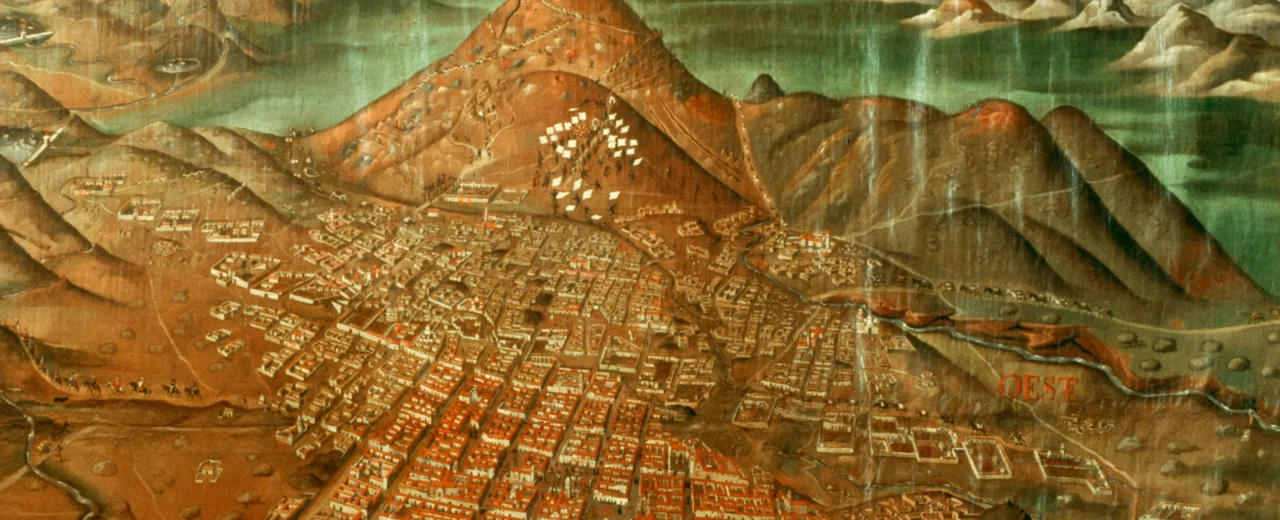
In the sixteenth century, a mining settlement nearly 4,100 meters above sea level became one of the most consequential cities on Earth. Potosí rose beneath Cerro Rico—the “Rich Mountain”—in the Andean highlands of present-day Bolivia. Its silver paid soldiers and creditors, supplied mints, crossed the Atlantic and Pacific, and entered markets from Seville to China. The wealth seemed so vast that “to be worth a Potosí” became a Spanish expression for fabulous value.
That glittering reputation hides a more difficult history. The Potosí silver mines depended on Indigenous knowledge, coerced labor, imported mercury, private capital, state power, and a vast urban workforce. They generated fortunes, but they also produced deadly accidents, displacement, debt, and contamination. The famous mountain was neither a magical source of effortless Spanish wealth nor a simple pit worked only by anonymous slaves.
Potosí matters because it exposes the machinery behind early globalization. Silver connected continents, but those connections were built through unequal institutions whose costs remained concentrated in the Andes.
Before Potosí became an “imperial city”
Cerro Rico rises above a landscape inhabited and used by Andean peoples long before the Spanish conquest. Communities possessed sophisticated knowledge of ores, smelting, exchange, and high-altitude agriculture. The Inca state drew labor and resources from the broader region, while local specialists processed metals with technologies adapted to scarce fuel and strong mountain winds.
A popular discovery story credits an Indigenous man named Diego Huallpa with finding exposed silver in 1545, sometimes after a fire or while pursuing a lost llama. Versions differ and were written down after mining had become enormously valuable. Historians therefore treat the picturesque details cautiously. What is secure is that Spanish entrepreneurs claimed rich veins in the mid-1540s and a settlement expanded with extraordinary speed.
Colonial writers also repeated a legend that the Inca ruler Huayna Capac had heard the mountain thunder and was warned not to take its silver because it was destined for other masters. The tale neatly made Spanish possession appear foretold. It is better read as colonial mythology than as a verifiable account of pre-conquest events.
A city built around Cerro Rico
Potosí was founded in 1545 as a mining settlement rather than a carefully planned capital. Miners, merchants, laborers, artisans, officials, clergy, transport workers, and suppliers poured into the highlands. Within decades, it ranked among the largest cities in the Americas. Estimates of its peak population vary widely because colonial censuses were incomplete and because many workers moved seasonally, but its urban scale was indisputably remarkable.
The city depended on regions far beyond the mountain. Lower valleys supplied maize, fruit, wine, timber, and coca. Herding communities provided llamas for transport and animal products. Textile workshops, farms, and markets across the Andes fed and clothed a population living in an environment where few essentials could be produced locally.
Potosí’s landscape displayed colonial hierarchy. Spanish and creole elites occupied wealthy central districts, while Indigenous workers lived in parishes and neighborhoods often described as barrios mitayos. Churches, mansions, workshops, warehouses, mills, and gambling houses grew beside crowded housing. Prosperity and precarity existed on the same streets.
How early miners processed rich ore
The first decades exploited unusually rich surface and near-surface veins. Indigenous smelters used small wind-driven furnaces commonly called huayras or guairas. Placed where mountain winds created sufficient draft, these furnaces could separate silver from high-grade ore without the enormous fuel demands of European-style smelting.
This was not merely labor supplied to a European industry. Andean metallurgical knowledge made the early boom possible. Indigenous specialists sometimes processed ore independently, received shares, traded metal, and built businesses within a coercive colonial order. Their economic agency does not cancel exploitation; it shows that the workforce cannot be reduced to a single undifferentiated category.
As the easiest ores declined, production faltered. Deeper material contained lower concentrations and chemical forms that were difficult to smelt profitably. Sustaining the boom required a technological and institutional reorganization in the 1570s.
Mercury amalgamation transformed production
Spanish America adopted mercury amalgamation first developed on an industrial scale in Mexican silver districts. Crushed ore was mixed with mercury, salt, and other compounds. Silver bonded with the mercury into an amalgam; heating later drove off the mercury and left the precious metal behind. The process recovered silver from ores that earlier furnaces could not treat economically.
At Potosí, Viceroy Francisco de Toledo promoted amalgamation alongside new mills, waterworks, regulations, and labor demands. Artificial lakes and dams in the Kari Kari range fed channels that powered ore-crushing machinery. The resulting system linked mountain tunnels, mills, refining yards, reservoirs, roads, markets, and the royal mint into one of the early modern world’s largest industrial complexes.
The process also tied Potosí to Huancavelica in present-day Peru, where workers mined cinnabar to produce mercury. Silver and mercury formed one colonial system: danger in the mercury mine enabled production at the silver mountain. Contemporary observers recognized mercury poisoning, although they did not understand every pathway of exposure.
The colonial mita was not the Inca system unchanged
The word mita came from an Andean tradition of rotating service owed to the Inca state and local communities. Spanish officials appropriated the concept but redirected it toward colonial extraction. From the 1570s, communities across a vast recruiting zone had to supply quotas of adult men for work associated with Potosí.
Drafted workers, known as mitayos, served for defined periods and nominally received wages. That fact sometimes leads to the misleading claim that the system was ordinary paid employment. In practice, men were compelled to leave home, travel long distances, and enter dangerous labor under rules they did not freely choose. Official wages often failed to cover food, tools, lodging, family support, and required payments.
Communities responded in different ways. Some sent workers, paid substitutes, contested quotas, migrated outside registered districts, or negotiated through local leaders. Families frequently accompanied migrants and sustained life in Potosí through trading, food preparation, domestic labor, and informal production. The burden therefore extended beyond the men counted on official labor rolls.
Free labor, coercion, and a mixed workforce
Not every miner at Potosí was a mitayo. The industry also employed voluntary wage workers, skilled miners, ore sorters, haulers, refiners, artisans, enslaved Africans, and Indigenous entrepreneurs. Some experienced workers returned for wages higher than those available in rural districts, especially when mine owners competed for labor.
The boundary between “free” and “forced” labor could still be blurred by debt, tribute obligations, market pressure, and colonial law. A worker might seek wages while having few realistic alternatives. Mine owners relied on the mita to guarantee a cheap core workforce, then hired additional workers when production demanded it.
Describing all workers as slaves erases these distinctions; describing them all as free wage earners disguises compulsion. Potosí functioned through a layered labor market in which legal status, skill, community obligation, bargaining power, and violence shaped different experiences.
Work inside the Rich Mountain
Underground miners followed narrow veins through a growing maze of shafts and galleries. They broke ore with hand tools, carried heavy loads, and climbed primitive ladders in thin air. Cave-ins, falls, dust, poor ventilation, cold, and exhaustion were constant risks. As workings deepened, removing water and moving ore became more difficult.
Outside the tunnels, workers crushed, sorted, mixed, washed, and heated ore. Refining exposed laborers and nearby residents to mercury through vapor, contaminated dust, water, and soil. Scientific estimates of total colonial emissions vary because production and mercury records are incomplete, but environmental studies agree that the scale was enormous and that contamination left a long legacy.
The familiar phrase that millions “died in the mines” should be handled carefully. Colonial exploitation caused severe mortality and social disruption, yet dramatic totals often combine broad regional population collapse from epidemics, hunger, migration, and multiple labor regimes without evidence assigning every death to Potosí. The brutality is documented; an unsupported round number does not make it more true.
The royal fifth, private profit, and smuggling
The Spanish Crown did not operate every mine directly. Private owners and refiners invested capital, managed production, and competed for ore and labor. The monarchy regulated the industry, supplied or controlled mercury, maintained institutions, and collected taxes. Most famously, a share of registered silver was taken as the royal fifth, though rates and fiscal arrangements changed over time.
Silver passed through official assay offices and mints, but not all production entered legal accounts. Smuggling reduced taxes and moved metal through unofficial Atlantic and Pacific routes. Corrupt officials, merchants, mine owners, and transporters could all benefit from evasion. Consequently, registered output is not identical to total output.
The Crown gained enormous revenue, but the notion that Potosí’s silver simply made Spain permanently rich is too simple. The monarchy carried heavy military debts and transferred much income to bankers, armies, shipbuilders, suppliers, and foreign creditors. Silver expanded imperial capacity while also feeding financial dependence and inflationary pressures.
Coins, mints, and the scandal of debased money
Potosí’s mint converted bullion into coins that circulated widely. Silver pieces produced in Spanish America became trusted trade currency across Europe, Africa, and Asia. Their standard weight and fineness made them useful beyond the political reach of the empire that stamped them.
During the seventeenth century, officials uncovered large-scale fraud at the Potosí mint. Assayers and mint contractors had allowed underweight and debased coins to pass with official marks. The scandal damaged confidence, prompted prosecutions, and forced recoinage and reforms. It shows that global currency depended not only on metal but also on institutional trust.
Coins found far from the Andes do not prove that every piece traveled along a single planned imperial route. Silver changed hands repeatedly. Merchants melted, restamped, hoarded, taxed, and exchanged it across overlapping networks.
How Potosí silver reached the wider world
Official shipments moved from the Andes to Pacific ports, north toward Panama, across the isthmus, and onward through the Caribbean to Spain. Other silver traveled through Buenos Aires despite restrictions. From Europe it paid for warfare and imports, while merchants redistributed it to the eastern Mediterranean and Asia.
Across the Pacific, American silver moved through New Spain and the Manila galleon trade in exchange for Chinese silks, porcelain, and other goods. China’s tax and monetary systems created powerful demand for silver, while differing gold-silver ratios could reward long-distance exchange. Scholars debate how decisive arbitrage was at particular moments, but Chinese demand clearly helped pull American silver into Asian markets.
Potosí was therefore central to early globalization without being its only engine. Mexican and Japanese mines also produced huge quantities, and global trade rested on shipping, credit, political protection, and consumer demand. The best interpretation treats Potosí as a major node in a changing system, not as the solitary birthplace of the world economy.
A boom sustained by colonial consumption
The city did more than export metal. It consumed food, cloth, candles, timber, tools, animals, luxury goods, and services on a remarkable scale. Merchants connected Potosí with agricultural valleys, Pacific ports, Atlantic routes, and Indigenous markets. Women played vital roles as vendors, property holders, brewers, servants, and managers of households and businesses, although official records often minimized their work.
Mining fortunes supported religious patronage, elaborate festivals, art, and architecture. They also financed gambling, conspicuous consumption, and political competition. The image of a city paved with silver is metaphor, not description, but it captures the reputation that attracted migrants willing to risk hardship for opportunity.
This mixture of extraction and consumption resembles other colonial commodity frontiers. The violence used to secure monopolies in the Banda Islands nutmeg trade differed from Andean labor drafts, yet both cases show how European empires converted regional resources into global commodities through coercive institutions.
Decline was real, but mining did not simply stop
Production declined from its late-sixteenth- and early-seventeenth-century heights as ore quality fell, tunnels deepened, infrastructure deteriorated, and labor arrangements changed. Political disruption and the wars of independence further weakened colonial institutions. Yet Potosí did not become an empty ghost town when the first boom ended.
Mining continued through the colonial era and after Bolivian independence. Tin became increasingly important in the nineteenth and twentieth centuries, while silver, lead, zinc, and other minerals remained part of the regional economy. Thousands of miners still work Cerro Rico through cooperatives and other arrangements.
The mountain’s long use complicates heritage preservation. It is both a historic monument and a workplace. Policies that treat it only as a frozen colonial ruin ignore living livelihoods; unrestricted extraction, however, threatens the mountain and the evidence contained within it.
Heritage, instability, and an environmental legacy
UNESCO placed the City of Potosí on the World Heritage List in 1987. The protected ensemble includes Cerro Rico, mine workings, dams, aqueducts, mills, the mint, churches, elite buildings, and Indigenous neighborhoods. Together they preserve an industrial and urban landscape rather than a single monument.
Centuries of tunneling have left Cerro Rico porous and unstable. Collapses and continued excavation threaten its recognizable profile and the safety of miners. In 2014 UNESCO added Potosí to the List of World Heritage in Danger, citing uncontrolled mining and related deterioration.
Mercury and other metals remain in soils and sediments, while present-day mining produces new waste and exposure. The environmental story is therefore not confined to a closed colonial chapter. It links historic extraction with modern public health, labor rights, poverty, and debates over who should pay for conservation.
What the usual Potosí story gets wrong
The first error is to describe Cerro Rico as a natural treasure discovered by Spain in an empty landscape. Indigenous people already knew Andean metals and supplied the expertise, food, transport, and labor that made production possible. The second is to portray every worker as legally enslaved. Coercion was fundamental, but the workforce included mitayos, wage workers, specialists, entrepreneurs, and enslaved people in different roles.
The third error is to reduce all demographic catastrophe to mine deaths. Potosí caused lethal working conditions and regional disruption, but epidemic disease, tribute, famine, migration, and other colonial demands also reshaped Andean populations. The fourth is to imagine silver flowing in a straight line from mountain to Spanish treasury. In reality, it moved through taxes, wages, contraband, credit, trade, and private fortunes before circulating across the world.
Correcting these myths does not soften colonial violence. It identifies how that violence actually worked—and how Indigenous communities navigated, resisted, and sometimes found opportunities within an imposed economy.
Conclusion
The Potosí silver mines changed the early modern world because they joined an extraordinary mineral deposit to an equally extraordinary system of labor, technology, water management, taxation, and trade. Cerro Rico supplied metal, but people built the economy: Indigenous metallurgists, coerced mitayos, wage workers, women traders, transporters, refiners, merchants, and officials.
The silver helped finance empire and connect Atlantic and Pacific markets, yet global integration did not distribute benefits evenly. Wealth traveled; much of the danger remained in the Andes. Mercury contamination, unstable tunnels, and contested labor conditions outlived the dynasties and commercial systems that profited from them.
Potosí should be remembered neither as a romantic mountain of limitless riches nor only as a symbol detached from evidence. It was a living city and industrial system whose brilliance and brutality were inseparable. Its history makes the foundations of globalization visible—and asks who paid for the connections that others celebrated.
Sources and further reading
UNESCO World Heritage Centre, “City of Potosí”.
U.S. Geological Survey, “The Age and Thermal History of Cerro Rico de Potosí”.
Nicholas A. Robins and others, “Mercury Production and Use in Colonial Andean Silver Production”.
CONICET, “The Silver of Potosí: The Beating Heart of Early Economic Globalization, 1580–1630”.