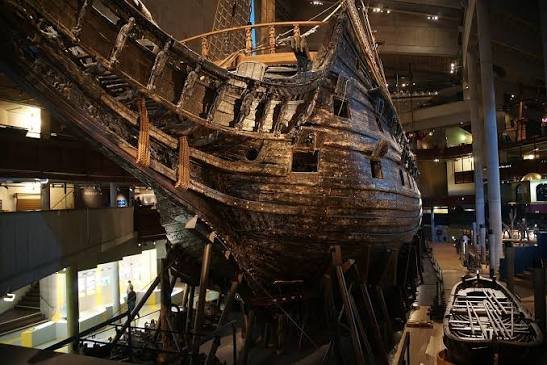
On the afternoon of 10 August 1628, Stockholm gathered to watch the Swedish navy’s newest warship begin her first voyage. Vasa was enormous, richly decorated and armed with two gun decks. Families accompanied crew members for the opening leg, small boats crowded the harbour and foreign observers watched a royal statement of military power move away from the quay.
About twenty minutes later, the ship was on the bottom. A gust pushed Vasa to port, water rushed through the open lower gunports and the vessel sank within sight of the city after travelling roughly 1,300 metres. Around thirty people died, most trapped inside. The disaster was public, humiliating and apparently inexplicable: the flagship had foundered in ordinary weather before reaching the open Baltic.
The familiar story of an arrogant king and a foolish builder contains pieces of truth but hides a larger failure chain: unstable design, weight distribution, incomplete warnings, operational decisions and institutional pressure. The later recovery turned that failure into one of archaeology’s richest records of seventeenth-century life.
Why Sweden Built the Vasa Ship
King Gustav II Adolf inherited wars with Denmark, Russia and Poland-Lithuania when he came to the throne in 1611. During eighteen of his twenty-one years as king, Sweden was at war. Naval force was essential for moving troops, protecting supply routes and controlling the Baltic. The conflict with his cousin Sigismund III Vasa, the deposed Swedish king who ruled Poland-Lithuania, also made war a dynastic and religious struggle.
In January 1625, the crown contracted the Dutch-born master shipwright Henrik Hybertsson and the merchant Arendt de Groote to build four ships. Vasa was intended to be the most formidable. Work began at the royal navy yard in Stockholm in 1626. Hybertsson became seriously ill during construction and died in 1627, leaving his assistant Hein Jakobsson to complete a project whose designer could no longer explain or revise his choices.
The mission belonged to the wider European crisis opened by the Defenestration of Prague. Vasa was expected to support operations near Gdańsk or Swedish forces protecting Stralsund. It was a working machine of war as well as a political statement.
A Floating Display of Royal Power
Vasa measured about 69 metres from bow to stern and rose more than 50 metres from keel to the top of the main mast. It carried ten sails, 64 cannon, roughly 120 tonnes of ballast and more than 700 carved ornaments. Lions, Roman emperors, biblical heroes, classical gods and members of the Vasa dynasty proclaimed Gustav Adolf’s strength and divine favour. Carved Polish figures beneath the crew’s toilets delivered a pointed insult to Sweden’s enemy.
The ship seen today is dark brown, which encourages the mistaken image of a sombre wooden fortress. Research on about 1,200 pigment samples shows that Vasa originally blazed with colour. Much of the upper hull was bright red, mouldings were yellow, sculptures were painted in strong colours and details carried gold leaf. The vessel was designed to be noticed. Its decoration was not incidental luxury but a visual argument about Sweden’s emerging place among European powers.
How Seventeenth-Century Shipwrights Designed Warships
Modern naval architects calculate displacement, centre of gravity, buoyancy and stability before construction. Hybertsson did not possess that mathematical system; the relevant theoretical tools developed later. Shipwrights relied on proportions, rules of thumb and accumulated experience. A successful hull could be adapted into a larger design, but every change introduced uncertainty.
Vasa was unusually ambitious for Swedish practice, with two full gun decks and tall, heavily built upperworks. The ship had too little underwater volume and breadth relative to the mass above the waterline. Its centre of gravity sat too high, so a relatively small sideways force produced a large heel while the hull generated too little righting force to recover promptly. Sailors called such a ship tender or crank.
Early modern builders still understood practical links among breadth, ballast, sail and upper weight. Tender ships could be altered by reducing armament, removing high structures or adding width near the waterline. Vasa reached departure without a correction substantial enough to save it.
The Stability Test That Was Stopped
Before the maiden voyage, Captain Söfring Hansson summoned Vice Admiral Klas Fleming to witness a traditional test. Thirty men ran from one side of the upper deck to the other, making the ship roll. The exercise was stopped after only three crossings because Vasa was moving so violently that observers feared it might capsize at the quay.
The episode is strong evidence that senior officers knew something was wrong. It is not, however, proof that they possessed a modern diagnosis with an obvious repair. Adding ballast seemed an intuitive answer, but the ship already carried around 120 tonnes of stone and lacked room low enough in the hold for enough additional weight. More ballast would also have lowered the gunports closer to the water.
Fleming reportedly wished the king were present, while royal correspondence pressed for the delayed ship to enter service. Gustav Adolf was away, and the institutional structure did not produce a firm stop. No single surviving order says, “Sail despite certain disaster.” Instead, responsibility was dispersed among naval officers, builders and royal administrators. Everyone had reasons to continue, while no one converted the alarming test into a binding cancellation.
The First and Last Voyage
Under the shelter of Södermalm’s cliffs, the wind was light and the ship responded poorly to its rudder. A small gust caused a heel to port, from which Vasa slowly recovered. At Tegelviken, a stronger gust struck. The ship leaned far enough for water to pour through the open ports on the lower gun deck. Once flooding began across a wide row of openings, recovery became impossible.
Captain Hansson ordered the sheets released to spill wind and the ports closed, but the deck angle and speed of flooding defeated the effort. People jumped overboard or struggled upward through the tilting interior. Small craft rescued survivors, and some swam approximately 120 metres to Beckholmen. Within minutes the hull rested about 32 metres below the surface, while the tops of the masts remained visible.
Why Vasa Sank: The Full Failure Chain
The fundamental defect was inadequate initial stability. Tall, heavy upperworks raised the centre of gravity; the underwater hull was too small to provide a strong restoring moment. Wind did not need to be exceptional. The ship was vulnerable to ordinary forces that a seaworthy warship should have tolerated.
The open gunports converted a dangerous heel into a sinking. Had they been closed, Vasa might have recovered or at least survived long enough to be brought back and modified. Keeping them open was operationally understandable during a ceremonial departure and salute, but it removed the vessel’s final margin of safety.
Other conditions compounded the risk. Weight was distributed high in the ship, and the available ballast could not compensate without creating new problems. The abandoned stability test supplied a warning but no numerical standard told officials how much rolling was unacceptable. Delays, war and royal expectations encouraged departure. The disaster therefore resists a single-cause explanation: defective stability made the accident possible, open ports made it catastrophic, and decision-making allowed both conditions to coincide.
Myths About Cannon, Measurements and the King
A popular story says loose cannon rolled to one side and overturned Vasa. Contemporary concern about the guns explains why Vice Admiral Erik Jönsson hurried below during the sinking, but the cannon were secured. They did not stampede across the deck. Nor were the guns alone an overwhelming fraction of the ship’s mass. Their location and supporting structure contributed to high weight, yet removing “too many cannon” from the explanation oversimplifies the whole vessel.
Another claim says the king ordered a second gun deck or a longer hull after construction had begun, ruining an otherwise sound design. Gustav Adolf certainly demanded a powerful ship and influenced armament, but surviving evidence does not support every dramatic version of mid-build interference. The configuration emerged through contracts, evolving plans and shipyard decisions rather than one documented royal outburst.
Four rulers of slightly different lengths found aboard Vasa have also inspired a story about Dutch and Swedish feet corrupting every dimension. Mixed measurement traditions may have contributed to asymmetry or inconsistency, but they cannot by themselves explain the sinking. The verified problem is the completed ship’s weight distribution and hull form. Measurement differences are a plausible contributing detail, not a proven master key.
The Inquest and the Search for Someone to Blame
An inquiry began immediately. Officials questioned Captain Hansson, surviving officers, shipwrights and naval experts. They investigated whether the crew was drunk, whether cannon were loose and whether the ship had been handled incorrectly. Witnesses repeatedly returned to the vessel’s tenderness and proportions.
The institutional situation made accountability difficult. Hybertsson, the original master shipwright, had died before completion. Jakobsson said he had followed inherited dimensions. The ship had been built under a royal contract and armed according to crown requirements. Naval commanders had witnessed the stability test, yet no rule clearly transferred its result into a legal prohibition on sailing.
No one was convicted. This outcome is sometimes portrayed as a conspiracy to protect the king, but the evidence also reflects genuine uncertainty in a craft-based system. The inquiry could recognize that the ship lacked enough “belly” for its upperworks without isolating one criminal act. Vasa was a system failure before that term existed: authority, design knowledge, communication and operational judgment all had gaps.
The Dead and the Lives Preserved in the Wreck
Roughly thirty people died, although the exact number is uncertain because no complete muster had been taken. Historical sources name only one of the dead with confidence, Captain Hans Jonsson, who had served as an earlier captain and joined the maiden voyage. Human remains from at least seventeen individuals were later recovered in and around the wreck.
Osteology, isotope analysis and DNA research have revised old assumptions. One skeleton long interpreted as male was confirmed in 2023 to be female. Researchers can investigate diet, origin and disease, but named biographies remain elusive; museum nicknames are research labels, not recovered identities.
The ship also preserved ordinary possessions rarely described in royal records: shoes, clothing, tools, wooden dishes, sailors’ chests, coins, food remains and gaming pieces. These objects shift the story away from kings and engineers. Vasa is not only evidence of a failed weapons project; it is a sealed social space containing traces of workers, sailors, officers, guests and families caught in a sudden disaster.
Why the Wreck Survived for 333 Years
Efforts to recover Vasa’s bronze cannon began soon after the sinking, and divers retrieved most of them in the seventeenth century. The hull itself remained embedded in Stockholm harbour. Cold, dark and oxygen-poor water slowed biological decay. The Baltic’s low salinity also discouraged the shipworm that destroys wooden wrecks in saltier seas.
The vessel had sunk largely intact and was gradually enclosed by silt. Iron fastenings corroded and outer wood degraded, but much of the oak survived. The same principle makes underwater archaeology exceptionally valuable: a wreck can preserve an assemblage rather than scattered objects, as seen in the much older Uluburun Shipwreck. Vasa’s exceptional completeness, however, resulted from a particular combination of fresh construction, harbour conditions and rapid burial.
Anders Franzén and the Rediscovery of Vasa
In the early 1950s, naval fuel engineer and amateur maritime historian Anders Franzén studied archives and searched Stockholm’s waters for historic wrecks. He reasoned that Baltic conditions might preserve wooden ships better than conventional opinion assumed. On 25 August 1956, a coring device brought up a small plug of black oak from the harbour bottom.
Navy divers Per Edvin Fälting and Sven Persson confirmed that the timber belonged to a large ship with two tiers of gunports. Franzén then built a coalition involving the navy, museums, the Heritage Board, a commercial salvage company and the royal family. His achievement was not simply finding a secret location. He transformed documentary clues and physical evidence into a project capable of financing, raising and conserving an enormous wreck.
Divers tunnelled beneath the hull and passed steel cables through the passages. Pontoons lifted Vasa in stages from deep water to a shallower position, where holes were repaired and the structure prepared for the final operation. On 24 April 1961, after 333 years underwater, the ship broke the surface before crowds and international media.
Excavating a Seventeenth-Century World
Raising the hull did not end the archaeological work. Mud and water inside it weighed hundreds of tonnes, while wet timbers risked distortion. Archaeologists worked for five months in cold spray and black silt, recording each object before transferring it to water-filled storage. More than 30,000 finds were recovered during the initial excavation; continued work ultimately produced a collection exceeding 40,000 objects.
Gun carriages still stood by ports. Chests held personal possessions, barrels contained animal bones from provisions, cannonballs filled storage areas and thousands of low-value coins remained in pockets and containers. Six folded sails and the longboat’s sails survived in a locker. The material record reveals provisioning, work, hygiene, rank and recreation with a detail unavailable from administrative documents alone.
Context is what makes the collection powerful. A spoon by itself is an artifact; a spoon recorded beside a chest, clothing and tools in a particular part of the ship helps reconstruct a person’s routines and status. Vasa became a landmark of maritime archaeology because the recovery treated the ship as an integrated site, not merely a spectacular object to display.
Seventeen Years of Conservation Spray
Waterlogged wood cannot simply be left to dry. Its weakened cells collapse as water evaporates, causing severe shrinkage and cracking. Conservators selected polyethylene glycol, or PEG, a water-soluble synthetic wax able to replace water within the wood and support its structure.
Spraying began in April 1962. Hand treatment was replaced in 1965 by an automated system of about 500 nozzles covering the interior and exterior. PEG concentration increased gradually, and the liquid was collected and reused. The spraying continued for seventeen years, until January 1979, followed by roughly nine years of controlled drying. Thousands of smaller objects underwent related treatments in tanks.
The programme was pioneering rather than routine. Later research identified acids associated with sulphur and corroded iron in the wood, while the hull continued to deform under its own weight. Climate control, bolt replacement, chemical monitoring and a new support structure remain parts of preservation. The ship is not a frozen time capsule requiring no care; it is a chemically and mechanically changing artifact whose survival depends on continuous science.
What Vasa Teaches—and What It Does Not
Vasa is often used in management courses as a lesson about unclear requirements, executive pressure or poor communication. Those comparisons can be useful, especially because the failed stability test shows how an organization can observe danger without acting. Yet modern project language can create false precision. Seventeenth-century shipbuilders lacked predictive tools, formal safety codes and testing standards that later engineers take for granted.
The disaster does not prove that ambitious technology inevitably fails or that one powerful client always corrupts design. It shows how innovation becomes dangerous when experience is stretched, warning signals are not converted into decisions and several small margins disappear together. The ship might have survived that day with closed ports; it might have been corrected after a safer trial; it might also have failed later in worse weather.
Conclusion: A Disaster Larger Than One Mistake
Vasa did not sink because seventeenth-century people were incapable of recognizing instability. The stopped rolling test proves that they recognized it. Nor did the ship sink solely because a king wanted grandeur, a shipwright used the wrong ruler or cannon rolled loose. Those simplified stories remove the crucial sequence connecting an unstable hull to open gunports and a bureaucracy unable to stop departure.
The confirmed record is more compelling. A new kind of heavily armed warship carried too much mass high above a relatively narrow underwater body. A light gust produced a severe heel. Water entered through the lower ports, and a public symbol of Swedish power sank in minutes. The inquiry understood much of the physical problem but punished no one.
Three centuries later, archival work, diving, engineering and conservation raised that symbol from the harbour. Vasa now survives not as the victorious flagship imagined in 1625, but as evidence of design under uncertainty and of the people whose possessions went down with it. Its greatest lesson is not that one person made a foolish mistake. It is that disasters emerge when technical weakness, institutional pressure and ordinary decisions align.