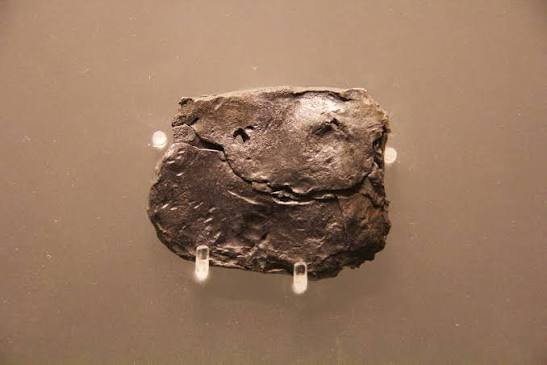
A Roman visitor to the hot springs at Aquae Sulis had lost two gloves. Instead of reporting the theft to a magistrate, he scratched an appeal onto a thin metal sheet: the person responsible should lose “mind and eyes” in the goddess’s temple. Another petitioner surrendered a stolen bathing cloak to the deity and asked that the thief receive neither sleep nor health until the property was returned.
These were not imperial decrees or polished literary compositions. They were private voices—angry, anxious and sometimes awkwardly spelled—preserved in the sacred spring beneath modern Bath. About 130 such inscriptions, now known as the Bath curse tablets, record ordinary people asking Sulis Minerva to discover and punish those who had wronged them.
The word “curse” suggests forbidden sorcery, but the tablets occupied a less tidy territory. They were deposited at a public sanctuary, borrowed the language of gifts and legal claims, and demanded justice while threatening bodily suffering. They reveal neither a purely Celtic survival nor a uniform Roman magical system. Instead, they show provincial people adapting writing, law, religion and emotion to everyday problems that official institutions had not solved.
What Are the Bath Curse Tablets?
The collection consists of small sheets inscribed mainly in Latin and deposited in the Sacred Spring of the temple complex at Aquae Sulis, the Roman settlement that became Bath. The Roman Baths Museum describes them as the personal prayers of about 130 individuals. They range broadly from the second century to the late fourth century CE, although individual pieces are often difficult to date precisely.
They are conventionally called defixiones, or curse tablets. That broad category includes metal texts intended to enlist gods, spirits or the dead against rivals, opponents and enemies. Across the Roman world, some targeted courtroom speakers, athletes, lovers or business competitors. Bath is distinctive because its surviving tablets overwhelmingly concern theft and the recovery or punishment connected with stolen property.
The tablets were rolled, folded or otherwise placed in the hot spring, where Sulis Minerva was believed to dwell. Deposition removed them from ordinary circulation and delivered them to the divine recipient. Many remained unread by other humans until archaeologists recovered them, yet their writers treated the goddess as a reader capable of understanding formal Latin, poor spelling, reversed letters and even marks that only imitated writing.
The Sacred Spring at Aquae Sulis
Hot mineral water rises naturally at Bath at a temperature of roughly 46°C. Long before modern spa tourism, the spring made the location religiously powerful. After Rome’s conquest of southern Britain, a monumental sanctuary and bathing complex developed around it, probably beginning in the later first century CE. The settlement’s Roman name, Aquae Sulis, means “the waters of Sulis.”
Sulis was a local deity associated with the spring. In inscriptions she appears joined with Minerva, the Roman goddess of wisdom, craft and other powers. “Sulis Minerva” is often described as a simple fusion of Celtic and Roman religion, but the label should not imply that scholars can reconstruct two complete, separate goddesses and watch them merge. Most evidence for Sulis comes from the Roman-period sanctuary itself.
Visitors sought healing, bathed, socialized, made offerings and addressed the goddess. The gilt bronze head from her cult statue and thousands of coins demonstrate the sanctuary’s wealth and reach. The curse tablets belonged within this religious landscape. Dropping one into the spring was not the furtive use of an unrelated bathhouse; it was a petition delivered at a temple to the power believed to inhabit its water.
How the Tablets Were Discovered
Individual inscribed pieces from Bath had been known since the nineteenth century, including the puzzling tablet mentioning Vilbia. The main corpus emerged much later. Excavations of the temple and baths between 1978 and 1983, led by Barry Cunliffe and Peter Davenport, reached deposits in the Sacred Spring that earlier construction had concealed.
During work in 1979 and 1980, archaeologists recovered roughly 130 tablets, many fragmentary or corroded. Their original context was crucial. A metal scrap from an old drain might be ambiguous; a concentration of inscribed, folded sheets in the goddess’s spring established a repeated ritual practice. The find transformed the study of both Romano-British religion and everyday Latin.
Roger Tomlin published the inscriptions systematically in 1988 as part of the major report on the Temple of Sulis Minerva. Drawings, readings and commentary made the difficult texts available for linguistic and historical analysis. Interpretations have continued to change as scholars reconsider letter forms, vocabulary and comparison material. In 2014, the collection entered the UNESCO Memory of the World UK Register and remains the only documentary heritage from Roman Britain to receive that recognition.
Lead, Pewter and Writing as Ritual
Popular descriptions often call every piece a lead tablet. Scientific analysis showed that many Bath sheets contain enough tin to be described more accurately as pewter or lead-tin alloy. Some were produced as thin, smooth sheets; others were roughly hammered. Material choice may have depended on availability as much as symbolism, and no single recipe governed the collection.
A writer used a sharp point to score letters into the metal. Scripts range from capitals resembling public inscriptions to cursive handwriting. Some texts run in unusual directions, contain reversed letters or were folded with the writing inside. Such choices could conceal the message, mark it as special or form part of delivering it, but it is unsafe to assign one magical meaning to every fold or reversal.
A few tablets are blank, while others carry rows of repeated marks that resemble letters without forming readable words. These may represent incomplete work, symbolic writing or attempts by people who could not compose a conventional text. The goddess, unlike a human official, might be expected to understand intention without perfect literacy. The artifacts therefore complicate any simple division between literate and illiterate visitors.
The Everyday Crimes Behind the Curses
The lost property was usually modest: coins, clothing, towels, jewellery, gloves or objects used at the baths. To a modern museum visitor, a cloak or several silver coins may sound trivial. To someone with few possessions, replacing a garment could be costly, while losing it during travel or bathing created immediate hardship.
Bathhouses created opportunities for theft. Visitors removed clothing before entering pools and treatment rooms. Wealthier bathers might bring an enslaved attendant to guard their possessions, but many relied on communal spaces and whatever supervision existed. Roman literature treated bath theft as a recognizable problem, and law distinguished certain habitual thieves, yet identifying an unknown culprit remained difficult.
The tablets expose the frustration produced by that gap. Writers sometimes named a suspect, but many used comprehensive formulas: whoever took the object, whether man or woman, enslaved or free, boy or girl. This was not evidence that the victim had narrowed the field. It was verbal insurance intended to prevent the guilty person from escaping through an omitted category.
How a Petition Tried to Make the Goddess Act
A common strategy was to “give” the stolen object to Sulis Minerva. Roman law still regarded the victim as owner even when possession had been lost, so the writer could imagine transferring ownership to the goddess. The theft was thereby transformed: the culprit had not merely wronged another bather but retained property belonging to a deity.
Some petitioners gave the whole item; a smaller group of British tablets promised the god a fraction of its value. This language resembles a votum, a bargain or vow in which a human offered something in return for divine aid. The transaction was logically strange—the petitioner donated what he or she no longer controlled—but ritually useful. It gave the goddess a direct interest in pursuing the thief.
The requested punishment might include sleeplessness, sickness, loss of bodily functions, mental distress, bloodshed or death. Often the suffering was conditional: it should continue until the culprit returned the property, confessed or brought it to the temple. The curse therefore combined vengeance with recovery. It was not necessarily a wish for pointless destruction; pain was imagined as pressure that would force restitution.
Curse, Prayer, or Lawsuit?
Scholars often call theft tablets “prayers for justice” because the writer identifies a wrong, appeals to a deity and asks for redress. That description usefully distinguishes them from spells intended to bind an innocent rival in sport or love. Their petitionary and sometimes contractual vocabulary can sound surprisingly close to law.
Yet the distinction is debated. Bath’s writers did not merely request an impartial investigation. They demanded physical and mental torment, sometimes against an unknown person whose guilt the goddess was expected to determine. Many texts mix humble prayer, property transfer and violent imprecation. Recent scholarship warns against drawing a rigid boundary between respectable religion and disreputable magic.
“Curse tablet” and “prayer for justice” therefore highlight different aspects of the same practice. The first captures coercive harm; the second captures the petitioner’s belief that harm was deserved. Neither label should turn the tablets into a Roman small-claims court or into evidence of a secret witch cult. They were personalized religious technologies used within an accepted sanctuary.
Sulis Minerva Was Not a Mechanical Vending Machine
The tablets sometimes read like contracts: an object is assigned, a culprit described and a penalty requested. That does not mean worshippers thought a coin or metal sheet automatically purchased a miracle. Ancient religious action depended on divine favour, correct approach, reputation of the sanctuary and expectations shared within a community.
Depositing a tablet may also have had human effects. A known suspect who learned that the property had been given to Sulis might fear illness, public exposure or sacrilege. The threat could encourage return even without any supernatural event. Whether tablets were displayed before deposition, announced by priests or kept entirely private varies across ancient contexts and cannot be assumed for every Bath example.
Nor do the tablets prove that the temple officially guaranteed their results. The survival of repeated formulae suggests shared knowledge, but only two of the 130 Bath texts have been attributed to the same hand. Many people appear to have written for themselves rather than purchasing a uniform professional service. Practice was widespread enough to be recognizable but flexible enough for individual improvisation.
What the Language Reveals About Roman Britain
Monumental inscriptions usually preserve official titles and carefully controlled Latin. The Bath tablets preserve hurried personal language. Spellings vary, grammar slips and familiar formulas appear in local forms. This makes them unusually valuable evidence for British Latin—the living language used in a province far from Rome.
The collection does not represent a transcript of ordinary conversation. Writers used ritual phrases, and some may have copied models. Literacy also varied: a person able to reproduce a curse formula was not necessarily able to read literature or keep accounts. Nevertheless, the variety of hands shows that writing was not confined to governors and elite monument builders.
A handful of tablets have been tentatively identified as Celtic rather than Latin, but the readings remain uncertain. Claims that they preserve the only substantial written British Celtic texts should therefore be treated cautiously. More secure evidence lies in names, unusual vocabulary and Latin influenced by local speech. The tablets show cultural interaction without allowing every nonstandard word to be confidently labelled Celtic.
The Mystery of Vilbia
One of Bath’s most famous tablets asks that whoever carried off Vilbia should become “as liquid as water.” For decades, Vilbia was often treated as a woman’s name. The inscription consequently became a dramatic story about a kidnapped or eloping woman and a jealous petitioner.
That reading creates problems. No other British curse tablet clearly treats a person as stolen property in this way, while Bath complaints normally concern portable objects. Paul Russell proposed that vilbia meant a sharp-pointed object and might be a word of Celtic origin. Other suggestions include a copying error or a form connected with a brooch or clasp.
The inscription itself securely contains the letters, but what they denote remains disputed. A woman cannot be ruled out simply because the case is unusual, and no alternative object has achieved universal acceptance. The responsible conclusion is not that the romantic tale is false or true, but that a famous translation rests on unresolved vocabulary. Vilbia demonstrates how easily a damaged, unfamiliar text becomes a confident modern story.
Names, Status and the Limits of Social History
Petitioners and suspected thieves bear a mixture of Roman and local names. Formulas explicitly imagine culprits who might be free or enslaved, male or female. The sanctuary served a socially mixed population, and people below the literary elite could use written appeals. The emotional intensity also shows that small losses mattered across status boundaries.
But the tablets do not provide a census of Bath. We cannot reliably infer the proportion of women, enslaved people or local Britons among worshippers simply by counting surviving names. Some writers omitted themselves, named only suspects or used formulas supplied by others. Preservation in one spring also favours people who chose this particular ritual response.
The texts reveal possibilities more securely than proportions. Women could petition; enslaved people could appear as victims, suspects or categories in a formula; non-elite visitors participated in literate religious culture. These conclusions enrich the social history of Roman Britain without pretending the sample is statistically representative.
Reading Scratches Without Inventing a Story
Decipherment is difficult. Corrosion interrupts strokes, folds hide letters and cursive hands turn familiar characters into shapes that resemble one another. Editors use raking light, photography, metallurgical study, parallels and linguistic knowledge to distinguish a word from damage. Punctuation and word division in modern editions are scholarly decisions, not features neatly supplied by the ancient writer.
An early misreading offers a warning. One Bath tablet was once interpreted as a Christian letter, partly because its editor approached the marks with that expectation. Roger Tomlin later recognized a familiar curse formula and showed that the inscription had effectively been read upside down. The error was not deliberate fraud; it illustrated how expectation can organize ambiguous scratches into the wrong text.
Translations should therefore retain uncertainty where the metal does. Brackets, dots and alternative readings record the difference between visible evidence and restoration. The broad character of the collection is secure, but individual names, objects and verbs may change as specialists reassess them.
What the Tablets Add to Everyday Roman History
Official sources describe conquest, taxation, military deployment and imperial administration. The Bath tablets record irritation over a missing glove. That scale is precisely why they matter. They preserve people acting when property, dignity and trust broke down in an ordinary public setting.
They complement other evidence from Roman Britain. The Vindolanda Tablets preserve letters, lists and requests from a frontier community; Bath preserves communications deliberately sent to a goddess. Both reveal handwriting, informal Latin and concerns absent from monumental history. Meanwhile, enigmatic finds such as Roman Dodecahedrons remind us that artifacts do not always arrive with texts explaining their use.
At Bath, object, inscription and findspot survive together. The alloy sheet shows how the message was made, the words explain the grievance and the sacred spring identifies the intended recipient. That unusually complete chain lets historians study religion as an action performed by individuals, not merely a list of official gods.
Conclusion: Private Anger in a Public Sanctuary
The Bath curse tablets preserve a chorus of people who felt ignored, robbed or humiliated. They turned private loss into a divine case by naming property, defining possible offenders and assigning punishment to Sulis Minerva. Their requests could be brutal, but they were also structured efforts to restore a moral balance.
Confirmed facts make the collection extraordinary without embellishment: about 130 tablets were deposited in the Sacred Spring from roughly the second to fourth centuries; most address theft; many different hands wrote them; and their language is a major source for religion and Latin in Roman Britain. More speculative claims—such as a kidnapped Vilbia, clearly Celtic sentences or a professional curse-writing industry—remain debated.
These thin sheets collapse distinctions modern observers often impose. They are prayers and threats, gifts and legal fictions, private messages placed in a public cult. Above all, they show ordinary provincial inhabitants using the written word to demand that the universe notice a wrong. Two thousand years later, their grievances remain legible because the petitioners entrusted them to water, metal and a goddess.