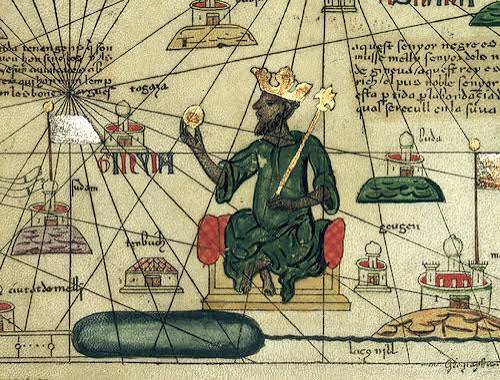
In 1375, a map made on the Mediterranean island of Mallorca pictured a Black ruler seated on a throne, crowned and holding a gold nugget. The caption named him Musa Mali, lord of a country whose gold was said to be extraordinarily abundant. The image was not drawn during his lifetime, and it was not a portrait. Yet it captures the result of one of the most public journeys of the medieval world: Mansa Musa’s pilgrimage from the Mali Empire to Mecca in 1324–1325.
That journey is now often compressed into the claim that Musa was “the richest person ever.” The phrase contains a real insight—Mali commanded immense resources and its ruler displayed them spectacularly—but it replaces a medieval political economy with a modern net-worth contest. No surviving account permits a reliable conversion into dollars, and even the famous figures for his caravan are difficult to verify. The more revealing question is how a ruler from West Africa made wealth, faith, diplomacy, and command of trade visible across the Islamic world.
A ruler reconstructed from unequal sources
Mansa Musa ruled the Mali Empire in the first half of the fourteenth century, conventionally from about 1312 until his death around 1337. “Mansa” was a title rather than a personal name; Musa is also rendered Moussa or Kankan Musa. Mali had emerged in the thirteenth century from Mande-speaking polities around the upper Niger and became one of the principal states of the western Sahel. Under its rulers, authority extended across a large but changing region touching present-day Mali, Guinea, Senegal, Mauritania, Gambia, and neighboring areas.
Its geography mattered. Mali stood between productive agricultural zones, the Niger River system, Saharan routes, and gold-producing districts farther south. Gold moved north; salt, cloth, paper, books, horses, metal goods, and other commodities moved south. The Metropolitan Museum of Art’s account of Sahelian exchange treats the Sahara as a difficult route of connection rather than an empty barrier. Camel caravans made the crossing possible, but only with specialized knowledge, water points, political protection, labor, and commercial partners.
The evidence for Musa has serious limits. The best-known written accounts come from Arabic authors based outside Mali. Ibn Fadl Allah al-Umari wrote in Cairo in the 1340s after speaking with people who had encountered Musa or knew Mali. Ibn Khaldun later preserved royal succession traditions. Ibn Battuta visited Mali in 1352–1353, after Musa’s death, under Mansa Sulayman. As historian N. Levtzion explained in a foundational study of the Arabic sources, each writer had different access to information. They are indispensable, but none is a neutral camera.
The Atlantic expedition said to precede Musa’s reign
One of the most intriguing stories about Musa concerns his predecessor. Al-Umari reported that Musa explained how the previous ruler had sent ships westward into the Atlantic. After one vessel returned, allegedly reporting a powerful current, the ruler supposedly assembled a much larger expedition and sailed with it, never to return. Musa then inherited the throne.
This account is valuable because it is an early report attributed to Musa, but it does not prove that a Malian fleet crossed the Atlantic or reached the Americas. No corroborating fourteenth-century West African logbook, archaeological assemblage, or contemporary American source confirms such contact. Estimates of the fleet’s size belong to a secondhand narrative recorded years after the conversation. The safest classification is reported tradition: evidence that a story about an Atlantic venture circulated around Musa, not evidence of a completed transoceanic voyage.
The distinction matters because modern retellings sometimes transform the episode into a claim that Mali “discovered America” before Columbus. That conclusion goes beyond the surviving record. The story may preserve an actual royal expedition, an attempt to explore coastal waters, a political explanation for succession, or a mixture of memory and royal presentation. Historians can discuss those possibilities without selecting the most dramatic one as fact.
Gold was imperial leverage, not a personal bank account
Musa’s reputation rests on gold, but Mali’s power cannot be reduced to a vault. Gold was extracted in regions linked to the empire, then taxed, traded, gifted, and used to sustain political relationships. Control was neither uniform nor modern in the sense of a state owning every mine. Rulers drew revenue through tribute, commerce, military power, and authority over routes and communities. A king’s resources also included his capacity to mobilize people, pack animals, food, guards, guides, and diplomatic gifts across great distances.
Al-Umari’s information suggests a complicated political economy. Malian rulers did not necessarily occupy every gold-producing settlement directly. Influence, tribute, and protected trade could be more useful than immediate administration. This is one reason historians are cautious about maps with hard imperial borders and statements that Musa personally “owned” West Africa’s gold. Medieval empires often contained layered jurisdictions. Local rulers, merchants, religious figures, kin groups, and tributary communities all shaped how resources moved.
Calling Musa the richest person who ever lived is therefore an interpretation, not a measurable fact. It applies a modern comparative category to an era without audited accounts, stable exchange rates, or a common unit for comparing land, labor, political authority, and bullion. What is strongly documented is that observers in Egypt regarded the Malian delegation’s gold as exceptional. That evidence tells us much about Mali’s place in trans-Saharan exchange and Musa’s ability to stage royal generosity, but almost nothing about an exact personal net worth.
Gold also had a social life beyond palace spectacle. It paid for goods, gifts, ornaments, obligations, and political reciprocity. African monetary history cautions against imagining one universal medium: commodities, metal by weight, credit, and locally preferred objects often worked together. The article on cowrie shell money offers a useful comparison with another form of value that circulated through African and Indian Ocean networks, although it concerns different regional systems and a much longer chronology.
The hajj joined devotion to diplomacy
In 1324 Musa set out for the hajj, the pilgrimage to Mecca required of Muslims who are able to undertake it. For a sovereign ruling a large Muslim and non-Muslim population, the journey was religiously meaningful and politically consequential. He traveled through Cairo, then ruled by the Mamluk sultan al-Nasir Muhammad, before continuing toward the Hijaz. The route placed Mali visibly within established centers of Islamic scholarship, commerce, and government.
Popular accounts usually supply precise numbers: 60,000 people, 12,000 enslaved attendants, 500 heralds, or 100 camel loads of gold. These figures derive from medieval reporting and have been repeated for centuries. They should be treated as evidence of perceived scale rather than as a census. Moving any large delegation across the Sahara required provisioning, security, guides, water, animals, and agreements at stopping places. Exact totals are especially uncertain because writers heard some details secondhand and could use conventional numerical language to express magnificence.
What cannot reasonably be doubted is that the delegation was large enough to become a public event in Cairo. Al-Umari’s account, presented in translation by the Boston University African Studies Center, describes negotiations over court protocol and a tense encounter with the Mamluk sultan. Musa initially resisted the expected act of submission. He eventually performed an obeisance framed as directed to God and then met al-Nasir Muhammad. The episode shows a West African ruler defending his dignity inside a hierarchy that Cairo officials expected foreign visitors to acknowledge.
The hajj produced relationships as well as spectacle. Musa received gifts from the Mamluk court and gave gifts in return. He encountered scholars, jurists, merchants, and officials; later traditions connect his return with new building and patronage in Mali. Such exchanges did not turn Mali into a passive recipient of “outside influence.” Muslim merchants and scholars had long operated in the Sahel. The pilgrimage intensified existing connections and advertised a sovereign who could participate in them on a royal scale.
Enslaved people were part of the display
Modern celebrations of Musa’s magnificence often omit the enslaved people in accounts of his caravan and in the political economy of medieval Mali. Some descriptions present thousands of attendants carrying gold staffs or bars. The exact numbers are questionable, but enslavement itself is not. Warfare, raiding, tribute, and trade moved captives through the Sahel and across the Sahara. Royal wealth included control over human beings as well as commodities.
This should neither be hidden nor flattened into a claim that medieval African slavery was identical to the later racialized plantation system of the Atlantic world. Forms of enslavement differed across time and place, and legal status, labor, military service, household incorporation, sale, and possibilities of manumission varied. The correct response to those differences is specificity, not euphemism. Musa’s celebrated generosity was performed inside a hierarchical society whose rulers could command unfree labor.
The omission has interpretive consequences. If the caravan is described only as a train of camels and glittering gold, Musa appears as a solitary possessor of treasure. Restoring labor to the account changes the picture. Miners, agricultural producers, caravan workers, animal handlers, guards, interpreters, merchants, enslaved attendants, and local suppliers made the journey possible. The royal image concentrated their work into the person of the king.
This does not cancel the hajj’s religious or diplomatic significance. It places that significance inside the social order that produced it. Medieval sources were chiefly interested in rulers, gifts, and ceremony; they rarely preserved the experiences of the people carrying loads or provisioning camps. A responsible narrative has to mark that silence rather than mistake it for absence.
Did Musa really crash Cairo’s economy?
Al-Umari wrote that Musa’s party gave and spent so much gold in Cairo that its value fell for years. He supplied a before-and-after price for the mithqal, a standard weight of gold, and attributed the change to the visitors’ spending. This is the strongest evidence behind the familiar statement that Musa “crashed Egypt’s economy.” It is also where an accurate retelling needs restraint.
Documented evidence: an informed Cairo-based author recorded abundant Malian gold, extensive gift giving, and a decline in gold’s local value. Historical interpretation: the influx likely influenced Cairo’s bullion market because the relative prices of gold and silver were sensitive to supply. Popular exaggeration: the claim that one traveler single-handedly destroyed the whole Egyptian economy or caused a modern-style financial crisis.
Egypt’s economy involved much more than one metal. Silver and copper coinage, grain prices, credit, taxation, government policy, and trade all mattered. Al-Umari’s statement that the effect persisted for about twelve years is significant testimony, but it is not a time series assembled by a modern statistical agency. His informants also remembered Musa as an astonishingly generous foreign ruler. Their account gives historians evidence while leaving the scale and duration of the causal effect open to debate.
Some retellings add that Musa borrowed gold in Cairo on his return and repaid it at a high rate, perhaps helping remove gold from circulation. Details vary, so the episode should not be used to construct a precise economic model. It does offer a useful corrective: access to vast resources did not mean limitless ready cash. A long royal expedition consumed supplies and required credit. Musa operated within markets and relationships rather than floating above them.
How Cairo’s visitor became Europe’s golden king
News of the pilgrimage traveled beyond Egypt. The 1375 Catalan Atlas placed Musa on a map of Africa with crown, scepter, and gold nugget. Its makers had not met him, and the picture belongs to the visual language of medieval kingship rather than portraiture. Still, it is striking evidence that Mali had entered Mediterranean geographical imagination as a sovereign, wealthy, identifiable political power.
Maps are arguments as well as records. The atlas did not survey West Africa in a modern scientific sense. Its imagery mixes commercial knowledge, inherited geography, reports from travelers, and artistic convention. Musa’s gold should not be treated as proof of a measured reserve. The image instead shows that information about Mali’s rulers and resources had become useful knowledge to mapmakers and elite patrons.
This corrects a persistent misconception that sub-Saharan Africa entered European awareness only when Portuguese ships rounded its coasts. Merchants and scholars around the Mediterranean already knew of West African states through Islamic commercial and intellectual networks. Mali was not “discovered” by the atlas. Its ruler became legible within a European map because information had already traveled through Cairo, North Africa, and Mediterranean exchange.
The famous image also narrows Musa. Modern illustrations reproduce the enthroned king so frequently that he becomes a symbol of gold rather than a historical actor. The sources support claims about his hajj, royal diplomacy, and Mali’s place in trade. They tell us much less about his daily court, private beliefs, spoken words, or administration of every province. Admitting those boundaries produces a more credible portrait than filling the gaps with cinematic invention.
Timbuktu’s history cannot be credited to one king
Musa is frequently described as the founder of Timbuktu’s great scholarly culture. There is a defensible core to the claim. After his return, he is associated with patronage of mosques, architecture, and Islamic scholars, and the Metropolitan Museum credits him with contributing to Timbuktu’s development as a center of study. The usual version, however—one king arrives, constructs a university, and creates a “city of books”—compresses generations of urban and intellectual history.
Timbuktu’s importance grew from its position near Niger and Saharan routes and from the work of scholars, families, traders, judges, copyists, builders, and students. Its most famous manuscript culture includes material from periods long after Musa. The city passed through Malian, Tuareg, Songhai, and Moroccan political contexts, while intellectual networks changed with them. Readers can follow that longer development in the site’s account of the Timbuktu manuscripts and West Africa’s written scholarly tradition.
Nor did royal Islam erase other religious identities inside Mali. The empire governed diverse peoples, and Muslim rule could coexist with local beliefs, political customs, and oral practices. The Met’s treatment of the Sahel emphasizes this plurality. Musa’s hajj was a strong statement of Muslim kingship, but it did not make every subject Muslim or produce a culturally uniform empire.
Attributing everything to Musa also repeats the royal bias of the written archive. Monumental patronage is memorable because authors attach buildings to kings. Intellectual life depends on less visible institutions: teaching, copying, collecting, debate, inheritance, and commerce. Musa helped create favorable connections and resources. He did not personally author the centuries of scholarship for which Timbuktu became known.
What historians can responsibly conclude
The source problem is not a footnote to Musa’s story; it shapes the story. Arabic authors preserve details unavailable elsewhere, but their perspective privileges courts, elite travelers, and what literate observers in Cairo or North Africa considered remarkable. Mande oral traditions preserve different kinds of historical memory. Archaeology supplies evidence for settlement, production, trade, belief, and urbanism that written accounts may ignore.
These forms of evidence should not be forced into perfect agreement. Chronicles conflict over succession and dates. Oral tradition has its own conventions and changes through performance. Archaeology has overturned older assumptions that complex Sahelian urban life required outside “civilizing” influence. Excavations at Jenne-jeno, for example, document local urban development and far-reaching exchange before Mali’s imperial peak.
A responsible conclusion is therefore narrower and stronger than the legend. Musa was a Muslim ruler of a powerful West African empire whose 1324–1325 pilgrimage displayed extraordinary access to gold and labor. His spending affected Cairo’s gold market, though “crashing Egypt’s economy” overstates the evidence. His journey expanded Mali’s diplomatic and intellectual connections. Reports about it helped place Mali prominently on later Mediterranean maps. His exact wealth, the precise size of his caravan, and many details of his reign remain unknowable.
Musa’s importance does not depend on winning an impossible global ranking. His hajj makes several medieval worlds visible at once: West African state power, Saharan logistics, Islamic pilgrimage, Mamluk court politics, gold markets, and Mediterranean information networks. The king holding gold on the Catalan Atlas is memorable. The empire, workers, communities, and routes behind that image are the history.
Evidence and further reading
- Boston University African Studies Center: “Kingdom of Mali” — translated extracts and context for al-Umari’s account of Musa in Cairo.
- N. Levtzion, “The Thirteenth- and Fourteenth-Century Kings of Mali” — an academic assessment of the principal Arabic sources.
- The Metropolitan Museum of Art: “Sahel—Art and Empires on the Shores of the Sahara” — trade, Islam, material culture, archaeology, and Mali in regional context.
- OpenStax: “Medieval Sub-Saharan Africa” — a synthesis with translated primary-source excerpts and discussion of the hajj.
- National Geographic Society: “The Mali Empire” — an accessible overview of the empire’s development and trade position.