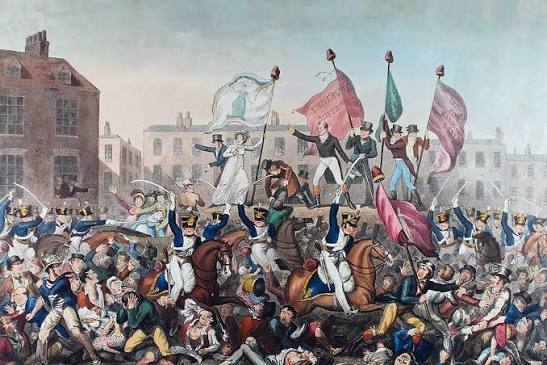
On 16 August 1819, tens of thousands of men, women, and children walked into Manchester carrying banners and wearing their best clothes. They came to St Peter’s Field to hear the celebrated reformer Henry Hunt demand a more representative Parliament. Within minutes of Hunt beginning to address them, mounted men forced their way through the crowd with drawn sabres. People were cut, crushed, trampled, and suffocated in the panic.
The violence became known as the Peterloo Massacre, a bitter parody of Waterloo, Britain’s celebrated military victory four years earlier. Modern research generally identifies 18 deaths linked to the event and hundreds of injuries, although older accounts often give 11 or 15 deaths and casualty totals vary. The disagreement reflects incomplete records and deaths that occurred later, not serious doubt that the dispersal caused mass suffering.
Peterloo is frequently described as a milestone on Britain’s road to democracy. That is true only with an important qualification: it produced no immediate democratic breakthrough. The government defended the magistrates and passed the repressive Six Acts. Its greater significance lay in political memory, radical journalism, mass organizing, and the enduring question it raised—what happens when authorities treat peaceful demands for representation as rebellion?
Manchester had no members of Parliament
Manchester was one of the fastest-growing industrial towns in Britain. By 1819 it had around 130,000 inhabitants, drawn by the cotton mills and the trades surrounding them. Yet Manchester elected no MPs of its own. The entire county of Lancashire returned only two, while tiny “rotten boroughs” with few voters could send representatives to Westminster.
The franchise was narrow, inconsistent, and overwhelmingly male. Voting qualifications differed between constituencies, and most working people had no vote. Reformers attacked not only exclusion but taxation, corruption, and laws made by a Parliament they considered unrepresentative. Their demands ranged from modest redistribution of seats to annual parliaments, secret ballots, and universal male suffrage.
Industrial growth sharpened the contradiction. Towns producing unprecedented wealth lacked direct parliamentary representation, while workers faced long hours, precarious employment, and political exclusion. Peterloo emerged from this imbalance between a rapidly changing society and an electoral system still rooted in older patterns of land and privilege.
War, hunger, and repression shaped the crisis
The Napoleonic Wars ended in 1815, but peace did not bring easy prosperity. Demobilized soldiers returned to a depressed economy. Textile workers faced falling wages and mechanization, while food prices remained politically charged. The Corn Laws of 1815 restricted imported grain and were widely seen as protecting landowners at consumers’ expense.
The government also feared revolution. Memories of the French Revolution, wartime invasion threats, Irish rebellion, Luddite machine breaking, and recent radical meetings shaped official thinking. Habeas corpus was suspended in 1817, allowing detention without ordinary trial safeguards, and authorities used spies and informers within radical networks.
These fears were not entirely invented: a minority of activists discussed insurrection, and serious disturbances had occurred. But officials often interpreted disciplined mass politics through the same lens as armed conspiracy. When workers drilled so they could march neatly to a meeting, magistrates could see military preparation rather than an effort to demonstrate respectability.
The mass platform offered a peaceful strategy
After parliamentary petitions failed, reformers developed the “mass platform”: immense outdoor meetings intended to show that public opinion could not be ignored. Henry “Orator” Hunt was its star speaker. He promoted large, peaceful assemblies whose numerical force would make reform appear both legitimate and inevitable.
Local reform unions organized contingents from Manchester, Middleton, Oldham, Rochdale, Stockport, and surrounding towns. Participants rehearsed marching in rows, elected marshals, and were told to bring no weapons. Many groups carried banners with slogans such as “Liberty and Fraternity,” “Unity and Strength,” and “Universal Suffrage.”
Women were unusually visible. Female reform societies formed in several Lancashire communities, raised funds, made banners, and marched in white dresses or distinctive ribbons. They did not generally demand votes for women in the modern suffrage sense; many supported universal male suffrage. Even so, their public organization challenged assumptions that formal politics belonged only to men.
The meeting was delayed and reorganized
Organizers initially planned a meeting for 9 August. Public notices suggested participants might elect a representative, a step that authorities argued would be illegal because Manchester had no parliamentary seat to fill. Reformers postponed the event, revised its stated purpose, and sought legal advice before calling a meeting for 16 August to consider parliamentary reform.
This legal preparation matters. Peterloo was not a crowd that unexpectedly turned into a political demonstration. The meeting was advertised, planned, and deliberately presented as lawful. The authorities knew when and where it would occur and positioned soldiers nearby.
Magistrates gathered in a house overlooking St Peter’s Field. They had access to Manchester and Salford Yeomanry, Cheshire Yeomanry, regular cavalry of the 15th Hussars, infantry, artillery, constables, and special constables. Government correspondence before the event encouraged caution about intervening unless an overtly illegal act occurred, yet local officials remained convinced that the assembly threatened public order.
A vast and disciplined crowd arrived
Groups walked miles into Manchester accompanied by bands and banners. The gathering included skilled workers, handloom weavers, laborers, small tradespeople, families, and political activists. Many had dressed for a public occasion rather than a battle. Witnesses remarked on the order of the arriving columns.
Crowd estimates range widely. Contemporary claims reached 100,000 or more, while later historians commonly place attendance between about 40,000 and 60,000. St Peter’s Field was packed tightly, making movement difficult even before the cavalry entered. Exact numbers cannot be recovered, but it was one of the largest political gatherings Britain had seen.
The platform, or hustings, held Hunt and other speakers, including members of the female reform movement. From the magistrates’ position, flags, marching columns, and the crowd’s size appeared intimidating. To participants, those same features demonstrated unity, discipline, and constitutional purpose. Peterloo’s conflict began partly in these opposing interpretations.
The magistrates ordered Henry Hunt’s arrest
Soon after Hunt arrived and began speaking, magistrates decided to arrest him and several organizers. They issued warrants and called on the Manchester and Salford Yeomanry to assist the constables. Whether the Riot Act was adequately read, heard, or allowed its required time before force was used became a central controversy. In a crowd that large, even a lawful proclamation from a window would have reached few people.
The local yeomanry were part-time mounted volunteers, drawn substantially from shopkeepers, manufacturers, and tradesmen. Some participants believed the unit had social and political hostility toward the reformers. As the yeomanry approached, one rider knocked down a woman carrying a small child; two-year-old William Fildes was killed before the main charge reached the field.
The yeomanry pushed toward the hustings through a crowd with little room to yield. They used sabres, claiming the horses were pressed and the banners obstructed them. Hunt was arrested, as were Joseph Johnson of the Manchester Observer and others on the platform. Rather than opening a path, the intervention created panic and compression.
Regular cavalry cleared the field
Magistrates then ordered the 15th Hussars to disperse the assembly. The regular cavalry entered from another direction and, together with yeomanry and constables, drove people from the field. Escape routes were constrained by buildings, walls, and the density of the crowd. Some fell beneath horses; others were struck with sabres or crushed by those fleeing.
The operation lasted only minutes. St Peter’s Field, previously filled with banners and families, was left scattered with clothing, shoes, bodies, and injured people. The violence extended into surrounding streets as troops pursued or confronted dispersing participants.
Most documented injuries were caused by sabres, trampling, or crushing. Women appear prominently in casualty lists, and some researchers argue they were disproportionately targeted because female reformers were conspicuous and politically provocative. Establishing intention in every attack is impossible, but testimony leaves no doubt that women as well as men were struck.
How many people died or were injured?
The often-cited death toll has changed as historians have reconstructed cases. Older official and educational summaries may list 11 or 15 fatalities. Recent Parliamentary Archives and National Archives material commonly uses 18, including people who died later from injuries or whose connection was established through subsequent research.
Injury figures also vary. Contemporary relief committees recorded hundreds, but many victims never sought formal help. Some feared losing work or attracting prosecution. Modern summaries often say more than 600 or as many as 700 were injured. Precise totals are impossible because no comprehensive neutral registration system existed.
The uncertainty should not be exploited to minimize the event. Named casualty research, petitions, medical testimony, newspapers, and eyewitness accounts reveal a broad pattern of sabre wounds and crush injuries.
Authorities and reformers told opposing stories
Magistrates argued that the assembly looked insurrectionary and that cavalry action was necessary to execute lawful arrests and prevent disorder. Supporters gathered sworn statements describing fear, drilling, banners, and allegedly threatening behavior. The Home Office and Prince Regent praised the magistrates soon after the event.
Reformers described an unprovoked attack on an orderly, unarmed crowd. They collected testimony, published casualty lists, and circulated prints showing mounted troops cutting down civilians. The Manchester Observer and national newspapers turned the field into a struggle over evidence as well as political rights.
Not every eyewitness account agrees, and visual prints were political objects rather than photographs. Yet multiple hostile, neutral, and radical sources establish that the meeting was peaceful when the arrest operation began. Claims that the crowd first launched a general attack do not fit the weight of the evidence.
Why it was called “Peterloo”
The name appeared within days in the radical press. It fused “St Peter’s Field” with “Waterloo,” mocking official celebration of British cavalry after Napoleon’s defeat in 1815. At Waterloo, soldiers had fought a foreign army; at Peterloo, mounted forces attacked British civilians seeking political reform.
The pun carried moral argument inside a single word. It presented the dispersal not as routine policing but as a battlefield massacre. Authorities and loyalist writers rejected that framing, while reformers used it on medals, handkerchiefs, ceramics, prints, poems, and pamphlets.
Calling Peterloo a massacre is sometimes challenged because the death toll was lower than in many events given that label. Historical usage is not determined by a numerical threshold. The term captured the asymmetry of mounted, armed force used against a densely packed civilian meeting and became part of the event almost immediately.
The government answered with the Six Acts
Peterloo did not produce an official parliamentary inquiry. More than a hundred petitions reached Parliament describing injuries and demanding investigation, but ministers supported the local authorities. Hunt, Samuel Bamford, and other reformers were prosecuted; Hunt was imprisoned after conviction for seditious assembly, and Bamford served a year.
Late in 1819, Parliament passed measures collectively known as the Six Acts. They restricted large meetings, accelerated prosecution for seditious publications, increased taxes on cheap political print, strengthened powers to search for weapons in specified areas, and tightened controls on training and drilling.
The legislation aimed to break the radical movement’s ability to gather and communicate. The Manchester Observer was repeatedly prosecuted and closed in 1821. Repression pushed some activists toward caution, others toward underground activity, and a very small number toward conspiracy—an atmosphere explored in the related Cato Street Conspiracy of 1820.
Peterloo transformed radical print culture
Reports, engravings, poems, and commemorative objects carried Peterloo far beyond Manchester. Radical publisher Richard Carlile printed accounts and imagery, endured prosecution, and continued publishing. John Edward Taylor, a witness who wrote reports for the Times, later helped found the Manchester Guardian in 1821, though the paper’s origins and early politics should not be reduced to Peterloo alone.
Percy Bysshe Shelley, living in Italy, responded with The Mask of Anarchy. The poem urged mass, disciplined resistance and famously imagined the many confronting the few. Research has shown how closely Shelley drew on radical newspaper reports, especially Carlile’s published material. The poem was not published in full until 1832, when political conditions had changed.
Objects also preserved memory. Printed handkerchiefs, medals, jugs, and plates allowed households to display political allegiance. In an age before photography, these materials helped fix the image of sabre-wielding cavalry attacking civilians.
Did Peterloo cause the Great Reform Act?
The 1832 Reform Act redistributed seats and widened the electorate, including representation for Manchester. Peterloo remained a powerful warning and symbol during the renewed reform crisis of 1830–32. But a direct line from massacre to act oversimplifies thirteen years of political conflict, economic change, organization, and elite division.
The 1832 settlement was also limited. It enfranchised more middle-class men but excluded most working-class men and all women. Secret ballots, broad male suffrage, and women’s parliamentary votes arrived through later reforms. Peterloo’s demonstrators did not receive their full demands in 1832.
Its influence was cumulative rather than immediate. Peterloo delegitimized complacent claims that the unreformed system commanded consent, supplied later movements with martyrs and language, and showed both the power and vulnerability of mass meetings. Chartists in the 1830s and 1840s inherited that political landscape.
Women were participants, not background figures
Female reformers chaired meetings, created organizations, presented addresses, raised subscriptions, and occupied visible positions around the hustings. Figures such as Mary Fildes became symbols of women’s radical involvement. Their presence complicates histories that begin women’s political activism only with the later suffrage campaigns.
At the same time, most female reform societies framed their cause through household hardship and support for male voting rights. It would be misleading to portray Peterloo as a modern campaign for equal adult suffrage. Women’s participation was politically innovative without being identical to twentieth-century feminism.
The injuries women suffered also shaped radical representations. Prints emphasized respectable mothers and female reformers attacked by armed men, using contemporary ideas about femininity to condemn the cavalry. Such imagery could honor women’s courage while still defining them chiefly as vulnerable victims.
Common myths and disputed details
Peterloo was not a spontaneous food riot. It was an organized reform meeting with speakers, marshals, banners, and contingents. Nor was it an armed uprising. Some marchers carried ordinary walking sticks, but organizers explicitly instructed participants not to bring weapons, and the crowd was peaceful before the arrest began.
It is also misleading to say regular soldiers alone carried out the massacre. The Manchester and Salford Yeomanry initiated the push toward the platform, while the 15th Hussars participated in clearing the field. Eyewitnesses sometimes distinguished between their conduct, but both forces formed part of the coercive operation ordered by magistrates.
Finally, casualty numbers depend on definitions and later research. Eighteen deaths is the strongest current figure in major archival accounts, while contemporary documents and older histories list fewer. Stating the range and method is more honest than presenting every source difference as a mystery.
Memory returned to the center of Manchester
For much of the nineteenth and twentieth centuries, Peterloo remained important to labor, liberal, and democratic traditions, yet its physical commemoration near the changing city center was modest. Campaigners argued that a plaque could not adequately explain an event of national significance.
The bicentenary in 2019 produced exhibitions, digital archives, performances, public discussions, and a new memorial by artist Jeremy Deller near the original site. Debate over the memorial’s accessibility showed that commemoration itself is political: a monument to democratic participation must also consider who can physically use and approach it.
The University of Manchester, the National Archives, Parliamentary Archives, and People’s History Museum have digitized documents that place eyewitness voices beside official correspondence. These sources prevent Peterloo from becoming either patriotic progress myth or simple radical legend.
Conclusion: the meaning of Peterloo
Peterloo began with a constitutional demand from people excluded from Parliament. The crowd used scale, discipline, banners, and public speech to make itself politically visible. Magistrates interpreted those same features as a threat, ordered arrests, and deployed mounted force into a space from which tens of thousands could not safely escape.
The immediate outcome was repression rather than reform. The government praised officials, prosecuted organizers, and passed the Six Acts. Yet the attempt to control the story failed. Testimony, petitions, journalism, objects, and poetry preserved the image of peaceful reformers attacked by armed authority.
Its lasting importance lies not in a claim that one terrible afternoon created British democracy. Peterloo exposed the violence required to defend an unrepresentative system and forced later generations to confront the limits of assembly, policing, and political voice. Democracy did not flow automatically from the field; it was built through the continued struggles of people who refused to let the field be forgotten.
Sources and further reading
- The National Archives: “The Peterloo Massacre”
- UK Parliament: Samuel Bamford’s Peterloo petition
- People’s History Museum: Archives Alive—Peterloo
- University of Manchester Library: Peterloo digital collection
- University of Cambridge: Shelley’s Peterloo poem and the radical press
- Robert Poole, “‘By the Law or the Sword’: Peterloo Revisited,” History