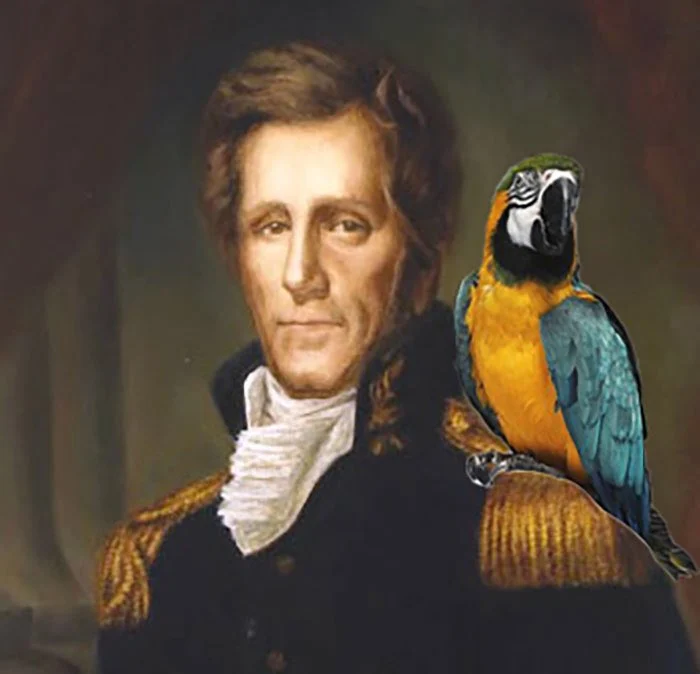
Among the many colorful stories that surround Andrew Jackson, the seventh president of the United States, few are as strange, humorous, and oddly revealing as the tale of his foul-mouthed parrot. Jackson, a fierce military commander, political brawler, and one of the most polarizing figures in American history, owned a pet African grey parrot named Polly. Unlike most presidential pets remembered for charm or elegance, Polly became infamous for something very different: an extraordinary talent for profanity. Jackson reportedly taught the bird to curse with such enthusiasm that by the end of the president’s life, Polly had developed a vocabulary so offensive that she caused chaos at his funeral. According to legend, the parrot had to be removed from the ceremony because it would not stop loudly swearing in front of grieving mourners. While the story sounds almost too absurd to be true, it is rooted in credible historical accounts and offers an unexpectedly intimate window into the personality of one of America’s most forceful and controversial leaders.
Andrew Jackson’s Temperament and Why a Cursing Parrot Made Perfect Sense
To understand why Andrew Jackson would teach a parrot to curse like a sailor, one must first understand the man himself. Jackson was not a polished aristocrat in the mold of Thomas Jefferson or James Madison. He was a frontier soldier, shaped by violence, hardship, and personal loss. Orphaned as a teenager during the American Revolution, Jackson endured brutal treatment as a prisoner of war and carried physical scars for the rest of his life. These early experiences forged a personality that was aggressive, confrontational, and fiercely independent.
As an adult, Jackson was notorious for his volatile temper and readiness to fight—sometimes literally. He participated in numerous violent confrontations, including at least a dozen documented duels. The most famous of these left a bullet embedded in his chest for decades after he killed his opponent. He was known for savage political feuds, blistering insults, and a complete lack of tolerance for anyone he considered disloyal or disrespectful. His presidency itself was defined by conflict: the destruction of the Second Bank of the United States, bitter disputes with Congress, fierce battles with political rivals, and the horrifying enforcement of Indian removal policies that culminated in the Trail of Tears.
Jackson’s language matched his temperament. Contemporaries frequently described his speech as coarse, blunt, and laced with profanity. Unlike earlier presidents who prized refinement, Jackson embraced a rough-edged populist identity that resonated with working-class voters. He portrayed himself as a man of the people rather than an elite philosopher-statesman. In such an environment, teaching a pet parrot to curse seems less shocking and more like a natural extension of his personality. Polly was not simply a novelty pet; the bird became a living reflection of Jackson’s household—loud, defiant, and entirely unconcerned with polite society.
This context matters because it transforms the parrot story from a random curiosity into a revealing character study. Jackson’s decision to cultivate vulgarity in his pet suggests that he found humor in defiance of social norms. It also underscores how deeply profanity was woven into his everyday life. Polly was not an accidental product of exposure; according to historical accounts, Jackson actively taught the bird to swear. The result was a parrot whose vocabulary reportedly rivaled that of hardened soldiers and sailors—and whose legendary outbursts would one day disrupt one of the most solemn events in American political history.
Polly the Parrot: Life at The Hermitage and Years of Learned Profanity
Polly spent most of her life at The Hermitage, Andrew Jackson’s plantation estate outside Nashville, Tennessee. This was not a quiet, refined home. The Hermitage was a busy and often chaotic environment, staffed by dozens of enslaved people, visited by political allies and enemies alike, and filled with stern arguments, laughter, illness, and constant activity. Jackson himself suffered from chronic pain due to various old wounds and illnesses, which made him even more irritable and sharp-tongued as he aged.
African grey parrots like Polly are known for their exceptional intelligence and speech mimicry. They do not merely repeat sounds mechanically; they can associate words with context, emotion, and reaction. This makes Polly’s case especially fascinating, because it suggests the bird was constantly absorbing the verbal environment of Jackson’s household. The profanity was not learned in isolation. It was reinforced by laughter, reactions, anger, and repeated human behavior.
Accounts from visitors suggest that Polly was perfectly capable of polite speech when she chose to be—but that her default mode was aggressive swearing. The bird allegedly responded to guests with shocking insults, often at full volume. Unlike a dog that might bark unpredictably, Polly’s outbursts were linguistic, targeted, and unmistakable in their meaning. This made her both entertaining and scandalous.
What is particularly telling is that Jackson allowed this behavior, even encouraged it. For a man so obsessed with honor and respect in public life, this tolerance for vulgarity in private reveals a sharp divide between his political image and his personal amusements. Among trusted friends, Jackson reportedly laughed at Polly’s verbal attacks. In that private world, profanity was not shameful—it was an expression of identity and emotional authenticity.
Polly also became closely associated with Jackson’s wife, Rachel, whom he adored deeply. Rachel’s death in 1828 devastated Jackson and permanently hardened his personality. After her passing, Polly remained a constant companion in his life, a living reminder of the household he once shared with his wife. This emotional connection likely explains why Polly was still present at The Hermitage at the time of Jackson’s own death in 1845. By then, the parrot had lived for decades in an environment saturated with intense emotion, political argument, grief, and rage—all of which shaped her extraordinary vocabulary.
Thus, Polly was not simply an oddity. She was a long-term inhabitant of one of the most emotionally charged homes in American political history. Her profanity was not merely a trick—it was the product of years of immersion in Andrew Jackson’s private world.
The Infamous Funeral Incident: Did Polly Really Get Kicked Out?
Andrew Jackson died on June 8, 1845, at the age of 78, after years of declining health. His funeral at The Hermitage was a major national event. Thousands of mourners gathered to honor the former president, including political supporters, military veterans, neighbors, clergy, and enslaved people from the plantation. It was meant to be a dignified ceremony celebrating the life of a man who had shaped the nation’s politics and identity.
Then came the parrot.
According to multiple historical accounts, including writings by Reverend William Menefee Norwood—an eyewitness to the funeral—Polly caused a scandal unlike anything the mourners had ever seen. As the ceremony progressed and emotions ran high, the parrot began screaming a torrent of profanity so loud and persistent that it disrupted the proceedings. Norwood described the bird’s language as “terrible,” noting that it shocked even those accustomed to rough frontier speech. The situation became so untenable that someone was forced to remove Polly from the vicinity in order to restore order to the service.
This account is widely quoted by historians and appears in multiple 19th-century sources, making it one of the better-documented presidential pet legends. While some later retellings exaggerate the details—claiming the bird cursed nonstop for hours or insulted the mourners personally—the core story remains remarkably consistent across generations: Andrew Jackson’s parrot disrupted his funeral with obscene language and had to be removed.
The symbolism of the event is almost too perfect. Jackson, a man whose political life was defined by conflict and controversy, was accompanied into death by a creature that embodied his most unfiltered habits. Even in death, the disorder and intensity that defined his personality refused to be fully contained. The parrot’s outburst became a kind of accidental eulogy—unplanned, inappropriate, but strangely fitting.
Some historians caution that while the basic account is reliable, the precise words spoken by Polly cannot be verified. Human memory tends to dramatize such moments over time. Yet the fact that multiple contemporaries recorded the incident confirms that it truly happened in some form. The parrot did, indeed, cause a scandal at the funeral. And that scandal has outlived nearly every other detail of Andrew Jackson’s private domestic life.
What Polly the Parrot Reveals About Jackson as a Man and a President
The legend of Andrew Jackson’s cursing parrot endures not simply because it is funny, but because it reveals uncomfortable truths about the man behind the office. Jackson cultivated an image of strength, honor, and frontier virtue. But Polly exposes the coarse, impulsive, and often cruel side of his personality in a way that speeches and portraits never could.
Jackson’s presidency was marked by brutal decisions, especially regarding Native American removal. The same temperament that found humor in a vulgar parrot also fueled policies that resulted in massive human suffering. His refusal to soften language in private parallels his refusal to compromise politically. Polly becomes, in a strange symbolic way, an echo of Jackson’s moral universe—one where power, force, and defiance took precedence over restraint.
At the same time, the parrot humanizes Jackson. It shows that he was not a distant marble statue of a president but a man who enjoyed ridiculous amusements, who laughed at profanity, and who kept a talkative companion in his home. It complicates the image of Jackson as nothing but a ruthless warrior. Behind the violent general and iron-willed president was a man who liked practical jokes, enjoyed animals, and apparently took great pleasure in hearing a bird swear like a deckhand.
This tension between brutality and familiarity is one of the defining features of Jackson’s historical reputation. He championed democracy for white working-class men while simultaneously committing grave injustices against others. He broke entrenched political elites while enforcing racial hierarchies with devastating force. Polly’s story sits squarely within this contradiction. The parrot is hilarious and unsettling at the same time—exactly like Jackson himself.
The funeral incident, in particular, resonates because of its symbolic power. Funerals represent control, reflection, and dignity. Polly represented chaos, raw emotion, and unfiltered voice. That clash at the moment of Jackson’s burial mirrors the way his life often clashed with the established norms of government. Even in death, he disrupted expectations.
Why the Story Endured and How It Became Part of American Folklore
The survival of the Polly story across nearly two centuries is no accident. American folklore thrives on tales that mix power with absurdity. A cursing parrot at a presidential funeral is exactly the kind of image that lodges itself permanently in cultural memory. It is shocking enough to be retold, funny enough to be remembered, and symbolic enough to carry meaning beyond the humor.
The story also benefits from being anchored in credible sources rather than rumor alone. The Reverend Norwood’s written account provided a contemporary foundation that later historians could reference, giving the legend legitimacy. From there, it passed into biographies, museum exhibits, and popular history books. Over time, the details have grown bolder, but the central event remains intact.
Polly has also become part of a larger tradition of unusual presidential pets—Teddy Roosevelt’s menagerie, Calvin Coolidge’s raccoon, Lincoln’s goats. But unlike most presidential animals remembered for charm, Polly is remembered for scandal. That makes the bird unique. She is not an emblem of innocence or whimsy, but of disruption.
There is also something psychologically satisfying about watching authority punctured by something ridiculous. Andrew Jackson commanded armies, reshaped political parties, and terrified enemies. Yet at his own funeral, he was upstaged by a foul-mouthed bird. History often preserves such moments because they restore a sense of balance. They remind us that no matter how powerful a person becomes, they remain vulnerable to the absurd.
In modern times, the story is frequently shared as trivia or a strange factoid. But within that humor lies deeper meaning. The parrot is not just a curiosity—it is a lens through which we glimpse Jackson’s private world and the contradictions that defined his life.
How historians understand the story today
Andrew Jackson’s parrot, Polly, remains one of the strangest and most revealing footnotes in presidential history. Taught to curse like a sailor by one of the most aggressive presidents the nation ever produced, the bird became a living echo of Jackson’s personality—loud, defiant, and impossible to silence. The fact that Polly reportedly disrupted Jackson’s own funeral with a torrent of profanity feels almost poetic in its symbolism. Even in death, Jackson could not fully escape controversy, conflict, or disorder.
Beyond the humor, the story invites us to see historical figures as real people rather than distant monuments. Jackson was a war hero, a president, a policy maker, and a deeply flawed human being. Polly does not diminish his historical importance—but she does strip away some of the mythic distance and replace it with raw, human absurdity.
In the end, the legend of the cursing parrot endures because it captures something essential about Andrew Jackson himself: powerful, disruptive, unforgettable, and incapable of fading quietly into the background, even in death.
Research and further reading
For readers who want to verify details or continue researching this subject, these external reference collections provide useful starting points: