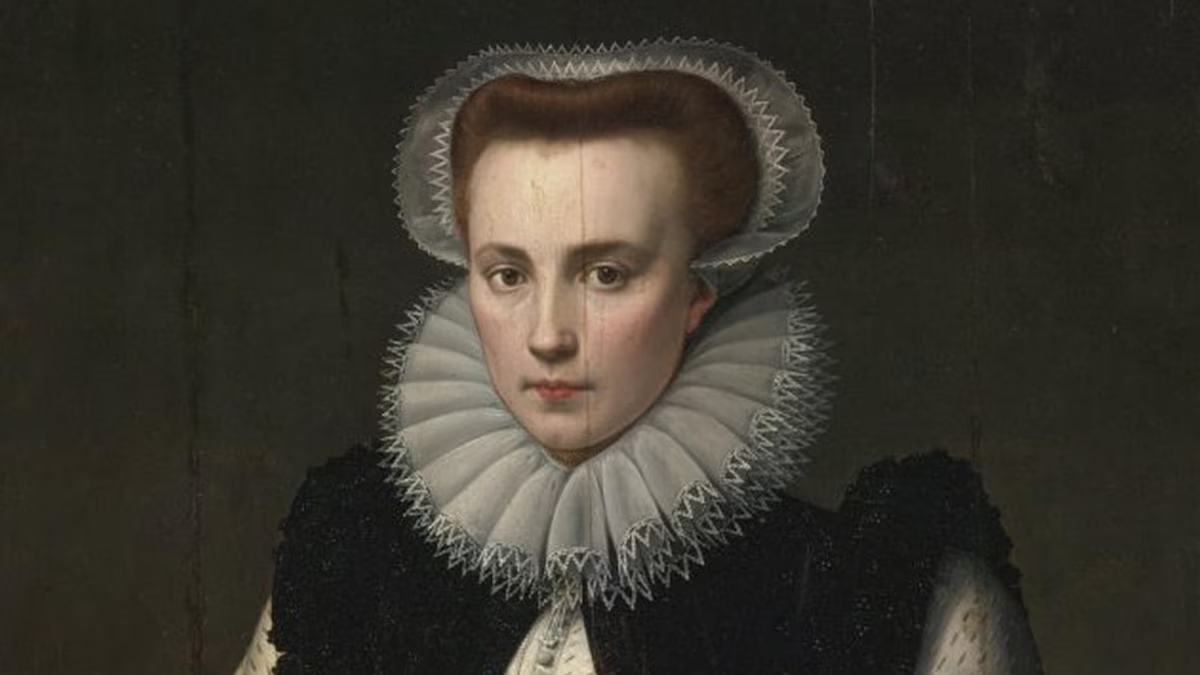
Few figures in European history evoke as much fascination, horror, and controversy as Elizabeth Báthory. Often described as the most infamous female serial killer of all time, she was a powerful Hungarian noblewoman accused in the early 17th century of torturing and killing hundreds of young girls—many of them reportedly between the ages of ten and fourteen. According to the most extreme claims, her victims numbered more than 650. These allegations earned her the chilling nickname “The Blood Countess,” a title that still echoes through folklore, literature, and popular culture centuries later. Yet beneath the monstrous reputation lies a complex historical case shaped by politics, gender, power, superstition, and a judicial system very different from our own. To understand whether Elizabeth Báthory was a uniquely evil murderer, a victim of political conspiracy, or something in between, one must step into the turbulent world of early modern Central Europe.
The World That Shaped Elizabeth Báthory: Nobility, Power, and Violence in 16th-Century Hungary
Elizabeth Báthory was born in 1560 into one of the most powerful noble families in the Kingdom of Hungary. The Báthory clan was wealthy, politically influential, and deeply entangled in the violent frontier between Christian Europe and the expanding Ottoman Empire. This was not a peaceful or gentle world. Warfare, public punishment, and systemic cruelty were normalized aspects of life. Noble families governed their lands with near-total authority over peasants, servants, and tenants. Justice was often private, administered by lords rather than centralized courts.
From an early age, Elizabeth was exposed to extreme examples of power and discipline. Chroniclers describe her witnessing public beatings and executions as a child, experiences that would not have been unusual for someone of her status. Education among high nobility was strict and demanding. She was highly literate, fluent in multiple languages, and trained to manage estates, judge disputes, and exercise authority. This intelligence and training later became central to both her success and her infamy.
At the age of fifteen, Elizabeth married Ferenc Nádasdy, a celebrated military commander known for his ruthlessness on the battlefield. Their marriage united two of Hungary’s most formidable aristocratic houses, further expanding Elizabeth’s wealth and autonomy. While her husband spent much of his life at war, Elizabeth managed vast estates, commanded servants, and exercised legal authority over thousands of people. This level of independence was rare for women of her era, making her both powerful and politically vulnerable.
Violence was not viewed through the modern psychological lens of criminal pathology. Harsh punishment was seen as necessary governance. Peasants had little legal recourse against noble authority. In this environment, brutality—real or alleged—might go unchallenged for years. Whether Elizabeth’s later accusations reflect extraordinary cruelty or reflect how unchecked aristocratic justice could become, her story cannot be separated from the violent world that produced her.
The Accusations: Torture, Young Victims, and the Rise of the “Blood Countess” Legend
The accusations against Elizabeth Báthory began circulating in the late 1590s and intensified after the death of her husband in 1604. Without Ferenc Nádasdy’s military prestige to shield her, rumors surrounding her household grew darker and more public. Servants reportedly began to disappear. Families in surrounding villages whispered about daughters who entered the Countess’s service and were never seen again.
According to later testimony, Elizabeth and a small circle of close assistants were accused of abducting, imprisoning, and torturing young girls. Many of the alleged victims were believed to be between the ages of ten and fourteen, sent by poor families who saw noble service as an opportunity for survival. Over time, claims escalated from dozens of victims to hundreds. One surviving court document cited a number exceeding 650, allegedly drawn from a ledger kept by one of Elizabeth’s servants. This number, however, remains one of the most contested aspects of the case.
It is crucial to note that no physical evidence survives today, and no modern forensic investigation was ever possible. Much of what we know comes from witness testimony recorded years after the alleged crimes took place. These testimonies were often second- or third-hand, describing what someone claimed to have heard rather than what they personally witnessed. Still, the consistency of certain patterns—disappearances, injuries, fear among servants—cannot be dismissed outright.
Legends later added grotesque elements, including the infamous claim that Elizabeth bathed in the blood of young girls to preserve her youth. There is no solid historical evidence that such rituals actually took place. Most serious historians view this detail as a product of later sensationalism rather than documented fact. The reality, if crimes did occur, was likely less theatrical but no less horrifying.
What made the accusations particularly shocking was not only the brutality described, but the social status of the alleged killer. Violent crime was expected among soldiers and criminals—not among aristocratic women who symbolized refinement and Christian virtue. The gap between Elizabeth’s noble image and the nature of the accusations helped transform her into a figure of enduring myth.
The Investigation and Trial That Never Fully Happened
In 1610, after years of increasing pressure from the public and from rival nobles, an official investigation into Elizabeth Báthory was finally launched. The man tasked with leading it was György Thurzó, the Palatine of Hungary—one of the most powerful political figures in the kingdom. Thurzó was not just an investigator; he was also deeply tied to the Habsburg monarchy and had significant financial interests in Elizabeth’s lands.
Hundreds of testimonies were collected during this investigation. Witnesses included servants, local villagers, and minor nobility. Some claimed to have seen injured girls. Others said they had heard screams coming from the castle. A few described finding bodies or assisting in the disposal of the dead. These statements formed the backbone of the case against Elizabeth.
Yet one extraordinary detail stands out: Elizabeth herself was never formally tried in an open court. Her servants and alleged accomplices were interrogated, tortured for confessions, convicted, and executed. Elizabeth, by contrast, was placed under permanent house arrest in her castle. Official explanations varied. Some argued that as a high noble, she was above ordinary trial procedures. Others suggested that a public trial would destabilize the political order.
This lack of a formal trial has fueled centuries of debate. Without a courtroom defense, Elizabeth never had the opportunity to contest the accusations publicly, cross-examine witnesses, or expose potential motivations behind the claims. Her guilt was assumed, her fate sealed without the legal process we would expect today.
She remained confined until her death in 1614. According to surviving accounts, she spent the final years of her life isolated in a small section of her castle, cut off from society but still alive. No execution was carried out. No public sentence was read. Her punishment was erasure—a living burial within stone walls.
The way her case was handled reflects not only the strangeness of early modern justice but also the dangerous intersection of crime, power, and politics in a world where law was not universal.
Politics, Property, and the Possibility of Conspiracy
From the moment of Elizabeth Báthory’s arrest, questions arose about whether her downfall was driven purely by justice—or by political and financial ambition. Elizabeth was one of the wealthiest landowners in Hungary. Enormous estates, castles, and village populations were under her control. Her family held debts owed to the Habsburg crown. Removing her from power conveniently resolved these financial entanglements.
György Thurzó himself became the administrator of much of Elizabeth’s property after her confinement. The crown benefited as well, as significant debts were nullified. These facts alone do not prove conspiracy—but they do reveal that powerful interests stood to gain from her removal.
Some modern historians argue that Elizabeth may have been guilty of cruel punishments common among feudal lords but that the scale of her alleged crimes was grossly exaggerated. In this interpretation, political enemies exploited real abuses to construct a monstrous narrative that justified stripping her family of power without provoking rebellion.
Gender may also have played a role. A highly educated, independently ruling woman in a deeply patriarchal society was already a social anomaly. A woman accused of extreme violence fit neatly into early modern anxieties about female power, witchcraft, and moral corruption. Even though Elizabeth was never officially tried for witchcraft, the moral panic of the era shaped how her story was told and believed.
Others maintain that the sheer volume of testimony—regardless of its imperfections—points to genuine atrocity. While the exact number of victims may be unknowable, they argue that Elizabeth’s household exhibited a consistent pattern of abuse that could not be explained away by politics alone.
The truth may lie between these extremes. Elizabeth Báthory may have been both a violent abuser of power and a convenient target for political destruction. History rarely offers clean villains or innocent victims in such cases—only layered human tragedy shaped by systems far larger than any one individual.
Myth, Folklore, and the Transformation of Elizabeth Báthory into a Gothic Icon
Long after her death, Elizabeth Báthory’s story escaped the realm of court records and entered the world of folklore, gothic literature, and horror myth. Writers in the 18th and 19th centuries reshaped her into a supernatural figure, blending her legend with vampire imagery, alchemy, and forbidden rituals. The most famous addition—the bathing in blood to maintain youth—emerged fully during this period, not from contemporary trial documents.
This transformation reflects how societies retell crimes to match cultural fears. In eras fascinated by immortality, forbidden science, and secret female power, Elizabeth became an ideal symbol. She was recast not merely as a murderer but as something unnatural, almost demonic—an embodiment of aristocratic corruption taken to its extreme.
Her story influenced later fictional characters and contributed to the broader development of the “female monster” trope in Western horror. Unlike male serial killers, who were often portrayed as brutal but human, Elizabeth was increasingly depicted as seductive, immortal, and predatory—an early prototype of the aristocratic vampire figure.
At the same time, popular memory simplified her narrative. The legal ambiguities vanished. Political context faded. What remained was the image of a countess who preyed on hundreds of young girls. The emotional power of that story proved irresistible, even when its historical foundations were uncertain.
Today, museums, films, novels, and documentaries continue to revisit Elizabeth Báthory as both historical figure and mythic villain. Each retelling reveals as much about the fears and fascinations of the storyteller’s era as about the original events themselves.
The Historical Legacy of Elizabeth Báthory and What Her Case Teaches Us
Elizabeth Báthory remains one of the most debated and disturbing figures in European history because her story sits at the crossroads of documented violence, legal irregularity, political ambition, and cultural mythmaking. If she truly committed the crimes attributed to her, she represents one of the most extreme cases of sustained violence by an individual in recorded history. If she was partially or largely framed, her case reveals how easily justice could be rewritten by power.
What is certain is that young girls—many from impoverished families—were placed in positions of extreme vulnerability within feudal systems that offered them almost no protection. Whether thirty, three hundred, or more, their suffering mattered, even if their names are lost. Their disappearance reminds us that early modern society valued noble authority far above peasant life.
Her case also exposes how early judicial processes differed radically from modern standards. Confessions extracted under torture, hearsay testimony, and the absence of a formal trial for the accused noblewoman would be unacceptable today. Yet these methods formed the backbone of legal truth in her age.
Finally, Elizabeth Báthory’s legacy demonstrates how history is shaped not only by what happened, but by how stories are told afterward. Over four centuries, she has been molded into a symbol of female evil, aristocratic decay, and supernatural horror. The line between history and legend has blurred so thoroughly that disentangling them may now be impossible.
What remains is a warning about unchecked power, dehumanization of the vulnerable, and the ease with which violence can be normalized when systems of accountability collapse.
Monster, Murderer, or Product of a Ruthless World?
Elizabeth Báthory de Ecsed endures as one of history’s most notorious figures because her story forces us to confront uncomfortable questions. Was she truly the most prolific female serial killer ever recorded, responsible for the deaths of hundreds of young girls? Or was her legend forged in the crucible of political ambition, gendered fear, and sensational storytelling?
The surviving evidence suggests that something dark occurred within the walls of her estates. Too many testimonies, too much fear, and too many vanishings surround her name to dismiss the case entirely. Yet the exact scale of her crimes, the reliability of the accusations, and the motivations of those who condemned her remain deeply uncertain.
What is beyond doubt is that her life unfolded in a world where noble power could operate almost without oversight, where the poor were expendable, and where truth was shaped as much by politics as by fact. Whether villain or victim of exaggeration, Elizabeth Báthory stands as a symbol of how absolute power can corrode moral limits—and how easily history can turn human tragedy into immortal horror.
Research and further reading
For readers who want to verify details or continue researching this subject, these external reference collections provide useful starting points: