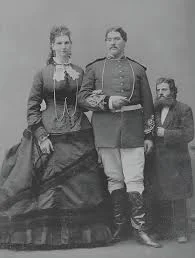
In the 19th century, an era fascinated by physical extremes and human curiosities, no married couple captured public imagination quite like Anna Haining Swan and Martin Van Buren Bates. Standing at an astonishing 7 feet 11 inches and 7 feet 9 inches respectively, they remain the tallest married couple ever reliably recorded. Their lives unfolded at the intersection of medical mystery, social spectacle, and genuine human dignity. While they were often displayed as marvels due to their extraordinary height, their story goes far beyond sideshow posters and newspaper headlines. It is a deeply human account of love, resilience, and the challenges of living in bodies that defied the physical norms of their time. Perhaps the most startling detail of all is that when Anna Swan gave birth, her baby weighed an astonishing 22 pounds—a figure almost impossible to imagine even today. Their story reveals much about 19th-century medicine, public attitudes toward physical difference, and the ways extraordinary people navigated a world built for the ordinary.
Anna Haining Swan: A Childhood That Defied All Expectations
Anna Haining Swan was born in 1846 in Nova Scotia, Canada, into a family of average height. From the beginning, her growth followed an extraordinary trajectory. As a child, she grew at a rate that quickly alarmed and amazed both her family and local doctors. By the age of four, she was already taller than many adults. By her teenage years, she stood well over seven feet tall. At a time when medical understanding of growth disorders was extremely limited, there was little explanation for her condition beyond vague references to “giantism,” a term used more descriptively than diagnostically in the 19th century.
Despite her size, Anna was described as intelligent, articulate, and gentle. She received a good education for a woman of her era and developed interests in literature, music, and religion. However, daily life posed constant challenges. Furniture, clothing, doorways, and transportation were all designed for people several feet shorter. Even simple acts like sitting at a desk or walking through a standard home required adaptation. Custom-made shoes and dresses were expensive and difficult to obtain, placing a financial burden on her family.
Public curiosity soon followed. In the mid-1800s, society was captivated by physical anomalies, often viewing them through a lens of spectacle rather than empathy. Traveling exhibitions and “curiosity shows” promised income and independence for people with unusual bodies, though often at the cost of privacy and dignity. For Anna Swan, the decision to enter public exhibition was not merely about fame—it was about survival and self-determination. With limited employment opportunities available to a woman of her size, exhibiting herself became one of the few ways to earn a living.
Yet Anna resisted being reduced to a novelty. She insisted on being treated with respect and often spoke publicly about her intelligence and humanity. She was not merely tall; she was thoughtful, articulate, and deeply aware of how society perceived her. This self-possession would later shape how she navigated marriage, motherhood, and public life alongside an equally extraordinary partner.
Martin Van Buren Bates: From Kentucky Giant to Civil War Veteran
Martin Van Buren Bates was born in 1837 in Kentucky and, like Anna Swan, came from parents of average stature. His exceptional height emerged during adolescence, though not as dramatically early as Anna’s. By adulthood, he stood 7 feet 9 inches tall and weighed over 400 pounds. His immense size made him a striking figure, but it also came with physical challenges, including joint strain and limited mobility—issues that were poorly understood and inadequately treated in the 19th century.
Unlike many giants of the era, Bates lived through one of the most defining conflicts in American history: the Civil War. He enlisted in the Confederate Army and served for a time, though his size made military life difficult. Accounts vary regarding his exact role, but it is clear that his stature attracted attention wherever he went. Military equipment, uniforms, and living quarters were never designed for someone of his dimensions, further highlighting how his body placed him outside the norms of everyday society.
After the war, Bates, like many veterans, struggled to find stable employment. His height limited his options but also opened unusual opportunities. He eventually joined traveling exhibitions, where he was billed as a “giant” and displayed to curious crowds. While modern audiences may view such exhibitions with discomfort, in the 19th century they were often the only viable means of financial independence for people with extreme physical traits.
Bates was reportedly soft-spoken and courteous, qualities that contrasted with his imposing appearance. He was deeply religious and valued domestic stability—traits that would later define his married life. Like Anna Swan, he navigated the fine line between public fascination and personal dignity. Their eventual meeting would unite not just two extraordinarily tall individuals, but two people who understood each other’s challenges in a way few others ever could.
A Marriage That Captivated the World
Anna Haining Swan and Martin Van Buren Bates met through the world of traveling exhibitions, where their paths crossed amid the circuit of public displays featuring people with extraordinary physical characteristics. Their shared experiences fostered mutual understanding, and over time, admiration turned into affection. When they married in 1871, their union became an international sensation.
The wedding was held in London and drew massive crowds. Newspapers across Europe and North America reported on the event with a mixture of awe and sensationalism. Journalists marveled at the couple’s combined height, calculating their measurements with near-mathematical fascination. Yet beneath the spectacle was a genuine relationship rooted in companionship and shared resilience.
For the couple, marriage represented something profoundly ordinary in an extraordinary context. It offered stability, intimacy, and a sense of belonging in a world that often treated them as curiosities. Their marriage challenged assumptions that people with extreme physical differences were incapable of conventional domestic life. They lived together, traveled together, and sought privacy when possible, even as public interest followed them relentlessly.
Their home had to be specially constructed to accommodate their size. Furniture was custom-built. Beds were oversized. Doorways were higher than standard. Every aspect of daily life required adaptation. Yet by all accounts, they valued these domestic comforts deeply. After years on the road, their home became a sanctuary from constant observation.
The marriage also carried symbolic weight. In a society that often marginalized people with physical differences, Anna and Martin’s union asserted their right to love, partnership, and normalcy. They were not anomalies seeking attention; they were two people choosing a life together on their own terms. This quiet assertion of dignity may be one of the most powerful aspects of their story.
Pregnancy at the Edge of Medical Possibility
Perhaps the most astonishing chapter of Anna Swan’s life came with pregnancy. In the 19th century, childbirth was already dangerous for women of average size. Medical knowledge of obstetrics was limited, anesthesia was primitive, and infection was a constant threat. For a woman nearly eight feet tall, carrying a child posed unprecedented risks.
Doctors were deeply concerned. There were no established medical guidelines for pregnancy in women with gigantism. Swan’s size suggested the possibility of an unusually large infant, but there was no reliable way to predict outcomes. Throughout her pregnancy, she was closely monitored, though monitoring itself was rudimentary by modern standards.
When Anna gave birth, the results stunned everyone involved. Her baby weighed approximately 22 pounds—more than double the average newborn weight even by today’s standards. The infant was also extremely long, reportedly measuring nearly three feet at birth. Such a size bordered on the limits of what the human body could produce or survive.
Tragically, the child lived only a few hours. While historical records vary in detail, it is likely that the infant’s extreme size placed overwhelming strain on its organs, particularly the heart and lungs. Neonatal care was virtually nonexistent at the time, and even today such a birth would require intensive medical intervention.
For Anna and Martin, the loss was devastating. Their grief was compounded by public intrusion, as newspapers reported on the birth with the same fascination that had followed their wedding. Yet the event also entered medical history, becoming one of the most extreme documented cases of infant birth weight.
The pregnancy highlighted both the resilience and vulnerability of bodies affected by growth disorders. It also underscored how limited 19th-century medicine was when faced with extraordinary cases. Anna survived the birth—a remarkable fact in itself—but the experience left a lasting mark on her life.
Medical Understanding of Gigantism in the 19th Century
During Anna Swan and Martin Bates’s lifetimes, gigantism was poorly understood. The condition, now known to be caused primarily by excess growth hormone—often due to pituitary tumors—was not scientifically explained until decades later. In the 19th century, giants were viewed as curiosities or biological mysteries rather than patients with specific medical needs.
Doctors could observe symptoms but lacked diagnostic tools or effective treatments. Surgery on the pituitary gland was impossible. Hormonal regulation was unknown. As a result, people with gigantism often suffered from joint pain, cardiovascular strain, and shortened life expectancy. Their height, while astonishing, frequently came at a significant physical cost.
Anna Swan reportedly enjoyed relatively good health for much of her life, though she experienced mobility challenges and chronic discomfort. Martin Bates likewise faced physical strain, particularly as he aged. Their size made them vulnerable to injuries and illnesses that could be life-threatening due to limited medical intervention.
The birth of their child added another layer of medical intrigue. Today, such a pregnancy would involve endocrinologists, obstetric specialists, and neonatal intensive care. In the 19th century, it was navigated largely through observation and hope. That Anna survived at all speaks to her physical strength and resilience.
Their lives contributed indirectly to medical understanding. Physicians documented their measurements, health challenges, and reproductive experiences, creating records that later researchers would study. While the attention they received was often invasive, it did help build the foundation for modern endocrinology.
Life After Fame and the Quiet Years
After years of public exhibitions and media attention, Anna Swan and Martin Bates gradually withdrew from the spotlight. They settled on a farm in Ohio, seeking a quieter existence away from constant observation. There, they lived much like any other rural couple, tending land and enjoying domestic life.
Unfortunately, their time together was relatively short. Anna Swan died in 1888 at the age of 41, likely due to complications related to her condition. Martin Bates survived her by several decades, living until 1919. After Anna’s death, Bates largely retreated from public life, reportedly remaining devoted to her memory.
Their quiet years contrast sharply with the sensationalism that had defined much of their public existence. Away from crowds and exhibitions, they found something closer to normalcy—a life defined not by height, but by companionship and routine.
Their story endures not merely because of record-breaking measurements, but because it challenges assumptions. They were not defined solely by their size. They loved, married, grieved, and sought peace like anyone else. Their lives remind us that extraordinary bodies still house ordinary human desires.
Why Their Story Still Resonates Today
The tale of Anna Haining Swan and Martin Van Buren Bates remains a subject of study because it sits at the crossroads of science, history, and humanity. Their record as the tallest married couple is impressive, but it is not the most important part of their legacy. What endures is how they navigated a world that constantly stared, measured, and judged them.
In an age increasingly attentive to inclusion and bodily diversity, their story feels newly relevant. It invites reflection on how society treats physical difference and how dignity can persist even under intense scrutiny. It also highlights the progress of medical science—how conditions once mysterious and untreatable are now better understood, though challenges remain.
Their child’s extraordinary birth weight remains a medical outlier, still cited in historical records. It serves as a reminder of the biological extremes the human body can reach—and the fragility that often accompanies such extremes.
their lives were not spectacles, even if the world treated them as such. They were people navigating extraordinary circumstances with courage and commitment to one another.
Beyond Records, a Human Story
Anna Haining Swan and Martin Van Buren Bates will always be remembered for their remarkable height and the astonishing details surrounding their lives, including the birth of a 22-pound baby. Yet to reduce them to records alone would miss the deeper truth of their story.
They lived in a time that struggled to understand difference, both medically and socially. They endured public fascination, physical challenges, and profound personal loss. And yet they built a life together marked by affection, resilience, and dignity.
Their legacy is not just one of inches and pounds, but of humanity. It reminds us that behind every extreme statistic is a real person—someone who loved, hoped, and sought meaning in a world that often saw them only as an anomaly.
Research and further reading
For readers who want to verify details or continue researching this subject, these external reference collections provide useful starting points: