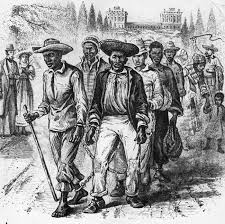
There is a chapter of American history that doesn’t get nearly enough attention in classrooms or textbooks — a chapter about courage, legal ingenuity, and the stubborn refusal to accept a life in chains. Long before the Civil War, long before the Emancipation Proclamation, and long before organized abolition movements gained momentum, enslaved men and women in Colonial America were doing something remarkable: they were taking their masters to court. Through a legal mechanism known as a freedom suit, enslaved people could — and sometimes did — argue their way out of bondage. It was an uphill battle against a system designed to keep them from winning. But when they did win, the stakes couldn’t have been higher. Freedom meant citizenship. And citizenship, in a society built on paperwork and legal identity, meant needing a last name. For many who walked out of those courtrooms as free people, that name became one of the most powerful words in the English language: Freeman.
The Legal Path to Freedom in Colonial America
The idea that an enslaved person could bring a lawsuit against their master sounds almost contradictory — and in many ways, it was. The entire institution of slavery was built on the legal fiction that enslaved people were property, not persons. And yet, threading through English common law and its colonial American offshoots was a principle that allowed individuals to challenge unlawful imprisonment or bondage through the courts. This principle became the foundation for what historians now call freedom suits.
Freedom suits were lawsuits filed by enslaved people in the Thirteen Colonies and later the United States against slaveholders, asserting claims to freedom often based on descent from a free maternal ancestor or time spent as a resident in a free state or territory. The legal right to petition descended from English common law and gave people a formal mechanism to challenge their enslavement or indenture. It wasn’t a straightforward path — nothing about navigating a legal system that fundamentally regarded you as someone else’s property ever could be — but it existed, and determined individuals found ways to use it.
In Massachusetts, enslaved persons were considered both property and persons with the legal right to file lawsuits as plaintiffs against their owners. This dual legal status was an unusual but critical distinction. It meant that while the law treated enslaved people as things to be owned, it also — somewhat paradoxically — recognized their standing to speak up in court. Cases were typically decided by panels of justices applying a mixture of British law and colonial modifications, and they were often built around very specific legal arguments: a master who had broken a promise of freedom, evidence that the person had been born to a free woman, or proof of white or Native American ancestry.
One of the first known freedom cases in the American colonies occurred in 1701, when an enslaved man named Adam sued for his freedom from his master, John Saffin, a Boston-based judge. Adam claimed that Saffin had promised to allow him to purchase his freedom after six years of service. It was a narrow legal claim, but it set a precedent. People were paying attention. The act of reaching for the courtroom — of saying, in effect, “I have rights, and I intend to use them” — was itself a form of resistance that would echo for generations.
How Freedom Suits Actually Worked in Court
Understanding what it actually took to bring a freedom suit to trial requires appreciating just how hostile the legal environment was to anyone making that attempt. Enslaved people had no independent legal standing in most colonies, no right to hire an attorney on their own, and no ability to compel witnesses to testify on their behalf without the cooperation of sympathetic free people. Every step of the process depended on finding allies in a society that was generally invested in maintaining the status quo of slavery.
The most common legal arguments used in freedom suits fell into a handful of distinct categories. Petitioners challenged slavery both directly and indirectly, often focusing on descent from a free maternal ancestor, illegal enslavement, or time spent in a free territory. The maternal lineage argument was particularly significant because of a colonial Virginia law — borrowed from Roman legal tradition — called partus sequitur ventrem, meaning the child follows the condition of the mother. This principle became part of colonial Virginian law and was soon adopted by the rest of the Southern Colonies, meaning that children of free white women or Native American women were born free, even if they were of mixed race. Petitioners who could prove their mother or grandmother had been a free woman had a legally recognized claim to freedom.
The geographical argument — that an enslaved person had been brought to a free territory for long enough to be considered legally free — became increasingly important after the American Revolution. Many free states had residency limits for masters who brought slaves into their territory; after that time, the slave would be considered free under the law. This created a legal loophole that some enslaved people were able to exploit, particularly those who had traveled with their masters to northern states or free territories.
In Massachusetts, legal agitation against slavery began as early as 1752, led by lawyer Benjamin Kent, whose cases were recorded by one of his law clerks — the future president John Adams. Kent represented numerous enslaved people in their attempts to gain freedom, and in 1766 became the first lawyer in the United States to win a freedom case, successfully freeing a woman named Jenny Slew. These cases were slow, difficult, and rarely guaranteed. But they were real, and they mattered.
The Odds Were Stacked Against Them
There is no sugarcoating the reality of what freedom suits meant in practice. For every case that succeeded, many more failed. The legal system was not neutral — it was operated almost entirely by white men who had significant financial and social stakes in the continuation of slavery. Judges, juries, and court officials were often drawn from the same propertied class that owned enslaved people. The mere act of filing a lawsuit could invite retaliation, harsher treatment, or being sold away to a more distant location before a case could be heard.
By 1780, nearly thirty enslaved people in Massachusetts alone had sued their masters for freedom. However, these cases were not decided on the basis of any natural right to freedom — instead, the courts required a specific point of law to decide in favor of an enslaved person, such as a master’s broken promise to grant freedom, or the questionable slave status of the individual’s mother. This meant that success depended not on justice in any broad moral sense, but on whether the petitioner could identify and prove a narrow, specific legal technicality. Without that hook, no matter how compelling the human argument for freedom might be, the case would fail.
Freedom suits were rare outside of Massachusetts, and in 1787, the newly adopted US Constitution actively protected the rights of enslavers— a sobering reminder of how deeply the system was rigged. In the South, most states eventually tightened restrictions so severely that freedom suits became nearly impossible to pursue. Most Southern states enacted laws requiring legislative approval for each act of manumission, making it so difficult that few slaveholders pursued this even for their own mixed-race children.
And yet people kept trying. Historians have uncovered far more freedom suits than previously thought — researchers have found roughly 300 cases in Missouri alone, mostly unknown to scholars until recently, offering a portrait of anguish and persistence by individuals trying to escape an institution that denied they existed as full human beings. These were not passive victims of history. They were people who looked at a system designed to crush them and decided to fight it on its own terms.
A New Name for a New Life
When an enslaved person won their freedom, the practical consequences were immediate and complex. They were now legally a free person, a citizen with rights and responsibilities. But citizenship, in the administrative world of colonial and early American law, required documentation. It required a name — a full name, first and last — that could appear on legal papers, court records, land deeds, employment contracts, and tax rolls.
This created an unexpected problem. Enslaved people had typically been known only by a single given name, usually chosen by their master. Some had surnames they had quietly maintained within the enslaved community, passed down through families in secret, never recorded in any official document. But many had no surname at all that could be legally recognized. And to take up the rights and responsibilities of citizenship — to open an account, sign a contract, appear in court as a free person — a surname was not optional. It was essential.
After gaining freedom, many Black people chose the surname Freeman or Freedman to formally establish who they were absent of the enslaver’s influence. The choice was both practical and deeply symbolic. It required no explanation and made no claim on anyone else’s identity. It was simply a declaration of status: this person is free. After gaining their freedom, formerly enslaved people could choose their own names, and many chose names like “Freeman” to denote their new status.
The name also carried a certain quiet defiance. In a society that had legally classified a person as property, choosing to call yourself Freeman was an act of public self-definition. It placed your status front and center, inscribed in the very word by which you would be known for the rest of your life and passed down to your children after you.
The Name “Freeman” and Its Place in American History
Perhaps the most famous person to carry the name Freeman through a freedom suit was a woman originally known as Bett — or Mum Bett — who was enslaved in Sheffield, Massachusetts. Elizabeth Freeman became the first enslaved African American to file and win a freedom suit in Massachusetts in 1781, using the new state constitution’s declaration that all men are born free and equal as the legal basis of her claim.
She had the resilience to walk to the home of a young lawyer named Theodore Sedgwick and ask him to represent her. Sedgwick agreed, adding another enslaved man named Brom to the lawsuit. The case, Brom and Bett v. Ashley, was heard in Berkshire County court. The argument was elegant: Massachusetts had just adopted a constitution declaring that all men were born free and equal. If that statement meant anything at all, it was incompatible with slavery. Sedgwick made that argument, and the court agreed. After winning her freedom, Bett began calling herself Elizabeth Freeman and worked for about two decades as a paid housekeeper for Sedgwick.
Her story was not unique in its outcome, even if it was extraordinary in its impact. Among the early Black Freemans were figures like Pearson Freeman, a former enslaved man from Massachusetts who earned his freedom fighting for the Continental Army during the Revolutionary War, and Chatham Freeman from Connecticut, who secured his freedom after serving as a substitute soldier. These were people who took the name and made it mean something — not just legally, but historically.
The prevalence of the Freeman name today in the states of the Old South testifies to the importance of African Americans in the history of that surname in America. It is a name that carries centuries of meaning in every syllable. When you meet someone with the last name Freeman today, there is a real chance you are encountering the living legacy of someone who once stood in a colonial courtroom and argued for the most basic of all human rights — and won.
The Legacy of Freedom Suits in the Fight for Abolition
The significance of freedom suits extends far beyond the individual lives they changed. Taken together, they represent something profound about the nature of the abolitionist movement in America — and about who actually drove it. The anti-slavery movement in the American colonies began with enslaved Black individuals seeking liberty for themselves and for other enslaved people. It began with the voices of the enslaved persons themselves. The movement was not “about” or “for” enslaved Black Americans — it was “by” them.
This is a crucial distinction. The popular narrative of abolition often focuses on white advocates — Quakers, religious reformers, political activists — as the driving force behind the end of slavery. And while those contributions were real and important, they built on a foundation laid by enslaved people who had been fighting for their own freedom through every available means for generations. Freedom suits were one of the most powerful of those means, because they forced the legal system to confront its own contradictions.
The 1783 freedom suit of Quock Walker in Massachusetts led the Supreme Judicial Court to rule that slavery was incompatible with the state’s new constitution, effectively ending slavery in the Commonwealth. That ruling was not handed down in a vacuum. It came after decades of freedom suits, petitions, and legal arguments that had steadily eroded the intellectual and legal foundations of slavery in that state. Each case that succeeded made the next one easier to argue. Each ruling that acknowledged the humanity of an enslaved person chipped away at the legal edifice that denied it.
Until the Civil War brought an end to slavery, thousands of freedom suits were tried in state courts across the country, with some enslaved people petitioning as high as the Supreme Court. Most lost. But the act of petitioning was itself meaningful — it said, in the clearest possible terms, that enslaved people knew they were being wronged, knew the law could theoretically correct that wrong, and refused to stop demanding that it do so. That persistence, maintained across generations under unimaginable pressure, is one of the most remarkable stories in American history.
Conclusion
The story of freedom suits in Colonial America is ultimately a story about human dignity and the refusal to accept a legal fiction that said some people were not really people at all. These men and women walked into courtrooms that were hostile to their very presence, argued their cases with whatever legal foothold they could find, and sometimes — not often enough, but sometimes — walked out as free citizens. The name Freeman, carried today by thousands of Americans, is one of the most direct links we have to that history. It is not just a surname. It is a verdict. It is proof that somewhere along the line, against considerable odds, someone fought the system and won — and then chose a name that made sure no one who came after them would ever forget it.
Research and further reading
For readers who want to verify details or continue researching this subject, these external reference collections provide useful starting points: