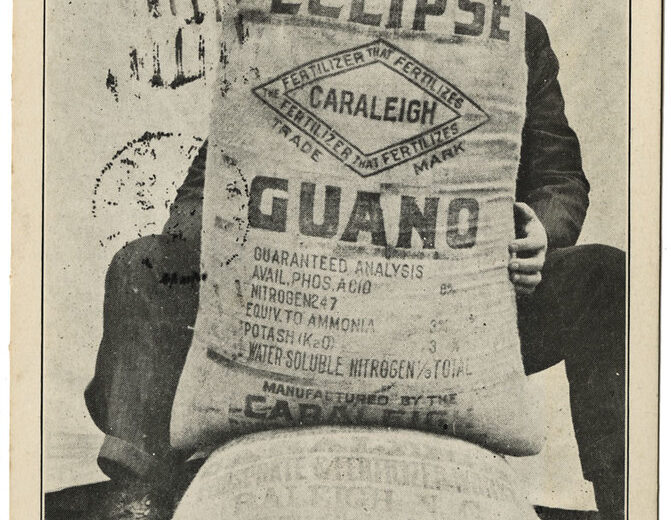
guano trade is a revealing historical subject because it opens a clear path into the people, events, and wider changes that shaped its era.
Few commodities in economic history are as strange, as profitable, and as revealing as guano. What began as the accumulated waste of seabirds and bats became, for a remarkable stretch of the nineteenth century, one of the world’s most sought-after agricultural inputs. Farmers wanted it, states taxed it, merchants speculated on it, and empires fought over access to it. In an age when harvests still depended heavily on the fertility of exhausted soils, guano arrived as a near-miracle: a concentrated source of nitrogen, phosphate, and potassium that could revive land that had been overworked for generations. The fertilizer boom it helped ignite was not just a story about agriculture. It was a story about finance, labor, empire, and the transformation of the global economy.
The rise of the guano trade shows how a humble natural substance could be turned into a strategic asset. Its value did not come from rarity in the abstract, but from the fact that industrializing societies were expanding the scale of food production at the same time they were stripping nutrients from fields faster than traditional manures could replace them. In that context, guano was more than fertilizer. It was a bridge between older agrarian practices and modern chemical agriculture, and it linked remote islands, coastal caves, shipping lanes, and European markets into a single commercial system. The consequences were enormous, and not always benign.
From island deposits to global demand
Guano’s commercial story began with a biological accident and an ecological advantage. On dry islands and arid coasts, seabirds deposited layer upon layer of droppings over centuries, and the lack of rain preserved the material in an unusually potent form. Similar deposits formed in caves where bats roosted in large numbers. Indigenous peoples in the Andes and along the Pacific coast had long understood guano’s value as a fertilizer, regulating access to bird islands and using it carefully to maintain agricultural productivity. What changed in the nineteenth century was not the existence of guano, but the scale of demand.
European and North American agriculture had entered an era of pressure. Population growth, urban expansion, commercial farming, and the intensification of export agriculture all placed unprecedented strain on soils. Traditional animal manure was bulky, unevenly distributed, and often insufficient for the needs of market-oriented agriculture. Guano, by contrast, was compact, transportable, and powerful. It could be shipped across oceans and applied in relatively small quantities with dramatic results. That combination made it ideal for a world increasingly organized by global trade.
Merchants, agronomists, and governments quickly recognized the opportunity. Newspapers and farm journals described guano almost as a miracle substance, and prices rose accordingly. By the mid-nineteenth century, it had become a major item in transatlantic commerce. The trade connected remote Pacific islands and South American coasts to farmers in Britain, France, the United States, and elsewhere. It also helped deepen the modern logic of commodity capitalism: a material extracted from a distant environment could be standardized, priced, insured, shipped, and sold to anonymous buyers thousands of miles away. In the same century that railways, telegraphs, and industrial mills were shrinking distances, guano showed that even something as earthy as manure could be pulled into the orbit of global markets. The boom was not merely agricultural; it was an early expression of the world economy’s hunger for inputs, much like the speculative energy seen in Chicago grain futures history.
Empire, law, and the geopolitics of fertilizer
Because guano was so profitable, states quickly turned it into a geopolitical concern. The most famous example was the United States’ Guano Act of 1856, which allowed American citizens to claim unoccupied guano islands in the name of the United States. The logic was strikingly imperial: if a remote island held a commercially valuable deposit, it could become an object of national interest, even if no permanent settlement existed there. This was one of the many ways nineteenth-century capitalism and empire reinforced each other. Fertilizer was no longer just a farm input; it was a reason to project sovereignty across oceans.
Peru, meanwhile, became central to the world guano market. Its island deposits were exceptionally rich, and for a time the republic relied heavily on guano revenues to fund state-building, infrastructure, and debt service. This made guano one of the most important fiscal pillars in Latin America during the mid-nineteenth century. Yet dependence on a single export also created vulnerability. Prices, transport costs, competition, and the eventual depletion of deposits all affected national finances. The guano boom therefore revealed a recurring pattern in economic history: commodities can enrich states rapidly, but they can also lock governments into narrow, unstable export systems.
The legal and diplomatic battles around guano were equally telling. Ships needed charters, islands required claims, and merchant houses wanted secure contracts. In practice, guano blurred the line between private profit and public power. The same substance that made farming more productive could also justify annexation, naval patrols, and new forms of extraterritorial law. For historians of economic life, this is one of the most important lessons of the guano trade. Commodity booms often look like purely market-driven events, but they are usually supported by law, coercion, and state power. The fertilizer boom rested not only on chemistry and shipping, but on the political authority needed to extract and control access to natural deposits.
Labor exploitation in the guano economy
Behind the glowing promises of fertilizer lay some of the harshest labor conditions of the nineteenth century. Guano extraction was dirty, dangerous, and grueling. Workers scraped deposits from cliffs, islands, and caves under punishing heat, often amid dust that irritated the lungs and eyes. The work could be physically exhausting and socially isolating, especially on remote islands where food, water, and shelter were limited. Because guano was valuable only if it could be gathered quickly and shipped efficiently, employers had strong incentives to push laborers hard while minimizing costs.
In the Peruvian guano islands, and in related nitrate and fertiliser-related extraction zones, labor systems became deeply exploitative. Chinese indentured laborers, along with other coerced or tightly controlled workers, were brought into extractive economies that relied on low wages, harsh discipline, and limited freedom of movement. Their experiences were part of a larger nineteenth-century pattern in which commodity booms depended on vulnerable labor populations. The fertilizer that nourished European and American farms was often produced under conditions that drained human bodies as much as it fed soil.
Even in places where labor was formally free, guano work remained precarious. Seasonal employment, dangerous transport, and the volatility of export markets made livelihoods unstable. The trade’s human cost is easy to overlook because guano itself appears so ordinary in hindsight. Yet the commodity history is inseparable from the lives of the laborers who mined, bagged, loaded, and shipped it. This is a familiar pattern in economic history: the more ordinary a commodity seems to consumers, the more invisible the people who produced it can become. The guano boom, like other extractive booms, concentrated wealth at the top while dispersing risk and suffering at the bottom. It reminds us that fertilizer was not only an agricultural innovation; it was also a labor regime.
War finance, state revenue, and the risks of dependence
Guano revenues were so substantial that governments used them for purposes far beyond agriculture. In Peru, especially, export earnings from guano supported public spending, debt repayment, military procurement, and the servicing of state obligations in international financial markets. In this sense, guano became a form of war finance and political finance. It helped states project strength, maintain credit, and pursue modernization projects that would have been difficult to fund otherwise. For a time, the resource seemed almost inexhaustible.
But commodity dependence always carries a hidden fragility. As deposits were worked down and other sources of fertilizer entered the market, the fiscal foundation weakened. States that had built budgets around guano found themselves exposed to collapse when prices changed or supply diminished. The same export revenues that once seemed to provide stability could rapidly become a source of crisis. The logic is not unique to guano. Economic history is full of examples in which governments come to depend on a narrow set of primary exports, only to discover that global markets are volatile and extraction is finite. The boom conceals the bust until it arrives.
This is also where the guano story touches broader questions of state formation. Windfall revenues can allow governments to expand bureaucracies, build infrastructure, and invest in military power. They can also delay difficult reforms by making it seem as though easy money will continue. When the boom ends, fiscal weakness is revealed. The guano era therefore offers a cautionary tale about the relationship between natural wealth and national power. A resource can finance sovereignty, but it can also undermine long-term resilience if policymakers treat it as permanent. In that respect, guano belongs alongside other commodity histories that show how market booms shape political institutions, much as local and regional trades shaped urban growth in stories like the Kauri gum trade: the forgotten commodity that made Auckland.
Environmental depletion and the end of the miracle
Guano’s rise was dramatic, but its decline was equally instructive. The very quality that made it valuable—its concentration—also meant that deposits were finite. Once mined, guano did not renew on human time scales. Heavy extraction removed centuries of accumulated bird waste in a matter of decades, leaving islands stripped and ecosystems altered. Bird populations themselves were often disrupted by human intrusion, habitat damage, and overharvesting. In other words, the boom consumed the ecological basis of its own success.
As guano supplies waned, chemical fertilizers gradually took over. Industrial chemistry made it possible to manufacture or refine nutrients from other sources, reducing dependence on natural guano beds. This transition did not eliminate environmental cost; it relocated it. The fertilizer boom helped normalize the idea that depleted soils could be restored through external inputs, a concept that became central to modern industrial agriculture. But the guano era had already demonstrated that those inputs could be extracted from fragile ecosystems with little thought for regeneration. The economic lesson and the environmental lesson were inseparable.
Looking back, guano’s history feels like a prelude to many modern dilemmas. It shows how markets can transform waste into wealth, how empires can follow fertilizers as readily as armies, and how agricultural productivity can depend on distant extraction zones that are easy to ignore from the consumer’s point of view. The boom also reveals the asymmetries built into commodity capitalism: profit flowed to merchants, states, and landowners, while laborers bore the costs and ecosystems absorbed the damage. If the nineteenth century celebrated guano as a miracle, the longer view is more sobering. It was a miracle with a deadline. Its legacy lives on not just in agriculture, but in the broader history of how economies chase fertility, convert nature into capital, and then struggle with the depletion left behind. That is what makes the guano trade so important to economic history: it captures, in one unlikely substance, the promise and peril of modern growth.
Research and further reading
For readers who want to verify details or continue researching this subject, these external reference collections provide useful starting points: