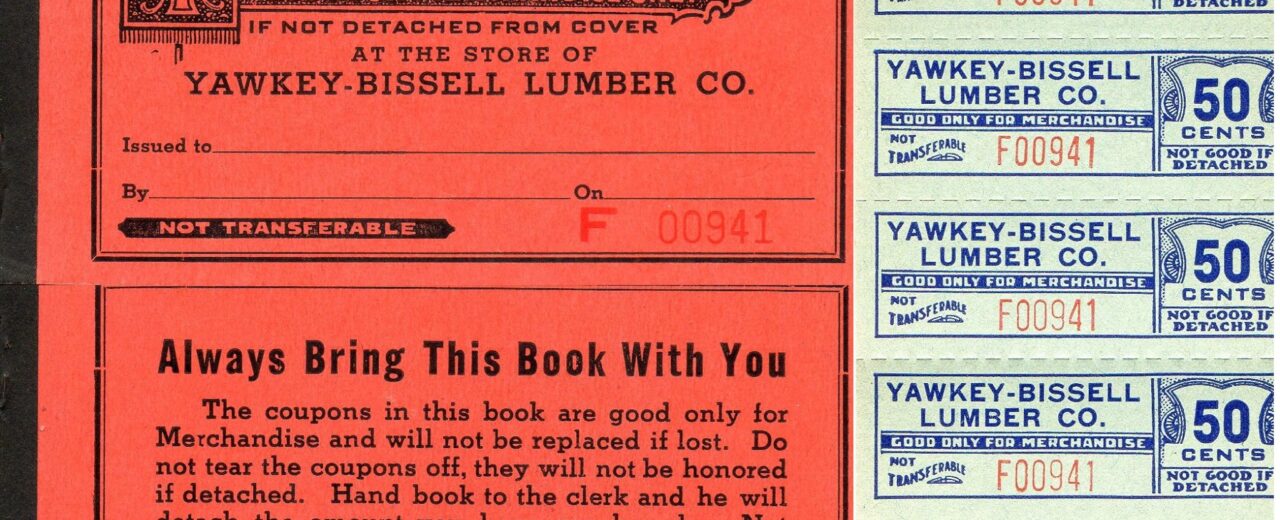
Few forms of money were as ordinary in appearance, and as coercive in practice, as company scrip. At first glance it looked like a practical solution for frontier industry: a token, a paper coupon, or a stamped disk that could be exchanged for goods, services, or wages in places where banks were scarce and payroll systems were still uneven. But in coal camps, iron works, logging towns, and other isolated industrial settlements, scrip became something much darker. It was a private currency that tied workers to one employer, narrowed their choices as consumers, and often made it nearly impossible to save real cash or leave town.
Company scrip sits at the intersection of labor history, monetary history, and the rise of industrial capitalism. It shows how control over money can become control over life itself. In company towns, wages were sometimes paid not in national currency but in paper redeemable only at the company store. Prices were often higher than in nearby markets, but nearby markets might be too far away to reach, especially for workers living on isolated company-owned land. The result was a closed economic system in which the employer was not just the boss but the banker, retailer, landlord, and sometimes even the police force.
This system did not emerge because industrialists were uniquely malicious, though many exploited it ruthlessly. It grew out of a mix of practical problems and profit-seeking opportunities. Miners needed supplies before cash wages were stable and local commerce was developed. Employers wanted to reduce the risk of unpaid labor and keep workers on site. In some regions, scrip helped fill a genuine monetary gap. Yet as company towns expanded, the same arrangement became a trap. The very thing that made scrip seem efficient also made it politically explosive.
To understand company scrip is to understand how money can be designed to serve power. It was not merely a substitute for cash. It was a mechanism for discipline, dependency, and extraction. And in the history of American industrialization, few mechanisms were more revealing.
What company scrip was, and why employers used it
Company scrip was a private payment instrument issued by an employer in place of, or alongside, ordinary money. It could take the form of paper notes, brass or aluminum tokens, chits, or punch cards. In theory, scrip could be redeemed for goods, food, clothing, tools, or sometimes cash at a company-run store or office. In practice, the exchange rate and the redemption rules were controlled by the company that issued it. That control mattered more than the physical form. Whether it looked like money, it functioned as a system of obligation.
Employers used scrip for several reasons. In remote industrial settings, especially coal camps and logging settlements, cash was not always abundant. A mine might open in a place with no established town, no bank, and no ready retail network. Scrip offered a quick way to circulate purchasing power without maintaining a robust cash payroll. It also helped companies manage labor costs and reduce the immediate drain of wages leaving the local economy. Because the scrip was redeemable only within the company’s own commercial system, the employer could effectively recapture a portion of wages through sales.
The logic appealed to industrial managers who wanted predictable labor relations. If workers were paid in cash, they could shop elsewhere, save money, move away, or use their wages to finance a strike. Scrip made those choices harder. It anchored workers to the company store, and by extension to the employer’s terms of employment. If a worker quit, the unused scrip might lose value quickly or entirely. That feature turned wages into a leash. It was a payroll system that doubled as a labor-retention strategy.
Historically, scrip was not limited to coal mining. It appeared in sawmills, railroad camps, plantations, smelters, and mill villages. But coal towns became the classic example because they were often geographically isolated and socially enclosed. The mine company might own the houses, the roads, the church lots, and the store. In that setting, scrip was not just a payment method; it was part of a broader architecture of company power. Economic historians studying the company town have shown how these settlements blurred the line between market exchange and coercion, creating miniature economies where private authority reached into nearly every daily transaction.
How company stores turned wages into debt
The company store was the heart of the scrip economy. It was where workers redeemed their tokens, purchased necessities, and encountered the full force of the system. In some towns, the store was the only store. Even where outside merchants existed, distance, poor transportation, and company control over housing or roads could make them effectively inaccessible. A miner might live miles from the nearest independent shop, and if he had no cash, the distinction mattered little. Scrip changed hands, but always within a closed circle.
Because the employer controlled both wages and prices, the store could quietly redistribute income upward. Prices were often inflated relative to regional markets. Quality was frequently uneven. Choices were limited. A worker’s weekly earnings might vanish on food, lamp oil, boots, or rent before any cash could accumulate. Some companies charged workers for housing, tools, medical care, and even the use of company facilities. The store system thus became a way to convert labor into controlled consumption, with the employer taking a cut at every stage.
Debt deepened the trap. If a worker needed goods before payday, the company might advance more scrip or extend credit against future wages. That could be useful in the short run and devastating in the long run. A family that borrowed against next week’s pay often arrived at payday already owing the company store. The debt was not always formal in the modern banking sense, but it functioned similarly: obligations accumulated, freedom shrank, and the worker became even more dependent on the employer’s continued goodwill or willingness to keep hiring.
In this way, company scrip transformed wages into a managed flow rather than a genuine choice. It did not simply substitute for currency; it redirected purchasing power into a captive market. The economic historian sees here a classic feature of monopoly power. But the moral force of the system was especially sharp because the consumers and the producers were the same people. Miners extracted coal from the earth, then returned to the company store to buy back a portion of the value they had created. The circle was complete, and the company controlled the radius.
This is why company towns were so emotionally charged in American memory. The grievance was not only low pay, but the feeling that pay was not fully pay at all. A wage that cannot be freely spent is a wage with conditions attached, and in coal camps those conditions often touched every part of life.
Coal camps, labor discipline, and the human cost of private money
Coal mining made company scrip especially notorious because the work itself was dangerous, exhausting, and often performed in isolated districts where employers held enormous leverage. In a coal camp, the company might own the mine, the housing, the store, the schoolhouse, and the infrastructure linking the settlement to the outside world. Workers and their families lived in an environment where nearly everything was mediated by employment. Lose the job, and you might lose the house. Fall behind on the store account, and you could face eviction, humiliation, or dismissal.
Scrip reinforced that vulnerability. A miner who accepted payment in company money had no easy way to build a buffer against injury, illness, or unemployment. This mattered enormously in an occupation where accidents, black lung, cave-ins, and long layoffs were common. Families in coal camps often lived one disruption away from crisis. The company could delay cash conversion, cut off credit, or enforce redemption rules that left workers with worthless paper if they were terminated or if a town was abandoned. The private money that was supposed to facilitate exchange instead became a tool for managing risk in favor of the company.
Labor discipline was one of the system’s most powerful effects. Scrip discouraged workers from spending outside the company network, but it also discouraged them from leaving the job. A man who had been paid in scrip had to keep buying from the employer, or else the paper in his pocket was of little use. This gave managers an advantage during strikes and organizing campaigns. If workers walked out, they could lose access to food, housing, and credit. The company store was not just a business; it was an arm of labor control.
Yet workers were not passive. They complained, organized, and in many places resisted with remarkable persistence. Oral histories and strike accounts repeatedly show miners angered by inflated prices, deductions, and payment in non-cash forms. Their grievances were economic, but they were also about dignity. Being paid in scrip told workers that the company did not trust them with real money. That message cut deeply in a society that increasingly defined citizenship and independence through cash wages.
One useful comparison comes from other forms of regulated exchange in history, such as taxes paid or avoided through design, or commodities routed through tightly controlled trade systems. The mechanics are different, but the logic is similar: when access to a basic resource is monopolized, the rules of exchange become a means of rule itself. Company scrip was a labor system disguised as currency.
Laws, lawsuits, and reformers pushed back
As abuses mounted, reformers, labor organizers, judges, and legislators began to challenge the company-scrip system. Their criticism was straightforward: workers should be paid in lawful money, not in instruments that locked them into company-controlled consumption. The issue became prominent in the late nineteenth and early twentieth centuries as industrial labor conflicts intensified and as states sought to protect workers from the most coercive practices of employer paternalism.
Some states enacted “anti-scrip” or “truck” laws, requiring wages to be paid in cash or in forms more readily convertible to cash. These laws varied in strength and enforcement. Employers often found ways around them through accounting tricks, wage deductions, delayed payments, or supposedly voluntary store arrangements. Still, the legal trend was important. It signaled a recognition that wages had to be freely usable if they were to be meaningful. A paycheck that can only be spent in one place is not a paycheck in the full sense of the term.
Court cases also helped shape the issue. The U.S. Supreme Court and lower courts dealt with disputes over wage payment, debt collection, and the legality of private forms of compensation. While specific rulings varied, the broader direction of law moved toward limiting the most restrictive scrip arrangements, especially those that effectively forced employees to transact with their employers. These legal conflicts were part of a wider debate over the boundaries of industrial authority. How much control could a company exercise over a worker’s life beyond the workplace itself?
Reformers also framed the issue in moral and political terms. Critics argued that company stores resembled feudal dependency more than free labor. In a nation that celebrated wage labor as a path to independence, scrip looked like a betrayal of the promise of capitalism. Labor unions made the issue central in organizing drives, especially in mining regions where the company town was a visible symbol of exploitation. Newspaper exposés and public investigations amplified the scandal. The system survived in many places for years, but its legitimacy was steadily weakened.
The decline of scrip was not just the result of legal reform. It also reflected changes in transportation, banking, and retail competition. As regional markets expanded and cash payrolls became more common, the old excuse for private money lost force. The state was increasingly willing to define money as a public standard rather than a private instrument. That shift did not eliminate exploitation in industrial capitalism, but it did close one of its most notorious channels.
Why company scrip faded, and what it still teaches us
Company scrip faded because the world around it changed. Better transportation made it easier for workers to reach outside merchants. Banking networks expanded, and employers could more easily pay cash wages or deposit earnings directly. Labor regulation became more assertive, particularly as Progressive Era reforms and New Deal-era policies strengthened wage standards, labor rights, and public oversight. The company town did not disappear overnight, but its most closed monetary forms became harder to defend.
The decline also reflected a broader shift in public expectations. By the twentieth century, many people increasingly believed that wages should be liquid, portable, and redeemable in a currency recognized beyond a single workplace. That expectation sounds obvious today, but it had to be won historically. Company scrip reminds us that “money” is not just metal or paper; it is a social promise backed by institutions. If the institution issuing the money can arbitrarily limit where it is spent, then money becomes a form of captivity.
Even so, the lesson of scrip is not confined to old coal camps. It speaks to modern questions about wage access, employer-controlled benefits, captive marketplaces, and the power of intermediaries to set terms of exchange. Whenever workers are paid in credits, tokens, or systems they cannot freely convert, the old logic reappears in new clothing. The historical case of company scrip helps explain why people become uneasy when compensation is tied too closely to one employer’s ecosystem. Economic freedom depends not only on how much one earns, but on how freely one can use it.
There is also a larger economic-history lesson here about the relationship between market development and coercion. Many industries first grew in places with weak infrastructure, sparse competition, and limited state oversight. In those conditions, private solutions could appear efficient while quietly concentrating power. The company town was a laboratory of industrial capitalism, and scrip was one of its sharpest tools. It showed that markets do not automatically produce freedom; the rules of exchange matter just as much as exchange itself.
In the end, company scrip survived as a cautionary memory because it captured something fundamental about labor under capitalism: the struggle over who controls the terms of everyday life. A wage is more than a number. It is access to food, housing, mobility, and choice. When an employer can define the medium of payment, set the store prices, and decide where value may circulate, the worker’s freedom is already compromised. That is why company scrip remains one of the clearest examples of how private money can trap people even while pretending to pay them.
History rarely offers such a neat lesson. But in the coal camps and company towns of the industrial age, the lesson was written plainly on the tokens in workers’ pockets. The money was theirs to hold, but not truly theirs to spend. And that made all the difference.
Related reading: Ice trade: The Ice King and the global, Guano trade: and the fertilizer boom.
Research and further reading
For readers who want to verify details or continue researching this subject, these external reference collections provide useful starting points: