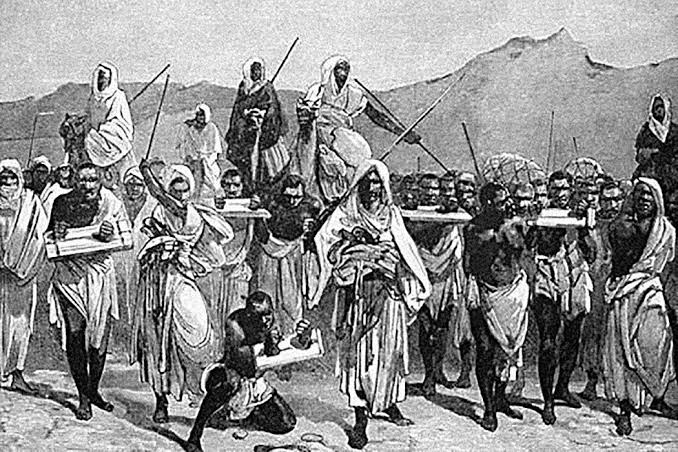
In September 869, a preacher named Ali ibn Muhammad entered the marshlands of southern Iraq and offered enslaved laborers something the Abbasid order denied them: freedom, wealth, and revenge. Within two years, his followers had sacked Basra. They built a fortified capital, minted coins, collected taxes, and defeated army after army. The caliphate needed fourteen years to destroy them.
The Zanj Rebellion is often called the greatest slave revolt of the medieval Islamic world. That description captures its origins but not its full development. Enslaved East Africans formed a crucial core, yet free villagers, deserters, Bedouin allies, boatmen, and discontented townspeople also joined. Our principal narrative was written from the victors’ side, and its enormous casualty claims cannot be accepted literally. What remains certain is extraordinary: people exploited at the lowest level of Abbasid society created a rival power that nearly severed Iraq from the caliphate.
Who were the Zanj?
Medieval Arabic writers used Zanj for peoples associated with the East African coast and, more loosely, for Black Africans from regions south of the Sahara. The word did not identify one modern nation or a single ethnic community. Captives entered markets around the Indian Ocean through several routes, and surviving texts rarely preserve their individual places of origin.
In southern Iraq, some Zanj were employed in extremely harsh agricultural work. Landowners sought to reclaim salt-encrusted ground near Basra by removing the upper crust and creating cultivable fields. Laborers lived in groups, received meager provisions, and performed exhausting work in a hot, wet environment shaped by canals, tidal waterways, and marshes.
Not every Black person in Abbasid Iraq was enslaved, and not every rebel was African. “Zanj” became the name used by hostile chroniclers for an expanding movement. It is therefore accurate to recognize the rebellion’s enslaved African foundation while avoiding the assumption that all participants shared one origin, status, or goal.
The plantation landscape of southern Iraq
Basra stood near the head of the Persian Gulf in a region where the Tigris and Euphrates created a maze of channels, wetlands, and alluvial land. Its merchants connected Iraq with Iran, Arabia, India, and East Africa. Wealth from trade stood beside difficult rural labor and sharp differences in status.
Traditional accounts describe gangs clearing sabkha, the saline surface crust, so land could be planted. Owners could profit from both reclaimed ground and salt-rich material removed from it. The system has often been compared to later plantation slavery, although the organization, crops, property relations, and scale should not be assumed identical to Atlantic models.
Recent archaeological research has mapped thousands of ridges and canals across the Shatt al-Arab floodplain. Scientific dating indicates that some large-scale landscape modification began around the ninth century, supporting the existence of intensive labor near the rebellion’s period. Yet construction continued for centuries. The earthworks cannot all be labeled “Zanj plantations,” and archaeology does not identify the legal status of every worker.
An Abbasid Caliphate divided against itself
The uprising succeeded partly because the caliphate was already in crisis. After 861, rival commanders and court factions at Samarra made and unmade caliphs during a period sometimes called the Anarchy at Samarra. Military salaries, provincial taxation, and authority became unstable, while powerful governors pursued their own interests.
Elsewhere, the Saffarids expanded from eastern Iran, the Tulunids established autonomy in Egypt, and conflicts consumed troops and revenue. Baghdad and Samarra still commanded formidable resources, but those resources could not be concentrated immediately in southern Iraq. Provincial officials repeatedly underestimated the rebels or lacked the forces to defeat them.
This context does not reduce the Zanj to beneficiaries of Abbasid weakness. They developed tactics suited to the waterways, recruited effectively, acquired weapons, and created organization from below. The political crisis opened space; the rebels’ decisions turned that space into a durable war.
Ali ibn Muhammad and the promise of revolt
Ali ibn Muhammad’s background is uncertain. He claimed noble Arab and possibly Alid ancestry, linking himself to the family of the Prophet Muhammad, but contemporaries disputed the genealogy. Before 869 he had pursued influence in other regions and shown an ability to preach, compose verse, and attract followers.
He approached laborers around Basra with promises of freedom and property. Accounts portray him learning about their masters, work groups, and grievances before coordinating action. He also used religious language that condemned oppression and emphasized equality. Some of his slogans resembled Kharijite ideas, although his movement did not fit neatly into one established sect.
Leadership created a paradox. Ali denounced enslavement and elevated men whom elite society despised, yet he became the head of a hierarchical military state. Rebel commanders accumulated wealth, captives were taken, and coercion did not disappear. Liberation for the movement’s core did not automatically become universal emancipation.
From scattered laborers to a fighting army
The first rebels possessed few weapons. They seized supplies, raided estates, and absorbed labor gangs. Southern Iraq’s waterways favored small mobile forces using boats and local knowledge. Marshes and narrow canals limited conventional cavalry while allowing rebels to approach settlements, ambush patrols, and withdraw rapidly.
Early victories generated credibility. Enslaved workers could believe escape was survivable, while soldiers and local groups saw an emerging employer and ally. The movement recruited beyond the salt marshes, incorporating people whose motives ranged from freedom and hunger to political ambition, protection, and plunder.
Abbasid commanders initially treated the revolt as a local disturbance. Several expeditions failed through poor coordination, inadequate intelligence, and unfamiliar terrain. Every captured weapon and defeated unit strengthened the insurgency. What began as rebellion among marginalized laborers developed into organized warfare with infantry, cavalry, boats, commanders, and supply networks.
The sack of Basra in 871
Basra was one of Iraq’s great cities, celebrated for trade, scholarship, and early Islamic history. It was also politically divided and poorly protected after years of insecurity. In September 871, Zanj forces entered and devastated the city. Buildings burned, markets were looted, and inhabitants were killed or taken captive.
Al-Tabari’s history gives a horrifying narrative and reports deaths on a scale far beyond what can be verified. Medieval chroniclers often used immense round numbers to communicate moral catastrophe, and the city’s population is not known precisely. The sack was unquestionably destructive; claims of hundreds of thousands dead should not be repeated as census-quality evidence.
The victory transformed perceptions of the revolt. Basra’s fall provided goods, captives, weapons, and prestige while demonstrating that the caliphate could not protect a major urban center. It also hardened elite hostility. Later accounts remembered the rebels not only as escaped laborers but as destroyers of a city central to Abbasid culture.
Al-Mukhtara: a rebel capital in the marshes
Ali ibn Muhammad established a capital called al-Mukhtara, meaning “the Chosen,” in the canal country. Its location exploited difficult terrain and access to water routes. Defenses, canals, residences, mosques, workshops, storehouses, and administrative spaces turned the settlement into more than a temporary camp.
The rebels collected revenue, distributed provisions, appointed officials, and negotiated with outsiders. Surviving coins struck in their name demonstrate a claim to legitimate rule. Coinage was political communication: it paid forces and announced that authority existed independently of the Abbasid caliph.
This state was not socially flat. A leadership circle controlled strategy and resources, commanders gained status, and the movement governed conquered populations. Some sources describe internal discipline and punishment. The Zanj had escaped one hierarchy only to build institutions necessary for war, administration, and control.
A war across lower Iraq and Khuzistan
From their base, rebel armies attacked towns, waterways, and supply routes across lower Iraq and neighboring Khuzistan. They captured important places including al-Ubulla and threatened Wasit. Control shifted repeatedly as Abbasid forces recovered settlements only to lose roads, canals, or countryside again.
Water was as important as land. Boats moved fighters and food through environments where roads were limited. Whoever controlled canals could isolate towns, interrupt grain shipments, or launch attacks from unexpected directions. Rebel familiarity with the marshes offset some of the caliphate’s greater wealth and manpower.
The conflict devastated civilians. Towns suffered assault, rural production was disrupted, captives changed hands, and armies consumed supplies. It is tempting to tell the rebellion solely as emancipation confronting empire, but prolonged civil war created new victims. Recognizing rebel agency does not require romanticizing every action committed under rebel rule.
How al-Tabari shapes what we know
The fullest narrative comes from the historian al-Tabari, who wrote in the early tenth century and organized events year by year. He had access to earlier reports and named transmitters, including material unusually detailed about campaigns. Without his work, the rebellion’s chronology would be far harder to reconstruct.
Al-Tabari was not writing from within the rebel community. His narrative reflects the political and literary world of Abbasid society, and the voices of enslaved laborers almost never reach us directly. Speeches assigned to leaders may convey remembered claims or narrative conventions rather than verbatim words.
Historians must therefore read both with and against the chronicle. Dates, places, commanders, and campaign sequences can often be compared, while huge casualty figures and moral descriptions demand caution. Silence is evidence too: we know much more about elite strategy than family life, African identities, women in the movement, or the experiences of ordinary rebels.
Was it truly a slave rebellion?
The answer is yes, but not only. Enslaved Zanj laborers were central to recruitment, identity, and the revolt’s historical meaning. Ali’s promise to free them addressed a specific system of brutal exploitation. Calling the conflict merely a regional civil war would erase that foundation.
However, the army soon included free people and groups drawn by other grievances. Some participants were Arab or local marsh dwellers; others were military deserters, clients, and adventurers. Political alliances shifted, and the rebel state ruled populations that had not all joined voluntarily.
Modern labels can also import expectations from Spartacus or the Atlantic world. The rebels did not leave an abolitionist manifesto demanding the end of slavery everywhere. They sought their own freedom, power, survival, and rewards within a ninth-century society where slavery was widespread and legally embedded. Their achievement was revolutionary without being modern abolitionism.
The Abbasid recovery under al-Muwaffaq
The balance changed when Abu Ahmad al-Muwaffaq, brother of Caliph al-Mu’tamid and the caliphate’s effective military ruler, concentrated resources against the rebels. His son Abu al-Abbas, the future caliph al-Mu’tadid, also played a major command role. The campaign combined force, blockade, engineering, negotiation, and amnesty.
Abbasid armies captured outlying positions and restricted supplies reaching al-Mukhtara. Commanders used boats and constructed fortified bases to contest the same waterways that had protected the Zanj. Offers of pardon encouraged defections, weakening the rebel force without requiring every fighter to be killed.
The war resembles other urban upheavals, such as the Byzantine capital’s Nika Riots, only at a far greater duration and territorial scale. In both cases, central government survived after initially losing control. At al-Mukhtara, however, recovery required a methodical siege rather than a single concentrated massacre.
The fall of al-Mukhtara in 883
By the early 880s, Abbasid forces had pushed toward the rebel capital. The final siege lasted roughly two years and involved repeated attacks on defenses, naval fighting, blockades, and attempts to draw followers away. Hunger and attrition eroded a movement that had once expanded through victory.
In August 883, government troops captured al-Mukhtara and Ali ibn Muhammad was killed. His severed head was displayed as proof that the rebellion had ended. Surviving followers were killed, captured, dispersed, or absorbed under terms offered by the victors.
The conclusion restored Abbasid authority in lower Iraq, but it did not reverse fourteen years of demographic and economic damage. Basra recovered only gradually. Canals, estates, villages, and trading connections had been disrupted, while the state had spent enormous resources suppressing people whom it had initially regarded as an insignificant laboring population.
Did the rebellion end plantation slavery in Iraq?
Some historians argue that the revolt discouraged the future concentration of large numbers of enslaved agricultural workers in southern Iraq. The danger of mass rebellion would have been obvious, and later Abbasid slavery became especially associated with domestic service, courts, armies, and other forms of labor.
The evidence does not support a clean before-and-after story. Slavery continued throughout the Islamic world, and coerced agricultural labor did not vanish. The newly dated ridge-and-canal systems show that intensive landscape work in the region continued beyond the ninth century, although they do not identify precisely who performed it.
A cautious conclusion is that the rebellion destroyed particular enterprises, altered calculations of risk, and became a warning to elites. It did not abolish the institution or liberate all enslaved people in Iraq. Its legacy was a major political and military shock, not a legal emancipation decree.
Memory, race, and modern interpretations
The Zanj Rebellion has attracted renewed attention as historians place Africa and the Indian Ocean more fully within medieval world history. It demonstrates that African diasporas, coerced migration, and resistance were not confined to the Atlantic era. East African connections shaped the Abbasid world centuries earlier.
Modern racial categories must still be used carefully. Abbasid writers recognized color, origin, lineage, and status, and anti-Black prejudice is visible in medieval literature. Yet their categories do not map perfectly onto modern concepts of race. Enslavement affected many peoples, while “Zanj” combined geography, appearance, and social stereotype.
The rebellion can be remembered as Black resistance without turning every participant into a modern racial nationalist. Its followers organized around shared exploitation and opportunity within their own political language. Respecting that difference makes their history more concrete, not less relevant.
What the rebellion reveals about Abbasid power
The caliphate’s long struggle shows both weakness and resilience. Provincial fragmentation and court conflict allowed the revolt to grow. Government armies failed repeatedly, and a rebel state operated near vital Iraqi cities. The Abbasid center was far from all-powerful.
Yet al-Muwaffaq eventually mobilized money, commanders, engineers, boats, and negotiated defections on a scale the rebels could not match indefinitely. Victory helped restore the prestige of the central regime and prepared the political recovery associated with al-Mu’tadid. Suppressing the Zanj became part of rebuilding Abbasid authority.
The episode therefore resists simple stories of inevitable decline. The same state that nearly lost southern Iraq could reorganize and reconquer it. Its recovery, however, depended on confronting the consequences of inequality it had tolerated and on devastating a region whose labor and trade it needed.
Why this episode still matters
The Zanj Rebellion began among enslaved laborers in 869 and ended with the destruction of al-Mukhtara in 883. Between those dates, the rebels captured cities, defeated imperial forces, issued coinage, and governed territory. Their war exposed how vulnerable the Abbasid Caliphate had become—and how much power could be created by people treated as disposable.
Confirmed history must be separated from dramatic simplification. Enslaved East Africans were fundamental, but the movement grew beyond one ethnicity and legal status. Basra suffered a terrible sack, but the chroniclers’ largest death totals are not reliable statistics. The revolt challenged slavery without becoming a universal abolitionist movement.
Its importance lies precisely in those complications. The Zanj were victims of exploitation, strategic political actors, builders of a state, and participants in a brutal civil war. They cannot be reduced to helpless laborers or romantic heroes.
For fourteen years, the marshes of southern Iraq reversed the expected order of Abbasid society. The people assigned its hardest labor forced caliphs, generals, and historians to reckon with them. The rebellion was defeated, but the fact that it existed on such a scale remains one of medieval history’s clearest demonstrations that systems of coercion can also create the conditions for organized resistance.
Research and further reading
For readers who want to verify details or continue researching this subject, these external reference collections provide useful starting points: